

Working to preserve Ottawa's past
for future generations.
Sudden Impact - The Story of the 1942 Almonte Train Wreck
Jamie BramburgerWilliam Peacock stood with dozens of people on the platform of the Almonte train station. December 27, 1942 was a miserable night with snow and freezing rain falling as the Almonte police chief joined others to see family and friends off who needed to work the next morning. It was 8:32 p.m. when the Local train pulled into the station. Six minutes later, it was about to leave.
The Local had started its journey in Petawawa three hours earlier. Extra crew and more coaches had been added because of the heavy load of passengers. It was a milk run with stops throughout the Ottawa Valley, but the passengers were singing Christmas songs, trying to make the best of a dreary holiday season that included restrictions on Christmas lights and food rations.
At the back of the train, five-year old Bernie Turcotte peeked out the back window and then turned to his mother and said, “Mommy what is that bright light?” Seconds later, at 8:38 p.m., a heavy troop train slammed into the back of the Local passenger train, obliterating the final two coaches of the train and coming to rest half-way through the third last coach.
Earlier in the evening, a 20-minute block had been initiated at the Renfrew and Arnprior stations, but with no operator working at Pakenham, the troop train continued to make up ground on the lead train. When it came around the gradual bend leading into the Almonte station, there wasn’t enough time for the engineer to stop. He was only a few car lengths away from the stopped Local train when he saw the reflection of his train’s headlights on the glass windows at the rear of the Local.
The impact was sudden and devastating. Within 24 hours, 36 people had died and more than 150 people had been hospitalized, some with life-altering injuries. Two more passengers on the Local train would pass away within a few weeks bringing the death toll to 38, making the Almonte train wreck one of the deadliest railway accidents in Canadian history.
In the weeks that followed, a coroner’s inquest held at the Almonte Town Hall, the same building used on the night of the accident as a temporary morgue, would exonerate the crews of both trains of any wrongdoing. The five-man jury blamed the Canadian Pacific Railway, primarily because the company had not staffed the Pakenham station, arguing that had an operator been on duty, the troop train could have been held back to give the Local train time to clear the Almonte station.
But Canada’s Transport Commission had a different opinion on what caused the deadly crash. The commission cited three violations of the operating rules and blamed the crews of both trains for the accident. The commission felt the troop train was travelling too fast and the engineer did not have his train under control when he arrived in Almonte. The commission also said the crew on the Local train had erred by not lighting a flare at the back of their train when they knew they were running behind on their schedule.
It's been more than 80 years since the Almonte train wreck occurred. There are few survivors of the accident still living, but there are many family members who still hold the stories of that fateful night. For them, the tragedy lives on through photographs, letters, and newspaper clippings. The family of Thomas Lynn, a survivor of the crash, keeps the train ticket he used to board the Local. Lynn badly injured his leg in the crash, preventing him from joining the Canadian military. Not being able to serve his country bothered him for the rest of his life, and when he passed away in his 73 rd year, his family found his ticket from December 27, 1942 in his wallet. He had kept it for more than 50 years, but no one in his family knew he had it.
In Almonte, the train station was torn down years ago, the railway tracks have been removed and in the centre of the town there are two large engraved stones that memorialize the victims of the crash. Sudden Impact – The Almonte Train Wreck of 1942 was written to ensure they are remembered.
Biography:
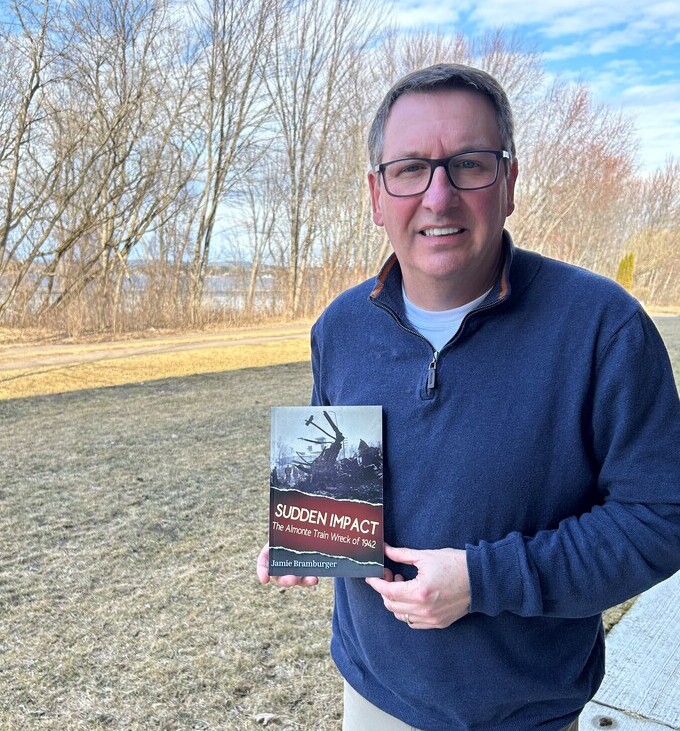 Jamie Bramburger, author, Sudden Impact – The Almonte Train Wreck of 1942Jamie Bramburger was trained as a broadcast journalist and spent 14 years working as a news director, assignment editor and news reporter in radio and television, before joining Algonquin College’s Pembroke Campus as its Manager of Community and Student Affairs. That was 25 years ago, but while working at the college, Jamie has retained his journalistic roots as a volunteer broadcaster with Cogeco community television and as a feature writer with Post Media. Sudden Impact -The Almonte Train Wreck of 1942 is Jamie’s second book. His first book, Go Kings Go-A Century of Pembroke Lumber Kings Hockey was released in 2018 and became a regional best seller in Eastern Ontario.
February 22 nd is the birthday of Baron Robert Baden-Powell, (1857-1941), the founder of the Scouting Movement. Coincidentally, it is also the birthday of his wife, Olave (1889-1977), the first Chief Guide. As such, the day has special meaning for Scouts, who call it BP Day, and Guides, who call it Thinking Day. It was thus very appropriate that the Historical Society of Ottawa used their February 24, 2024, in-person speaker session to explore the history of Scouting and Guiding. There were many members of both organizations among the 50 who gathered in the auditorium of the Main Branch of the Ottawa Public Library to listen to the presentations of Dave Truemner from Scouts Canada and Emma Kent from the Girl Guides of Canada.
Dave started as a Cub in 1953 and has spent most of the past 70 years in Scouting, in one capacity or another. He is currently a volunteer researcher at the Scouts Canada National Museum, located at the Scouts Canada National Headquarters, 1345 Baseline Road in Ottawa.
Dave explained that Scouting officially began in England in 1908 and spread quickly throughout the country, then through the British Empire and finally throughout the world. One of the first great events for Scouting was the 1911 Coronation of King George V, when it was decided that Scouts from around the Empire should line the parade route, providing both an Honour Gard and crowd control. Between 50 and 60 Canadian Scouts made the trip, including six from Ottawa. The Canadian contingent remained in touch over the years holding reunions every decade until 1981.
In the early years, Scouting in Canada was simply a part of Scouting in England. On June 12, 1914, however, The Canadian General Council of the Boy Scout Association was incorporated by an act of the Canadian Parliament. This gave Scouting in Canada some degree of independence while giving the government of Canada some degree of control.
Dave pointed out that this control soon came into play. Though Scouting was never a military organization, unlike Cadets, its members were pressed into service during both World Wars, though not in actual combat. During the First World War, Scouts were valued due to their First Aid training and for their fundraising. The money raised by the Scouts was used for the purchase of ambulances, it being considered inappropriate to use it to buy weapons. Dave explained that in the Second World War the role of Scouts was expanded to include many civil defense duties, including that of air raid patrol. Dave related a cute story about a former Mayor of Ottawa. J. E. Stanley Lewis (1888 – 1970) who served as our mayor from 1936 to 1948. As he was born on February 29, he celebrated his 12 th birthday in 1940 when he was 52 years old and the local Scouts invested him as a Boy Scout. In 1942 he participated as a Scout in Apple Day, the annual fundraiser when Scouts give away apples and accept donations. Given the state of things in the Second World War at these times, this must have provided a well needed relief from the more serious and tragic news that dominated the papers of the day.
Dave showed us two sculptures of Scouts on the Confederation Building, one accompanied by a rose and the other by a fleur de-lis. The sculptures acknowledge that this was the site of the original Scout Headquarters, expropriated in 1926. The use of two Scouts and their accompanying flowers denote that there are both English and French Scouting organizations in Canada. Les Scouts du Canada run their programs in French, primarily in Quebec, where there are also Scouts Canada groups. The World Organization of the Scouting Movement (WOSM) will only recognise a single Scouting organization per country, so today Les Scouts du Canada operates as a semi-autonomous organization under the Scouts Canada umbrella.
Dave explained that the National Headquarters didn’t move far, just over to the historic Birkett Castle at 306 Metcalfe Street, now the Embassy of Hungary, where it would remain from 1931 through 1960. He then related a couple of stories about the site. A large addition was added onto the house and served for many years as the Scouts warehouse for uniforms, books, and all other Scouting materials. Later one of the local volunteers, E. R. Fisher who ran a successful retail clothing business, convinced Scouts to allow him to sell uniforms through his four local stores. This proved so successful that it led to uniforms being sold through 142 different stores across the country. The Scouts National leadership realized that they could open their own stores instead, and so, in 1975 began to open Scout Shops. As times changed, and finally due to the pandemic, the world switched to online shopping, so uniform sales have, in a sense gone full circle, back to a warehouse. The second story involved a “totem pole” which stood outside Birkett Castle from 1935 to 1960. This was, in fact, a fake. A local volunteer worked for Bell Telephone and got them to donate a telephone pole, which he and other volunteers carved. When Scout Headquarters moved, this pole was cut down and into four sections, three of which are now preserved in the Scout Museum.
This led to another story of another totem pole, this one genuine. The totem pole that stands outside the current Scout Headquarters was carved by Chief Mungo Martin in 1960 and donated by the British Columbia Scouts to celebrate the opening of the new headquarters building. It was erected in 1961, with 60 feet above ground and 10 feet below ground anchored by 78 tons of concrete. When originally erected, Baseline Road was just 2 lanes, a few years later, in 1966, however, it was widened to 4 lanes with a median, and the totem pole had to be dug out again and moved back 15 feet. Today, with work-from-home being common, Scouts Canada no longer needs its headquarters building and is in the process of having the 4.5 acres on which it sits rezoned for sale. Coincidentally, the City of Ottawa is planning a further widening of Baseline Road, which will necessitate the totem pole, now fragile, be moved once more. At this time, the ultimate fate of this landmark is unknown.
Scouts Canada does have other land holdings in the greater Ottawa area. Camp Opemikon on Christie Lake near Perth is the largest and most developed Scout camp in the area. Opened in 1937 with 100 acres, it has since grown to cover 200 acres. Now accessible by road, the Scouts originally took the train to Christie Lake and crossed on a flat-bottomed cargo barge, which was still on the property, though unused, into the 1960s.
Dave told us of a number of other Scout adventures that have taken place in Ottawa. These range from a Scout hockey league that operated in the 1940s to participation in the first tour of Canada by Princess Elizabeth in 1951. Connaught Ranges was the home to three of the first Canadian Jamborees in which Scouts from across the country, and often from other nations, gather for a week or more of activities and fellowship. These took place in 1949, 1953, and 1961. Over the years, Scouts have also provided services to the community, including toy repair and distribution, Lost Children services at the Central Canada Exhibition, Canada Day and during Winterlude, and tree planting.
Scouting in Canada strives to remain relevant. In 1971 it started its move to become co-ed when girls were officially accepted as Rovers (ages 18 – 26). By 1992 all Scouting Sections were made co-ed. It has created specialized programs for some older youth. Dave explained that in Ottawa there are PoliceVents, who work with the police, FireVents, MedVents, who provide First Aid services at many community events and even SARVents, who are learning Search and Rescue. Although the Venturers (ages 15 – 17) are not directly involved in the actual work, they do learn the skills, provide support and prepare themselves for careers in these fields.
Scouting is still a major activity in the world with over 200 countries and territories participating. Dave noted how the movement of the World Headquarters has mirrored the politics and membership within the movement. Originally in London, it was moved to Ottawa in the 1960 so that it would be less British. Later it was moved to Geneva and Dave said that it is now being moved to Kualalumpur in Malaysia which better reflects the dominant numbers of members outside of North America and Europe.
Emma’s mother, a long-time Guider herself, enrolled her as a Spark at age 5 and she has never left, with now more than 25 years in Guides. She is a graduate in history from Carleton University, a frequent HSO Speaker and the current President of the Historical Society of Ottawa. Emma led us on a virtual walking tour of downtown Ottawa using various locations to tell the story of the Gul Guides.
Emma started us off at the South African War Memorial in Confederation Park. It was while serving in South Africa that Baden-Powell first became aware of how useful boys could be if they had received some training. Returning to England he discovered that a book he had written for military training, “Aids to Scouting” had become popular with boys. He rewrote the book as “Scouting for Boys” and the two movements soon followed. The Memorial was paid for by donations from 30,000 local school children, many of whom would become Ottawa’s first members of Scouting and Guiding. Many veterans of the war also became Ottawa’s first leaders in the movements, some like the Woolsey family becoming active in both. Camp Woolsey, Ottawa’s Guide camp which operated from 1937 to 2021 was named in their honour.
She then took us to the Laura Secord statue at 53 Elgin Street. Laura Secord was viewed as an inspiration and role model for girls because of her courage and especially her patriotism and loyalty to the British Empire. An early Guiding Pamphlet written by Agnes Baden-Powell, the sister of Robert, was entitled “How Girls Can Help to Build Up the Empire”. Emma pointed out the importance of recognizing the colonial roots of Guiding, a theme to which she would return. She also noted that the first official Guide Company in Canada, formed in St. Catharines in 1910, focused many of their activities around a statue of Laura Second in Queenston Heights Park in Niagara.
We then “walked” on to the National War Memorial. Emma reminded us that wars affect all members of a society. This ranges from a loss of normal opportunities, Camp Woolsey was closed for the final two years of the Second World War, through to involvement on the home front, and in some cases, overseas activities. Among other things, Guides rolled bandages, raised funds for the Red Cross and worked in Red Cross canteens. A National War Service Project called “The Guides Overseas Gift Project” saw the Guides sew and knit some 30,000 pieces of clothing for English children who had endured The Blitz.
We then moved down Wellington Street to the statue of Terry Fox. Each fall the running community in Ottawa hold “The Great Big Cookie Run” which raises funds for local Guiding, especially camperships to allow all girls the opportunity to participate. Emma noted that this was the first 5K she ever ran and that one of the best things about the event is that runners get a cookie as they cross the finish line.
From here, Emma took us to the other side of Wellington Street, to the Confederation Building at the corner of Bank Street. She showed us the two sculptures of Scouts on the building and recounted an early incident in the history of both the Scout and Guide Movements that led to their separation. With the growing popularity of Scouting in England, Baden-Powell decided to hold a gathering at the Crystal Palace in September 1909. There he was confronted by a troop of girls who proclaimed themselves to be “Girl Scouts”. Baden-Powell soon responded. He believed that boys would object to the name Scouts being used by the girls and also felt that the name Guides represented a more traditional and nurturing role, so the would-be Girl Scouts became the Gil Guides. Baden-Powell also stepped away from the Guides, turning the new Movement over to his sister Agnes. These changes of name and leadership were not universally accepted, many preferring the name “Scouts”. In the United States, the movement rejected the change and returned to the use of the name “Girl Scouts”. Internationally, WAGGGS is the World Association of Girl Guides and Girl Scouts.
Emma then took us back to gather around the Centennial Flame, which she pointed out was originally intended as a temporary monument for 1967 but has remained due to public demand. Parliament Hill has witnessed many gatherings of Guides, dating back to as early as 1917. More recently it hosted large gatherings to celebrate the 95 th and 100 th anniversary of Guiding, which took place in 2010. This celebration featured a campfire sing-along around the Centennial Flame led by two local Guiders which has now become an annual event in the early fall.
In Major’s Hill Park, we stopped at the statue of Lieutenant-Colonel John By. Funds were raised for it by the Historical Society of Ottawa and it was erected in 1971. The current Historical Society of Ottawa came into being as the Women’s Canadian Historical Society of Ottawa in 1898. It and the Girl Guides were only two of a number of organizations that were founded and run by women in the late 19 th and early 20 th centuries that focussed on social improvement, reform, and patriotism. Among the other organizations that appeared at the same time include the May Court Club, the YWCA, and the International Order of the Daughters of the Empire. Like Guiding, these organizations were formed by affluent women, wives of successful husbands who had time to give to the service of others who were less fortunate. Emma noted that today’s volunteers are not so privileged and we need to acknowledge and celebrate the contributions they make today.
Emma then took us to see the Three Watchmen on Sussex Drive, which is a casting of an original work in wood by sculptor and Haida Chief, James Hart. It is carefully positioned so that it can watch the Parliament Buildings, the American Embassy, and Notre Dame Cathedral, representing groups that have done great harm to Indigenous peoples. Emma pointed out, that by extension, they watch all of us who come from a settler background. She explained that the Girl Guide program was used in 34 Residential Schools between 1910 and 1970, as were many other recreation programs. Girl Guides of Ca nada officially apologised for this in 2021 and has since created their National Indigenous Advisory Circle to ensure that Guiding is a welcoming place for Indigenous girls and women.
Emma ended our tour at the National Gallery at Maman, one of six sculptures made by Louise Bourgeois as an ode to her Mother. Maman, a mother herself, symbolizes the role of the Guiding Movement in creating a safe, caring and nurturing space for all girls, women and openly transgender and non-binary people who feel comfortable in a space focused on girls and women.
Emma, an experienced tour guide, made sure to have a snack to share with all her participants at the end of her presentation, Girl Guide cookies, of course.
On February 7, 2024, the Historical Society of Ottawa was pleased to feature Dave Tulloch on our Zoom Speaker series, who spoke to us about the history of Ottawa’s Caribbean Community. Dave came to Ottawa from Jamaica as a student in 1970, graduating from Algonquin College, the University of Ottawa, and finally received a Masters of Business Administration from Concordia University in Montreal. He has worked as a computer engineer, information systems consultant, and as a lecturer and tutor. He is also a columnist, author, and a volunteer musician and cameraman. Dave’s interest in the history of the Caribbean community in Ottawa was sparked by a visit, some years ago, to the Gloucester Branch of the Ottawa Public Library. He had taken his daughter to the library to help her with her school research project on black history in Canada, and discovered that the library had no resources on the subject. The situation remained at the back of his mind, and some years later, he took action.
Dave started us off with a brief background of early black settlement in the Ottawa area. Philemon Wright led five families to this area in 1800. His own, that of his brother, those of his two sisters, and a fifth headed by London Oxford, our first black settler. Relatively little is known about Oxford, he was a land owner and a raftsman, but left the region around 1809. Our next known black family, headed by Robert Richardson, arrived in Bytown about 1836, and may still have descendants in the area. A third followed in 1844 led by Perry Adams and later still, in 1885, Paul Barber arrived in Ottawa, where his family has remained. Dave pointed out that all these families came from the United States not the Caribbean.
Dave explained that Canadian government policy largely prevented black immigration until 1952, with some restrictions remaining for another decade. Thus it was not until 1952 that Herbert Brown, who was born in Jamaica but served with the Canadian Armed Forces during the Second World War, moved to Ottawa, after short stays in Montreal and Hull. He opened Browns Cleaners in 1957, growing the business, which he finally sold in 1978. At one time he maintained a book with information on black residents of Ottawa that he had met, but this has vanished.
Dave explained that there were three groups that came from the Caribbean to Canada starting in the 1950s. There were domestic workers, who came to Canada under the West Indies Domestic Scheme, there were students, primarily those with some economic means seeking post-graduate degrees and finally there were professionals, who from 1967 were granted entry based upon a point system. No matter the group, nor the variant processes they needed to follow to become citizens, they shared a common goal, to find a better life for themselves and their families, members of whom they could then sponsor.
Dave then gave us some examples of individuals who had come from the Caribbean, taken advantage of the educational opportunities available to them, and went on to make major contributions to their community and the country. Dr. Jean Augustine, who came to Canada under the West Indies Domestic Scheme, obtained degrees from Carleton University and undertook a career in education. She went on to be the first black woman elected to Parliament, and later served as the Parliamentary Secretary to Prime Minister Jean Chretien. Dr. Rudolph Gittens was born in Trinidad and came to Canada as a student in 1953. He would go on to be the team doctor for the Ottawa Rough Riders for over 20 years and then for Canada’s National Soccer teams. Gilbert Scott came to Canada in 1968 as a meteorological technician. As a community builder he was the first president of the Jamaica-Ottawa Community Association, and professionally, he joined the Federal Public Service and eventually served as the Commissioner of the Public Service between 1988 and 1994.
Although the Caribbean immigrants found success, it was rarely easy. Most relate instances of opportunities denied to them because of their race. They persevered and thrived, building their own support networks and associations.
Dave then gave us three examples of children of Caribbean immigrants that had gone on to extraordinary success. He noted that as the years pass, the new generations simply consider themselves to be Canadian, though they still value their heritage.
You can watch Dave’s full presentation on the HSO's YouTube channel .
Dave has also written a book based on personal interviews with many of the key community members, and, when necessary, on secondary sources. We highly recommend “Ottawa's Caribbean Community History and Profiles - since 1955”, which can be purchased at the following link: Dave Tulloch Ottawa's Caribbean Community since 1955 by Dave Tulloch, Hardcover | Indigo Chapters | The Pen Centre
Additional Info
- Year 1928
- Date March 5
Dave Allston is a ‘trash talker’. Specifically, on the afternoon of Saturday, January 27, 2024, he talked to the Historical Society of Ottawa at our first in-person presentation of 2024 on how the Ottawa River shoreline was reshaped during the early 1960s using garbage. Dave is the senior asset manager (heritage) at National Defence and also an author, columnist, researcher, and runs the blog, The Kitchissippi Museum. He was making his 3 rd presentation to the Society. The session, which was hosted by the Main Branch of the Ottawa Public Library, received a record turnout of 113 attendees, who were captivated by Dave’s account.
Dave explained to us that in 1959 the City of Ottawa was facing a major problem. The two municipal dumps, one on Riverside Drive and the other on Raven Road, were both reaching capacity and would need to be closed within two years. A solution was urgently needed. Likely inspired by Toronto’s redevelopment of their waterfront and similar work in other cities, in February 1959 the Ottawa Works Commissioner, Frank Ayers, recommended to the Board of Control that Nepean Bay, which lay just to the west of the current site of the Canadian War Museum, could be used as their new landfill site. The Board directed him to approach the National Capital Commission with the idea. Their response was immediate and enthusiastic. The NCC had envisaged creating a giant beach along the Ottawa River along with a large playground and other recreation facilities, but had no clear plan for how to proceed. The City’s proposal was approved in one week. The scheme, part of the NCC’s implementation of the Greber Plan, would eventually also encompass Lazy Bay just north of Laroche Park and Bayview Bay between the Lemieux Island Bridge and the Chief William Commanda Bridge.
The plan was simple. Build a causeway across the mouth of the bay that would both seal it off from the river and provide a roadway for the garbage trucks to dump their loads. They would then pump out the water from behind the causeway; the bay was only 4 or 5 feet deep. Ignore the many feet of water-rotted sawdust that covered the bottom of the bay, a by-product from the lumber industry. Then fill the whole thing with garbage, finally to be covered by rock and a thick layer of soil. Presto, 50 acres of new land created and a temporary end to the garbage crisis. Work commenced on the causeway in the early months of 1962 and the dump was opened during the week of March 4, 1963.
There would be a massive amount of rock required to build the causeway, which would extend west to Lazy Bay. Dave explained that fortunately, there were other major projects underway in Ottawa at that time, which both provided the necessary rock for the causeway and a convenient disposal solution for the other projects. Tunnelling for the Ottawa Interceptor and Outfall Sewer project would create millions of tons of rock. The tunnels ran from Booth Street under Wellington past the Chateau Laurier and east through to the new sewage disposal plant at Green’s Creek. At this time, Ottawa pumped all its raw sewage directly into the Ottawa River. The new treatment plant would partially treat this sewage, the City feeling that it was not worth the additional expense to fully treat the sewage as the communities upstream continued to pump their sewage into the river untreated. A second excavation project to entrench what is now the OC Transpo’s Trillium Line and take it underneath Dow’s Lake, also provided rock for the causeway. Finally, the major excavation project involved in the construction of the National Arts Centre would provide the fill needed to cover all the garbage once the dump was full.
With the closure of the Riverside Drive landfill on March 9, 1963, all city garbage was sent to the new site, which was expected to have a lifespan of two years. The city even placed ads in the newspaper to encourage their citizens to bring their own garbage to the new dump. Dave revealed that there were other factors at play that would dramatically shorten the life of the new landfill. The National Capital Commission had begun an urban renewal project in LeBreton Flats in 1962 and as residents of the area moved away, their former homes and businesses remained empty. It didn’t take long until this proved to be a problem, encouraging squatters, cases of arson and a range of other undesirable activities. As such, the NCC began demolishing the structures as soon as they became vacant, and as the new city dump in Nepean Bay was handy, the remains were carted there. The result was that the dump filled quickly and was closed on February 1, 1964, less than a year after it opened.
By this time the NCC had abandoned their grandiose beach plans in favour of simple parkland, other uses, and a parkway, now known as the Kichi Zībī Mīkan. This meant excavation of thousands of tons of the recently buried garbage and transferring it west to either Bayview Bay or Lazy Bay. Although the parkway provided a scenic drive and a much needed west – east link, it also separated the communities from the river and areas that had traditionally formed part of their neighborhood.
Dave reminded us that this all happened over the span of a few years some 60 years ago and that today few are even aware that this took place. This is true even for some members of the National Capital Commission. As new development is proposed and eventually undertaken in these areas, such as the construction of a number of embassies on Lazy Bay Commons, do the planners know what to expect? Will the solution to our garbage crisis of 1959 come back to haunt us in the years ahead, and, as we face the same problem again, what lessons are to be learned from our response back then?
Earlier on the morning of January 27, 2024, CBO-FM featured an interview between Dave and the host of their program “In Town and Out”, Giacomo Panico. The interview carries additional information on the topic and can be heard at: Ottawa River shoreline made out of garbage | In Town and Out with Giacomo Panico | Live Radio | CBC Listen.
In 2023 we asked ourselves the question – are there ways the Historical Society of Ottawa can be of assistance to teachers who would like to expand their students knowledge of the Ottawa area’s local history?
To that end, we have assembled an “Educational Resource List” and have made it available on our website. This Educational Resource List consists of more than 30 helpful links to specific stories from Ottawa’s past as well as links to additional resources. The links include short essays, pamphlets and video presentations from our own website, as well as links to third party resources that we strongly recommend. Various resources are suitable for group learning activities and/or independent study assignments.
We are happy to meet with teachers to further explore how we can be of assistance. We can also arrange for speakers to come to your classroom or to arrange walking tours. All free-of-charge. We are a non-profit, all-volunteer organization. It has been the Society's goal (since 1898!) to increase awareness of the Ottawa area’s fascinating history. (See Educational Resource List for full details and contact information.)
We welcome any suggestions you may have for the Educational Resource List. We hope to make it a resource that we can continually build upon.
Please let us know if you would like to part of the group of teachers who receive regular updates from us regarding our resources — and please feel free to share with other educators!
Born in Kemptville, Ontario (Canada West) on October 6, 1842 to Elizabeth “Melinda” Pierce and Joseph Lockwood, Alvira Lockwood, the eldest of eight children, was one of Ottawa’s earliest photographers, as well as the city’s first professional female photographer, and likely, its youngest. Her vast catalogue has been all but lost over the years – her negatives destroyed by fire or discarded, her photographs rare and mostly in private holdings, and her pioneering work largely unknown outside of local photographic circles. However, her impact on the development of photography, and of the art scene in general in Ottawa was undeniable.
From a young age, Alvira began her informal education in the photographic process by assisting her father Joseph, a traveling daguerreotype artist originally from Madrid, New York. Throughout the 1840s, Joseph operated via a horse-drawn portable photography saloon in Carleton and Lanark Counties, as well as in upper New York State and western Quebec with partner George Martin of Montréal.[[1]] In 1851, after several itinerant years, the Lockwood family settled in Bytown and built a home and studio on Sparks Street. Joseph’s studio, Lockwood’s Daguerrean Gallery, advertised daguerreotypes, melainotypes, and ambrotypes, and dealt in photographic supplies.[[2]] The home was said to have been quite conspicuous, being the first building at the western end of Sappers Bridge.[[3]] Unfortunately, by early 1859 the landowner, Sir Henry Egan, notified Joseph of his intention to reclaim the land and the home was pulled down. Lockwood Studio then moved into a space over Scott’s Confectionary on the southwest corner of Sparks and Elgin Streets.[[4]]
Sadly, Joseph Lockwood died of consumption in 1859, and ownership of the business passed to Melinda. Alvira, who was just 12 years old at the time of her father’s death, was ever-present in the studio and knew the business and the photographic process well. She later stated, “from the time I was seven years old I had always been around the studio” and, “at fifteen I was a full-fledged photographer.”[[5]]
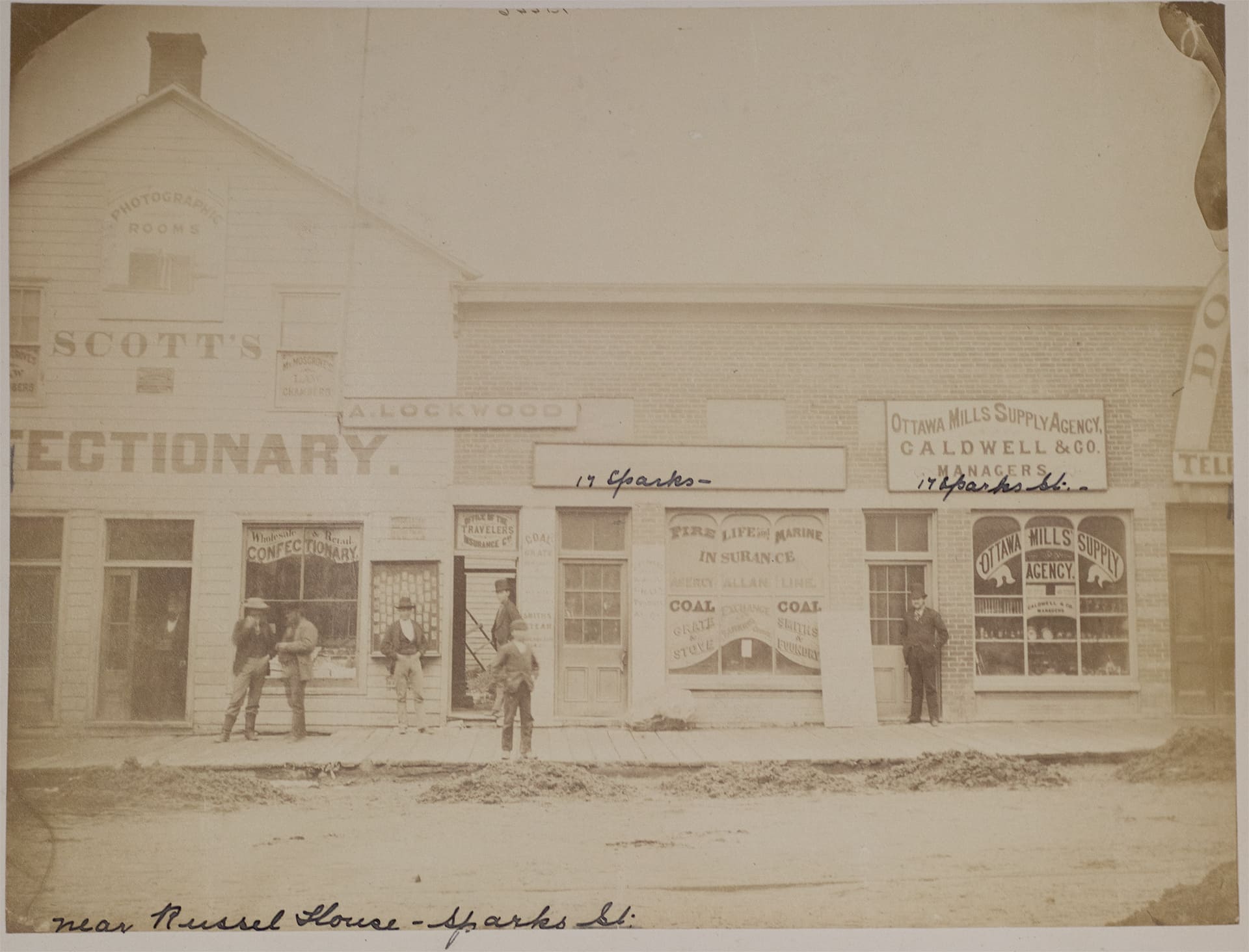 Figure 2 Notman Studios, William James Topley (attrib.), Sparks Street Storefront (detail), c.1870, City of Ottawa Archives, MG597.
By 1863 Alvira began operating the studio under her own name. Her studio at 15 Sparks Street (renumbered 44 Sparks Street after 1875) was adorned with a simple sign that read “A. Lockwood,” with a larger sign featuring an image of an old daguerreotype camera (a nod to her father’s earlier work) and reading “Photographic Rooms” at the building’s gable.[[6]] Alvira’s photographic work focused almost exclusively on portraiture. By the later part of the 1860s she was producing mostly carte-de-visite prints and cabinet cards, which were more accessible to the burgeoning middle class than earlier cased photographs.
In 1870, Alvira had built a house on Rideau Street (between Nelson and Friel Streets), where she lived with her mother, and where she also maintained both an office of sorts and her amateur painting studio.[[7]] On March 19, 1872, the home was destroyed by fire. In the aftermath, the Ottawa Journal reported that many citizens had “joined in making up a purse… as a tribute of their regard… to a most deserving lady on the occasion of [Alvira’s] recent trouble.”[[8]] Following the fire, Alvira continued her work in Ottawa, operating on Sparks Street while living in the up-and-coming Sandy Hill neighbourhood.[[9]]
Alvira closed her studio in 1883 to pursue an education in painting, a long-enduring passion which she had set aside in order to focus on the family business. She first relocated to New York, and then to Paris, where, according to a later interview in the Ottawa Citizen, she spent a further five years “under the great teachers of the eighties.”[[10]] Alvira returned to Ottawa in 1891 and opened a new studio in her home at 386 Rideau Street where she devoted considerable time to painting. For many years Alvira “taught oil painting, painting on china, charcoal work, burnt wood work, water colors, etc.” out of her home studio, which was judiciously hung with her own works.[[11]] She entered, and often won, competitions at local fairs, submitting works of embroidery, painting, charcoal, and more.[[12]] Later in life, Alvira continued her artistic endeavours, taking woodworking classes and remaining active within the community. She was a member of the Ottawa Horticultural Society and the Canadian Red Cross. An article in the Ottawa Citizen described an eighty-year-old Alvira as “not a bit” old fashioned: “She lives vigerously [sic] in the present and is right up to date.[[13]]
Alvira Lockwood died at the Perley Home for Incurables on April 5, 1925, at the age of 82. She had been suffering from hemiplegia (paralysis) for several months, eventually dying of heart failure. Her funeral was attended by her brother Joseph, as well as her sister Eliza Lockwood, Mrs. B. Billings, and Mrs. Jennie Russell Simpson, then-member of the Women’s Canadian Historical Society of Ottawa, among many others.[[14]] A handful of her portraits remain in museums and private collections, while an unsubstantiated portrait of the artist herself exists within the holdings of Library and Archives Canada. The Bytown Museum currently holds a collection of fifteen of her portraits. Alvira was pioneer in Ottawa’s burgeoning photography scene, Ottawa’s first professional female photographer and a beloved figure in the city’s artistic community.
Grant Vogl is the Senior Manager, Collections and Exhibitions, at the Bytown Museum. Grant has worked in the heritage sector since 2007, holding various positions relating to: collections management, curatorial research, and exhibition development. With the Bytown Museum since 2010, Grant has curated sixteen temporary exhibitions, co-curated twenty-two community-based exhibitions, and undertaken major updates throughout the Museum's permanent gallery. In addition, he has led the Museum's digital initiatives, including social media, virtual tours, video guided tour and vignette series, digitization, and more. Grant has contributed to numerous periodicals, publications, books, conferences, research papers, and partner exhibitions, and delivers regular public lectures throughout the heritage community. In 2022 Grant spearheaded the OMA award-winning "Permanent Gallery Renewal Project" in close collaboration in the Algonquin community, presenting the topic at the 2023 CMA conference.
Notes
[[1]] Curtis Gates, Our County and Its People: A Memorial Record of St. Lawrence County (New York: D. Mason, 1894), 88-89.
[[2]] Clint Hryhoijiw, “Clint’s Curio Corner,” Email Supplement to Photographic Canadiana for Volumes 10-12, January 2013, 7, https://phsc.ca/camera/wp-content/uploads/2013/01/PHSC-E-Mail-V12-10rev.pdf; Gates, Curtis, Our County and Its People, 88-89;“Along Sparks Street,” The Ottawa Citizen, November 9, 1907, 19, Newspapers.com.
[[4]] “View of the Southwest Corner of Sparks and Elgin Streets 55 Years Ago,” The Ottawa Citizen, June 20, 1925, 26, Newspapers.com.
[[6]] Notman Studios/William J. Topley, “Sparks Street storefront,” ca.1870s, City of Ottawa Archives, MG597.
[[7]] Cherrier & Kirwin's Ottawa Directory For1872-1873, (Ottawa: Cherrier & Kirwin 1872), 89,156, https://vitacollections.ca/ottawalibrary/3566634/page/3?n=.
[[8]] “Destructive Fire,” The Ottawa Daily Citizen, March 20, 1872, 3, Newspapers.com; “A Handsome Testimonial,” The Ottawa Daily Citizen, March 21, 1872, 3, Newspapers.com.
Songs & Stories of Ottawa's Past
Paul Weber entertains us with songs and stories from Ottawa's history.
Media
In January 2024, Andrea Bissonnette, Ben Weiss and myself had an extraordinary experience—the opportunity to sit down with Madame Adrienne Clarkson at the Château Laurier Hotel to have tea and chat about her past and Ottawa history more generally. For those who might need a reminder, after a stellar career as a journalist, Madame Clarkson was Canada’s governor general from 1999 to 2005, and the Historical Society of Ottawa’s patron.
The story began in the spring of 2023 when Andrea contacted the Historical Society of Ottawa regarding an old family photograph album that had originally belonged to her grandmother, Marie Albina Guilbeault. Andrea had inherited it following the passing of her mother, and offered the photos to the Society.
Although the Society no longer maintains a photo archive, we agreed to go through the album, scan photographs of interest, and then send the collection to the City of Ottawa Archives. Among Andrea’s fascinating photos was a picture of her great-grandfather, Arthur Guilbeault, who was a mayor of Eastview (Vanier) in the 1920s, and another of Zoë Laurier, the wife of Sir Wilfrid Laurier.
It took us some months to go through the album in detail. In January, Ben Weiss read a number of newspaper clippings, snipped by Andrea’s grandmother, about her son, Andrew (André) Bissonnette, who was Andrea’s father. Representing the Ottawa Technical Institute, Andrew had won third prize in a Rotary Club public-speaking contest held on April 1, 1955 at the Château Laurier Hotel. Perusing the articles more closely, Ben recognized the name of the second-place winner—16-year-old Adrienne Poy, the young immigrant girl from Hong Kong who was to become Canada’s 26 th governor general.
Ben contacted Madame Clarkson’s office and offered to send the newspaper clippings to her as a gift. Instead, Madame Clarkson graciously volunteered to receive them in person as she was soon to be in Ottawa to give an address on leadership at Carleton University.
After meeting at the City of Ottawa Archives where Andrea officially donated her grandmother’s photographs, Andrea, Ben and I trooped down to the Château Laurier, expecting a brief meeting with Madame Clarkson. Instead, she spoke with us for more than an hour. It seemed like she would have happily chatted longer had it not been for another appointment (which turned out to be with none other than Randy Boswell, the well-known journalist, professor and Society member!).
Madame Clarkson was delighted to receive the clippings and recalled the Rotary contest in detail. In the lead-up to the event, she had practised under the direction of her English teacher, Mr. Mann. She entered the Rotary inter-school contest by winning a similar public-speaking event at her school, Lisgar Collegiate. Madame Clarkson said that Mr. Mann had had a profound influence on her, giving her skills that had served her well through her life.
The topic of her young Adrienne Poy’s twelve-minute presentation was “The Problem of China.” She also had to speak extemporaneously for two minutes on the postal system. She clearly impressed the judges and the reporters covering the event. Indeed, her speech garnered more press coverage that that of the first-place winner, Tony Reynolds from Glebe Collegiate, who spoke on “Moral Rearmament.” Madame Clarkson recalled that “moral rearmament” had been a popular, neo-fascist philosophy during the 1950s. (A 1967 article that appeared in The Harvard Crimson called the movement simplistic, anti-intellectual, emotional, and irrational.) Madame Clarkson said that her second-place finish had come as a disappointment; she had hoped to take first place. Indeed, there had been a general feeling that she had performed better than Reynolds but lost owing to her gender. In the 1950s, women did not come first.
Responding to a question from Andrea, Madame Clarkson admitted that while she knew Andrea’s father, Andrew Bissonnette, she did not know him well. She gave Andrea a hug when Andrea revealed that she had never met her father as he had tragically died while her mother had been three months pregnant with her. To talk to somebody who had known her father, even a little bit, was very special.
Madame Clarkson went on to speak about her early life in Ottawa after her family arrived as refugees from Hong Kong in 1942. Her first recollection was falling off the steps of a streetcar. Landing in a snowbank, three-year old Adrienne Poy was fortunately uninjured. She also recalled that her mother didn’t know how to cook when they first arrived in the city. Francophone neighbours taught her how to prepare Western food. Later, Mrs. Poy learnt how to cook Chinese cuisine at a Chinese restaurant. Subsequently, the Poy family ate Chinese food on weekdays and Western food on weekends.
She also described the social and religious divides in Ottawa at the time—English versus French, Irish versus Francophones in Lowertown, and Catholics versus Protestants. One thing she did not experience was anti-Chinese bias, possibly because there were so few Chinese in Ottawa owing to the 1923 exclusion law that barred most Chinese from emigrating to Canada until 1947. But, even within Ottawa’s small Chinese community—just two Chinese restaurants—there was a divide between those who had owned land back in China and those with a water, or fishing background. Her mother would not allow young Adrienne to bring home Chinese children with a fishing heritage.
One thing that was strong in the Poy household was their attachment to the Anglican Church. Madame Clarkson’s parents had been married in Hong Kong by Bishop Ronald Hall, who became famous for the ordination of Florence Li, the Anglican Church’s first woman priest, in 1944. After living in an apartment on Sussex Avenue, the Poy family later moved to Laurier Avenue west to be closer to Christ Church Cathedral where her parents were active members.
When asked about why her family remained in Canada after the war, Madame Clarkson said that her parents had considered going back to Hong Kong. Indeed, many Hong Kong friends were expecting and hoping that they would return. However, her father, William Poy, was concerned about the future of the British colony given the rise of Mao Zedong, fearing that Hong Kong could not last more than two years after Mao’s takeover of mainland China. While his fears later proved to be mistaken, the family stayed in Ottawa.
Noting that her upcoming birthday fell on the Chinese New Year, Ben asked Madame Clarkson if that had any significance for her. She laughed, saying that it did for her mother. Mrs. Poy spent the last three weeks of her pregnancy in bed in the hope that her child would be born a “rabbit” instead of a “tiger.” Failing in that endeavour, she despaired that young Adrienne’s character would be too forceful, making it difficult for her to find a husband.
Madame Clarkson also talked about senior government positions. She said she had turned down an offer to become a senator as she felt that she didn’t have the temperament for the job. While she could do committee work, it wasn’t her preferred type of activity. The role of governor general was more in keeping with her leadership skills. One position she has particularly enjoyed is being Colonel-in-Chief of the Princess Patricia’s Canadian Light Infantry, a role she has had since 2007. Madame Clarkson noted that she was only the third Colonel-in-Chief since the formation of the regiment in 1914, and is proud to be the first Canadian.
With her assistant indicating that it was 3:30pm, and time for her next appointment, Andrea, Ben and I gave our thanks and said our goodbyes. Before going, Ben gave Madame Clarkson a copy of Dorothy Phillips’ book on the Duke and Dutchess of Devonshire, Victor and Evie, British Aristocrats in Wartime Rideau Hall as well as Bill Galbraith’s work on Lord Tweedsmuir titled John Buchan: Model Governor General. He also gave honorary membership certificates to both Madame Clarkson and Andrea. We hope that both are able to join us for future events.
Quick Links
About
Supporting Partners