

Working to preserve Ottawa's past
for future generations.
Additional Info
- Year 1724
- Date September 3
Under threatening skies, the Museum Club visited Dickinson Square in Manotick on Sunday, August 18, 2024, for a guided tour of Watson’s Mill and Dickinson House. Eighteen of the twenty registered participants took the chance and were rewarded with a wonderful experience.
After we gathered and were welcomed by our host Avery Geboers, we split into two groups, one starting in Watson’s Mill and the other in Dickinson House.
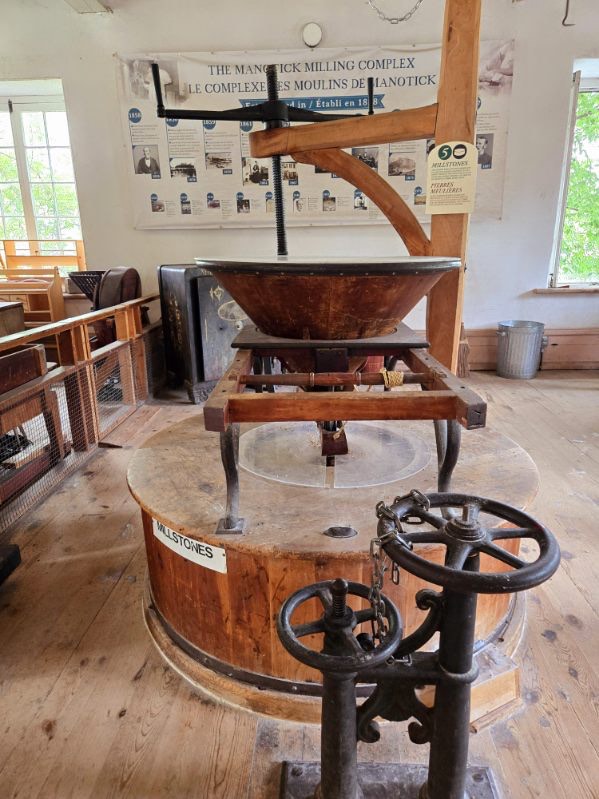 Inside Watson's MillWatson’s Mill was built by Moss Kent Dickinson and Joseph Merrill Currier, one of four mills to be constructed in the general location, including a sawmill (1859), a flour & grist mill (1860, Watson’s Mill), a wool carding mill (1861), and a bung, plug and spile mill (1875, 1888). The 4-storey mill was a marvel of automation for its day, powered by water turbines, rather than a waterwheel, which allowed the mill to operate year round. An ingenious combination of belts and chutes enabled the mill to be run by one person. As far as we know, we were not joined on our tour by the ghost of Ann Crosby Currier, (wife of Joseph for only 6 weeks), who died in a tragic accident in the mill in 1861 and is said to have never left.
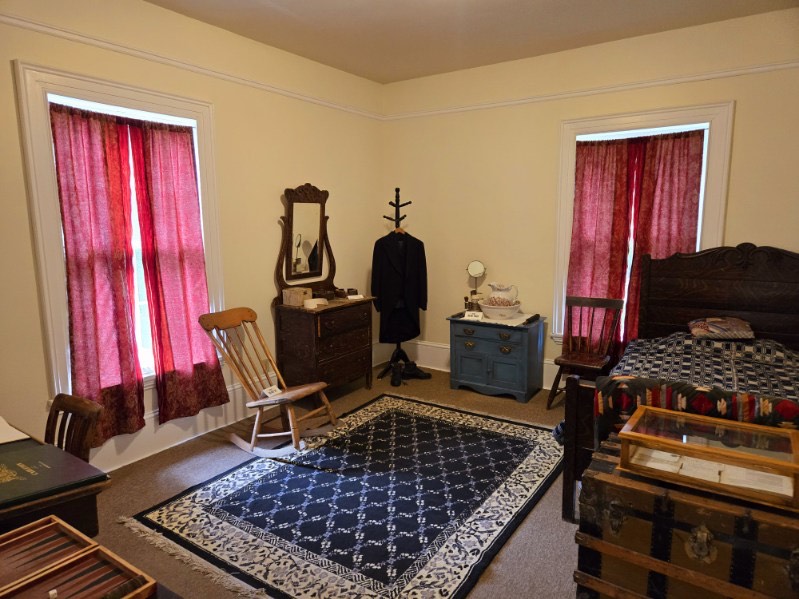 Inside Dickinson HouseDickinson House, across the street from the mill was built in 1867 and served as the village post office, general store and home to the Dickinson family and all subsequent mill owners. The house is furnished in pieces from the late 1800s, though only one chair and a notary seal are from the Dickinson family.
The costumed interpreters in both the mill and the house were poised, polite, professional and extremely knowledgeable. They added greatly to our understanding of the site and our overall enjoyment of our visit.
When both tours were completed, we gathered again in the mill. On most summer Sunday afternoons there is a milling demonstration, but due to unfortunate circumstances, this could not be done on the day of our visit (a good reason for another trip). Our hosts did, however, arrange for us to start the water turbine so we could see some of the mill equipment in motion. The President of the Historical Society of Ottawa, Emma Kent, was put to work, turning the heavy wheel to start the mill. You can watch her in this video:
If you were unable to join us for the day, we strongly urge a visit to this very interesting complex. There is much more to learn about Watson’s Mill and Dickinson Square from their fact-filled website: Watson's Mill & Dickinson House
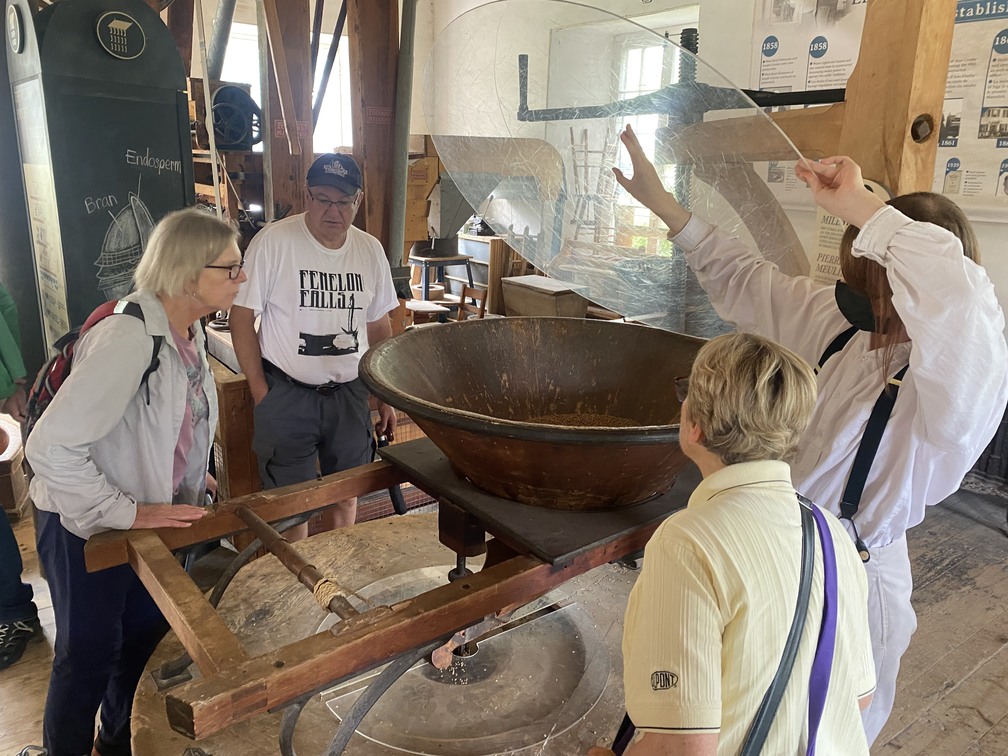 Grain Milling Process at Watson's Mill
Having finished at the mill site, fifteen of us took the short walk to The Vault Bistro where we enjoyed a variety of fine dishes.
The weather smiled upon us and we all left Manotick with smiles ourselves.
Video and photos courtesy of Justin Lacasse.
Publications and Presentations
Did you have a story to share about the history of Ottawa? Would you like to publish or present with the Historical Society of Ottawa? HSO looks at topics within the Ottawa-Gatineau area and the Ottawa Valley. We are dedicated to highlighting the diverse experiences of Indigenous peoples, racialized groups, underrepresented communities (including but not limited to: children/youth, low income/in poverty, women, elder, etc.), 2SLGBTQI+ groups, and others, who continue to enrich our communities. We have many options for you, presented below.
French Presentations/Publications
We offer publications and a series of conferences in French. You can contact Christine (This email address is being protected from spambots. You need JavaScript enabled to view it.) for more details.
Speaker's Series
We host over a dozen Speaker's Series sessions each year, either in person at the Ottawa Public Library or virtually on Zoom, each being about one hour followed by a Q&A session. You can contact Scheherazade at This email address is being protected from spambots. You need JavaScript enabled to view it. for more information. Past sessions are outlined in the meetings section of our website and recordings available via our YouTube channel.
Memory Project
The HSO’s Memory Project is an initiative designed to preserve and celebrate the history of our community and its members. This project aims to collect, digitize and preserve the personal stories, photographs and documents of those who call, or have called, Ottawa home.
Through this project, we hope to preserve these stories for future generations and to provide accessible, educational resources for all those interested in learning more about the history of our city. By celebrating our shared history, we're building a stronger, more connected community where everyone's story is valued and remembered.
If you have a story you’d like to share, please reach out to John at This email address is being protected from spambots. You need JavaScript enabled to view it. and you can view the stories on the Memory Project page of our website.
Social Media
We have active Facebook and Instagram pages. Ben (This email address is being protected from spambots. You need JavaScript enabled to view it.) can help you there if you wish to make a post or simply join us and jump with your comments on our posts on social media!
Quarterly Newsletter
For content that is roughly of a page or two, we have the Capital Chronicle newsletter which Richard spearheads (This email address is being protected from spambots. You need JavaScript enabled to view it. ). You can read past issues on the newsletters section of our website.
Blog
Are you a historian, heritage professional or member of the public who is actively engaged in historical research related to the Ottawa area? Interested in sharing your research in a shorter (500-1000 words) blog format? The HSO blog team would love to hear from you! Full details and past blog posts can be viewed on the Blog page of our website.
The HSO blog team would also love to hear from student bloggers. As an extension of the HSO blog platform, The Student Corner gives students a space to showcase their knowledge of the history of the Ottawa area through blogging. More information can be found on the Student Corner page of our website.
If you are interested in writing for us, please get in touch with Kirsten by emailing: This email address is being protected from spambots. You need JavaScript enabled to view it..
Pamphlet Series
Is your story or research between 10 to 60 pages, with or without photographs, that you would like to see published? HSO has been publishing a pamphlet series for over 40 years and we have well over 100 titles. You can read digital versions of them in the Bytown Pamphlets section of our website.
HSO can offer some assistance with editing and we do all the formatting. Pamphlets are assigned an ISBN (International Standard Book Number) from Library and Archives and HSO deposits copies there, at the Ottawa Public Library, and at the City of Ottawa Archives, which adds a veritable permanence to your work.
We print over 150 copies of the pamphlets and distribute them to our members along with electronic access to the public. Contact Erik at This email address is being protected from spambots. You need JavaScript enabled to view it. for more information.
Other Options
For Ottawa Stories, featured interactive publications, multimedia, or anything else you would like to pitch, please send Erik an email at This email address is being protected from spambots. You need JavaScript enabled to view it..
If you have questions, you can always reach us at This email address is being protected from spambots. You need JavaScript enabled to view it..
We look forward to hearing from you!
I Want to Ride My Bicycle: How Ottawa Took on the Bicycle Craze
Kirsten WiddesWhile not entirely present in this photograph, according to the by-laws of the same year, the club’s uniform consisted of a “Peaked Cap, Tunic, Knickerbockers, and Ribbed Stockings all of a Dark Blue Color. [with] the trimmings to be of Black Braid…”
The bicycle, in its various forms, became an established form of amusement in the 1860s. [[1]] It was however, not until the late 1890s, that the bicycle craze was in full swing. It was during this time that the bicycle became the site of much public discussion. For Ottawa, the craze had taken hold by April of 1895, with The Ottawa Journal declaring the Capital, “all hot for wheels.” [[2]] In the same year, according to the Ottawa business directory, a concentration of bicycle shops could be found on Bank and Sparks Streets, six on Sparks and two on Bank. [[3]] One of these shops was McFarlane Bros, located at 115 Bank Street, it was originally an iron foundry that took up bicycle manufacturing during this period.
This bicycle boom reflects Victorian ideals and preoccupations, namely that of health and respectability. At a time when there was a growing concern over cities being unhealthy spaces, bicycling was seen as the right kind of sport for the health of the nation, as it benefited both physical and moral health. Regarding morality, the perspective at the time concerning morality and sport, viewed amateur sports as pure, reflecting respectability, while professional sports, where money was earned, as corrupt. In examining the Ottawa Bicycle Club (established in 1882), this attitude regarding the bicycle comes into view, as the clubs’ mandate which stated that the club was only open to amateurs.
The stated objective of the Ottawa Bicycle Club, according to the by-laws from 1890, was “to promote the general interest of cycling and to encourage and facilitate “touring.’” [[4]] By the last decade of the 19 th century, there was a growing concern for the proper use of bicycles in public spaces in an era of the ‘safe bicycle.’ This era meant, not only changes to the bicycle itself but concerns for the activity of cycling. The club, and other clubs like it, engaged in family-oriented bicycling, whereby rowdy, reckless cycling (read masculine qualities) was viewed as improper. Before this, during the highwheeler (a bicycle with a large front wheel and a small back one) phase, clubs operated on a more informal basis. Members would engage in Victorian chivalry, taking on the role of ‘two-wheeled knights.’ [[5]] In highlighting ‘touring,’ the mandate of the Ottawa Bicycle Club heeded this concern for proper bicycling etiquette. Etiquette was reflected in the respectability of the club members and through maintaining proper order in public spaces. The activity of touring indicates a level of activity that was seen as being beneficial to one’s physical health while maintaining respectability.
Maintaining one’s respectability was especially important for women who, with the development of the safe bicycle, took up cycling. Admittance of women into the club likely occurred around the time that the above photograph was taken, as between 1890-1891 greater numbers of women actively took up cycling in Canada. By the late 1890s, women accounted for between one-quarter and one-third of all riders. [[6]] In addition to the Ottawa Bicycle Club opening its door to women, other ladies’ clubs within the Capital also took up learning to ride bicycles. [[7]] As The Ottawa Journal stated in 1896, “…it is no uncommon thing to see a number of women on bicycles riding along our roads.” [[8]]
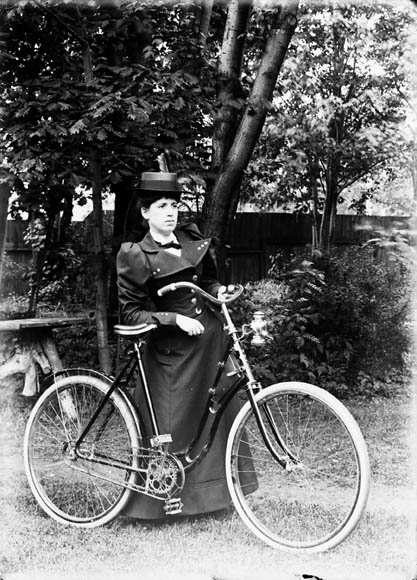 Mrs. Albert H. Campbell on Wheel (1897) - James Ballantyne / Library and Archives Canada / PA-130015.
Unlike previous iterations, the safety bicycle did not pre-empt women from the activity of cycling. This was in part because Victorian Women’s dress codes, which had made it possible to ride, could be accommodated, even creating new fashions directly linked to the leisure activity. The creation of a skirt, designed to meet “every requirement of the wheelwoman,” was the subject of an article from the February 12, 1897, issue of The Ottawa Citizen , which describes the skirt as seeming to “answer every requirement of modesty as well as convenience.” [[9]] Divided in the front and back to accommodate the frame of the bicycle, the skirt concealed the movement of limbs, while at the same time affording freedom. Women taking up cycling was, as with many other things where women entered the public sphere, not without objection. Those involved in reform, for example, expressed concern that it facilitated inappropriate relations between men and women. An article from the Dominion Medical Monthly and Ontario Medical Journal states that some objection to female cyclists was “…because it is injurious to the rider herself and decidedly immoral in its tendencies.” In response to the article, both cycling organizations and publications wrote to the editor to dispute the article’s claims regarding the question of women riders. [[10]] Women who rode became a ‘flaneur[use] on wheels,’ displaying good taste, appropriate attire, commitment to healthy motherhood, and bourgeois propriety in public while touring. [[11]] In addition to touring, women, as well as children, took part in public bicycle tournaments or “bicycle gymkhana” (something originally associated with equestrian skill) which had gained popularity at the time.
These tournaments brought together all the ideals of the safety bicycle era as it “favoured bicycling decorum and propriety over athleticism, though many of the events of the gymkhana required significant bicycle-handling skill.” [[12]] These events also signified the proper use of public space, usually taking place in and around a park, which was a cultivated and clean space. Taking place largely during the summer season, the gymkhana events involved such things as a bicycle parade and bicycle decoration, as well as games including obstacle races. While Ottawa held its own gymkhana as the bicycle craze was drawing to a close in 1900, it did so in what seems to be a uniquely Ottawan fashion, with the gymkhana taking place in the middle of November at the indoor Rideau rink. Jointly organized as a benefit by the lady’s auxiliaries of St Luke’s and the children’s hospitals, the program included races and drills, as well as a military musical ride. While the event was said not to have gotten as many spectators on its second night, it was said to be a success. [[13]] If low attendance was thought to be a sign of decreased interest in bicycling, ‘the number of shops related to bicycles suggests otherwise, as there were over 10 in business in 1900. [[14]]
Whether out for a leisurely tour or participating in an organized event, the bicycle boom certainly did not go unnoticed in the Capital. In taking up the sport of bicycling, Ottawa residents heeded the call that it was indeed the right kind of sport for the health of the nation. While the actual craze only lasted until around the turn of the century, the interest in cycling has remained a part of the capital’s landscape, enjoyed by many no matter the season.
Kirsten Widdes is currently an independent researcher and writer. She holds an MA in History from Carleton University, as well as a BEd in Junior/Intermediate Education from the University of Ottawa. She has been a volunteer with the Historical Society of Ottawa since August 2023 and currently serves as the managing editor of HSO blog.
[[2]]“All Hot For Wheels: The Spread of Bicycle Craze in the Capital,” The Ottawa Journal, April 4, 1895, 3, https://www.newspapers.com/image/43441283.
[[3]]Might Directory Co., Ltd, Classified business directory of the cities of Hamilton, London, Montreal, Ottawa and Toronto (Toronto: Might directory co., ltd, 1895), 280, https://digitalarchiveontario.ca/objects/355512/classified-business-directory-of-the-cities-of-hamilton-lon?ctx=5f968c77a9bdefd1d0331b218963f702e2154d97&idx=13.
[[4]]Ottawa Bicycle Club, Constitution and by-laws of the Ottawa Bicycle Club (Ottawa: A. Bureau & Freres Printers, 1890), 1, https://www.canadiana.ca/view/oocihm.11587.
[[5]]Philip Gordon Mackintosh, “A Bourgeois Geography of Domestic Bicycling: Using Public Space Responsibly in Toronto and Niagara-on-the-Lake, 1890–1900,” Journal of Historical Geography20, 1 (2007): 139, https://doi.org/10.1111/j.1467-6443.2007.00303; G. B. Norcliffe, The Ride to Modernity: The Bicycle in Canada, 1869-1900 (Toronto: University of Toronto Press, 2001), 195-196.
[[8]] “Women on Bicycles,” The Ottawa Journal, February 8, 1896,1,https://www.newspapers.com/image/43359474.
[[9]]“A New Bicycle Skirt,” The Ottawa Citizen, February 12, 1897, 3, https://books.google.ca/books?id=RmcuAAAAIBAJ&lpg=PA2&dq=bicycle%20skirt&pg=PA2#v=onepage&q=bicycle%20skirt&f=false.
[[10]]Rebecca Beausaert, “‘Young Rovers’ and ‘Dazzling Lady Meteors:’ Gender and Bicycle Club Culture in Turn-of-the-Century Small-Town Ontario,” Scientia Canadensis 36, no. 1 (2013): 34, https://doi.org/10.7202/1025788ar; “Female cyclists,” Dominion Medical Monthly and Ontario Medical Journal Vol.7, no.3 (September 1896): 255, https://www.canadiana.ca/view/oocihm.8_06539_15; Female cyclists,” Dominion Medical Monthly and Ontario Medical Journal Vol.7, no.5 (November 1896): 514, https://www.canadiana.ca/view/oocihm.8_06539_17.
[[11]] Norcliffe, The Ride to Modernity,244 -245; Mackintosh, “A Bourgeois Geography of Domestic Bicycling, 133.
[[12]]Mackintosh, “A Bourgeois Geography of Domestic Bicycling, 144. A Faneuse or Flaneur is some who strolls about the city, taking in its sights and sounds.
[[13]]“Society and personal,” The Ottawa Citizen, November 13, 1900, 9, https://books.google.ca/books?id=elguAAAAIBAJ&lpg=PA5&dq=%22Bicycle%20gymkhana%22&pg=PA5#v=onepage&q=%22Bicycle%22&f=false; “A Bicycle Gymkhana,” The Ottawa Journal, October 3, 1900, 8, https://www.newspapers.com/image/42370524/; “The Gymkhana,” The Ottawa Journal, November 18, 1900, https://www.newspapers.com/image/42371912/.
The third Museum Club outing took place on Thursday, July 18, 2024, when a dozen registered participants, and two “foundlings” received a guided tour of the Merrickville Blockhouse Museum from our host, Jane Graham, who is the President of the Merrickville & District Historical Society (MDHS). Jane explained that the Blockhouse was built in 1832 to defend the Rideau Canal but never served in its original role. Instead, it became the home of the first lockmaster, Sgt. Johnston, his wife and children. Over the years the Blockhouse has had many other uses including as a storage facility and a church. Eventually it fell into disrepair and was scheduled to be demolished in the early 1960s. It was saved by the community of Merrickville who raised funds and created the Merrickville & District Historical Society to restore and operate the Blockhouse. The work has since become more than the volunteers of the MDHS can realistically handle, so the Town of Merrickville has now assumed responsibility for the Blockhouse Museum.
After about an hour in the Blockhouse Museum, Jane led ten of us on a guided walking tour along the main street of Merrickville pointing out many of the historic buildings and telling us the stories behind each. Jane told us some of the details of the history of Merrickville itself, from its origin as a thriving industrial and commercial hub, through its decline into the mid twentieth century and its renaissance in the past few decades as a vibrant community and a haven for artists and artisans of all kinds. She also told us some colourful stories of a number of its more prominent early residents and of the plans of the MDHS to honour one of these, Harry McLean, with a statue. The weather was perfect for the walking tour and there was much to see and yet more that could be explored independently based on a walking tour guide that is available through their web site.
Following our walking tour, which lasted just over an hour, we said good bye to Jane and retreated to the Mainstreet Restaurant, across the street from the Blockhouse, where the ten of us were warmly greeted. The large menu offered many tasty choices and their own lager was enjoyed by a number of our party. After lunch, the group dispersed, some browsing, and buying, in Merrickville’s fascinating array of shops.
Museum Club provides an opportunity for its participants to make new connections or in some cases discover existing connections they did not know they already had. The latter occurred on our Merrickville trip when a casual lunchtime discussion revealed that one of the participants knew the grandparents of another, even though the two participants had never met and the grandparents live in south-western Ontario. As they both agreed, it is a small world.
One of the goals of the Museum Club is to strengthen the relationships between the Historical Society of Ottawa and other organisations involved in the exploration of our local history or in preservation and conservancy. To this end, a partnership is now being established between the HSO and the MDHS whereby the MDHS will send the HSO electronic copies of their newsletters and invitations to their speaker series presentations and the HSO will reciprocate, providing more opportunities for the members of both organizations.
Ottawa’s Camp Woolsey, Guiding, and the Power of its Community
Sadie CannJulie Côté on Ottawa’s Camp Woolsey, Guiding, and the Power of its Community
Could you introduce yourself and tell us how you’re involved with Girl Guides?
My name’s Julie, but a common thing in Girl Guides, especially at Camp Woolsey, was to use fake names or ‘camp names’. So my camp name is Jaf, and that’s what most of the people involved in Guiding in Ottawa would know me as.
I’ve been a member of Girl Guides for basically my whole life. I started in 1997 when my family was posted in Germany. When my family moved back to Canada, I joined as a Brownie. Girl Guides of Canada has recently changed the branch name to Embers, but originally the branch was named after a type of Scottish Fairy. After Brownies I did Guides, Pathfinders, and Rangers but took a break when I went to university. When I came back to Ottawa I became a Guider, and have been a Guider ever since, going on 10 years now.
The biggest reason I stayed as a kid was because of two really good friends, who I met in Guides. They weren’t going to my school, so that was the only time I saw them. The three of us did the leadership training program at Woolsey together, and my first job was working at camp. It was this friendship that kept bringing me back. When I said earlier I took a break from Guides, that was only half true. While technically I wasn’t a member, I still worked at camp. When I got back to Ottawa, the reason I joined again was because some of my friends had a unit and asked me if I could help out. As a kid, I was never interested in working with other kids, but that changed and now I work for the school board.
When I was 12 or 13 there was a big change in the way Girl Guides was run. It became a lot more centralised. No longer did we have “districts” that handle their own affairs, like the Ottawa District for example. It was actually the Ottawa District that first bought and ran Woolsey right from the very start. There have also been program changes and uniform changes. The organisation is always trying to evolve and keep up with the times.
Could you tell me a bit about the camp itself?
David (Dave) Kent - Beep Ball, Disability, and Sports Memory in Ottawa
In March 2024, the Historical Society of Ottawa sat down with David (Dave) Kent to discuss beep ball, disability and sports memory in Ottawa.
Why don’t we start by telling a bit about yourself and your life?
Dave: Well I was born in Ottawa in the summer of 1951 and did almost all of my schooling, elementary, middle and high school in Ottawa. I went to the University of Ottawa in the early '70s and did an arts degree in Geography. I then went to the University of Manitoba to take a course in data processing, or what they call computer science now. I had normal vision until I was about 8 or 9, when I lost 90% of my sight.
And what was it like attending public school with a visual impairment?
Most of us think of “Dow’s Swamp” as having disappeared during the construction of the Rideau Canal, two centuries ago, leaving us with what we know today as “Dow’s Lake”.
But did you know that a remaining southern portion of Dow’s Swamp continued to thrive until Ottawa’s ever-expanding urban footprint brought about the final destruction of this vital and vibrant vestige of wetland in the 1950s?
Long-time naturalist and plant ecologist Joyce Reddoch reminds us of our tragic loss of that precious remnant of primaeval ecosystem, as is illustrated in the attached collection of articles, including a post-mortem of her own, published in a journal of the Ottawa Field Naturalists’ Club almost a half century ago.
Scientific studies show that this now-gone swamp – a low trough between Dow’s Lake and the Rideau River, bounded on the west by the old CPR track and on the east by the old Bronson Avenue – was a lake from about 7,000 until about 3,000 years ago when bog and swamp forest began to form, finally becoming tree-covered 1,000 to 1,500 years ago.
(A swamp is generally a wetland or peatland with standing water or water gently flowing through pools or channels. The water is rich in nutrients and the vegetation is characterized by a dense cover of deciduous or coniferous trees and shrubs, herbs and mosses. Oft-misunderstood and underappreciated, our swamps are crucial to maintaining biodiversity.)
John MacTaggart, Colonel By’s chief engineer observed of Dow’s Swamp in 1829 that “the cedar-trees… grow as thickly in the swamp as they possibly can grow, an average fourteen inches thick and seventy feet high”.
In the century+ old Ottawa Field Naturalists’ Club’s earlier days, this remaining southern remnant of Dow’s Swamp was cherished as a seemingly inexhaustible refuge for sightings of rare and flourishing flora and fauna, including rare and endangered orchids, rare butterflies, birds and frogs and other wildlife.
The terrain of Dow’s Swamp, as it still existed earlier last century, was well-described by renowned Canadian forester/zoologist C.H.D. Clarke as he noted the birds he had spotted “there, among the cedars, willows, alders and elms, in tangled glades that led over sodden ground to beds of cattails”.
More than a dozen species of native orchids had been excitedly recorded in this now-disappeared remnant of the Dow’s Swamp wetland complex. Alder flycatchers, Lincoln's sparrows, white-throated and clay-coloured sparrows, rusty blackbirds, ruby-crowned kinglets, veeries, vireos, scarlet tanagers, waterthrushes, warblers, Carolina and marsh wrens, purple finches and black ducks were among the sometimes-scarce birds that Dr. Clarke and other avid naturalists would add to their observation lists.
Through these attached articles, Dr. Reddoch invites us to better understand that swamps, in their undamaged state, are ecosystems crucial to the maintenance of ecological diversity (and for maintaining ground water levels) – not dismal, stagnant, fetid places as per our popular misconceptions.
(Even mosquitoes – such as those who had likely persuaded the Dow family to abandon their allotment in 1826 – perform crucial roles as plant pollinators and food for birds.)
Dow’s Swamp is a lost ecological gem that Joyce Reddoch urges us never to forget.
(As we mourn the loss of this one small urban-enclosed portion of primaeval wilderness, one can only reflect on the impact post-contact settlement has had across our nation, not only on the long-existing flora and fauna, but also on the Indigenous people, upon this land their lives and livelihoods had vitally depended.)
Here are the articles that Joyce has kindly provided for us to read and learn more:
Quick Links
About
Supporting Partners