

Working to preserve Ottawa's past
for future generations.
How Immigration Has Shaped Ottawa’s Cultural Mosaic - Part III
Dave KentAnother good crowd gathered at the Sunnyside Branch of the Ottawa Public Library on Saturday, April 20, 2024 to listen to the third and regrettably final installment of Phil Jenkins’ lecture series on four immigrant groups in Ottawa. In this session, Phil completed his discussion of the Chinese community and went on to talk about the role of the Italian community in Ottawa.
Phil highlighted two of the most famous members of Ottawa’s Chinese community before concluding this part with a brief discussion of the community as it exists today.
Adrienne Clarkson was born in Hong Kong in 1939 and moved to Ottawa in 1941 after the Japanese occupation of that territory. She attended public school and Lisgar Collegiate before going on to a very successful University education. Adrienne worked for the Canadian Broadcasting Corporation for some 30 years but achieved her greatest fame when, in 1999, she was appointed as Governor-General, a post she held until 2005. During this time, she led a “Team Canada” of artists and musicians to China to broaden cultural ties and understanding between the two nations. Recently, two members of the Historical Society of Ottawa met with Adrienne Clarkson and presented her with some old newspaper clippings that had come into their possession. This story can be read online: Tea with Adrienne Clarkson.
Denise Chong, a 3 rd generation Chinese-Canadian was born in Vancouver in 1953. After studying economics in Vancouver and Toronto she moved to Ottawa to work in the Department of Finance, eventually becoming a special advisor to Prime Minister Pierre Trudeau. This was remarkable for the time as the world of finance was dominated by white men. She left government work in the mid-1980s to pursue a career in writing and has since published four non-fiction books and edited one collection. Her books include: The Concubine’s Children (1994), The Girl in the Picture: The Kim Phuc Story (1999), Egg on Mao: The Story of an Ordinary Man Who Defaced an Icon and Unmasked a Dictatorship (2009) and Lives of the Family: Stories of Fate and Circumstance (2013). The collection she edited is entitled The Penguin Anthology of Stories by Canadian Women (1997). She still lives in Ottawa with her husband and two children.
The Chinese community in Ottawa remains very active and vibrant with 5 newspapers and many specialized support services. Focussed on Somerset Street West, its most recognizable symbols are the Royal Arch – Ottawa Chinatown that was constructed in 2010 and the annual Dragon Boat Festival.
History suggests that the first Italian to visit what would become Canada was John Cabot (Giovanni Caboto in Italian, Zuan Caboto in Venetian, Jean Cabot in French). Cabot was likely born in Genoa sometime about 1450 later moving to and becoming a citizen of Venice. By the mid-1490s he was in England and with financial support from Italian bankers in London and merchants in Bristol, he received letters patent from Henry VII to undertake expeditions of exploration. Phil read part of this, as follows: “…to find, discover and investigate whatsoever islands, countries, regions or provinces of heathens and infidels, in whatsoever part of the world placed, which before this time were unknown to all Christians.” Phil noted that this can be seen as the start of colonialism in Canada. On June 24, 1497, Cabot landed on the east coast of North America.
Phil explained that Italian craftsmen worked throughout Europe, but as passage across the Atlantic became cheaper than train travel around Europe, they began to come across in the spring, returning home in the fall, thus avoiding the harsh winters, though some stayed and settled. Phil identified two major waves of Italian immigration, the first falling roughly between 1900 and 1914, with the other following the Second World War. The 1911 census recognized around 700 families of Italian origin in Ottawa, clustered mainly in Lowertown, and employed primarily as painters, plasterers, stone masons, bakers, and barbers.
Among the bakers were Frank and Maria Galla who arrived in Ottawa in 1908 and opened their bakery at 597 Somerset Street West in 1920, later moving it to Rochester Street. They had 6 children, 5 sons and a daughter, the boys all working in the bakery with their father and remaining bachelors until the business closed in the late 1960s. As seen with other immigrant community leaders, Frank and Maria were instrumental in welcoming newcomers, the bakery often becoming their first place of employment. The couple was also key to the evolution of recreation and cultural growth, especially with the heart of their community, their church, St. Anthony of Padua on Booth Street.
On June 10, 1940, Italy entered the Second World War on the side of Germany and Prime Minister Mackenzie King responded by authorizing the RCMP to apprehend Italians living in Canada who they perceived as a threat. Phil explained that there were about 150,000 Italians in Canada at that time, about half of which had been born in Canada. This distinction did not matter. Approximately 31,000 Italians were identified as “Enemy Aliens”. They were photographed, finger-printed and required to report to the authorities on a monthly basis. Between 600 – 700 men were placed into internment camps, the largest being Camp 33 in Petawawa, two other camps existing, one in New Brunswick and the other in Alberta. Some of these men were held for as long as 3 years. None were ever charged with any offence. As a community, Italians were shunned by other Canadians and demonized by the press, many losing their jobs. In 1990, Prime Minister Brian Mulroney offered an apology to Italian-Canadians for the internment but it was not until May 27, 2021 that Prime Minister Justin Trudeau formally apologized on behalf of the Canadian Government.
Phil read us an account by Giacomo Moscatelli, a second generation Italian-Canadian that reflects on his own childhood and the transition through the generations from Italian, to Italian-Canadian, to Canadian-Italian, and finally simply to Canadian. It’s a great read: Growing up Italian.
In the late 1950s and 1960s the City of Ottawa undertook several “Urban Renewal” projects. These identified communities where it was felt that houses and other buildings were in poor condition. The area around Rochester and Booth Streets was one of the targets of this policy; large numbers of houses, mostly Italian-owned, were expropriated and demolished. The community was dispersed.
Phil went on to profile two of the best known members of the Italian community in Ottawa. Robert “Bob” Chiarelli, who was born near Preston Street (aka Corso Italia) has served as the Regional Chair, the Mayor of Ottawa, and as a Member of the Provincial Parliament, in which he was a Cabinet Minister. Mario Bernardi became the founding conductor of the National Arts Centre Orchestra in 1969, becoming its Music Director in1971. He is credited with turning his hand-picked orchestra into one of the finest in the world.
One of the many pamphlets produced by the Historical Society of Ottawa is entitled “Growing Up in “La Colonia” and was written by Salvatore Pantalone. It provides more background on early Italian settlement in Ottawa and a collection of family anecdotes that colourfully describe life in “The Village” through the depression and the Second World War, with a special reference to the internment. Like many of the HSO pamphlets, it can be read online: Bytown Pamphlet #89.
Phil ended this session, and the series with his guitar. He performed Michael Bublé’s song "Home" , which was enthusiastically received, as were all aspects of this fantastic lecture series by one of our area’s leading public historians.
The Historical Society of Ottawa would like to thank Phil Jenkins once again for his time, his support, and especially for his passion.
Ottawa is one big graveyard! Cemeteries are peaceful. Some like to stroll among the dearly departed to get away from the noise and chatter of daily life. Historians, on the other hand walk among the graves hoping that the tombstones will tell a story of those below.
I feel the same way when I walk the streets of Centretown, Lowertown, Sandy Hill, and Hintonburg. Old houses are my memorials to the past. Big or small, elaborate or modest, Ottawa’s houses of the 19th and early 20th century tell us how the people who lived in them . . . lived. To me cemeteries are about death. But the homes of those now gone are about the life that they chose or inherited.
For the HSO March 13, 2024, Zoom presentation, I took people on a journey of the residences that were once a place of relaxation after a hard day at the office . . . or store, or operating room, or laboratory, or forest. The unadorned elegance of homes in Lowertown – some of wood, others of stone – reveal the modest lifestyles of Ottawa’s labourers and lower management civil servants.
Brick, on the other hand, was the preferred choice for the upper crust of Upper Town. The streets of Centretown run red with Edwardian masterpieces. These homes hint of a congenial social norm where the women played Whist in the parlor, while their husbands discussed the rising or falling business climate in the sitting room across the hall.
At the southern extremity of the Bank and Elgin streetcar lines, Glebe became the exclusive domain of brokers and bankers. These people could afford the services of local architects like Werner Noffke and William Caven Beattie, who were commissioned to design “revival” homes in colonial and Classical styles, and to avoid, at all costs, the staid British styles of the “old money” families.
Part One of Who Lived Here? can be seen at the HSO YouTube website.
Thomas Mackay & The Making of Ottawa
Alastair Sweeny, author of "Thomas Mackay, The Laird of Rideau Hall and the Founding of Ottawa" recounts the beginning of Bytown.
Media
We were excited to gather again at the Sunnyside Branch of the Ottawa Public Library on Saturday, April 13, 2024, to hear the second installment of Phil Jenkins’ lecture series dealing with the contributions of four immigrant communities to Ottawa. In this section, Phil would complete his discussions on the Jewish community and introduce us to the history of the Chinese community in Ottawa.
The audience was delighted when Phil chose to continue his history of the Jewish community in Ottawa with his guitar and a rendition of the Leonard Cohen song Tower Of Song which was greatly appreciated and an excellent reintroduction to the topic of Jewish history in Ottawa.
Phil told us stories of a number of individuals, the first being the remarkable story of Lillian Bilsky Freiman, who was also known as “The Poppy Lady”. At the outbreak of the First World War Lillian arranged to get 30 sewing machines put into her home and organized Red Cross sewing circles to sew blankets and other clothing for the troops overseas. In 1918 she was tasked by the Mayor of Ottawa to organize a volunteer force of some 1,500 to help combat the spread of the Spanish Flu in the city. In 1921, with growing interest in using the poppy as a symbol of remembrance, she crafted Canada’s first poppies in her living room and later became the Chair of Ottawa’s annual Poppy Campaign for much of the rest of her life. She also founded Canadian Hadassah and worked tirelessly for many other charitable organizations including the Ottawa Welfare Bureau, the Protestant Infants Home, the Red Cross Society, and the Salvation Army along with many others. In 1934 she was appointed to the Order of the British Empire (OBE) by King George V, the first Jewish Canadian to be so honoured. Upon her death in 1940, among the many who attended her funeral were Prime Minister Mackenzie King and the Mayor of Ottawa, Stanley Lewis.
As a teenager, David Mirsky, the son of Ottawa's first rabbi, collected empty bottles and returned them to Brading’s Brewery. By 1920, he was filling bottles with spring water from a spring at the base of Nanny Goat Hill and selling them; he founded The Pure Spring Company in 1925 and it would become the largest independently owned soft drink company in Canada. The company remained in the Mirsky family until the mid-1960s when it was purchased by Crush.
Louis Baker was joined by his brother Jake and opened Baker Brothers at the corner of Booth and Duke Streets. It was the largest scrap yard in the area and survived in that location until the general demolition of Lebreton Flats in the mid-1960s. The business remains in operation, now located on Sheffield Road.
Phil then reminded us of the decision of the Canadian government not to offer sanctuary to the passengers of the St. Louis.
Scribe’s Note: The MS St. Louis sailed from Hamburg on May 13, 1939 bound for Havana with 937 passengers on board, mostly German Jews fleeing Nazi persecution. When the ship docked in Havana on May 27, the Cuban authorities only allowed 28 passengers to disembark. Negotiations to allow the others to land in Cuba failed and the ship was ordered out of Cuban waters on June 2, 1939. They were unable to obtain permission to land in the United States, so on June 7 the St. Louis set sail directly back to Europe, not entering Canadian waters. The St. Louis did not contact Canadian authorities requesting permission to disembark its passengers in Canada, but Prime Minister Mackenzie King did receive a petition on the evening of June 7th from a group of prominent Canadians led by historian and professor George Wrong suggesting that sanctuary be offered. At that time, Mackenzie King was on the Royal Train in Niagara and the government was not sitting. He contacted the Undersecretary for External Affairs, Dr. Oscar D. Skelton, to consult with Minister of Justice, Ernest Lapointe, and the Director of Immigration, Frederick Blair, as he “would like to be advised immediately as to powers of government to meet suggestion which communication contains”. Blair informed Skelton that the refugees could be admitted to Canada by having their names listed on an Order-in-Council but advised against so doing. As a result on June 9 Mackenzie King was informed that only people from four specified groups (family, investors, entrepreneurs, and highly-skilled immigrants) could be admitted by Order-in-Council. Thus Mackenzie King was told that the passengers of the St. Louis were inadmissible. Mackenzie King recorded in his diary that the refugees’ plight was “much less our problem than that of the U.S. and Cuba” while Blair wrote “It is manifestly impossible for any country to open its doors wide enough to take in the hundreds of thousands of Jewish people who want to leave Europe: the line must be drawn somewhere.”
The St. Louis returned to Europe and distributed her passengers to four nations, the Netherlands (181), Belgium (214), France (224) and the United Kingdom (288). The Second World War soon erupted and 254 of the former passengers of the St. Louis would die in the Holocaust, while one would die in a German air raid on London.
Source: MS St. Louis in Canadian Context | Canadian Museum of Immigration at Pier 21
Phil then began his history of the Chinese community in Ottawa, with its very early beginnings a half of a continent away. The first 60 Chinese immigrants were brought to Nootka Sound , Vancouver Island in 1788 by British merchants. They built a schooner and what was intended to be a permanent fur trading post. An additional 80 Chinese workers were brought over the following year, but soon after, the post was taken by the Spanish and the fate of the Chinese workers remains unknown. There were two major events which spurred Chinese immigration to British Columbia. The first was the Fraser Canyon Gold Rush of 1858, which initially drew immigrants from California, but then directly from China. The second was the building of the Canadian Pacific Railway between 1880 and 1885. Approximately 17,000 Chinese labourers were employed on the construction of the section through British Columbia. The work was dangerous and conditions hard, resulting in the deaths of between 600 – 700 Chinese workers. The Chinese labourers were cheap and it is likely that the railway would not have been affordable had they not been employed. Although the bulk of the Chinese who remained in Canada stayed in British Columbia, the now completed trans-continental railway served as a means for the eastward migration of the Chinese.
With work on the railway completed, the Chinese workers needed to find another way to make a living. Hand laundry service proved a popular choice as investment was low and the hard work and long hours made it unpopular among white men, though there was some push-back from washer women. The first Chinese Hand Laundry in Toronto seems to have been opened about 1877 with the first in Ottawa being opened on Sparks Street by Wing On in October 1887. The Chinese laundries flourished, 2 more opening in 1889, offering good service at low cost due to the high level of competition. Phil told us that, by 1901, 56 of the 68 laundries in Ottawa were Chinese owned, increasing to 68 of 72 by 1914. They reached their peak at 83 in 1916. Phil explained that those who became successful would often move on to open cafes, which were seen as a higher class of business.
As the number of Chinese immigrants increased, so did the public backlash and the community was subjected to extreme racism and discrimination from the general public and through the press.
The Chinese also fell victim to official racism from the Canadian government with the passing of the Chinese Immigration Act in 1885, which imposed a $50 Head Tax on Chinese immigrants. This was raised to $100 in 1900 and raised again in 1903 to a staggering $500. Those who paid the tax and so gained entry were issued a Certificate which carried their photo and personal information. This applied to children as well as adults. On July 1, 1923, the Canadian government replaced the Chinese Immigration Act with another piece of legislation with the same name, but more commonly known as the Chinese Exclusion Act that denied entry to Canada for all Chinese with the exception of diplomats, merchants, students and special cases. This made it impossible for Chinese men, who usually came to Canada on their own, to bring their wives, children or other family members to join them in Canada. It was not until 1947 that the Act was repealed and in 2006 Prime Minister Stephen Harper officially apologized for the discriminatory legislation and authorized token compensation payments to those who had paid the Head Tax, though not to their children.
Phil related the personal stories of a number of the Chinese immigrants to Ottawa, including that of Shung Joe, who came to Ottawa as a teenager in 1913 to work in the laundry owned by his half-brother. He worked diligently and saved enough to return to China in 1919 to marry and later in 1923, to send for his wife Kai Voon. This was a common practice among those who were successful enough to afford it. Kai Voon arrived just as the Exclusion Act was coming into force and it took the intervention of a church official in Victoria to permit her entry. Shung Joe’s own first laundry was in their home on O’Connor Street, follow by a second location on Slater Street before introducing the new service of Dry Cleaning. The couple had 7 children, one son tragically drowning near the Chateau Laurier. The family home was a welcoming place for new immigrants from China and the family would make weekly drives throughout eastern Ontario, visiting with other Chinese families to spread the news of what was happening in Ottawa and what they had heard from cChina. As a teenager in the 1940s, one of the sons, Bill, began working at two restaurants, the Canton Inn and the Cathay Chop Suey Palace, both on Albert Street. In 1950, Bill took over ownership of the Cathay and in 1958, over the objections of then Mayor Charlotte Whitton, it was granted the first liquor licence to a Chinese restaurant in the city. Bill went on to become one of the most important and influential members of the Chinese community in Ottawa, well respected for his leadership, he was responsible for the formation of the Ottawa Chinese Community Service Centre, and for his philanthropy.
Phil told us that Albert Street was Ottawa’s original Chinatown, the first Chinese restaurant in Ottawa opening at the corner of Albert Street and Metcalfe Street in 1904. By the 1920s many of the restaurants on Albert Streets were Chinese owned, but catered to a white clientele, employing white servers and had names such as Capital Lunch, Boston Café, Ontario Restaurant, and Harry’s, there being no taste yet in Ottawa for Chinese food. As this changed restaurants such as the Cathay and the Canton Inn, opened by Stanley Wong from Montreal, flourished. Often staff of these original Chinese restaurants would move on and open their own places, such as the Golden Palace on Carling Avenue. In the 1970s, higher rents on Albert Street forced most Chinese businesses to close or move. Many moved to Somerset Street West between Bay Street and Preston Street and now include Vietnamese, Korean, and other Asian owned businesses in what is Ottawa’s new Chinatown.
Part One: Pre-Logging
The Kichi Sipi, also known as the Ottawa River, is the thirteenth longest river in Canada. The rivers’ one hundred and forty-six thousand square miles watershed is bisected by the Sibi’s serpentine route as it curls back on itself going west from its source north of Ottawa, then heading southeast from Lake Témiscamingue to the St Lawrence River. It is the traditional unceded territory of the Anishinabe-Algonquin Nation. From the interior, sixteen major tributaries flow from various large headwater lakes to form multiple access routes into the watershed. The only major tributary to have never been dammed, settled, or industrialized save for logging, is the Dumoine. It is now protected as a Quebec aquatic reserve (2008) along with the Coulonge and Noire (2023).
The Kichi Sibi is the watershed that defined the Anishinabe-Algonquin history for time immemorial. Groups of Anishinabe families separately identified themselves as unified self-regulating custodians for ‘their tributary . ’ Together they all formed the Anishinabe-Algonquin Nation. Each family (10-20 related individuals) was assigned approximately a thousand square mile hunting territory, orally defined using natural feature boundaries, and protected by customary law. The Dumoine was a popular route for other nations to cross the Algonquin territory. The Dumoine families, of course, used it frequently to paddle to Algonquin rendezvous for social events. These events were centred on trade, religion, and customary law. The summer wanderings of the families were focused on seasonal harvesting of spawning fish and eels, birds migrating, maturing of fruit, vegetable and medicinal plants, and the gathering of raw materials. These materials were used for creating canoes, hunting and cooking tools, clothing, footwear, dwellings, baskets, and infant cradles. All these goods were often decorated with impressive artwork. The Dumoine group of families, known first to the Jesuits and Champlain as the Otaguottouemin, were identified two centuries later in government documents as the Dumoine Band. Their story is typical of those Algonquins that lived for centuries along the major tributaries.
Long before the Europeans arrived, the Dumoine Band maintained a lifestyle that involved wintering in their designated hunting territories while hunting and trapping. They used the paddling season for travelling throughout the watershed. The chiefs endorsed a few adventuresome individuals to participate in war or trade missions further afield. A wide variety of other First Nations traders brought goods to these families, most often at the trading site at the mouth of the Dumoine. These goods originated from the Mississippi watershed, the Great Lakes, the James Bay, and the Atlantic Ocean, so a variety of food, goods, and cultural ideas penetrated the interior long before the first white man arrived.
The mouth of Dumoine featured a long sandy spit that rose gracefully up into the pine forest as a grass-covered gravel bar capable of growing root crops. It formed a perfect camping and trading site. The Wolf Lake elders (2022), the direct descendants of the Dumoine families, shared with us the name Akonakwasi for this site meaning ‘a long stretch of sand extending far away’ adding Sakik for the mouth and Sibi for the river (now underwater since the Rapides des Joachims dam was built in 1950).
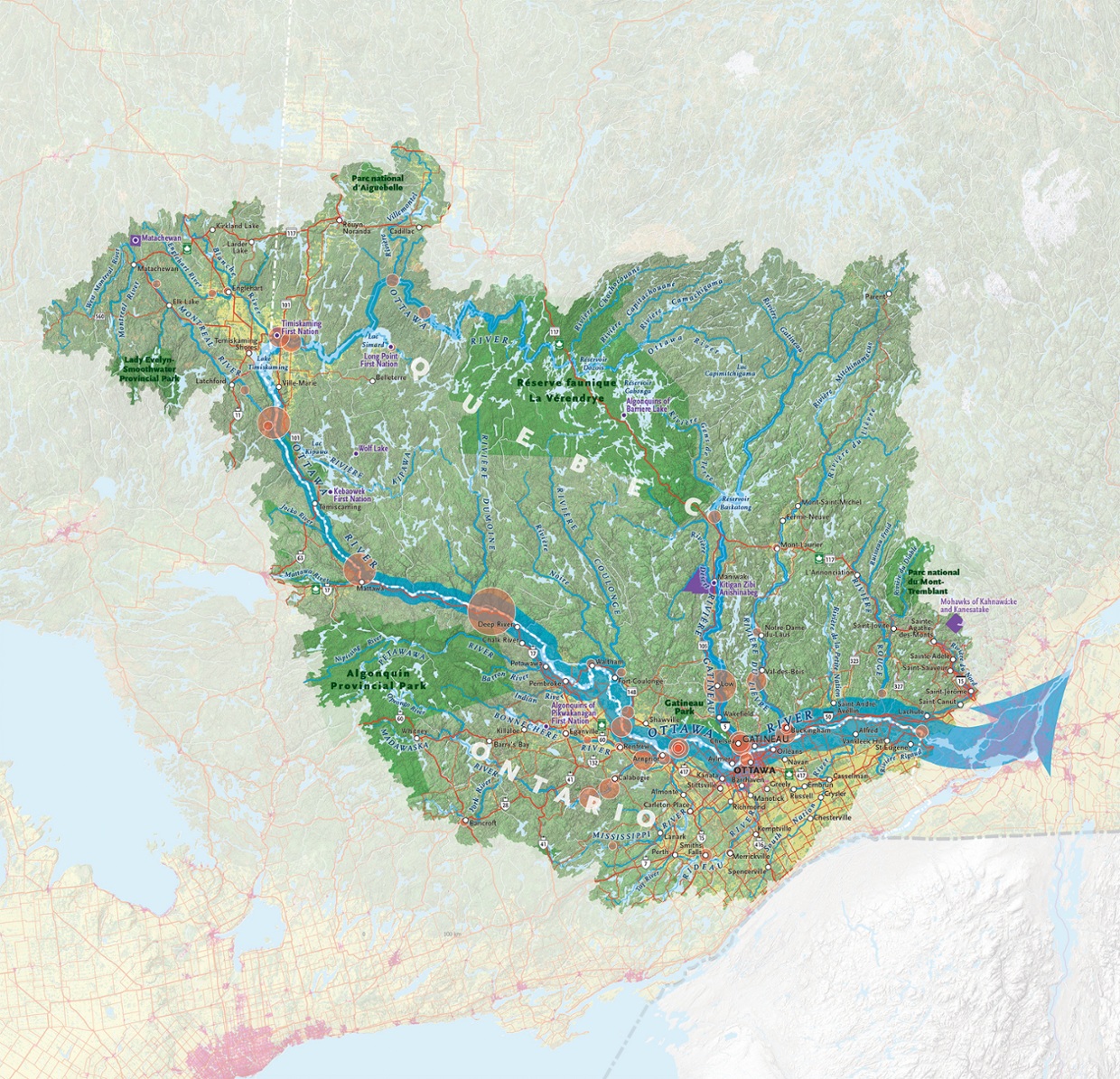 Canadian Geographic map of Ottawa River Watershed.
It is a challenging four day paddle up the Dumoine which rises one hundred vertical feet as falls, chutes and rapids from the mouth to Lac Dumoine. The creation of magnificent Lac Dumoine is as difficult to imagine being done by a retreating glacier, carving out this eighty-one square mile lake as it is to imagine Nenabojo (also known as Wiske’djak the Anishinabe trickster) chasing a giant beaver out of the south end churning up the land and forming the Dumoine River in the process. But both are accepted stories in different cultures. Lac Dumoine (Anishinabe name is Keewagama one of the many accepted spellings) is unique for four long outlets stretching in each cardinal direction and with a river entering or exiting each. It is a natural traffic circle and has served as an important crossroads for trade and travel since the melting glacier filled it.
French explorer, Samuel de Champlain, was one of the first white men to travel the Kichi Sibi in 1613, preceded by his youthful emissaries Étienne Brûlé and Nicholas de Vignau (1611). Some Anishinabe met white men earlier (i.e. Champlain in Tadoussac in 1603) on their travels outside the watershed. Priests often accompanied Champlain and his emissaries, reflecting that their mission to convert Algonquins (and also exploration) was a priority from France. Champlain himself functioned as both an explorer and soldier, representing New France as an ally of the Algonquins and Hurons against the Iroquois.
Prior to contact with the Europeans, the Algonquin economy had centred on trading furs, dried foods, and hand-crafted products, like birch-bark canoes and other practical implements. After contact, the focus on trade changed to European manufactured goods for furs. From 1620-1700 the Iroquois (Haudensaunee) Confederacy attacked the region of the Kichi Sipi because of their desire to influence the beaver fur trade south to their territory. They sent their warriors north to control the Kichi Sibi trade with attacks originating along many of the major portages along the Ottawa River and as far north as the James Bay height of land. It was tributaries like the Dumoine that provided detours north then east to the French trade centres of Montreal and Trois-Rivières for those trying to avoid the Iroquois. Beginning in 1670 (Royal Charter), the new Hudson's Bay Company was attracting Cree and Anishinabe fur traders north to James Bay. In 1686, to protect the business interests of the merchants of New France, Pierre Le Moyne, Chevalier de Troyes d`Iberville, with the assistance of Anishinabe guides, led French Marines from Montreal up the Ottawa River to attack the British posts on James Bay.
The European trade and the Catholic religion influenced the Dumoine family life by the 1600s. Trade brought metal tools, pots, traps, firearms, woollen blankets and clothing, and other luxuries into the family unit. It also brought disease and alcohol. The Black Robes (Recollects, Jesuits, Sulpicians and finally the Oblates) brought Catholicism to the Algonquins. Being a Catholic (approximately half the Anishinabe population converted) required an annual pilgrimage to the Sulpician mission at Oka near Montreal to be properly baptized, married, or buried as a Catholic. However, beginning in the 1830s, the Oblates built mission churches closer to the Dumoine beside Hudson’s Bay Company posts located at Fort William, Fort Témiscamingue and Fort Grand Lac Victoria, resulting in the elimination of this pilgrimage. The route to the mission at Grand Lac Victoria was up the Dumoine from the Kichi Sibi. Oblate priests, guided by Algonquins may have named the river ‘the river the monks travel.’ This was translated onto maps as Rivière du Moine (Hawkins 1836) and later map makers anglicized this to the Dumoine River.
There were temporary trading posts set up at the Dumoine each spring. Starting with trading posts that independent traders set up in the 1700s, followed by the Northwest Company from 1790-1820, and finally the Hudson’s Bay Company, whose trading posts lasted from 1821 to 1840.
Lumberjacks mixed their French, Irish and English accents together to create the unique phrase for travelling to their new workplace “Going Up da Dumun.” Roderick Ryan was the first lumber baron who used the mouth as a base for his operations for travelling upriver circa 1840. He and John Egan lead an invasion of a new type of economy away from furs and at the expense of the Algonquin Dumoine family way of life. The story of Roderick Ryan and John Egan will be shared in Part Two this blog.
Wallace A Schaber
I am not a professional historian or Anishinabe expert. I am a collector of maps, stories, and artifacts about the Dumoine based on fifty years of guiding there by canoe, ski, and foot. Many of these stories are found in my book, Last of the Wild Rivers (2016), which is out of print but available as an e-book online.
Friends of the Dumoine
In 2016, concerned Dumoine guides and travellers formed Friends of Dumoine to keep the rivers portages and campsites clean.
Mission Statement
“To champion conservation of the Dumoine watershed, promote non- mechanized recreation and strengthen knowledge of its natural environment and human history.”
Our major achievement to date is the re-opening and interpretation of the old Anishinabe portages that existed for centuries and linking them to the Dumoine tote road used by the lumber industry beginning in 1840. This hiking trail is now open from the Ottawa River to Grande Chute as a twenty-six kilometre hiking-skiing trail www.sentierdumoine.ca. A visitor centre at Grande Chute complete with historic maps and artifacts is located at the northern gateway.
Please join us on the trail or virtually online to explore Canada's history and protect it. For more information about how to volunteer or donate write This email address is being protected from spambots. You need JavaScript enabled to view it..
Friends of the Dumoine would like to thank our partners in helping to make this project a reality.
CPAWS Ottawa Valley
ZEC Dumoine
Wolf Lake First Nation
References and Further Reading
Fournier, J-L. Anishinabe Place Names for the Dumoine Hiking Trail, confirmed and sanctioned by Wolf Lake First Nation, May 2022. Prepared for Friends of Dumoine Trail Map published 2024.
Morrison, James. “Algonquin History in the Ottawa River Watershed.” Sicani Research & Advisory Services Ottawa, Ontario, Revised 2005.
Frank G. Speck. “Myths and Folklore of the Timiskaming Algonquin and the Timagami Ojibwa.” Canada Department of Mines. Geological Survey, Memoir 71, No 9 Anthropological Series. Ottawa: Government Printing Bureau, (1915):1-3.
Paupers, Peddlers, Purveyors and Parishioners - Ottawa’s Jewish Community
David MartinIn this presentation to the Ottawa Historical Society, historian David C. Martin takes us back to the real beginnings of Ottawa’s Jewish community.
At the core of David’s thesis is the notion that the immigrant pioneers of Ottawa’s Jewish community ‘conserved’ and ‘adapted’ in equal measure, bringing with them the rituals and traditions of their homelands while simultaneously planting their roots in Ottawa prior to the outbreak of World War I.
Beginning with an overview of the city’s demographics during what he calls the “First Golden Age” of Jewish life in the nation’s capital (c. 1880-1914), David then turns to explore a handful of the community’s most influential personalities before examining some of the institutions they helped to build.
In 1881 there were about 20 self-identified Jews living amongst Ottawa’s 21,545 inhabitants, by 1914, that number had risen to almost 3,000. When compared to the number of Jews residing in the country at large however, it’s clear that despite significant growth, Ottawa was still not a major destination for the period’s Jewish immigrants. Both Montreal and Toronto offered these migrants a more established community, where synagogues, kosher food and Yiddish-speakers were far more accessible.
The vast majority of Jewish migrants to Canada during this period were refugees. Most had fled the Czarist Russian Empire following local pogroms. For survivors, at least for those who could manage, immigration became the best means of escape. Most of the era’s Jewish migrants arrived from Europe with very little. In their home countries, especially in Eastern Europe and the Russian Empire, economic opportunity was severely restricted. In fact, The Russian Empire established what it called the Pale of Settlement, where Jews were forced to live – keeping them outside of the major industrial and economic centres of Russia-proper. Professional jobs, including in the civil service, were essentially off-limits as were most educational opportunities.
To survive in the Pale, many Jews scratched out a living as peddlers, which usually involved the retail sale of wares or trade services and the purchase and re-selling of agricultural produce by traveling salesmen of generally humble means. Peddling was the most common occupation of Jews in the Pale – and indeed for Jewish migrants arriving in Canada. One advantage that Ottawa did offer over Montreal or Toronto was the more favourable cost of a peddling licence, and that alone may have inspired several of the period’s earliest Jewish migrants to arrive in our fair city. By 1939, approximately 43% of Ottawa's hawkers and peddlers were of Jewish descent.
With the scene set, David presents short biographies of some of the city’s earliest Jewish pioneers; those that had some of the greatest impacts on population settlement and community-building including Moses Bilsky, John Dover, Archie and Lillian Freiman, the Rev. Jacob Mirsky, and Casper Caplan.
Having familiarized our audience with some of the key players, David looks at some of the institutions that these pioneers, among others, helped to create. Synagogues like Adas Jeshurun (the city’s very first), Agudath Achim and Machzikei Hadas (which continues to thrive) are followed by others of the community’s most vital institutions like the Bank Street Cemetery, the Hebrew Benevolent Society, and the city’s then-incipient Hebrew schools.
This talk offers a comprehensive look at the roots of the Ottawa Jewish community and is surely a valuable resource for anyone interested in the subject.
You can view the full presentation on the Historical Society of Ottawa's YouTube channel.
On the 6 th of April, 2024, the Historical Society of Ottawa in conjunction with the Sunnyside Branch of the Ottawa Public Library was pleased to present the first of a three part lecture series by noted historian, author, columnist and musician, Phil Jenkins. This is the third such series that Phil has given and this one is focussed on four immigrant communities that settled in and helped to build Ottawa. This session covered the contributions of the Irish community along with an introduction to Jewish settlement in the area. Part two will complete the Jewish community and introduce the Chinese community, while the final session will complete the discussion of the role of the Chinese community and then focus on the Italian immigrant community.
Prior to Phil’s session, Ben Weiss of the Historical Society did a Land Acknowledgement, which he used to remind the audience of over 50 attendees that apart from our Indigenous peoples, the rest of us are immigrants or descendants of immigrants. As such, though HSO has had a Speaker Series session on Algonquin Grand Chief Pinesi and that many of our speakers have dealt with the immigrant experience. In February 2024, for example, the Caribbean community was the subject of our presentation Ottawa's Caribbean Community , while in 2021, Indochinese refugees and Project 4000 was discussed.
Phil told us that the Irish emigrated for the same reasons that all choose to leave their homeland, to escape hardship and find a better life. The spur to Irish immigration in the mid 1800 was the famine that struck the island. Canada was a favoured destination, not only because passage was cheap, but because there was a heavy demand in England for lumber, required to build ships for the Napoleonic War, thus there were many ships from Canada that had delivered lumber and were now looking for any cargo for the return trip. The Irish were an available cargo. The trip was hazardous, not only because some 20% failed to reach port, but also because many ships became infected with “Ship’s Fever”, Typhus. In Ottawa, Elisabeth Bruyère and the Grey Nuns treated the sick. HSO held a session on this in 2023 Élisabeth Bruyère in Ottawa-Bytown .
It was the young who risked the voyage and Phil related the story of how grandmothers would hold a skein of wool at the dockside in Liverpool while her grandchild boarded the ship holding onto one end. As the ship sailed away and the wool unspooled, it would be reeled in by the departing family member and eventually made into a scarf. This being the last gift they would ever receive from their family.
Phil went through some of the contributions of some of the early Irish immigrants, such as the navvies, who built the Rideau Canal under the direction of Lieutenant-Colonel John By, himself an Irishman. Perhaps as many as 1,000 workers and members of their families would die primarily due to malaria, the survivors going on to work in the logging industry. Phil highlighted many specific individuals including:
Nicholas Sparks, who became very prosperous through the purchase, sale and sometimes resale of land, as well as by providing loans and then collecting the debts.
Henry Friel, who started the Ottawa police force and was an early owner of “The Packet”, the newspaper that would become The Ottawa Citizen.
Thomas Ahearn was one of Ottawa’s earliest electrical entrepreneurs. He brought the electric streetcar and the first automobile to Ottawa. He is also credited for preparing the first meal fully cooked by electricity in his demonstration at the Windsor Hotel.
Thomas D’Arcy McGee, a noted orator and parliamentarian who was assassinated on Sparks Street. He was allegedly shot by another Irishman, Patrick Whelan, who was later executed for the crime.
Samuel Bingham, who held logging rights on the Gatineau River and drowned in it after clearing a logjam. He is also noted as opening the first city playground for boys.
Many of these individuals served on Council or as Mayor. The impact of the Irish in the late 1800s can be easily seen by the population statistics of the time: 35% Irish, 34% French, 18% English, 11% Scottish and 2% Others.
Phil reminded us that the contributions of the Irish continue to enrich our community, making special note of local author Brian Doyle, whose works were familiar to many in the audience.
Phil concluded his section on the Irish with his guitar and a wonderful rendition of “Cockles and Mussels” (aka “Molly Malone”).
Phil then went on to start his talk about Jewish immigration to Ottawa. Like others, they sought a better life, but in this case many were fleeing political persecution, especially in Russia and the Ukraine. Many settled and opened businesses in the Byward Market. These included small grocery stores, shoe stores, and, in the case of Max Cohen, a Kosher butchery. Four of Max’s sons continued in the meat business, but two decided to go into used furniture and demolition, Cohen & Cohen, becoming famous across the city.
Perhaps Ottawa’s most successful and best known merchant was A. J. Freiman, a Jewish immigrant from Lithuania, who owned and operated Ottawa’s premier department store on the north side of Rideau Street, which is now the site of The Bay. Caplan’s, another Jewish-owned department store, operated for many years just a bit further east on Rideau Street.
Phil commented that most of the “Rag and Bone” men in the city were Jewish immigrants. The rags they collected going into the manufacture of paper, while the bones went to produce glue.
Phil highlighted the contributions of two particular families. Moses Bilsky ran a jewelry store and pawn shop beside the old Union Station. He was a key community organizer, welcoming new Jewish immigrants, finding them lodging and employment. He even donated and personally delivered a 100-pound sack of potatoes to each new family to ensure they had something to get them started. He also brought the first Torah scroll to Ottawa.
The Greenberg family settled outside of Ottawa on the Billings estate, south of the Rideau River where they grew vegetables for the community and eventually opened a feed store. They were also key in welcoming Jewish immigrants, providing employment and supporting Jewish education. Later, one of their number, Lorry Greenberg, would become the first Jewish mayor of Ottawa serving from 1975 to 1978.
We all look forward to next Saturday, April 13, 2024, when Phil will complete his story of the Jewish immigrants and begin his tale of the origins of our Chinese community.
It was just coincidental, though perhaps entirely appropriate, that the presentation on March 23, 2024, at the Main branch of the Ottawa Public Library titled “Ottawa Women on Ice” took place against the backdrop of the World Figure Skating Championships in Montreal and a game between Ottawa and Toronto in the newly-formed Professional Women’s hockey League. James Powell, the speaker that afternoon, told an enthusiastic audience of 44 about Ottawa’s lengthy and often glorious history in women’s hockey and the achievements of two Ottawa women in figure skating—Barbara Ann Scott and Elizabeth Manley. James is a frequent speaker at HSO and community events; runs the blog “Today in Ottawa’s History” and was awarded the Historical Society of Ottawa’s Story Teller award in 2023 for his fine work in telling Ottawa’s history.
Few probably realize that women’s hockey started in Ottawa when Isobel Stanley, the daughter of Lord Stanley, Canada’s Governor General from 1888-1893, strapped on a pair of skates in 1889 and stick-handled around other Rideau Hall women in the first ever women’s hockey game in an outdoor rink at Government House. That same year, Isobel Stanley and other ladies from Rideau Hall triumphed over a team from the Rideau Rink in the first ever women’s hockey game covered by the press. With a vice-regal stamp of respectability helping to alleviate concerns about the appropriateness of women playing hockey, women’s hockey teams multiplied in the Ottawa-Hull area and throughout the Ottawa Valley, this included the “Alphas” of New Edinburgh, the Rideau Rink Ladies, the Vestas of Hull, and the Cliffside Ladies, also known as the “Busy Bees,” who claimed the first city championship when they defeated the Sandy Hill Ladies in 1908. Away games by Ottawa teams to play teams in Smiths Falls and Cornwall were chaperoned to keep the young ladies in line. Long skirts and tam-o-shanters were the uniforms of the day.
Women’s hockey received a major boost with the outbreak of World War I. With the men away, scarce rink time opened up for women. As well, rink owners looked for new ways to rent out the ice and fill seats. In Montreal, a women’s hockey league brought in thousands of fans attracted by the high calibre of the game. Many also came to see the Cornwall Victorias, led by their superstar Albertine Lapensée, also known as the “Miracle Maid” and “Étoile des étoiles”, and the Ottawa Alerts, the formidable team from the Capital. Lapensée was likely the first professional female hockey player.
The origins of the Ottawa Alerts are obscure but the team, captained by Edith Anderson burst onto the scene in 1916. Their most fierce local rivals were the Westboro Pats led by Tena Turner. The two teams fought for the city championship in 1917 with the Alerts prevailing in a two-game, total goal series. The Alerts then defeated the Westerns, Montreal’s hockey champions, to win the Dey Cup.
The Ottawa Alerts joined the Ladies’ Ontario Hockey Association (LOHA) in 1922 when the league formed, bringing together fifteen teams from across the province. Behind their star player, the all-round athlete Shirley Moulds, the team won two consecutive championships in 1923 and 1924. The Alerts went into decline when Moulds moved to the Ottawa Rowing Club as the team’s captain. The “Scullers” defeated the Alerts to take the city championship in 1927, and subsequently won the provincial title, defeating the Toronto Pats.
The Great Depression was the death knell for women’s hockey in Ottawa and in Canada more generally. Both the Alerts and the Scullers disappeared into history as did the LOHA and the Dominion Women’s Amateur Hockey Association, the latter founded in 1933. By the onset of World War II, organized women’s hockey was no more. However, before the end came, the 1930s saw the emergence of the most powerful women’s hockey team of the era—the Preston Rivulettes. During its short career, the team lost only two out of 350 games.
Women’s hockey didn’t re-emerge as a significant sport until the 1970s. However, leading the way in the post-war era was ten-year old Dee Dee Hamilton who stepped into the breach in 1956 when the goalie on her brother’s team, the St. Pat’s, couldn’t play in a game hosted by Ottawa’s Cradle Hockey League. So good was Dee Dee that she played in the 1957 All-Star Game. For two years, she was the only girl amidst 800 boys in the league.
With the establishment of a new professional women’s hockey league at the beginning of 2024 with a team in Ottawa, it is possible that the old “Alerts” name may be revived. In the lead-up to the formation of the league, a number of trademarks were registered for potential names of its clubs. In addition to such monikers as the Toronto Torch and the Montreal Echo was the Ottawa Alert.
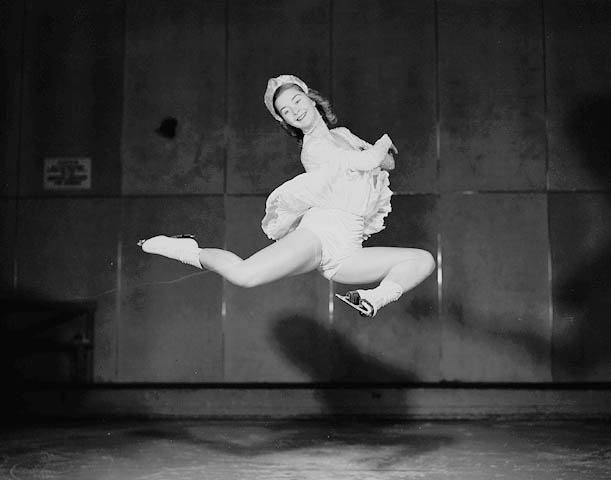 Credit: Frank Royal / National Film Board of Canada / Library and Archives Canada / PA-112691.Switching to figure skating, James traced the career of Canada’s sweetheart, Barbara Ann Scott, from winning the Canadian Junior Figure Skating crown in 1940 to taking the gold medal at the 1948 Winter Olympics held in St. Moritz, France. But it didn’t come easily for Scott. Her success required long hours of practice and hard work, training at the Minto Skating Club, the skating club founded by Lord and Lady Minto in 1903. James showed a short film of her performance at St Moritz which displayed her grace and form as a gold-medal figure skater.
Returning to Ottawa as a national hero after the Olympics, some 70,000 fans met her train at Union Station, where she was personally greeted by Prime Minister Mackenzie King and Ottawa Mayor Stanley Lewis. Schoolchildren were given a half-day holiday. In honour of her victory, Ottawa gave Scott a car with the licence plate 48-U-1. She then started her professional career, ousting Sonja Henning, her arch rival, from the Hollywood Ice Review. In 1950, the most desired Christmas gift was a Barbara Ann Scott doll, complete with white figure skates, costing a steep $5.95.
Scott retired from skating in 1955 when she married Tom King. In 1991, she was appointed to the Order of Canada. Scott passed away in 2012 in Florida at age 84. She bequeathed her sports memorabilia to the City of Ottawa.
James ended his presentation with the career of another daughter of Ottawa, Elizabeth Manley, who won the silver medal at the 1988 Olympics in Calgary. Like Scott forty years earlier, it took years of grit and determination to achieve perfection—and that was what she achieved in her long program in Calgary. Although she came first in that section of the competition, she lost overall by a hair to East Germany’s, Katerina Witt. At the end of a short video of her long program, people in the library auditorium broke out into applause, indicative of the power of Manley’s performance thirty-four years ago. Manley was appointed to the Order of Canada in 1988, and, following her skating career, has devoted considerable time to charity.
In the usual question and answer section that followed, three descendants of Shirley Moulds, the Ottawa Alerts’ star player, identified themselves in the audience. They indicated Moulds had been a very private person who had not talked about her hockey career. Her niece said that it was only after Shirley’s death that she became aware of her prowess as a hockey player. The only thing she knew was that Aunt Shirley was a great bowler! Shirley Moulds’ great-nephew was instrumental in Moulds being named to Ottawa’s Sports Hall of Fame in 2010.
Quick Links
About
Supporting Partners