

Working to preserve Ottawa's past
for future generations.
James Powell takes us back to the early days of the Rideau Canal and Bytown with stories about the Shiners’ War, the Stony Monday Riot, The ByWard Market, Bytown’s first newspaper, Bytown's journey to becoming Canada's capital... and more.
James is the author of the blog Today in Ottawa's History giving a day-by-day account of local history.
The Chaudiere Bridges
One of the most pressing priorities for Lt. Colonel By and his engineering colleagues, was to span a bridge across the Ottawa River in order to transport essential supplies and workers from Wright’s Town urgently needed to begin construction of the Rideau Canal: The Chaudière Bridges, 28 September 1826
The Canal
James shares the story of one of the most remarkable engineering feats of its era – the construction of the Rideau Canal: The Canal, 29 May 1832
The Shiners’ War
For the better part of a decade, lawlessness reigned as Bytown’s citizens were terrorized by violent gangs of thugs known as the “Shiners”, cunningly manipulated by the ruthless and ambitious Peter Aylen, a man willing to fuel religious and linguistic division in his attempt to solidify his own unassailable Ottawa Valley timber empire: The Shiners’ War, 20 October 1835
Ottawa’s First Newspaper
500 copies of Bytown’s first newspaper hit the streets on February 24, 1836. James Powell flips through the pages of that first four-page edition and takes a peek at what its first subscribers would have been reading: Ottawa’s First Newspaper, 24 February 1836
The ByWard Market
James Powell traces the history of Lowertown’s almost two-century old ByWard Market: The Byward Market, 4 November 1838
Corporation of Bytown
John Scott was elected the first mayor of Bytown – twice. Initially incorporated in 1847, with John Scott elected as Bytown’s first mayor, Bytown’s charter was subsequently disallowed following a dispute with the Ordnance Department, the military administration that had become accustomed to being in charge since the days of Lt. Colonel John By. James Powell shares the story of how matters were eventually resolved and how, upon reinstatement of Bytown’s charter, John Scott was, for a second time, elected as Bytown’s first mayor: The Corporation of Bytown, 28 April 1847
Stony Monday Riot
In 1849, the Stony Monday Riot erupted in Lowertown between the Reformists and the Tories. Dozens of injuries and one death resulted when as the (mostly Protestant) Tories, furious over the impending visit of the Governor General, Lord Elgin, clashed with the (largely working-class Catholic) Reformists: Stony Monday Riot, 17 September 1849
Lord Elgin Visits Bytown:
Remarkably, Lord Elgin’s visit in 1853 -- only four years after the Governor General had been forced to cancel his visit following Bytown’s violent Stony Monday Riot -- resulted in Lord Elgin’s recommendation that Bytown to be chosen as the Province of Canada’s new capital: Lord Elgin Visits Bytown, 27 July 1853
Choosing Canada's Capital
Toronto, Kingston, Hamilton, Montreal and Quebec City were among Bytown’s rivals in the intensely-fought contest be chosen as the Province of Canada’s new capital. Bytown even went so far as to change its name to “Ottawa” in hopes of distancing itself from its (well-earned) reputation as a violent and uncivilized backwoods lumber town. James Powell retraces Bytown’s surprising journey to becoming Queen Victoria’s unexpected choice as Canada’s new capital: Queen Victoria Chooses Ottawa, 31 December 1857
Money In Old Bytown
Tucked away in the HSO’s archives, James Powell discovered a small cache of “merchants’ script”, the paper money that would have circulated during the Bytown era. James explores this collection in an article (starting on page 7) in the Fall 2022 issue of the HSO’s Capital Chronicle newsletter.
Ottawa’s Centenary
In celebration of Bytown’s 100th anniversary in 1926, the Ottawa Journal published an article predicting what Ottawa might be like a century later, in 2026. Today, as we mark the 200th anniversary of the founding of Bytown, James Powell takes us back to 1926 for a look at those predictions and at how else our city celebrated our centenary: Ottawa’s Centenary, 16 August 1926
Paul Weber is a bilingual singer-songwriter, guitarist, storyteller and videographer who likes to share Ottawa history in song.
In this 3½ minute video, Paul performs an ode to the workers who toiled on construction of the Rideau Canal, completed in 1832: Three Years on the Rideau Canal.
In this one-minute video, Paul finds remains of a bridge in the Rideau River, and traces that bridge back to first railroad to reach Bytown, the Bytown and Prescott Railway, the first train arriving on Christmas Day, 1854: Rideau River Train Bridge Ruins.
Andrew King is an Ottawa artist and historian and author of the Ottawa Rewind blog.
- Andrew recalls the steamships that once plied the Rideau Canal: The Lost Steamships of The Rideau Canal (May 22, 1832)
- Andrew unearths the Firth Tavern: Ottawa's First Pub (1819)
- Thirsty canal workers? Andrew combs through old maps to track down Bytown’s first brewery: Ottawa First Brewery (1831)
Rick Henderson is the great-great-great-great-grandson of Philemon Wright & Abigail Wyman and author of "Capital Chronicles".
Rick recounts the history of the region in four parts:
- The Curious Cast that Created Canada's Capital
- Bridging the Divide
- Canada's Capital - Set in Stone
- A Capital Route - Canal
Epi(b)logue - The Inglorious End of Two Glorious Men
We are saddened to learn that long-time HSO member and WWII veteran Elsa Lessard has passed away at the age of 103.
A “WREN”, a member of the Women’s Royal Canadian Naval Service, and Bletchley Park “Secret Listener” during WWII, Elsa has been described as a national treasure” by the CBC’s Adrienne Arsenault and by Admiral Topshee, Commander of the Royal Canadian Navy.
Read the Ottawa Citizen obituary.
Listen to a CBC interview with Elsa.
Read more about the story of the WRENs in Bytown Pamphlet #104: Our "Capitol" Wrens.
Read about Ottawa's Bletchley Park in Bytown Pamplhet #100: Canada’s Bletchley Park: The Examination Unit in Ottawa’s Sandy Hill 1941–1945.
On the afternoon of Sunday August 3rd, 2025, a number of members of the Historical Society of Ottawa’s Museum Club, along with several members of the Cumberland Township Historical Society, enjoyed a peaceful stroll through a village magically trapped in the 1920s. This village, the Cumberland Heritage Village Museum, located at 2940 Old Montreal Rd, Cumberland, ON K4C 1G3, features about two dozen buildings placed in a beautiful parkland setting. Unlike many living history museums that place themselves in a pioneer or settler timeframe, the Cumberland Heritage Village Museum represents a rural village set in the 1920s and 1930s, which makes it both oddly familiar and strangely different.
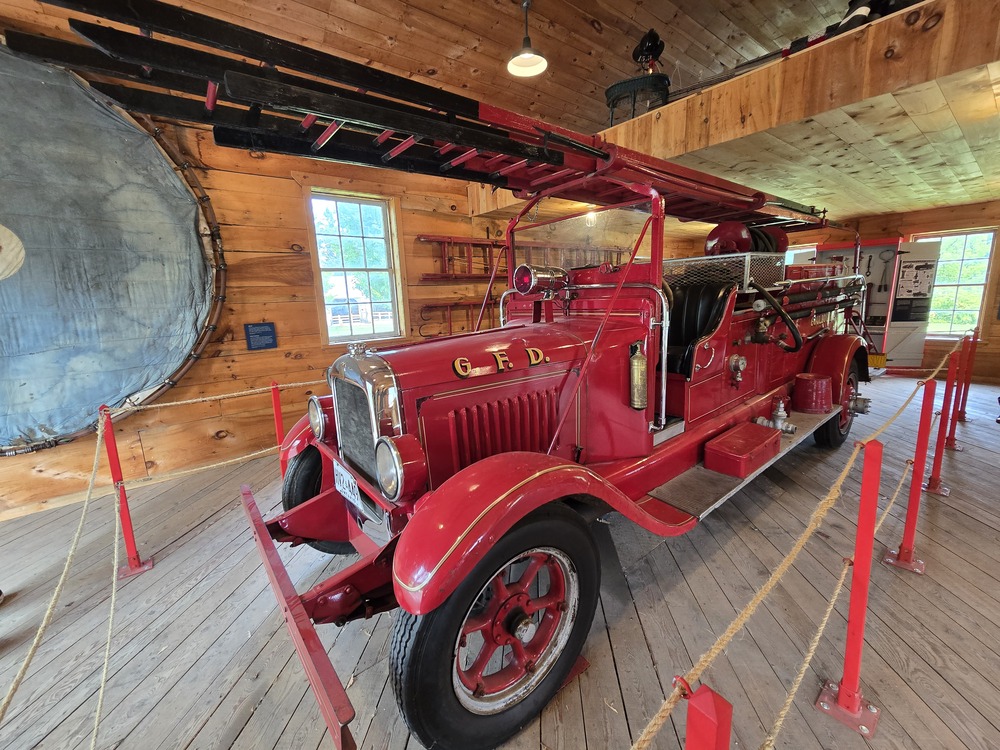 Photo by Justin Lacasse
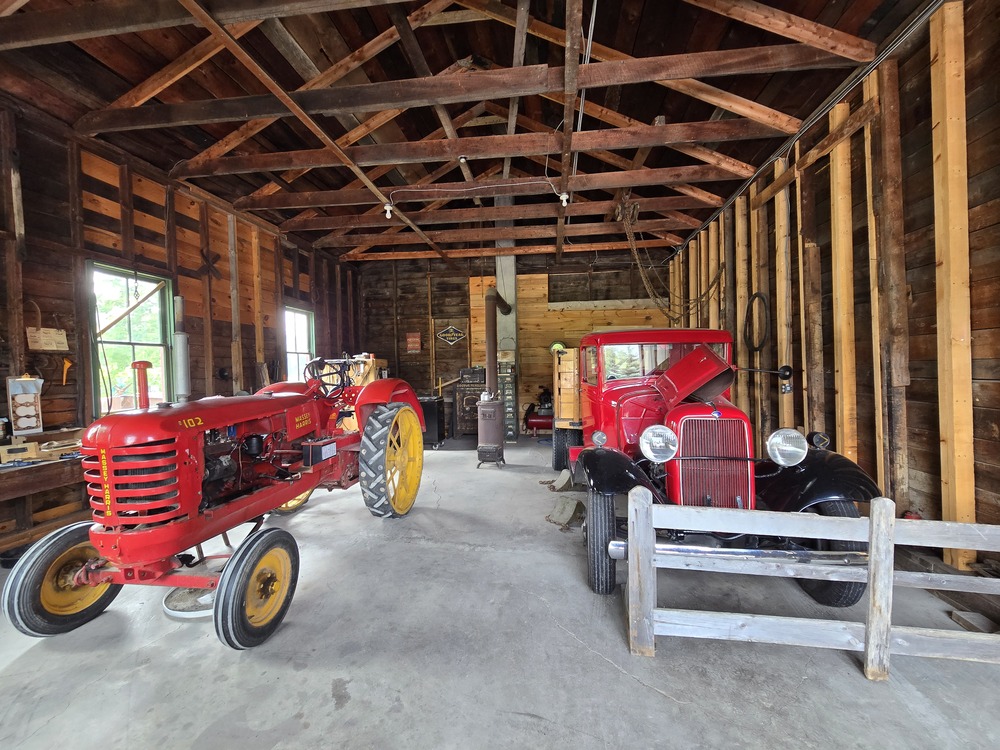 Photo by Justin Lacasse
The museum offers many of the buildings you would expect to find in a village of that era. These include a church, schoolhouse, railway station, general store, blacksmith’s forge, printer’s shop, carpenter’s shop, sawmill, plus a number of houses and other buildings. Of special note, there is an Imperial gas station, complete with visible gas pumps, a Fire Hall with a vintage fire engine and a recreation of Sharkey’s Pump Shed, which was used for the manufacture of hand water pumps and wooden pipes well into the last century. Many of the buildings are original, moved to the site to create the village while others are faithful recreations. Apart from the buildings, the museum features some 19,000 artifacts ranging from a caboose, a mix of vehicles and large agricultural equipment, down to the everyday items of a normal home of the period.
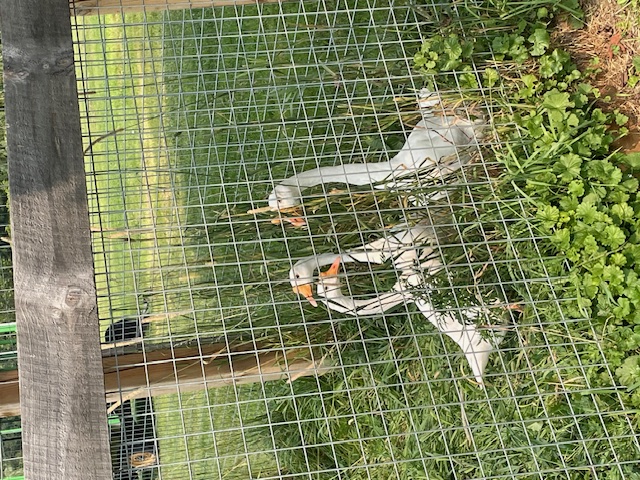 Photo by Lynn McFarlaneWe took advantage of the covered wagon ride that departs from the gas station. This gave us a chance to rest and provided a wonderful overview of the village and its picturesque property. Located at the back of the large property, we discovered the base of operations of the Ottawa Valley Live Steamers and Model Engineers, who provide sessions on selected days over the summer that examines the evolution of rail travel and provides an interactive demonstration of their large-scale model locomotives. Regrettably, our visit was not one of those days, but this is just another reason for a return visit.
One of the great joys of a living history museum is the chance to speak with the costumed interpreters that were at work in and around a number of the buildings. We encountered them as they baked, weeded, and did some repair work; and we had long discussions about their particular tasks and the village in general. From one we learned that all the animals in the museum, chickens, ducks, geese, rabbits, pigs, sheep, cows and horses, are from heritage breeds and that the museum partners with local farms to support the conservation and reproduction of these breeds. The animals are not owned by the museum but spend their summers there, where they add so much to the rural village environment and the visitor experience.
After some three hours of roaming the pleasant pathways, we stopped for a cold drink and an ice cream bar at the canteen, before making our exit through the station, where we bought a few souvenir postcards. It was with regret that we left the quiet world of the 1920s/1930s Cumberland Heritage Village Museum to make our way home through the construction-riddled turmoil of 2025 Ottawa. We all shared one thought, our determination to visit again.
Thursday, July 24th, 2025 dawned sunny and hot as our Museum Club undertook its walking tour of Sandy Hill and its guided tour of Laurier House. In response to the extreme heat predicted for the day, our organizer, Callie Foster, a summer co-op student, and our walking tour lead, Ben Weiss, had arranged to split the group offering a walking tour both before and after the Laurier House tour, so some of our participants could avoid the hottest part of the morning, if they chose to do so. As such, Ben and Callie had to do the walking tour twice in the heat.
Our Parks Canada guide at Laurier House, located at 335 Laurier Avenue East, explained that the house had been built by John Leslie, a prosperous Ottawa jeweler, who moved his family into it in1879. When Wilfred Laurier became Prime Minister in 1896, he needed a suitable place to live in Ottawa, there being no official residence provided by the government at that time. As Laurier was not wealthy, a group of friends came together to purchase the house for $9,500. The Lauriers moved into the house in the fall of 1897 and lived there until their deaths, Wilfred in 1919 and his wife Zoé in 1921. The Lauriers had no children and upon her death Zoé left the house to their friend and then Liberal leader William Lyon Mackenzie King. King was also not a rich man, but again friends stepped forward to pay for the extensive renovations he requested. King moved into the home in January 1923, living there until his death in 1950. He bequeathed the house and most of its contents to the people of Canada and it opened as a museum in 1951.
Our tour of Laurier House, three storeys with lots of stairs, lasted an hour and our guide pointed out many interesting features of the house and kept us all entertained with stories about the Lauriers and King. Laurier House is free to visit, though there is a charge for the guided tour, which I believe is well worth it. They also serve a High Tea and there is a small gift shop in the Visitor’s Centre around the corner on Chapel Street.
The walking tour, led by Ben Weiss, lasted about 1.5 hours and went east along Laurier Avenue East to Charlotte Street, then back along Daly Avenue and on to Wilbrod Street, to Laurier Avenue again and return to Laurier House, though we did veer off a few times to look at specific structures and learn of their historic significance. Due to its proximity to the centre of government and commerce, Sandy Hill became the community of choice for the political and business elite of early Ottawa. It remains a favoured location for embassies and official residences, many of which Ben pointed out as we walked along. This included the Russian embassy at 285 Charlotte Street, where we encountered a small demonstration in support of Ukraine. Ben quickly related the story of the Soviet defector Igor Gouzenko, which in September 1945 started the Cold War, and the fire that destroyed the original building in January 1956 with a delay in fighting the fire caused by the Soviet officials who refused entry to the burning building by the Ottawa Fire Department.
Apart from Laurier and King, a number of other Prime Ministers lived or grew up in Sandy Hill. We passed by houses or apartments which had been lived in by John A. MacDonald, Charles Tupper, Lester Pearson and John Diefenbaker. Two leaders of the New Democratic Party also lived in Sandy Hill, Tommy Douglas and Ed Broadbent. Ben pointed out the former homes of many other famous Canadians including Sandford Fleming, Billy Bishop, Dan Aykroyd, Archibald Lampman, and many many others.
We relaxed in the shade at Strathcona Park, that Ben explained had been through a long transition from swamp, to cow pasture to rifle range and golf course and finally to an extravagant park, since scaled down.
Though Ben did his best to point out many of the significant buildings and tell their stories and those of their generations of occupants, the history of Sandy Hill is so rich that a single walking tour can do little more than scratch its surface. Fortunately, Ben has agreed to return in the summer of 2026 to lead a Sandy Hill Walking Tour Part 2.
Given rising international tensions, sixteen members of the Historical Society of Ottawa’s Museum Club sought shelter in the Diefenbunker, Canada’s Cold War Museum, on the afternoon of Sunday, June 29th, 2025. Our guide informed us that the facility had been commissioned by Prime Minister John Diefenbaker in 1959, though he never visited it, and that it became fully operational in 1962. Designed to protect 535 senior government and military officials, all men, it could survive a blast from a 5-megaton atomic bomb at a distance of 1.8 km. A full-scale model of a “Fat Man” style bomb is displayed in the blast tunnel and is one of the first artifacts we saw.
Our guide took us first through the decontamination room, though we were not asked to strip, (probably a good thing for all concerned), before heading to check out the medical centre, where the “modern” equipment included an X-ray machine. She pointed out the irony of voluntarily being exposed to radiation given the expected circumstances.
Our guided tour, which lasted an hour or so, led us through many of the rooms of the four storey underground shelter that reaches some 75 feet below ground level. She explained that our country’s leaders, but not any family members, would shelter here, with provisions for 30 days, should there have been an attack. Fortunately, the attack never came, though the bunker remained an active military base, as a communications centre, until 1994. During all its active service it was only visited by a Prime Minister on one occasion, in 1976, when Pierre Trudeau visited. Our guide did point out that Justin Trudeau had come to the Diefenbunker, to partake in their popular Escape Room activity.
Upon decommissioning as a military base, the facility was sold to local investors. Some thought was given to turning it into a giant mushroom farm, while another idea would have had the facility flooded as a site for scuba diving adventures. Fortunately for all Canadians it has been preserved as a museum, though it is privately funded without government support.
For those assigned to the bunker, living underground became a challenge in more ways than one. It became a literal challenge to see who could remain underground the longest, the “winner” staying inside for some 11 months. Smoking was, of course, permitted, as attested to by the ceiling tiles of the cafeteria, and eventually the base personnel had to be ordered out for regular exposure to the sun and fresh air.
Our guide took us to the Women’s quarters, implemented in the 1970s as society and the military changed. She pointed out that the cramped sleeping quarters were painted blue, the men’s being painted in yellow, so no man could claim a “mistake” in wandering into the wrong sleeping quarters. The women’s quarters could only accommodate just over 100, so there was integration though not equality.
Following our formal tour, which ended in the vault at the very bottom of the bunker, where Canada would have kept its gold reserves, and the personnel kept their supply of beer, we were invited to continue to explore the Diefenbunker on our own. There were many interesting displays and exhibits, especially on the 1st floor, and this also gave us a chance to investigate further some of the rooms we had been introduced to on the tour. As we exited the Diefenbunker, some of us took the opportunity to take the trail that leads up and onto the top of the bunker, where we discovered a number of interesting features and plaques containing valuable facts. The top of the bunker also treated us to a fabulous view of the surrounding countryside.
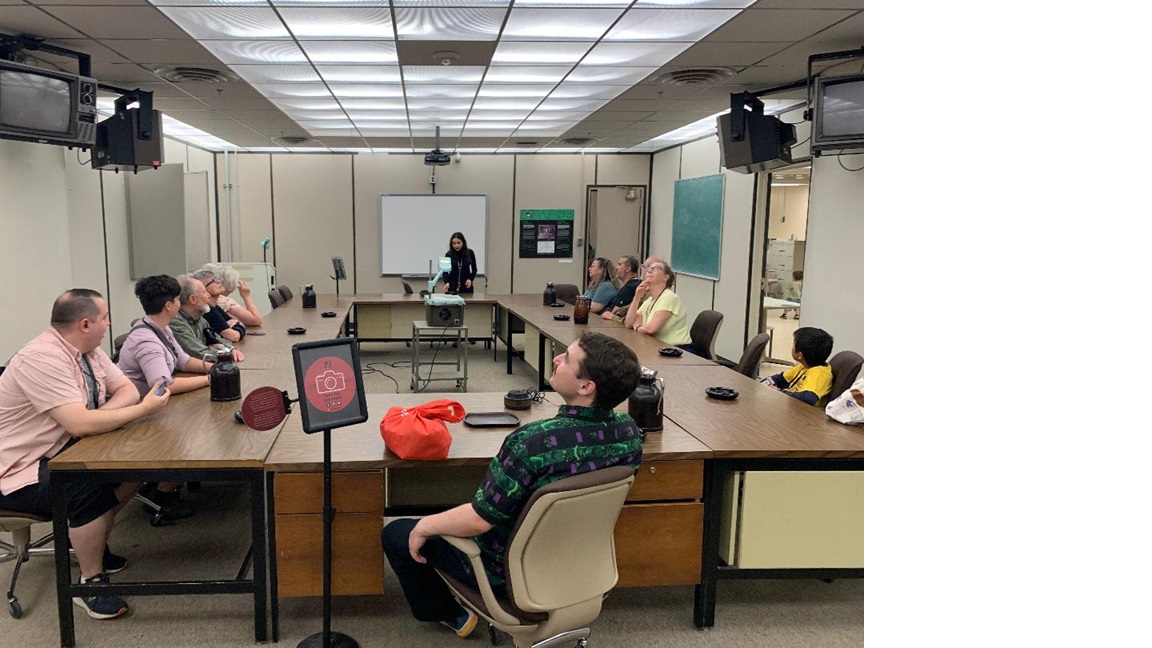 HSO members serve as Canada's War Cabinet. Photo by Doug MacKinnon.
The Diefenbunker is located at 3929 Carp Rd, Ottawa, ON K0A 1L0, and has plenty of free parking. Its website, (just Google Diefenbunker), carries a lot of additional information and video tours.
Sundaes, Milkshakes & Sodas, Oh My! Remembering the Westgate Milk Bar
HSO BlogFollowing World War Two, the suburban shopping centre embodied consumerism of the period. Designed to accommodate the whole family, shopping centres expressed the post-war notion of the “good life,” whereby all manner of goods and services were offered in a relaxed, informal, and pleasant atmosphere. [1]
When the Westgate shopping centre opened in May 1955, this kind of shopping experience was offered to the residents of Ottawa’s west-end, complete with modern stores, enjoyable music and ample parking to accommodate increasing automobile ownership. Amongst the offerings at Westgate were Freiman’s Department Store, Steinberg's Supermarket, and Tip Top Tailors.
Westgate was also home the popular refreshment spot, The Milk Bar. Described by The Ottawa Journal as “completely modern in every respect,” the shop was noted for its large plate glass windows, soft green walls, white enamelled woodwork, matching green and white tile floors, stainless steel appliances, and red leather and chrome stools. [2]
First managed by Myrtle MacDonald of Clark’s Dairy, the dairy bar offered everything from butter, eggs, and sour cream to take-home containers of ice cream.
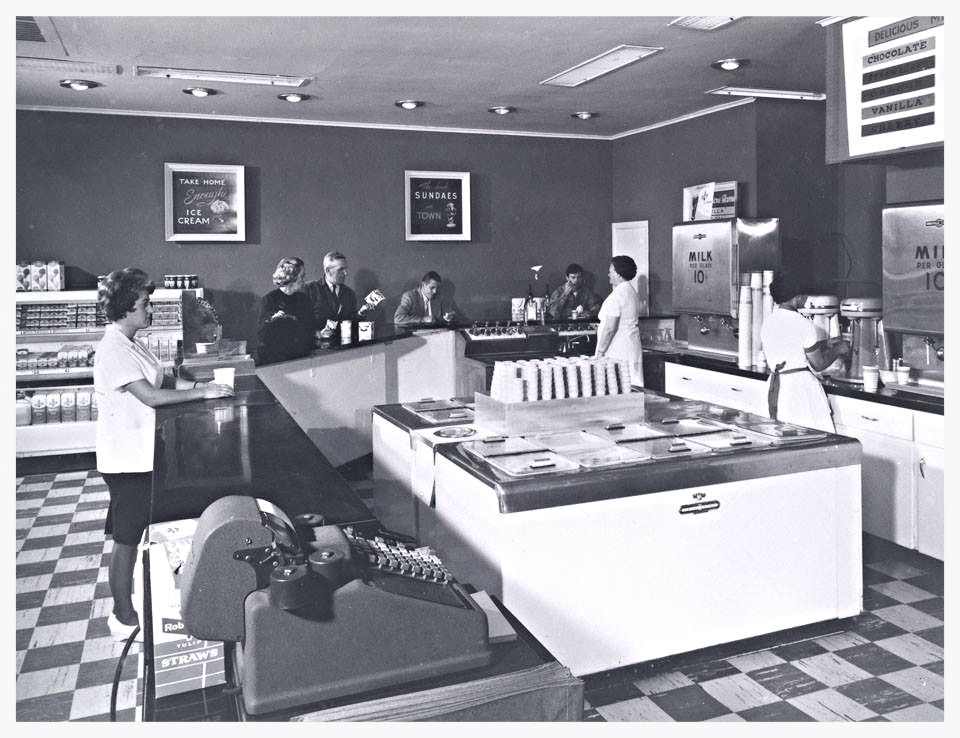 [Fig.2] Clark's Dairy Bar at Westgate Shopping Centre (1958) – Ross Dunn/Wikimedia Commons.
At the serving counter, patrons could indulge their sweet tooth with a menu featuring ten ice cream flavours (including Cherry, Peacan and Butter Scotch Ripple) and the option of ice cream cones, sundaes, milkshakes, and sodas.
Capturing that family friendly suburban feeling, advertisements urged shoppers to “bring the children in for the best ice cream cone in town” or stop by when out for a Sunday drive. [3]
On the first anniversary of their opening, the shop “proudly boast[ed] a never-ending flow of customers…that kept them on the hop.” [4] By 1965, the milk bar remained as popular as ever, with an average of 3,000 cones served on an average summer day. [5] In the following decade, however, this familiar favorite among shoppers found itself amid a changing suburban landscape and shifting consumer preferences.
A significant change came in 1972 when Freiman’s Department Store left Westgate, leaving the shopping centre without an anchor department store. In February 1978, it was announced that renovations were set to begin at Westgate to give it a warm appearance. These renovations included enclosing the shopping centre and landscaping, as well as the addition of new stores, such as Shoppers Drug Mart, and the closing of others including The Milk Bar. [6] Once considered “one of the shopping centre’s most striking assets,” following the renovations, it was no longer a part of the newly modernized Westgate shopping experience.
[1]. “Shopping in the modern Manner,”The Ottawa Citizen,October 28, 1955, 32, https://www.newspapers.com/image/456862544/.
[2]. “Ice Cream, Dairy Products Featured at New Milk Bar,” The Ottawa Journal, May 11, 1955, 66, https://www.newspapers.com/image/48461164/; “Refreshment At Milk Bar,”The Ottawa Citizen,May 11, 1955, 83, https://www.newspapers.com/image/456812781/.
[3]. The Westgate Shopping Centre Milk Bar, "The Milk Bar," advertisement, The Ottawa Citizen, May 11, 1955, 74, https://www.newspapers.com/image/456812710/; The Milk Bar, “For That Sunday Drive,” advertisement, The Ottawa Journal, August 6, 1955, 7, https://www.newspapers.com/image/48613348/.
[4]. “The Milk Bar is Busy One,” The Ottawa Journal,May 15, 1956, 50, https://www.newspapers.com/image/48813856/.
[5] “Milk Bar Celebrates Tenth Anniversary,” The Ottawa Journal,May 4, 1965, 22, https://www.newspapers.com/image/44453595/.
[6]. “Westgate undergoes face-lift,” The Ottawa Citizen,February 14, 1978, 4, https://www.newspapers.com/image/460266819/; “City’s first shopping centre to shed ‘tackey image,” The Ottawa Citizen, June 10, 1978, 29, https://www.newspapers.com/image/460314724/.
Time Travelling with Jean-Marie Guerrier "Black History in Ottawa Streets"
Enjoy this episode of the HSO/Rogers TV series Time Travelling with Jean-Marie Guerrier.
Media
Quick Links
About
Supporting Partners