

Working to preserve Ottawa's past
for future generations.
Historian and documentary filmmaker Allison Margot Smith, winner of the Ontario Historical Society’s President’s Awards for her fascinating documentary films, shares four of her short films reflecting back on the history of the Rideau Canal:
“Taverns and Their Keepers”
During the early settlement of the area that becomes the Township of Rideau Lakes, travel is difficult and people depend on taverns for shelter, as they travel through the wilderness. Taverns are also important gathering places for local community members. But, as sites with significant drinking, taverns often experience violence, giving rise to the Temperance Movement and then Prohibition.
https://www.youtube.com/watch?v=QT4TJkRSfaY
“The Rideau Canal: The Big Breakthrough”
The construction of the Rideau Canal cost a great deal, not only in terms of money, but also in lives and time. Colonel John By's use of the slackwater design helped reduce these costs and saved lives - the Big Breakthrough.
https://www.youtube.com/watch?v=1Rs4KbKqI2M
“Fettercain: WWI on Indian Lake”
On Indian Lake, just north of Chaffeys Lock, in the Township of Rideau Lakes, is an island that came to have a hospital for returning soldiers from WWI -- The Great War. These soldiers suffered from PTSD, which at the time was called Shell Shock. Called Fettercairn, the hospital was established in the family cottage owned Agnes Etherington (nee Richardson).
https://www.youtube.com/watch?v=si6BFrsusG0
“Vacations in 19th- and 20th-Century Portland and the Rideau Lakes”
During a period of industrialization in the mid-19th century, Canadians began to move off the farm and into larger towns and cities. But this urbanization made city-dwellers long for nature and the wilderness experience. And with spare time, a bit of money and better transportation options, vacations became a possibility for the urban middle class. This film looks at the emergence of the concept of the middle class vacation in the late 19th and early 20th centuries, and the significance to Portland and Big Rideau Lake. Portland made the transition from being a commercial centre to a hopping hub of recreation. This seamless transition, and the popularization of owner-operated motorboats, undoubtedly played a significant role in the continued use and preservation of the Rideau Canal.
https://www.youtube.com/watch?v=nS8zbYRDREM
Join us for our March 28, 2026 Speaker Series presentation when Allison will share a brand new film on the history of the Rideau Canal, produced specially for the 2026 HSO Bytown200 Bicentennial Storytelling Challenge: https://www.historicalsocietyottawa.ca/activities/events/eventdetail/184/-/the-rideau-canal
Visit Rideaulakes.ca to view more of Allison’s award-winning films.
Historian Michael McBane, author of Bytown 1847: Élisabeth Bruyère & the Irish Famine Refugees, re-tells this important story for the "Time Travelling with the Historical Society of Ottawa" HSO/Rogers TV series: https://www.historicalsocietyottawa.ca/resources/videos/time-travelling-with-michael-mcbane-bytown-1847
Michael is also author of John Egan: Pine & Politics in the Ottawa Valley.
Much of our nation’s capital today sits specifically on the (unceded) traditional land of Grand Chief Pierre Louis Pinesi and his family.
Jim Stone, a non-Indigenous historian, researched the story of Chief Pinesi in consultation with members of the Algonquins of Pikwakanagan First Nation, where many of Chief Pinesi’s descendants live.
Here is link to the HSO Speaker Series presentation in which Jim spoke about the life and legacy of Chief Pinesi, with introduction and Q&A by Pikwakanagan Band Councillor Merv Sarazin: https://www.historicalsocietyottawa.ca/publications/past-presentations/chief-pinesi-and-his-pursuit-of-justice
In addition, Jim has written a paper about Chief Pinesi presented here: https://kichisibiancienttrails.ca/grand-chief-constant-pinesi/
Alastair Sweeny, PhD, has written extensively about Thomas Mackay, including his 2022 book “Thomas Mackay: The Laird of Rideau Hall and the Founding of Ottawa”.
Other books authored by Alastair Sweeny include George-Étienne Cartier: A Biography, BlackBerry Planet, and Fire Along the Frontier: Great Battles of the War of 1812. Alastair is based in Ottawa and is a member of the Historical Society of Ottawa.
More on the story of the New Edinburgh Shintie Club medallions can be read in the excellent book “Win, Tie, or Wrangle: The Inside Story of the Old Ottawa Senators 1883-1935” by the late Paul Kitchen.
Scottish Shinty
Shinty (or shintie) is unique to Scotland and is regarded as the Scottish national sport. The game was supposedly introduced from Ireland 2000 years ago, along with Christianity, and was often played clan against clan.
Shinty is played with a cork ball covered in leather, that is slightly smaller than a tennis ball. Shinty sticks or camans were formerly similar to modern hockey sticks and are commonly confused by the same.
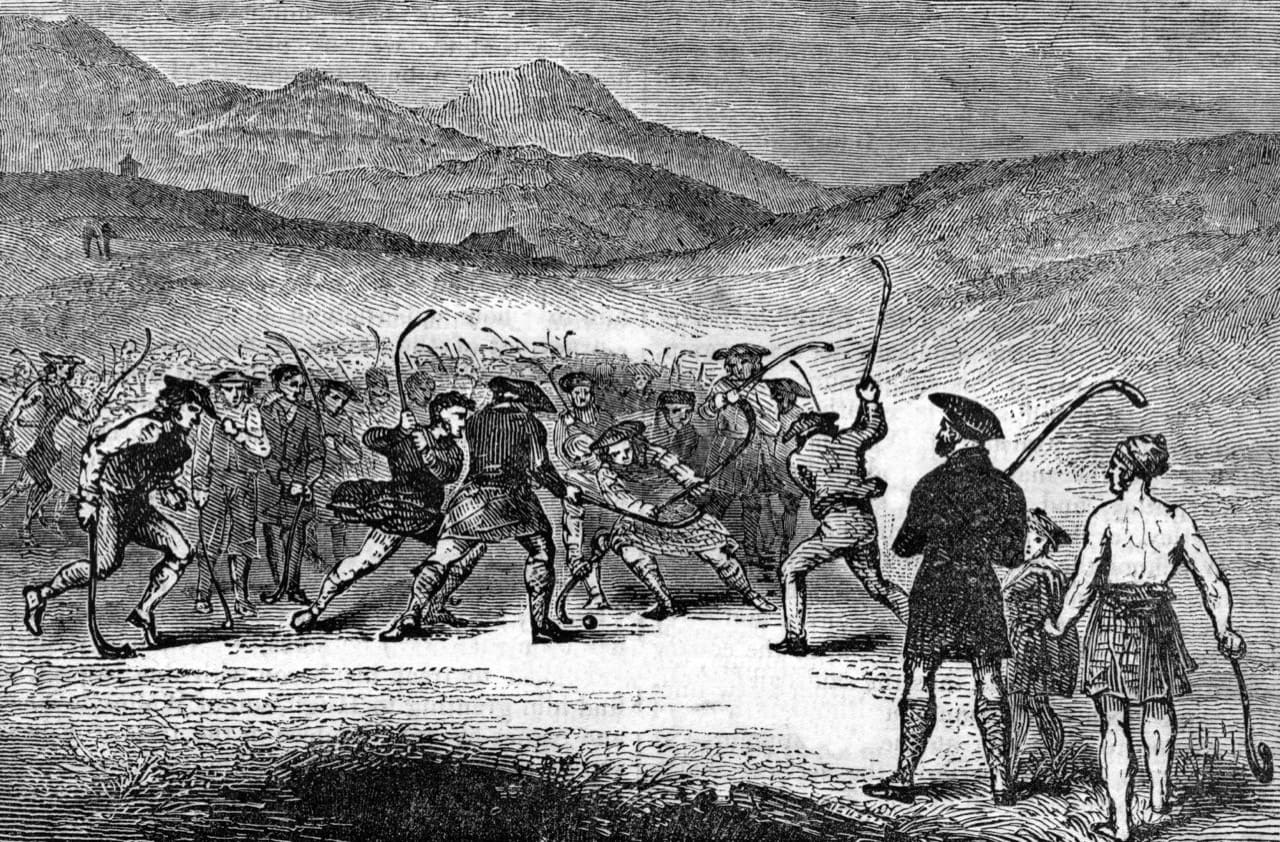 Shinty in the Highlands with Camans
The earliest reference to shinty – or camanachd, prounounced ca-man-achd in Gaelic – comes from a Scottish text written on 1608:
A vehement frost continued from Martinmas [November 11] till the 20th of February. The sea froze so far as it ebbed, and many people went into ships upon ice and played at the chamiare [shinty] a mile within the sea mark. Many crossed over the Firth of Forth on the ice a mile above Alloa and Airth, to the great admiration of aged men, who had never seen the like in their days.
The keenness and duration of this frost was marked by the rare occurrence of a complete freezing of the Thames at London, where accordingly a fair was held upon the ice. In Scotland, rivers and springs were stopped; the young trees were killed, and birds and beasts perished in great numbers. Men, travelling on their affairs, suffered numbness and lassitude to a desperate degree. Their very joints were frozen; and unless they could readily reach shelter, their danger was very great. In the following spring, the fruit-trees shewed less growth than usual; and in many places the want of singing-birds was remarked.
The cold was caused by the eruption of the Peruvian volcano, Huaynaputina, which sent over 12 cubic miles of rock and ash into the atmosphere. This caused catastrophic weather events for a decade, including a Russian famine that killed two million.
Ice hockey evolved from Shinty after Highlanders and Scottish soldiers settled in Canada and took to playing shinty on ice for lack of a grass field in winter. Informal ice-hockey games in Canada are still referred to as shinny games.
In 1809, we find one of the very first documented mentions of a ball and stick game being played on the ice by skaters, in Perth, Scotland.
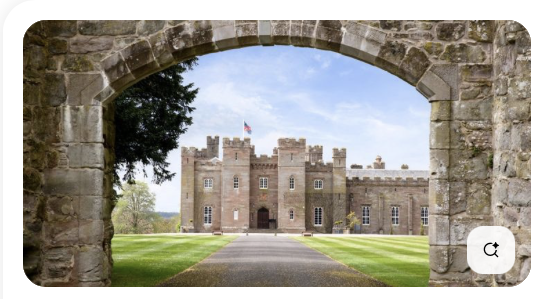 Scone Abbey
Close to Perth is Scone Abbey, where the Kings of Scotland were traditionally crowned for hundreds of years. From the 9th to the 15th Century, Perth was effectively the capital of Scotland. It was a primary residence for monarchs, and it was where the Royal Court was held. Royalty enhanced the early importance of Perth, and Royal burgh status was given to the city by King William the Lion, in the early 12th century.
In 1836, Scottish historian George Penny published Traditions of Perth, a collection of town anecdotes. One of his entries mentions games of shintie being played on Inch Island in the Tay River that runs through the town. Shintie – aka “shinty” – was an old Scottish form of field hockey or bandy, played with a ball and a caman - a shintie stick curved at one end, similar to a field hockey stick. Penny relates that Perth boys also played an ice version on skates:
The Shinty or Club used to be played in all weathers on the Inch; and frequently on the streets, by large assemblies of stout apprentices and boys. This game was also played on the ice by large parties, particularly by skaters, when there was usually a keen contest.
This explicit reference to skates is absent from the 1607-08 and 1740 references to games played on the ice.
It’s highly probable that one passionate player of the game was a seventeen year old Perth lad, Thomas Mackay, apprenticed to his father as a mason. After his father’s death at age 50, Thomas and his wife and mother emigrated to Canada, where he found plentiful masonry work in Montreal. In 1815 he won a contract to build the Lachine Canal, and in 1825, on the recommendation of Governor Lord Dalhousie, the Royal Engineers engaged him to build the Rideau Canal entry locks. In the 1840s, next to the Rideau Falls, he built a mill complex and village he called New Edinburgh, and a villa his daughter named Rideau Hall.
Mackay never forgot the game of his youth, and encouraged his friends and mill workers to take time out for winter play on the frozen Rideau River. On Christmas Day, 1852, Mackay, then age 60, hosted an ice shintie match between the New Edinburgh Scots against the Bytown Sassenachs (Englishmen). The Scots won 2-1 and the Laird of Rideau Hall awarded the Shintie Club winners this silver medal, now in the Bytown Museum in Ottawa.
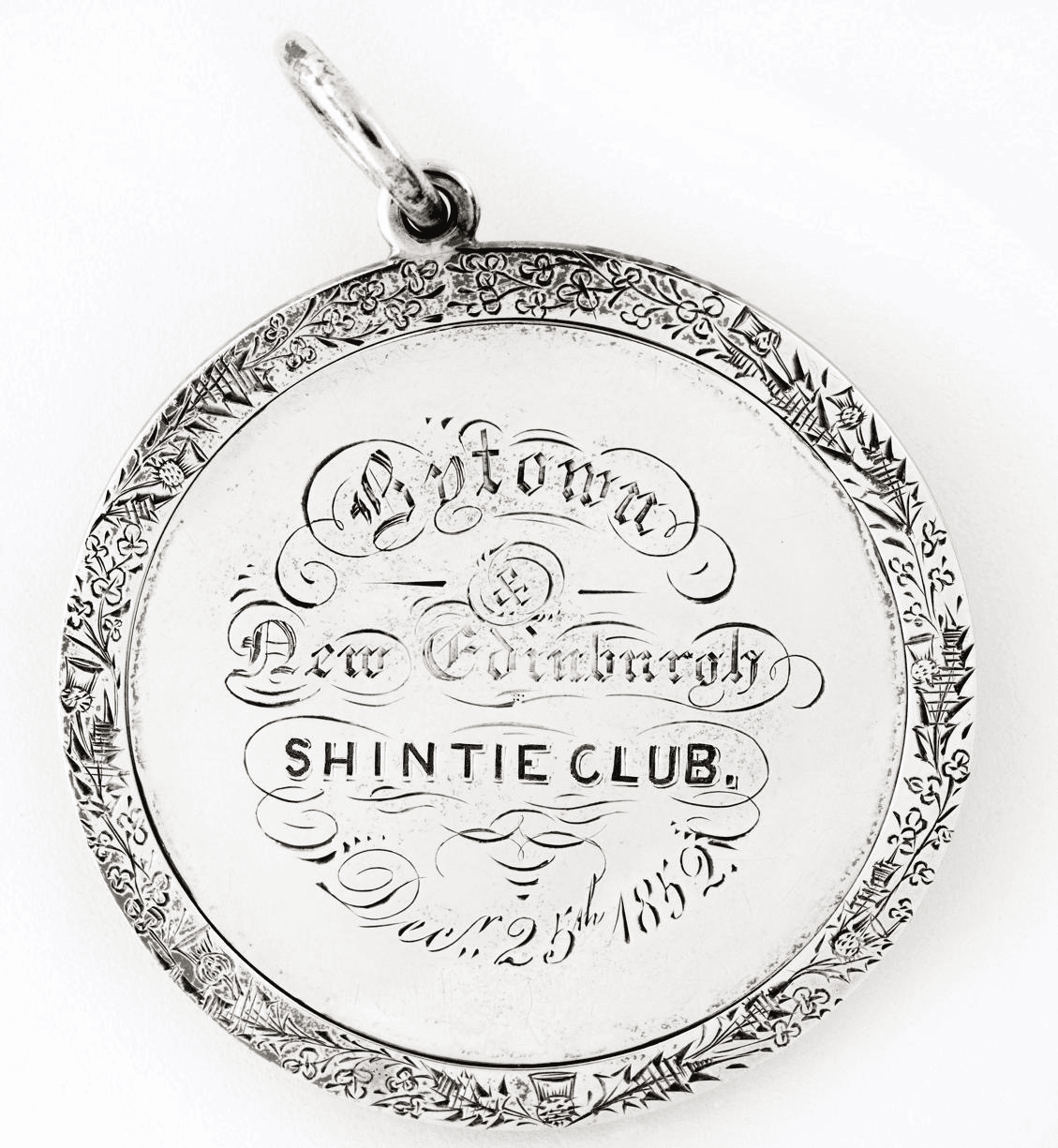 Mackay’s Silver Shintie Medal, 1852 @Bytown Museum
Curtis Wolfe researches local history and heritage and his writings have been featured in Lowertown’s Community Newspaper The Echo.
Curtis uncovers the history of a local street: What’s in a name? Uncovering the namesake of Tormey Street.
John Morrison lived in Manotick from 1994 to 2005 where he spent many happy hours paddling the area waterways and viewed the river and the canal as his own little piece of heaven on earth.
The Rideau Canal
A curtain does fall, so majestic and proud
Such a natural wonder, so gracious a shroud
Like a powerful train of glory descends
As a continuous fall at the Outaouais end
A fire alights from the south it did spread
To the north like a plague through the heart it has bled
With a mawkish like cry for freedom and joy
But freedom’s best chance was a fraudulent ploy
From a flicker of flame to a firestorm bred
Death escalates through a life cycle of dread
And taming this shrew with its penchant for blood
Was a foolish man’s bait for poor Madison’s club
Yet a fire would spread in a harrowing scene
From a spark it would roar with a devilish scream
From Niagara, on east, to a Forty Mile Creek
To a nondescript farm and a Chateauguay sneak
From Queenstown to Lundy, Detroit and the Thames
The Boxer and Enterprise, surrender of Maine
Through Ohio and Plattsburg, to a Moravian town
The war it did rage for Miss Liberty’s crown
Cities would fall and the towns they would burn
First Newark then York; it was Washington’s turn
War’s firebrand eyes thrust farther to yield
And finally burn in an Orleans field
What came but a draw in this foolish man’s quest?
For power and glory are such meaningless guests
Whatever the gain from the lives that were lost
For the hawkish bent men who lied at great cost
And the curtain still fell, so majestic and proud
As if sensing the chaos, so soothing its sound
Like the rapturous strains of a torrent, transcends
To emerge as a call at the Outaouais end.
***
The years fell away, and the anger did wane
Rush-Baggot had calmed such a petulant strain
An American age brought prosperity’s peace
As a confidant pace of change was unleashed
But the land to the north so upright and proud
Was paranoid still to the south’s freedom sound
A country that cried for security’s calm
Yet stands all alone ‘against a threatening psalm
But this land full of lakes and rivers and streams
Was a natural course for a military dream
For fear set in stride a magnificent quest
To build a canal that was strategically blessed
While the mighty St Laurence was a natural draw
It was fraught with real danger from its rapid rock falls
And upstream it ran with a thunderous roar
Too close to the south with its threatening core
The Ottawa ran to St Laurence’s call
To strike from the north and a western landfall
An historical route that opened the west
Where the traders would meet at the curtain for rest
Two rivers did run from a common high ground
To the south and the north from Lake Rideau their sound
From the shallows and falls through the marshes and swamps
From King’s town to Wright’s town, two rivers as one
To build a canal through this wilderness screams
Of a madness and curse of the military’s dream
A task so immense, so daunting and brash
That only the British could fathom this task
But the British did find a man of the Corp
A Wellington man from the Peninsular War
A man who had held the Canadian Shield
So right for this task with indefatigable zeal
John By was a Colonel and a leader of men
Ahead of his time and a genius, well bred
An engineer’s man with a passionate streak
For simplicity’s beauty with its functional tweaks
With orders to build a navigable path
From the Outaouais south to Ontario’s wrath
To rise from a bay named the Entrance - way crept
Up flight after flight, like some nautical steps
A plan was developed and contracts were signed
Engineering so simple with symmetrical lines
Pure genius at work with a heavenly hand
To guide and instruct a magnanimous man
With Drummond and Redpath, Phillips, MacKay
Canadian contractors, strong men of their day
These artists of stone were men of their word
So forthright and loyal to the Colonel’s accord
The sappers and miners and mason’s stones lay
Stonecutters and woodmen, all of the trades
For comfort, their spirit; their love of the crown
Romantic and colourful, these men of the realm
But the marvelous work that was soon to unfold
Was dependent upon the poor labourer’s code
The back wrenching work to clear out the land
And dig such a ditch with just spades in their hands
Such men from hard times, forever were cursed
To fight for survival and work through their thirst
Through backbreaking strains as their calloused hands scream
As they toiled and they toiled for this military dream
The Frenchmen held sway with their skill and savvy
So noble these men and their role as navvies
Independence of mind with a will to succeed
Just pride in their work and their songs and their deeds
But an Irishman’s fate to arrive at this place
To rescue one’s life from some wretched like fate
The scourge of the earth in the Englishman’s eye
Forgotten at home, they severed all ties
For a pestilence spread to drive them afar
From an emerald isle to this devil’s back yard
Though beauty may rest on the eye from beyond
A hellish nightmare was reality’s song
Just rags on their backs with their wives by their side
With children so weak from starvation and pride
A thousand would fall from a dengue-ish like hue
And die from this work’s laborious flu
Poor brothers would cry as their graves had been marked
So blind to the danger and the peril from sparks
As the powder was set with a magical link
Their lives were extinguished from the death blast’s cruel drink
Yet the lakes and the streams, swift water, rock falls
Were captured and tamed by this engineer’s call
Magnificent feats what By had achieved
In this harsh, hellish wilderness, was hard to conceive
The entrance way blessed by a protestant prayer
The first stone was set by John Franklin with care
Not mindful as yet that his greatness was cast
To die in the Arctic from an arctic cold blast
The curse of Hog’s Back; an Isthmus scourge
The tranquility of Chaffey’s; Long Island was purged
At Burritt’s and Black, these rapids were tamed
And Merrickville’s beauty, a religious refrain
With names like Poonamalie, with its cedar incense
An Indian aura in a wilderness sense
Opinicon’s names and a Cranberry fog
The curse of the labourer to die in this bog
The dam at the falls known locally as Jones
Is a testament still to its magnificent stone
Block upon block in a crescent like stance
Like a rampart of genius or an engineer’s dance
The work underway, six years to progress
The locks were completed, and the dams were well dressed
Through steamy hot summers, through sweat and death’s fear
Through winter’s ice jams; hell’s nightmare those years
The locks and the dams, wastewater and weirs
The cut at the entrance, eight steps to the piers
The breadth of this work remains unfathomable, sealed
As a masterpiece set in the Canadian Shield.
***
The threat from the south was all but contained
For the status quo boundary was all that was gained
From the firestorm set in those years long ago
Extinguished for good as a friendship would grow
Poor tragedy’s mark on this cornerstone lay
On the heart of a man who held the Rideau at bay
Called back by a King who questioned his deed
A question of funds from some zealot to heed
An inquiry would set the tone through the years
To diminish By’s feats; he was ignored by his peers
His spirit would die from his countrymen’s chill
And not from the bog or the Isthmus ills
Yet his legacy flows for our nation to see
Wonderment still, a magnificent deed
To balance such beauty with a functional stream
Through a Canadian wilderness with just minimal means
But the jewel in the crown of this engineer’s quest
Was not the canal or a technical best
For a town that was born on the Outaouais scene
In this land full of lakes and rivers and streams
By the Barracks Hill shanty near the Sapper’s stone bend
A magnificent tower of peace would ascend
From a lower town swamp to an upper town’s view
A great city would grow with great values imbued
For this capital’s crown of achievement remains
From the peaceful green flow of the Rideau, contained
The seeds of a city and a national theme
To build a great country with the freedom to dream
And the curtain still falls, so majestic and proud
Like a sentinel’s call or a passionate bow
For the genius who toiled on the Outaouais scene
And left such a mark with this beautiful stream.
© 2007 John Morrison, Mill Bay BC
James Powell takes us back to the early days of the Rideau Canal and Bytown with stories about the Shiners’ War, the Stony Monday Riot, The ByWard Market, Bytown’s first newspaper, Bytown's journey to becoming Canada's capital... and more.
James is the author of the blog Today in Ottawa's History giving a day-by-day account of local history.
The Chaudiere Bridges
One of the most pressing priorities for Lt. Colonel By and his engineering colleagues, was to span a bridge across the Ottawa River in order to transport essential supplies and workers from Wright’s Town urgently needed to begin construction of the Rideau Canal: The Chaudière Bridges, 28 September 1826
The Canal
James shares the story of one of the most remarkable engineering feats of its era – the construction of the Rideau Canal: The Canal, 29 May 1832
The Shiners’ War
For the better part of a decade, lawlessness reigned as Bytown’s citizens were terrorized by violent gangs of thugs known as the “Shiners”, cunningly manipulated by the ruthless and ambitious Peter Aylen, a man willing to fuel religious and linguistic division in his attempt to solidify his own unassailable Ottawa Valley timber empire: The Shiners’ War, 20 October 1835
Ottawa’s First Newspaper
500 copies of Bytown’s first newspaper hit the streets on February 24, 1836. James Powell flips through the pages of that first four-page edition and takes a peek at what its first subscribers would have been reading: Ottawa’s First Newspaper, 24 February 1836
The ByWard Market
James Powell traces the history of Lowertown’s almost two-century old ByWard Market: The Byward Market, 4 November 1838
Corporation of Bytown
John Scott was elected the first mayor of Bytown – twice. Initially incorporated in 1847, with John Scott elected as Bytown’s first mayor, Bytown’s charter was subsequently disallowed following a dispute with the Ordnance Department, the military administration that had become accustomed to being in charge since the days of Lt. Colonel John By. James Powell shares the story of how matters were eventually resolved and how, upon reinstatement of Bytown’s charter, John Scott was, for a second time, elected as Bytown’s first mayor: The Corporation of Bytown, 28 April 1847
Stony Monday Riot
In 1849, the Stony Monday Riot erupted in Lowertown between the Reformists and the Tories. Dozens of injuries and one death resulted when as the (mostly Protestant) Tories, furious over the impending visit of the Governor General, Lord Elgin, clashed with the (largely working-class Catholic) Reformists: Stony Monday Riot, 17 September 1849
Lord Elgin Visits Bytown:
Remarkably, Lord Elgin’s visit in 1853 -- only four years after the Governor General had been forced to cancel his visit following Bytown’s violent Stony Monday Riot -- resulted in Lord Elgin’s recommendation that Bytown to be chosen as the Province of Canada’s new capital: Lord Elgin Visits Bytown, 27 July 1853
Choosing Canada's Capital
Toronto, Kingston, Hamilton, Montreal and Quebec City were among Bytown’s rivals in the intensely-fought contest be chosen as the Province of Canada’s new capital. Bytown even went so far as to change its name to “Ottawa” in hopes of distancing itself from its (well-earned) reputation as a violent and uncivilized backwoods lumber town. James Powell retraces Bytown’s surprising journey to becoming Queen Victoria’s unexpected choice as Canada’s new capital: Queen Victoria Chooses Ottawa, 31 December 1857
Money In Old Bytown
Tucked away in the HSO’s archives, James Powell discovered a small cache of “merchants’ script”, the paper money that would have circulated during the Bytown era. James explores this collection in an article (starting on page 7) in the Fall 2022 issue of the HSO’s Capital Chronicle newsletter.
Ottawa’s Centenary
In celebration of Bytown’s 100th anniversary in 1926, the Ottawa Journal published an article predicting what Ottawa might be like a century later, in 2026. Today, as we mark the 200th anniversary of the founding of Bytown, James Powell takes us back to 1926 for a look at those predictions and at how else our city celebrated our centenary: Ottawa’s Centenary, 16 August 1926
Paul Weber is a bilingual singer-songwriter, guitarist, storyteller and videographer who likes to share Ottawa history in song.
In this 3½ minute video, Paul performs an ode to the workers who toiled on construction of the Rideau Canal, completed in 1832: Three Years on the Rideau Canal.
In this one-minute video, Paul finds remains of a bridge in the Rideau River, and traces that bridge back to first railroad to reach Bytown, the Bytown and Prescott Railway, the first train arriving on Christmas Day, 1854: Rideau River Train Bridge Ruins.
Andrew King is an Ottawa artist and historian and author of the Ottawa Rewind blog.
- Andrew recalls the steamships that once plied the Rideau Canal: The Lost Steamships of The Rideau Canal (May 22, 1832)
- Andrew unearths the Firth Tavern: Ottawa's First Pub (1819)
- Thirsty canal workers? Andrew combs through old maps to track down Bytown’s first brewery: Ottawa First Brewery (1831)
Rick Henderson is the great-great-great-great-grandson of Philemon Wright & Abigail Wyman and author of "Capital Chronicles".
Rick recounts the history of the region in four parts:
- The Curious Cast that Created Canada's Capital
- Bridging the Divide
- Canada's Capital - Set in Stone
- A Capital Route - Canal
Epi(b)logue - The Inglorious End of Two Glorious Men
Quick Links
About
Supporting Partners