

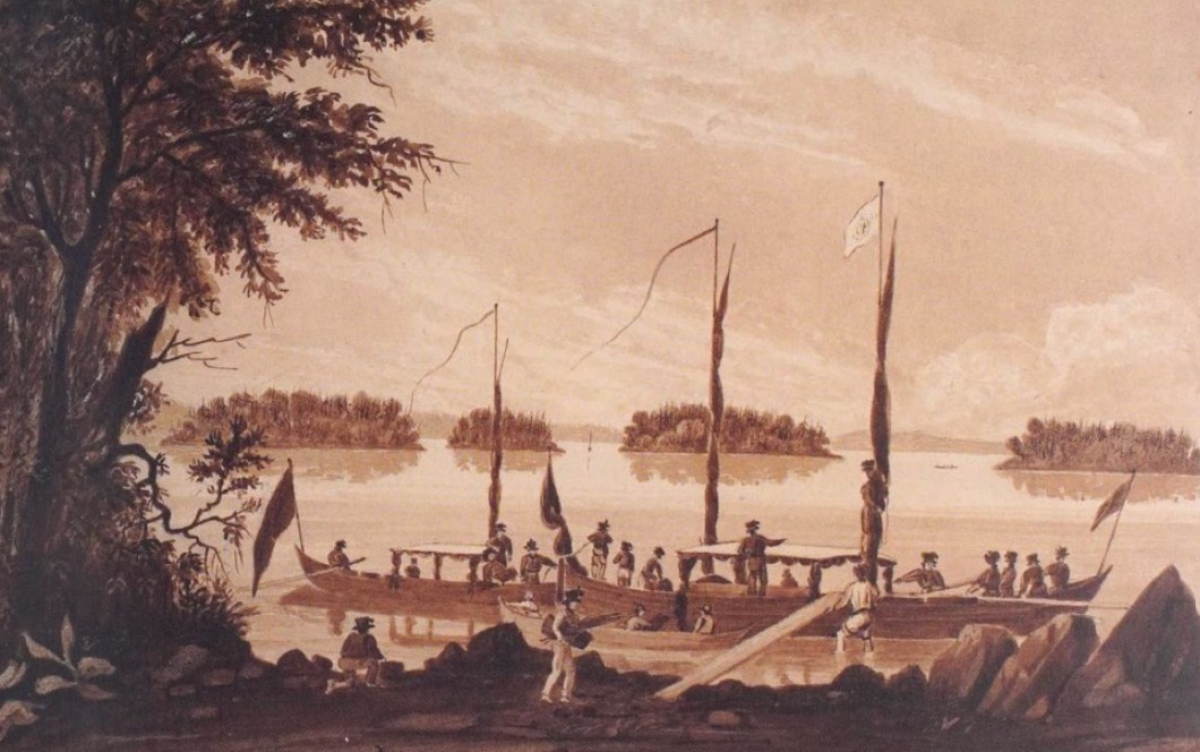
On September 25, 1826, hoping to obtain vice-regal confirmation of his chosen route for the Rideau Canal, Lt.-Col. John By led the Governor-in-Chief of British North America, Lord Dalhouisie, on an arduous 13-km hike through the then tangle of forests and swamps that we have come to know today as Centretown, the Glebe and Old Ottawa South, finally reaching and surveying the point where the Rideau Canal would eventually meet up with the Rideau River at today’s Mooney’s Bay/Hog’s Back Falls.
Before turning around to complete their round-trip trek back to that morning's starting point at Sleigh Bay (today’s Ottawa Locks), By and Dalhousie were graciously welcomed into the log cabin home of one of Old Ottawa South’s, earliest settlers, Lewis Williams.
“After feasting on his potatoes,” Dalhousie wrote, “after our hot walk we asked for a little rum, but he had none. We drank water from his well as cold as any ice. I need not say that our visit gave the old man unbounded joy, tho’ we left without giving the least hint who we were.”
The following day, September 26, 1826, Lord Dalhousie recorded in an official letter that he had met once more with Colonel By at Sleigh Bay, below the future Parliament Hill, and confirmed that site’s selection to be the northern starting point of the Rideau Canal at the Ottawa River.
In the same meeting, plans were approved for the town site for the future Bytown, divided by the Rideau Canal into Lower Town and Upper Town, for bridges across the Ottawa River to connect Upper Canada and Lower Town, and, at the request of the region’s fledgling logging industry, a dredged canal at Richmond Landing to ease passage of timber rafts around the turbulent Chaudière Falls.
In this comprehensive and fascinating new essay, Carleton University’s Randy Boswell chronicles these and more of the extraordinary events surrounded the “birth” of Bytown and the Rideau Canal two centuries ago this past month, including detailing interactions with the Indigenous people at the time, and the long-term impact of this uninvited settlement on the future of the Anishinaabe Algonquin:
Bytown 200 – The Birth of Bytown
An abridged version of this essay appeared as an article in the September 26, 2026 edition of the Ottawa Citizen and is also featured in a new book by Randy Boswell and photographer John McQuarrie, “Ottawa Spirit of Place 200th Anniversary Edition”.