

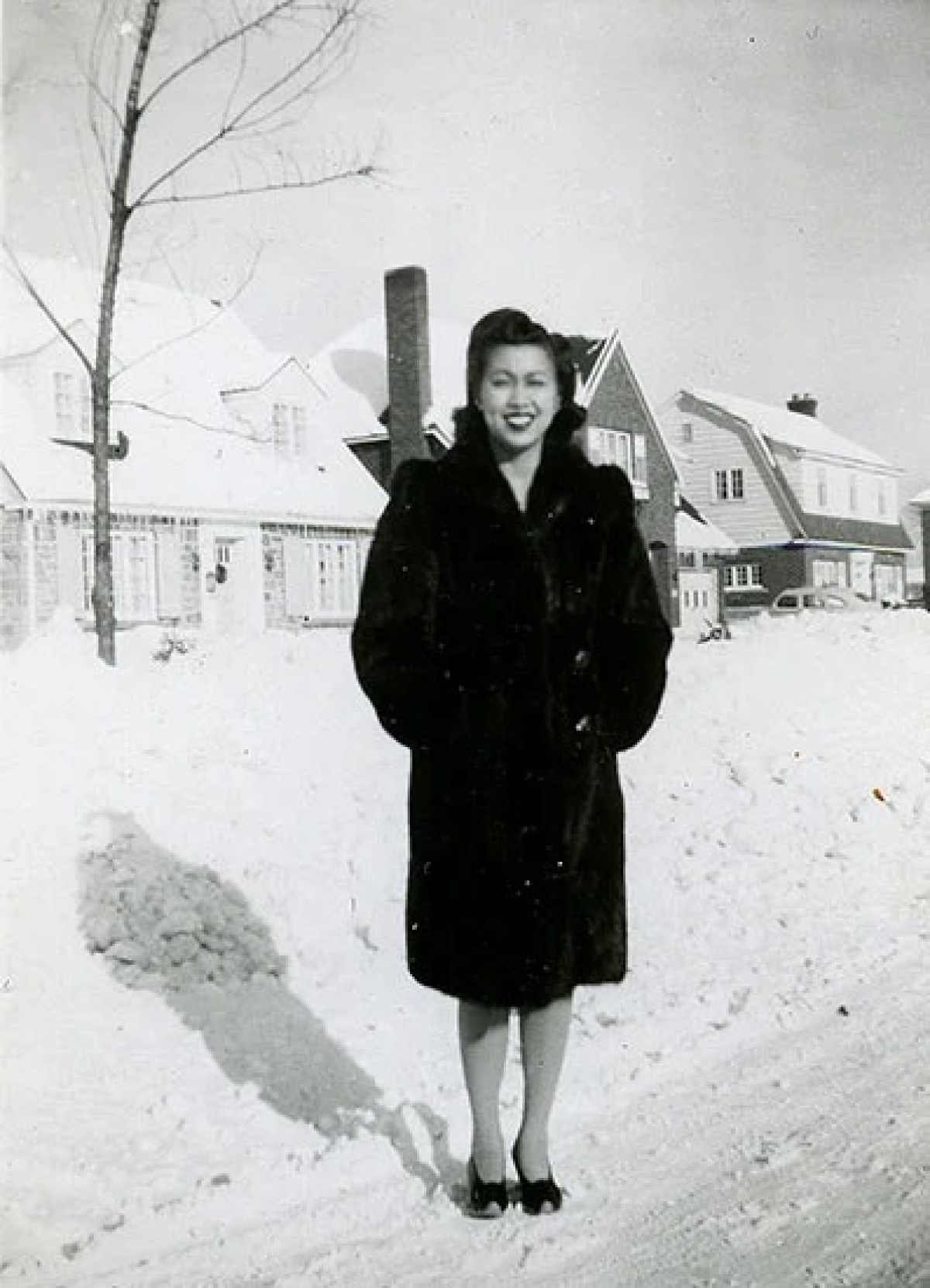
Before the “Chinatown” that now strives along Somerset Street, the nucleus of Ottawa’s Chinese business community in Ottawa was downtown’s Albert Street.
In January 2014, award-winning author Denise Chong presented her talk “A History of Chinese Settlement in Ottawa” for the Historical Society of Ottawa.
Here are excerpts from the report on that talk, written at the time by HSO President George Neville:
The earliest incidence of Chinese in the Ottawa area dates to the 1890s.
The first Chinese man to bring his wife from China was Joe Sim of Hull, Quebec. He came in 1904, and his wife came in 1919. The Sims would be one of four families in the Ottawa area.
Kwong Hum was perhaps the first Chinese to open a business on Albert Street in Ottawa.
Soo Wong, who worked in a laundry, had savings enough only for his wife’s passage and $500 head tax; the couple would not be reunited with their eldest daughter left behind in China for 50 years. Their house and grocery on Albert Street was a social hub for the few Chinese here.
The Chinese Exclusion Act of 1923 essentially excluded Chinese immigration to Canada.
The boat on which Shung Joe’s wife was a passenger was mid-ocean at the time the legislation as passed; Shung was able to use his connections with a church official, who pleaded her case.
Shung was allowed to pay the now-defunct $500 head tax and gain entry for her. The Joes would have seven children born in their home and laundry on O’Connor Street in Ottawa.
Urban populations could support laundries, whereas cafes could be set up in most smaller communities e.g. Harry’s Cafe in Perth.
(Members of local churches often gave out first names to the Chinese, the Presbyterian Church in Perth gave Harry Fong, who owned Harry’s Cafe, a surname as well, replacing Fong with “Johnston”; the church gave the second Chinese in town the surname of “Hamilton”.)
The first cafe to serve Chinese food in Ottawa was on Albert Street, opened by Stanley Wong who came from Montreal.
Most Chinese would move on from laundries to cafe businesses; Shung Joe remained in the laundry business, later extending operations into dry cleaning.
The Second World War brought employment opportunities for the Chinese in the federal government. Discrimination remained strong on the west coast, but lessened as one went est.
Vancouver-born Hin Lew came to Ottawa to spend a life-long career with the NRC.
Wartime brought business of soldiers to cafe owners; for example, the Lims’ New York Cafe in Carleton Place benefited from soldiers travelling to Petawawa.
Among the four or more cafes named the “New York Cafe” along the St. Lawrence, the one of highest regard was that of Leip Lor’s in Brockville where Leip prided himself on menu entries that rivaled the best of American resort hotels.
Names of restaurants tell a story: Tom Hum opened the Lucky Key on Carling Avenue opposite the Westgate Shopping Centre noting “every gate needs a key”.
George Neville further noted that Denise Chong wrote a book called “Lives of the Family”, overlapping stories set in and around Ottawa, and in her talk Denise concludes with a reference to the epilogue of her book, which includes the Poy family, who came as wartime refugees during the period of exclusion. Adrienne, 3 years old at the time, would become Canada’s 26th Governor General.
In 2025, Jeff Wang recorded an episode of our “Time Travelling with the Historical Society of Ottawa”series, recounting the history of Ottawa’s Chinese community:
Visit our website to view additional episodes of “Time Travelling with the Historical Society of Ottawa”, produced in partnership with Rogers TV: www.historicalsocietyottawa.ca/resources/videos/time-travelling-series