

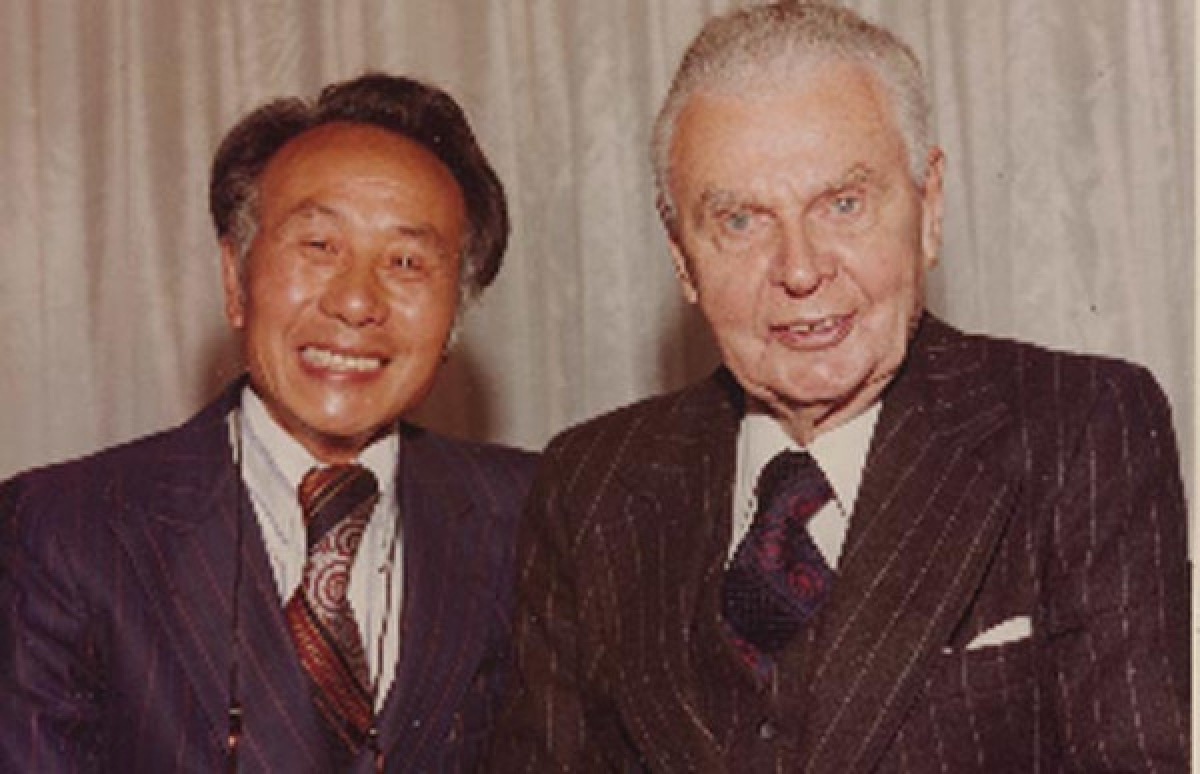
In 1953, Tsin Van stood in a citizenship judge's office and declared his allegiance to the Queen and this country. Four years later, he was positioned only a few feet from that same Queen as a principal photographer during her visit in 1957.
In addition to Queen Elizabeth II, Tsin Van would photograph the likes of John Diefenbaker, Pierre Trudeau, Marion Dewar, Zhao Ziyang, Jordan’s King Hussein and the Esquires — along with countless everyday Ottawans during his career spanning four decades.
Phil Jenkins had the opportunity to interview Tsan Van (1918-2010) at the age of 92, just months before he passed away. Here are excerpts from the article Phil prepared for the Citizen:
“Ottawa, in the fall of 1946, was not much of a place to Tsin Van's eyes, himself being a recent immigrant to the capital of a country bigger than even his native China.
The Chinese population in Ottawa the year after the end of the war was around 500, mostly Cantonese speakers with Billy Joe's Cathay restaurant as the social centre, and Tsin found only three others that could speak his Shanghai dialect.
But in the office on Rideau Street where he worked as a transportation manager for the Chinese government supply agency, he found something much better; a wife.
Betty was born in Ottawa, knew the town very well, and their attraction across a desk was palpable.
They eloped and then married with relative speed for the times and, with $500 in the bank, moved into a small apartment in Aylmer on the cheaper side of the river, a headquarters from which to plan and implement their Ottawan lives.
The job with the Chinese agency, which was working with a finite fund of $60 million, ended, and Tsin needed to find another line of work, along with all the other war veterans who were now returning to resume their interrupted lives.
He was trained in transportation, both in China and the United States, but it was his lifelong interest in photography that now surfaced.
On the understanding that everything in life operates on odds of fifty-fifty either it happens or it doesn't he sent some photographs of puppies in a basket, an "animal interest" shot as it is called in the trade, to Dick Jackson, the city editor at the Journal newspaper, then Ottawa's other daily broadsheet (The Journal lasted until 1980, having started in Ottawa in 1885).
Within a week Tsin heard that his puppies in a basket had been bought, for $3 a shot. And the paper would have a look at any more photographs of Ottawa city life he might care to send in.
He had embarked on the life of a freelance photographer, complete with a fedora hat with a card saying PRESS tucked into the headband.
Tsin kept up his ties with his family in China (his father had died during the war, of pneumonia), but then Mao Zedong, chairman of the Chinese Communist Party, after two decades of civil war, established the People's Republic of China on Oct 1, 1949, and one particular person in Ottawa knew that he would not be returning there for some time.
In 1953, Tsin stood in a judge's office and declared his allegiance to the Queen and this country. Four years later, as it happened, he was only a few feet from that same Queen when she visited us in 1957. He was one of the principal photographers on the royal occasion (as well as several later ones) and one picture in particular, of the Queen arriving by open car to open Parliament, enjoyed what we would now call global viewing.'
Another photo shoot stands out in Tsin's mind from among the thousands of portraits and weddings he has captured on the streets and in his studios on Sparks Street and later on Carling Avenue.
It came along in January 1984, when the premier of China, Zhao Ziyang, visited Ottawa and attended a gala at the National Arts Centre thrown by Prime Minister Pierre Trudeau.
Photographers lead an oxymoronic life, being both on the periphery in terms of standing at major events in the lives of others, and yet at the very centre of them physically.
On this occasion, Tsin was but a few feet from two men he admired Zhao was a reformer who five years later went into Tienanmen Square to make a sympathetic speech to the students and he was able to put them both in a single frame.
‘The RCMP liked me,’ he says, ‘because I wasn't pushy, not like now, and they let me get close to people they were guarding.’
Tsin's stock of stories of encounters with former high-ups in Ottawa fill many an album, like the snap he took of King Hussein of Jordan with a gun tucked in his belt and the portrait he did of Dief the Chief in his office in the late 1950s; he gave the prime minister a Hansard to play with while he composed the shot and Diefenbaker promptly found a speech he had been searching for about the Canadian flag, and thanked Tsin for changing his luck.
But Tsin reserves the most affection in his voice, as do many in this town, for Marion Dewar, Ottawa's best mayor in living memory.
He was a co-sponsor of a family from the Project 4000 Vietnamese refugees that Dewar invited to settle in Ottawa, and he even arranged for her to visit China along with 11 other prominent Canadians. They remained in contact until Dewar's death in September last year.
In 1989, in his early 70s, after 40 years of photographing, Tsin retired, donated a lot of his photographs to the national archives and concentrated on his family and his friendship association with China, continuing to make visits there, his last to Shanghai in 2006.
Betty, who is now 80, and Tsin have remained married for 62 years, and are blessed with children who have gone far in life; there are now great-grandchildren. They have settled, for the remainder of their incarnations, in Amberwood Village out in Stittsville.
Tsin still hoists a camera, a digital one now, but it is only every now and then, at family events. He still looks life square in the eye, and has left a space in his albums for a self-portrait at age 100.”