

Working to preserve Ottawa's past
for future generations.
Museum Club Starts the Season with National Holocaust Monument Tour
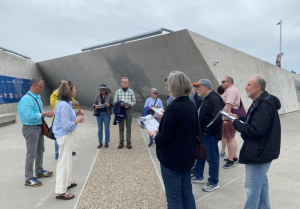
On Sunday May 31, 2026, the HSO Museum Club had the privilege of touring the National Holocaust Monument, led by members of the Centre for Holocaust Education and Scholarship (CHES), Artur Wilczynski and Alyssa Novick. The monument was inaugurated in September of 2017, after a student had proposed a monument back in 2013, and had helped to get a parliamentary bill passed to construct one.
Our tour began with an explanation of the symbolism behind the shape of the monument. The monument is made up of six triangular sections, and when viewed from above they resemble the Star of David. The above view can also be seen to represent that important symbol of Judaism being broken, with this notion being contrasted by the monument itself, showing that Judaism remained together. The triangles in the design also represent the different triangular configurations that the Nazis used to identify different prisoners based on why they were in the camps. As we descended into the centre area of the monument, the noise from the traffic nearby faded away and we learnt that this was by design. The monument has high and thick concrete walls and a sloping entrance that is meant to symbolize the isolation of the victims of the Holocaust. On one of the walls in the centre area there are panels of information that provide historical context for the monument, such as what the Holocaust was, the growth of the Second World War, the mass murders that took place, and Canada’s role in all of this.
The centre and side areas also contain six images each embedded into their own wall, of different Holocaust sites as they look today. The images were photographed by Canadian photographer Edward Burtynsky who had taken over 150 photos that had been narrowed down to these six. There is no specific order to view these photographs in, and each has an explanation written on a plaque next to it. The monument does not have much writing in it (aside from the panels of historical context) as it can be paired with the IWalk app which contains in depth explanations of the images and Holocaust Survivor testimonies which add a human, personal element to the monument.
The first image is of the abandoned rail tracks leading to Treblinka which had been a labour camp, with Treblinka II, a death camp just a few kilometres south of it. The second image is of the Okopowa Street Jewish cemetery in Warsaw. This was a hiding place used by Jews to escape the deportation to the Treblinka death camp in the summer of 1942. The next image is of a prayer room from a Czech town called Terezin that served as a ghetto. This prayer room, decorated with Hebrew texts, was created by Rabbi Artur (Asher) Berlinger, a German-Jewish artist, imprisoned in the camp, risking severe punishment if caught. Another image shown is of Track 17 in Berlin which was the track that most of the German Jews coming from Berlin were deported on. The track now has steel plaques on it with information about those who were deported. Next to the image is a photograph of Auschwitz-Birkenau which was the largest concentration camp. The last image is one next to the plaques of information which is of the site of the Death March in Mauthausen, Austria. Near the end of the war, the Nazis forced tens of thousands of prisoners to walk for days without food or water, and those who survived ended up at Mauthausen.
Moving away from the centre area, we were led to the room with the Flame of Remembrance, which is a space for reflection and memory. The flame is in the Jewish tradition and is called “Ner Tamid” (Hebrew for eternal light), and it has also been associated with God’s eternal presence.
The last section of the monument is a set of stairs (or elevator) leading up to an upper viewing area that looks out at the Peace Tower on Parliament Hill. This path out of the isolated area symbolizes the journey made by 40,000 Jewish people at the end of the war who came to Canada and eventually found peace here.
A big thank you to Artur Wilczynski and Alyssa Novick for leading the tour and to Ana Cristina Villegas for helping to organize the event! The National Holocaust Monument is open to the public for free every day from 7am to 9pm.
We are the Children
Award-winning educator, activist, and community leader June Girvan discusses the importance of understanding and reconciliation—and the complicated journey we all share in trying to make peace with the past.
Upheaval Across Canada’s Landscape of Commemoration
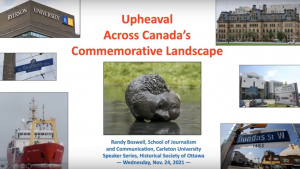
Randy Boswell highlights the opportunity to find deserving figures "other than Victorian-era politicians, government functionaries and members of the British mobility" to name our landmarks after. Randy had been one of the first to propose, in a 2020 Ottawa Citizen column, to rename Ottawa's Prince of Wales Bridge in honour of Chief William Commanda.
Randy, a past member of the HSO Board of Directors, draws attention to the way "the naming of streets, buildings and other places has sometimes memorialized slave owners and other unworthy figures from the past" and suggests replacing implied tributes to "historical figures (Henry Goulbourn, for example) with deeply problematic past and little or no connection to our country".
In other cases, Randy advocates a delicate balance, with figures such as Sir John A. Macdonald, to "find ways to preserve pride in the achievements of Canada's founding prime minister without ignoring his role in shaping the Residential Schools system and other racism-laced policies targeting Indigenous and Chinese people."
(At the start of his presentation, Randy acknowledges that there exist a wide range of views on this topic and invited audience members to join the conversation during the Q&A session following his talk.)
Since the HSO's founding almost 124 years ago with our mission to “increase public knowledge of the history of Ottawa” and “to preserve the history of the peoples of Bytown and Ottawa”, we have frequently been guilty of telling Ottawa's stories from a very narrow cultural perspective.
We can't "erase" the past in terms of erasing what has already been written. But we need now to expand upon what has been written -- and update the record of our past with the important perspectives that thus far have been glaringly missed from our history books.
We need to understand, acknowledge and come to terms with our past -- as historical society, as a city, and as a nation.
Randy, a journalist and Carleton University professor, notes that we should be at liberty to override some of the naming choices made by our Victorian-era forebearers that date back to a very different colonization era.
Randy's presentation recognized the difficult task ahead for Ottawa’s politicians, city planners and community groups (including HSO) in setting new, inclusive standards on how to honour the past, into the future.
Upheaval across Canada's Landscape of Commemoration
Follow this HSO presentation by Randy Boswell, Carleton University professor and journalist, as he investigates the ongoing controversy over our commemorative landscape and explores whether there are constructive healing ways forward.
Capital History Kiosk Project
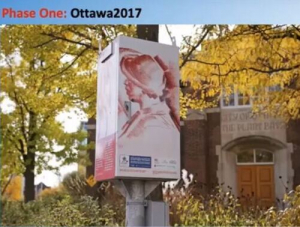
They’re easy to spot when you’re walking along any of Ottawa’s busy streets. They’re designed to be recognized.
Our October 13, 2021 presentation is about the traffic control boxes at many of Ottawa’s intersections; not of the drab utility boxes themselves, but about the colourful history lessons that have been applied to them to remind you of what Ottawa used to look like 10, 50, or 100 years ago, and to tell the story of a significant event that took place near each control box.
David Dean has been a professor of History at Carleton University since 2000. He got the kiosk project moving forward in 2015 with utility boxes along Bank Street, to tell the story of the local businesses. This early stage was completed in collaboration with the Workers History Museum and the Carleton Centre for Public History. The Capital History Kiosk Project expanded city-wide in 2017, as part of Canada’s 150th Anniversary celebration.
Danielle Mahon is an MA student as Carleton. She talked about the process of gathering information on each kiosk, and uploading location information on the kiosks to the Capital History website, at www.capitalhistory.ca. Students have also assisted in the project to add QR codes at each traffic box so that pedestrians can scan the code with a cell phone to read more about the history depicted at each box.
Being the national capital, there is no shortage of stories to tell about Ottawa, and fortunately there is no shortage of control boxes. David notes that the city as about 19,000 of them. The kiosk project is expanding as more research is done, so don’t be surprised if you see a new one next time your walking, jogging, or cycling around town.
Visit the HSO YouTube channel for to view the full presentation about the Capital Kiosk Project.
Capital History Kiosk Project
In this presentation, David Dean and Danielle Mahon demonstrate the unique approach to local storytelling through the Capital Kiosk Project.
Quick Links
About
Supporting Partners