


Working to preserve Ottawa's past
for future generations.
The HSO 2026 Bytown200 Bicentennial Storytelling Challenge
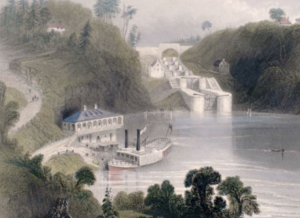
Let’s hear your stories about Bytown and the Rideau Canal as we begin to mark 2026, the 200th anniversary of the beginning of both!
All contributions are welcome. Selected submissions will be shared on a special webpage on the HSO website for all to access, including educators. Eligible contributions can be submitted in a variety of formats, including written or audio/video.
We hope to also incorporate selected contributions into our many other platforms – such as our blog, the HSO Capital Chronicle newsletter, website articles and the Ottawa Stories sections and potentially our pamphlet series. All will be shared through our social media platforms well.
We welcome stories that pertain to the Rideau Canal or Bytown (1826-1855) or the Ottawa area’s history beforehand, as well as stories exploring the impact that the establishment of both had on the lives and livelihoods of Indigenous people.
We welcome new as well as updated or previously-published materials for submission. Contributors will allow HSO the right to publish their materials while also retaining the right to do so themselves.
Contact us to learn more: This email address is being protected from spambots. You need JavaScript enabled to view it.
We will also be happy to discuss any proposals for submissions you may have.
Have a look at our collection of stories: www.historicalsocietyottawa.ca/resources/bytown-200
Andrew King – The Vanished Village of Long Island
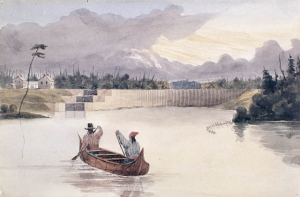
First settled in the early 1830s during the construction of the Rideau Canal, the bustling village of Long Island would, by the mid-1800s, boast multiple streets, churches, general stores and hotels — and its own post office.
Once located near today’s Long Island Locks, Andrew King was perplexed to find nothing now remaining but grassy empty fields and the crumbling ruin of an old farmhouse, and no surviving signs of the once thriving community.
Curious as to how all traces of this “ghost village” north of present-day Manotick could simply disappear, Andrew proceeded to try to track down clues of “The Vanished Village of Long Island”:
ottawarewind.com/2017/11/19/the-vanished-village-of-long-island/
Andrew King is an Ottawa artist and historian and author of the Ottawa Rewind blog.
Alastair Sweeny – Lord Dalhousie and the Rideau Canal
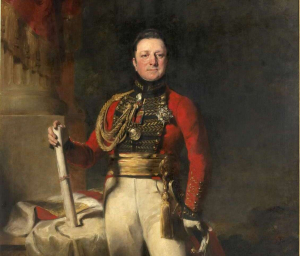
There was perhaps no greater proponent for construction of the Rideau Canal than Lord Dalhousie, Governor-in-Chief of British North America.
As part of the HSO 2026 Bytown200 Bicentennial Storytelling Challenge, Alastair Sweeny recounts the contributions of Lord (and Lady) Dalhousie to the establishment of the Rideau Canal and Bytown.
Alastair Sweeny, PhD is the author of several books on Canadian history and technology, including George-Étienne Cartier: A Biography, BlackBerry Planet, and Fire Along the Frontier: Great Battles of the War of 1812 and Thomas Mackay: The Laird of Rideau Hall and the Founding of Ottawa.
Dr. Sweeny is based in Ottawa and is a member of the Historical Society of Ottawa.
Read the essay here: Lord Dalhousie
The Origins of the Rideau Canal
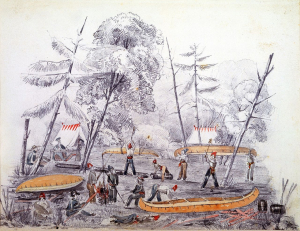
On Saturday March 28, 2026, Allison Margot Smith gave a film-screening of her recent film “Two Wars, Three Watersheds, a Slew of Surveys and a Canal.” The film describes the history of the Rideau Canal, and in particular, the planning of the route of the canal, starting in the 1780s.
The reasons for building the canal changed over time, as did ideas for the route. So, it took more than fifty years to arrive at a plan for the canal. Even the geography of the land mass to be transited by the canal changed due to human activity in this relatively wild country. But by 1826, 200 years ago, a route had been chosen and budget had been allocated by British Parliament. Lieutenant-Colonel John By was sent to start work on this mammoth project, and his encampment – called Bytown – was established, launching what is now our city.
Following her film, Allison gave a short talk on the imagery used to create her film, including the challenges of sourcing archival imagery for historical documentary films. She discussed how archival imagery and archival film footage can, in some cases, act as a kind of citation, offering proof that the assertions in a film reflect the realities of the past. This is important in a historical documentary film, since films, unlike academic papers, don't have traditional citations. And while archival images may be imperfect citations, even traditional citations may not be perfect proof of an assertion.
Allison also talked about questions, raised recently, about the potential inability to trust documentary films, with the emergence of Artificial Intelligence and AI-generated films. Her talk addressed the intent and legitimacy of AI in film-making, and she suggested that these new technologies may not be so different from traditional photography or historical art composition, depending on the intent. Finally, she touched on the use of archival cartoons as a way of illustrating and providing a "citation" for historical social commentary.
The City of Ottawa Archives – Bytown 200th: Ottawa's history
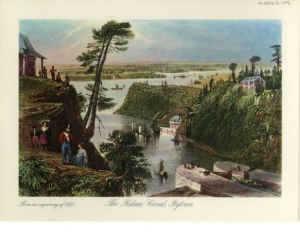
The City of Ottawa Archives joins in marking 200 years since the founding of Bytown, by presenting a serialized look at the community’s early development.
“Bytown: Construction Camp to Fledgling City” explores the transformation of a frontier settlement into a vibrant urban centre. Through archival records, historical insights, and profiles of key figures, follow this series as the Archives brings Bytown’s story to life—one chapter at a time: https://ottawa.ca/en/node/3042265
The City of Ottawa Archives are the custodians of permanent and historical civic government records on behalf of the City of Ottawa and its many departments, as well as local, community records with historical value. They preserve, acquire and make these documents accessible for City staff, the public, and other researchers, for present and future generations.
Jack Hanna – Centretown BUZZ Ottawa 200 series
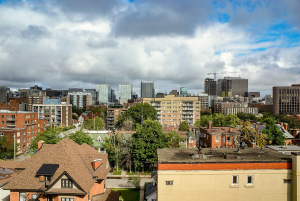
To mark Ottawa’s 200th anniversary, the Centretown BUZZ community newspaper has commissioned Jack Hanna to pen an eight-part series reflecting back on the history of our city.
Jack Hanna is a retired teacher and journalist, amateur historian, and heritage chair of the Centretown Community Association.
, painted circa. 1870. (Library and Archives Canada, W.H. Coverdale Collection of Canadiana).jpg) “Lake Allumette on the Ottawa River in Ontario”, by Alfred Holdstock (1820 1901), painted circa. 1870. (Library and Archives Canada, W.H. Coverdale Collection of Canadiana)
“Lake Allumette on the Ottawa River in Ontario”, by Alfred Holdstock (1820 1901), painted circa. 1870. (Library and Archives Canada, W.H. Coverdale Collection of Canadiana)
As a (non-Indigenous) Centretown resident, Jack Hanna reflects on the devastation caused to the Algonquin Anishinaabe people following the establishment of Bytown.
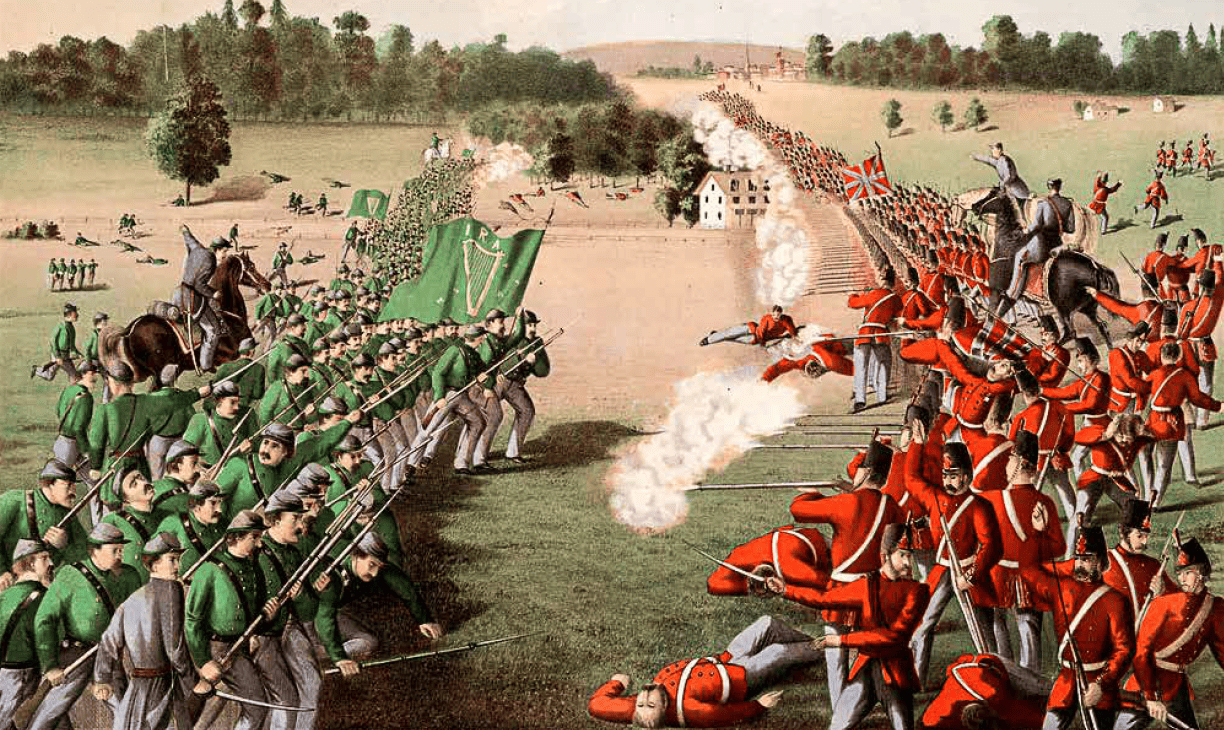 The charge of the Fenians at the Battle of Ridgeway, near Niagara, Canada West, on June 2, 1866. LAC.
Jack continues his look at local history by examining the threat posed by Americans over the years.
David C. Martin – What a Surveyor Saw: John Burrows and the Rideau Canal
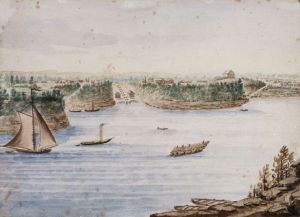
What can we learn from the long-ago diaries of Rideau Canal surveyor John Burrows about how he perceived the landscape unfolding around him, through the lens of the British military, engineering, and colonial culture of the time?
Adapted from his recent lecture “Engineering Identity: John Burrows, Rideau Canal Landscapes, and Anglo-Canadian Ways of Seeing”, historian/researcher/writer David C. Martin looks beyond the many landscape paintings Burrows left behind, and instead explores what Burrows further revealed when he put pen to paper.
Read his account: Engineering Identity: John Burrows, Rideau Canal Landscapes, and Anglo-Canadian Ways of Seeing
Marking Bytown's 200 Anniversary

Many thanks to CTV Ottawa and CFRA iHeart radio for highlighting our bicentennial celebrations planned for 2026.
Watch HSO spokesperson Ben Weiss on CTV Ottawa Morning discuss the Historical Society's bicentennial plans. And stay tuned to the end of the clip to see a 100-year old relic from the centennial celebrations in 1926 to compare civic festivities of yesteryear! Link to Ottawa turns 200 this year video.
Check out our Bytown 200 story collection: www.historicalsocietyottawa.ca/resources/bytown-200
James Powell – Today in Ottawa's History
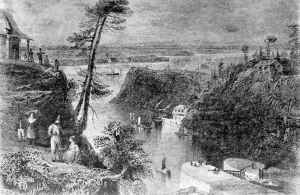
James Powell takes us back to the early days of the Rideau Canal and Bytown with stories about the Shiners’ War, the Stony Monday Riot, The ByWard Market, Bytown’s first newspaper, Bytown's journey to becoming Canada's capital... and more.
James is the author of the blog Today in Ottawa's History giving a day-by-day account of local history.
The Chaudiere Bridges
One of the most pressing priorities for Lt. Colonel By and his engineering colleagues, was to span a bridge across the Ottawa River in order to transport essential supplies and workers from Wright’s Town urgently needed to begin construction of the Rideau Canal: The Chaudière Bridges, 28 September 1826
The Canal
James shares the story of one of the most remarkable engineering feats of its era – the construction of the Rideau Canal: The Canal, 29 May 1832
The Shiners’ War
For the better part of a decade, lawlessness reigned as Bytown’s citizens were terrorized by violent gangs of thugs known as the “Shiners”, cunningly manipulated by the ruthless and ambitious Peter Aylen, a man willing to fuel religious and linguistic division in his attempt to solidify his own unassailable Ottawa Valley timber empire: The Shiners’ War, 20 October 1835
Ottawa’s First Newspaper
500 copies of Bytown’s first newspaper hit the streets on February 24, 1836. James Powell flips through the pages of that first four-page edition and takes a peek at what its first subscribers would have been reading: Ottawa’s First Newspaper, 24 February 1836
The ByWard Market
James Powell traces the history of Lowertown’s almost two-century old ByWard Market: The Byward Market, 4 November 1838
Corporation of Bytown
John Scott was elected the first mayor of Bytown – twice. Initially incorporated in 1847, with John Scott elected as Bytown’s first mayor, Bytown’s charter was subsequently disallowed following a dispute with the Ordnance Department, the military administration that had become accustomed to being in charge since the days of Lt. Colonel John By. James Powell shares the story of how matters were eventually resolved and how, upon reinstatement of Bytown’s charter, John Scott was, for a second time, elected as Bytown’s first mayor: The Corporation of Bytown, 28 April 1847
Stony Monday Riot
In 1849, the Stony Monday Riot erupted in Lowertown between the Reformists and the Tories. Dozens of injuries and one death resulted when as the (mostly Protestant) Tories, furious over the impending visit of the Governor General, Lord Elgin, clashed with the (largely working-class Catholic) Reformists: Stony Monday Riot, 17 September 1849
Lord Elgin Visits Bytown:
Remarkably, Lord Elgin’s visit in 1853 -- only four years after the Governor General had been forced to cancel his visit following Bytown’s violent Stony Monday Riot -- resulted in Lord Elgin’s recommendation that Bytown to be chosen as the Province of Canada’s new capital: Lord Elgin Visits Bytown, 27 July 1853
Choosing Canada's Capital
Toronto, Kingston, Hamilton, Montreal and Quebec City were among Bytown’s rivals in the intensely-fought contest be chosen as the Province of Canada’s new capital. Bytown even went so far as to change its name to “Ottawa” in hopes of distancing itself from its (well-earned) reputation as a violent and uncivilized backwoods lumber town. James Powell retraces Bytown’s surprising journey to becoming Queen Victoria’s unexpected choice as Canada’s new capital: Queen Victoria Chooses Ottawa, 31 December 1857
Ottawa’s Centenary
In celebration of Bytown’s 100th anniversary in 1926, the Ottawa Journal published an article predicting what Ottawa might be like a century later, in 2026. Today, as we mark the 200th anniversary of the founding of Bytown, James Powell takes us back to 1926 for a look at those predictions and at how else our city celebrated our centenary: Ottawa’s Centenary, 16 August 1926
Ken Watson – History of the Rideau Canal
![This 1688 map [1910 copy] is one of the first to name the Rideau River. "Kataracoux" is today's Kingston and "Tonniata" is Brockville.](/media/k2/items/cache/3119c7be2ab58173062c39c6b8c72ed7_Generic.jpg?t=20260112_155343)
Ken Watson, a member of the Board of “Friends of the Rideau” since 1997, is a geologist with a deep interest in Rideau heritage and the environment.
Ken recounts the history of the oldest continuously operated canal system in North America: History of the Rideau Canal.
Quick Links
About
Supporting Partners