

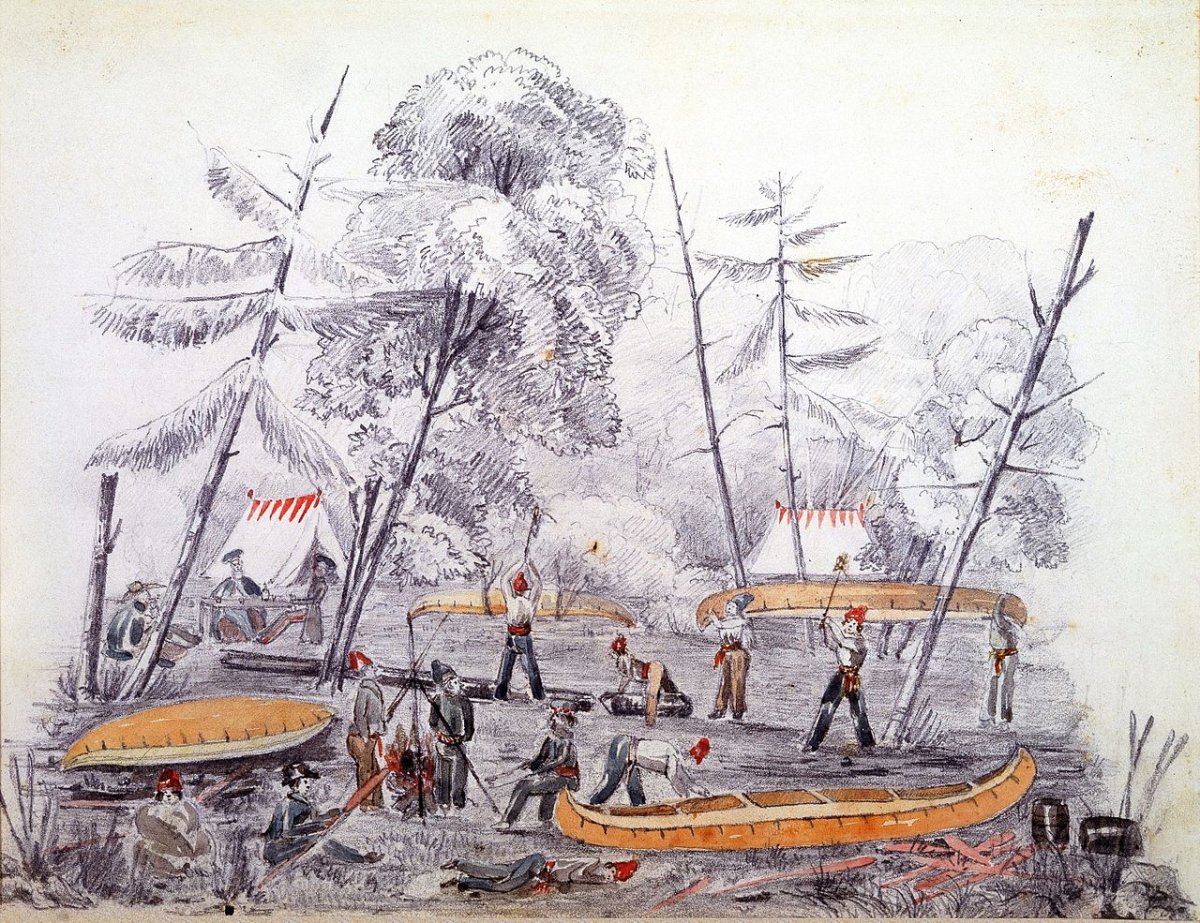
On Saturday March 28, 2026, Allison Margot Smith gave a film-screening of her recent film “Two Wars, Three Watersheds, a Slew of Surveys and a Canal.” The film describes the history of the Rideau Canal, and in particular, the planning of the route of the canal, starting in the 1780s.
The reasons for building the canal changed over time, as did ideas for the route. So, it took more than fifty years to arrive at a plan for the canal. Even the geography of the land mass to be transited by the canal changed due to human activity in this relatively wild country. But by 1826, 200 years ago, a route had been chosen and budget had been allocated by British Parliament. Lieutenant-Colonel John By was sent to start work on this mammoth project, and his encampment – called Bytown – was established, launching what is now our city.
Following her film, Allison gave a short talk on the imagery used to create her film, including the challenges of sourcing archival imagery for historical documentary films. She discussed how archival imagery and archival film footage can, in some cases, act as a kind of citation, offering proof that the assertions in a film reflect the realities of the past. This is important in a historical documentary film, since films, unlike academic papers, don't have traditional citations. And while archival images may be imperfect citations, even traditional citations may not be perfect proof of an assertion.
Allison also talked about questions, raised recently, about the potential inability to trust documentary films, with the emergence of Artificial Intelligence and AI-generated films. Her talk addressed the intent and legitimacy of AI in film-making, and she suggested that these new technologies may not be so different from traditional photography or historical art composition, depending on the intent. Finally, she touched on the use of archival cartoons as a way of illustrating and providing a "citation" for historical social commentary.