

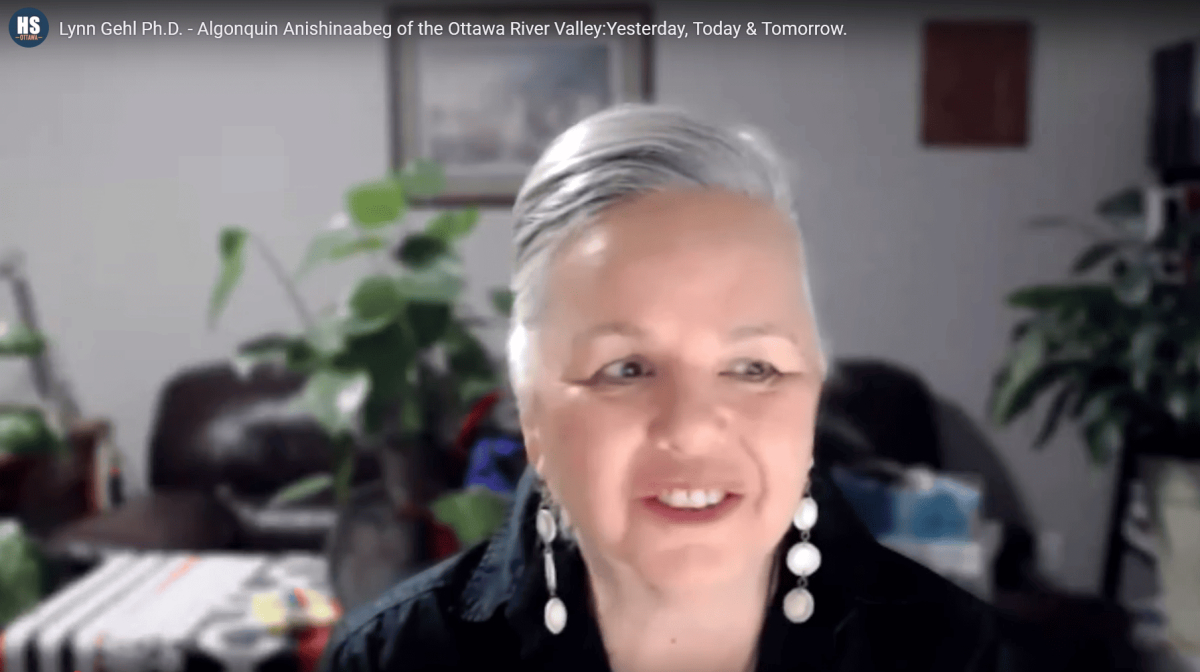
The Historical Society of Ottawa’s Zoom presentation of February 11th, 2026, was the 1 st of a 3 part series on the beginning of the Rideau Canal, (March 28), and the founding of Bytown, (April 25), in recognition of 2026 being the 200 th anniversary of both. We started the series with a look at the effects these events had on the Algonquin Anishinaabeg peoples. We were pleased to welcome Dr. Lynn Gehl, noted academic, author, artist, and advocate. She is a member of the Algonquins of Pikwàkanagàn First Nation . Dr. Gehl holds a Doctorate in Philosophy in Indigenous Studies as well as a Masters in Canadian Studies and Indigenous Studies and an Undergraduate degree in Cultural Anthropology. She is also the recipient of a Governor-General’s award.
The evening’s presentation took a conversation format, with questions being posed by Ben Weiss, long time member of the Historical Society of Ottawa, and Dr. Gehl, both providing specific answers and using the questions as a lead to discuss related issues. To get the full impact of the information and perspective provided by Dr. Gehl, we encourage you to watch the presentation or check out her other works through the links provided below.
Ben Weiss: Can you start off by telling us about your early life?
Dr. Gehl: Dr. Gehl started us back with her Great-grandfather, Joseph Gagnon and Great-grandmother Annie Jane. They lived on what was then known as the Golden Lake Reserve, but after returning wounded from the First World War, Joseph was advised by the government to move off the reserve to receive benefits. Dr. Gehl’s father grew up in the area and was a fisherman on the lake. Her mother went to Residential School in the Montreal area. Dr. Gehl is the 5 th of 8 children, and after the breakup of her parents, her mother raised the 8 children in the Toronto area. She suffered through poverty, housing and food insecurity and a series of operations that attempted, unsuccessfully, to correct a medical issue. As a youth, she found reading and writing difficult, both due to a vision impairment and because her focus was, by necessity, more on physical survival than intellectual development. She wanted to share these aspects of her personal story so others would recognize that she is not approaching these issues as a person of privilege.
Ben Weiss: You are now our foremost Indigenous scholar. Could you take us through a bit of your academic journey?
Dr. Gehl: Dr. Gehl confirmed that reading is still a burden for her, but she does a lot of it and has what may be the largest Algonquin library existent. At 30, she decided to leave her job monitoring water quality for the Ontario Provincial government to pursue her desire to understand what had happened to the Algonquin people. She started as a part-time student in Psychology, later switching to anthropology that better matched her interests. Her studies in anthropology revealed to her that there are many ways to be a human being and that poverty is often related to the power system in place. For her Masters work, she investigated the question of identity and the way it has been assessed. Are you Indigenous because you look Indigenous? Are you Indigenous as the result of a blood test or are you Indigenous because the government has said you are Indigenous. She was concerned how this assessment, especially when the identity is denied, affects the spirit of the individual. For her PhD, Dr. Gehl switched topics and studied the Algonquin Land Claims Process. Her findings were later converted into a book, The Truth that Wampum Tells: My Debwewin on the Algonquin Land Claims Process – Fernwood Publishing . Unlike most who find the results of her PhD a happy one, Dr. Gehl characterized hers as brutal, as an understanding that Canada has yet to move past its colonial period.
Ben Weiss: Could you tell us about your decades- long struggle around the key issue of unknown or unstated paternity inside the Indian Act, Gehl v Canada ?
Dr. Gehl: Dr. Gehl explained that in 1985, the government amended the Indian Act and she thought that they would remove sex discrimination from the Act, which they did not. They instead added additional stipulations that they falsely claimed would bring the definition in line with the Charter. As a result, Dr. Gehl, then 23, approached the Aboriginal Legal Services of Toronto to see if they would accept her case challenging the Act. She found herself, one individual taking on the Department of Justice. After much archival research, a dismissal in 2012, a verdict against her in 2014, she finally received a partial victory from the Ontario Court of Appeal in 2017. Dr. Gehl explained that at this time, Sharon McIvor was going through a similar struggle and, in 2010, had petitioned the United Nations Human Rights Commission, who found in her favour in 2019 (McIvor Case | The Canadian Encyclopedia). Dr. Gehl pointed out that though her fight lasted 34 years, her Great-grandmother had written a letter, in 1945, asking about her status following the death of her husband and was informed that she was now a “White Woman”.
Ben Weiss: Can you take us through the concepts of Indigenous knowledge and the Debwewin Journey?
Dr. Gehl: Dr. Gehl explained that when she was completing her Indigenous Studies PhD, she made the decision to do so through Indigenous knowledge and Indigenous ways of knowing and being. She did this by getting as much exposure to Indigenous knowledge as she could, through the literature, ceremonies, talking with Elders and by learning the language. In this process, she learned of the concept of “Heart Knowledge” and gave the example of looking at each other when we talk so we can tell that we are being truthful. Dr. Gehl discovered that truth exists when our “Mind Knowledge (reasoned knowledge) and our “Heart Knowledge” agree. She developed this understanding into a Methodology, the Debwewin Journey .
Ben Weiss: Can you tell us something about Algonquin contact and pre-contact history?
Dr. Gehl: Dr. Gehl reminded us that the history of Canada is taught as the French and English being the benevolent founders of the nation. This is obviously untrue. She noted that the Algonquin territory covers some 200,000 square miles, larger than the combined lands of Prince Edward Island, New Brunswick and Nova Scotia, yet the Algonquin peoples have little control over this territory. The European historic record dates as far back as 1613, when Champlain documented the control of the territory by the Algonquin. After the British defeated the French to gain control over these lands, they signed a treaty in 1760, vowing to protect Indigenous lands, which they later broke. Dr. Gehl detailed a number of treaties and a Royal Proclamation, that defined Algonquin lands, as far as the governments of the day were concerned, eventually resulting in 2 federally recognized Algonquin First Nations in Ontario and 9 in Quebec, though some actually have no land associated with them. There are also 4 unrecognized Algonquin collectives in Ontario. The Algonquin lands in Ontario were lost through a series of treaties signed by the Mississauga peoples, not the Algonquin. Dr. Gehl noted additional pieces of legislation that granted Algonquin lands to settlers, but not to Algonquin peoples, and remarked that Parliament itself is built on stolen Algonquin land.
Ben Weiss: Do the Algonquin have any land treaties?
Dr. Gehl: No. Dr. Gehl explained that the only treaties that cede their lands are those signed by the Mississaugas. There are, however, Peace Treaties, such as the Treaty of Niagara, which identified the 24 Indigenous nations attending as Nations, but also as Subjects. They were, in fact, allies, of equal status to the British.
Ben Weiss: What is the significance of the Wampum Belt in Indigenous culture?
Dr. Gehl: Dr. Gehl explained that a Wampum Belt is a form of symbolic literacy, just like words on a page. Though many believe that only the Haudenosaunee used Wampum Belts, this is not true; Wampum Belts were used by a number of peoples including the Algonquin. Wampum Belt Diplomacy was often used to codify agreements, such as those between Indigenous Nations and the British Crown.
Ben Weiss: Why is it important to understand the significant difference between what Canada calls the Modern Treaty process and the Land Claims process?
Dr. Gehl: It is crucial. Dr. Gehl explained that a Treaty Process is about sharing the land and resources in equal and equitable ways. A Land Claims process is about extinguishing Indigenous Rights. Canada’s Modern Treaty process is simply a Land Claims process. The Canadian government is currently offering the Algonquin Nation only 1.7% of their territory and a one-time buy-out of $800 Million.
Ben Weiss: Can you tell us about the Algonquins of Ontario and the 2016 agreement in principle?
Dr. Gehl: Dr. Gehl explained that the Agreement in Principle, which includes transfers of funds, ownership of some lands and jurisdictional rights over resource exploitation, was signed by the Algonquins of Ontario and the governments of Ontario and Canada. She told us that this happened when only 47% of those eligible to vote participated and it was opposed by the Pikwàkanagàn First Nation. Later, a tribunal removed over 2,000 ‘pretendians’ who had been eligible to vote on the Agreement.
Ben Weiss: Can you talk about the harmful effect of ‘pretendians’?
Dr. Gehl: Dr. Gehl explained that some 2,500 members had been removed as Algonquins from the Pikwàkanagàn / Sharbot Lake communities along with the 2,000 previously mentioned. A CBC investigation discovered that about 1,000 of these had been signed-up through a fraudulent document. This means that at least 4,500 non-Algonquins were corrupting the Land Claim process. Pretendians’ are often in positions of influence, such as university professors, and so control such things as scholarships and research funds. If Indigenous peoples are to have a better world, they don’t need ‘pretendians’ telling them how. The ‘pretendians’ are white people and it should be the responsibility of white people and the government to deal with them, not the Indigenous community, who have many other issues to address.
Ben Weiss: Can you finish off by talking about the important work you’ve been doing regarding Indigenous Women and girls with disabilities?
Dr. Gehl: Dr. Gehl explained that when you are discriminated against by sex, race and disability, your life is “extra extra miserable”. Being oppressed by three layers of structural oppression can, and does, lead to death. Rates of disability are higher in Indigenous communities because they lack housing, lack nutrition, and are frequent victims of sexual violence.
Dr. Gehl then shared some images of various maps that relate to her research, as well as a diagram and a video that help to explain Indigenous Knowledge.
For those interested in reading more, Dr. Gehl is offering her books as a bundle for $100, including shipping within Canada.
This presentation was the most attended of the year, with over 130 participants, and was exceptionally well received.
The full presentation can be viewed at: Lynn Gehl Ph.D. - Algonquin Anishinaabeg of the Ottawa River Valley:Yesterday, Today & Tomorrow.
Dr. Gehl’s website can be found at: Lynn Gehl, PhD, Algonquin Anishinaabe-Ikwe.