

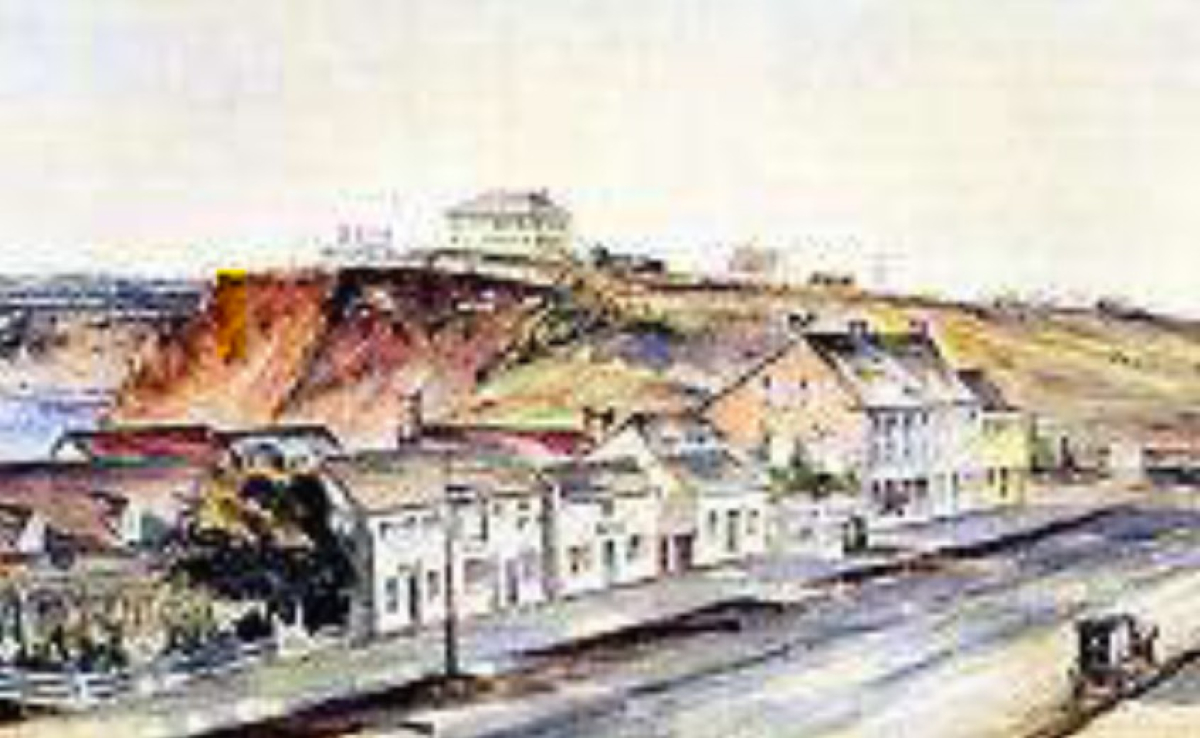
On April 25, 2026, the Society hosted the third presentation of its Bytown200 series. It followed a February presentation by Dr. Lynn Gehl on the past, present and future of the Anishinaabeg Algonquin of the Ottawa Valley, and one in March by Allison Margot Smith who gave a screening of her documentary on the Rideau Canal. Presented by Society member James Powell, the third and final part of the Bytown200 trilogy focused on Bytown itself. Despite stiff competition from two hockey games that afternoon with both the Ottawa Senators and the Ottawa Charge in action, close to 100 people attended James’s presentation at the Ottawa Public Library.
James started by looking at the men who were instrumental in Bytown’s early development, starting with Lord Dalhousie, Canada’s Governor General, who with great foresight bought 400 acres of land in 1821 at would become the entrance of the Rideau Canal in anticipation of a sizeable town developing there. James then talked about Colonel By who was given the task of planning the new town that took his name along with constructing the Rideau Canal. Attention then shifted to Nicholas Sparks, who owned much of the land that was to become downtown Ottawa. Sparks became extremely wealthy when the Rideau Canal cut through his property. And let’s not forget Philemon Wright, the founder of Hull, Quebec, Thomas Mackay, the father of New Edinburgh, and Louis-Théodore Besserer, the father of Sandy Hill.
James then gave a fascinating overview of life in Bytown. With a population of about 2,000 in 1840, the small community was divided in two parts--Upper Town which was mostly well-to-do, English and Protestant and Lower Town which was mostly poor, French or Irish and Catholic. The two communities, separately by about a half mile, were linked by one road and one bridge over the Rideau Canal. Regardless of where one lived, however, Bytown was “unsafe, dirty, smelly, unsanitary and unhealthy.”
Ethnic rivalries, often fuelled by alcohol, spilled over into the streets. Irish loggers called Shiners fought their French counterparts for control of the timberlands. Shiner atrocities led one Catholic priest to say Il n’y a pas de Dieu à Bytown. Without running water, sanitary sewers, garbage collection or paved streets, life in Bytown was harsh and unpleasant. Roads were often muddy and covered with horse manure. People donned wooden pattens (overshoes) to protect their boots. But one thing that they could not protect themselves from was disease. Cholera, typhoid, typhus, smallpox, diphtheria, measles, and scarlet fever ran rampant through the town. A measure of health care was brought to the town in 1847 by Élisabeth Bruyère, mother superior of Bytown Sisters of Charity, who founded the first civilian hospital aided by Dr. Van Cortlandt.
Still, there were opportunities for fun and education. In addition to boozing in the town’s many bars and taverns, Bytown citizens enjoyed cricket and lacrosse. Plays were produced at Her Majesty’s Theatre on Wellington Street. Two newspapers, the Bytown Gazette and The Packet, the forerunner of The Citizen, provided windows to the world outside of Bytown. Two literary groups—the Bytown Mechanic’s Institute and Atheneum and L’Institut canadien français d’Ottawa—gave learned lectures and for a fee provided Bytown residents access to circulating libraries.
James also talked about the fraught political scene in Canada at that time with people divided between Tories and Reformers. When rioting Tories burnt down the Parliament building in Montreal in 1849, incensed by Lord Elgin, the Governor General, signing into law the Rebellion Losses Act, Bytown’s was back in the running to become the capital of Canada. But Bytown too was divided between Tories and Reformers. Just months after Parliament was torched in Montreal, fighting between the two groups broke out on the streets of Bytown. Stones were thrown and shots fired in the Stony Monday Riot in the Byward Market during a public meeting to discuss an invitation to Lord Elgin to check out Bytown as a potential future capital. One man died. Two days later, armed Reformers and Tories squared off close to the canal. Separated only by a group of British soldiers, calmer heads fortunately prevailed and the two groups peacefully dispersed. Civil war was averted. The Packet newspaper wrote: Can it be true? Can such a scene have occurred in the middle of the 19 th century in enlightened Canada?
Four years later, the political environment had mellowed, and Lord Elgin finally journeyed to Bytown where he was warmly greeted by Joseph-Balsora Turgeon, Bytown’s first Francophone mayor. Both Tories and Reformers, eager to make a good impression, wined and dined the governor general during his stay in Bytown and his trip up the Ottawa River. The political storm had passed.
Bytown became Ottawa in 1855, a name viewed as more fitting for a town aspiring to be the new capital of Canada. After years of sterile debate and failed votes in the legislature, the Canadian government asked Queen Victoria in 1857 to settle the debate over the location of the new capital. Ottawa won, beating outrivals Toronto, Quebec and Kingston. Following more months of political wrangling, Parliament finally ratified the Queen’s choice in 1859, but the vote was close. Had three MPs voted differently, ratification would have failed.
After the presentation concluded, there was a lively question and answer period covering such topics as John LeBreton’s land speculation, reasons why Queen Victoria selected Ottawa as the capital, schools in Bytown, and the occupations of people who lived in Upper Bytown.
For those unable to attend (or were watching the hockey games!), the presentation was recorded.