

Working to preserve Ottawa's past
for future generations.
The Role of Art & Artists in Ottawa's History
Jim Burant, author of 'Ottawa Art & Artists: An Illustrated History', takes us on a tour of Ottawa's surprising artistic past.
Media
The Historical Society of Ottawa was honoured to welcome back Dr. Jean-Luc Pilon as the featured speaker at the April 12, 2023, speaker series session, hosted by the Main Branch of the Ottawa Public Library. Dr. Pilon is a renowned archeologist, long-time curator of Central Canada archaeology at the Canadian Museum of History, an educator, and was the first recipient of the J.V. Wright Lifetime Achievement Award from the Ontario Archaeological Society.
Dr. Pilon, who had spoken to us in November 2016, led us through some of the history of archeological activities in the Ottawa area along with the views of some individuals, organizations and governments. He pointed out that Europeans immediately grasped the importance of this location, Champlain making note of it in his journal in 1613. A Royal Proclamation of 1763 offered a degree of protection to Indigenous lands west of the Appalachian Mountains, but land grants from the Crown and later questionable Crown treaties and purchases, such as the Rideau Purchase of 1819, served to strip the Indigenous peoples of their land and heritage. Philemon Wright noted the objection of the local Indigenous population as he expanded his own enterprises in the area in the early 1800s, especially logging in support of the Napoleonic Wars. Later, about 1843, Dr. Edward van Courtland, a local medical doctor, naturalist and archeologist, identified a major ceremonial and burial site in the area, collecting many artifacts from his find. Archeology, at that time, had little concept of context and would from today’s perspective be more closely associated with looting than science. In describing the site, Dr. Courtland failed to mention on which side of the Ottawa River it fell, leading to a misunderstanding about the location of his discovery that was to endure and propagate for over 170 years. Writing for the Women’s Canadian Historical Society of Ottawa in 1901, Gertrude Kenny provided an anecdotal account of the Indigenous culture that had existed in the area for hundreds of years, but provided no sources for her account. Dr. Pilon noted many others who found artifacts or provided their own interpretations.
Dr. Pilon described how the artifacts flowed to and through a series of museums including the Bytown Mechanics Institute, the Literary and Scientific Society of Ottawa, the Geological Survey of Canada, and now the Canadian Museum of History. The artifacts that have been collected in the valleys of the Ottawa and Rideau rivers have a story to tell. Implements of stone quarried from deposits in Labrador, the Hudson Bay / James Bay and New York State areas, copper from west of Lake Superior, pottery of the Middle Woodland period, virtually identical to that found in the Lake of the Woods area, speak to a broad-based and sophisticated trading network with a critical hub in the Ottawa / Gatineau area that had been active for more than 4,500 years before the arrival of European settlers. The meeting of the Gatineau, Rideau, and Ottawa rivers made this an ideal location for the exchange of goods and ideas, while the presence of the Chaudière Falls, also known as Akikodjiwan, made this a significant spiritual location as well.
During excavations associated with the renovation of the Centre Block of the Parliament Buildings, a stone knife, dated between 2,500 and 4,000 years old was discovered. The knife has been returned to the stewardship of the Algonquin Anishinabe peoples and it is expected that it will be displayed in the Center Block when it reopens.
Dr. Pilon reminded us that as we think about our city, we must remember that this was a center of commerce and culture for thousands of years before anything we see today.
Following Dr. Pilon’s presentation, we were privileged to be joined by several students from Anishinàbe Odjìbikan. Anishinàbe Odjìbikan is an Indigenous Archaeological Field School that provides First Nations students from Pikwakanagan and Kitigan Zibi the phenomenal opportunity to take part in archaeological digs along the shorelines and uncover and better understand their own ancestral past. Jenna and Kyle gave us some background to their program,. Planned in 2019, it, like most things, was delayed by Covid. In 2021, 8 students, 4 from each community participated, while in 2022, 16 students, 10 from Kitigan Zibi and 6 from Pikwakanagan took part. Their hope is to continue the program for at least another three years. The program has strong support from the communities, financial support from the federal government and archeological mentoring from the National Capital Commission. It is hoped that some financial independence can be achieved through access to bid on government contracts.
Jenna and Kyle explained some of the differences between their approach and that of traditional archeology, which has largely ignored First Nation’s voices and their traditional knowledge. They explained that while recovering their own people’s artifacts, they adopt appropriate cultural practices, such as ceremonies to thank the land for its care of the items before and after their recovery and the renewed use of the recovered items as they had been originally intended. In recovering the artifacts, the students and their communities recognize that they are also recovering their own heritage, allowing them their own interpretation not one from a colonial perspective. These artifacts also provide an undeniable proof of the occupation of this land by indigenous peoples for thousands of years before the arrival of the first colonists.
Jenna and Kyle expressed the urgency of their undertaking. Climate change, high water levels and urbanization are damaging and destroying potential sites. They see this program as critical in providing the skills and trained individuals needed to perform the work ahead.
Following their presentation, the students displayed a number of the artifacts they had uncovered and responded to many questions posed by audience members who came down to the stage for a closer look and a chat.
This in-person session, the most popular this season with over 90 people attending, left all of us with a thirst to learn more about the earlier history of the land on which we live and the peoples to whom it belongs.
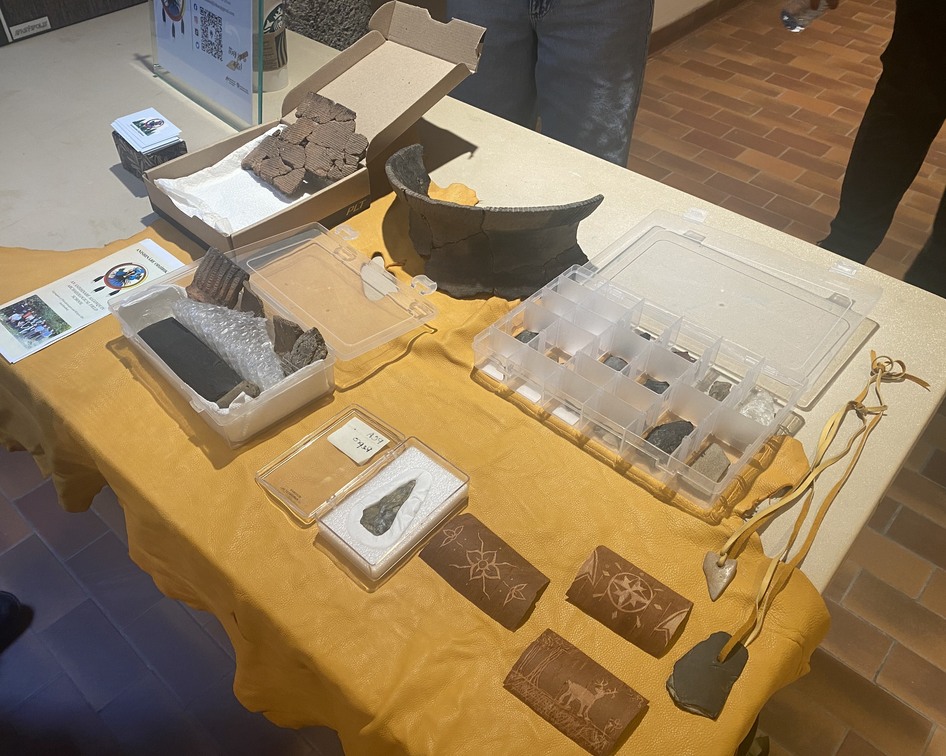 Artifacts presented by Anishinàbe Odjìbikan.
Dr. Jean-Luc Pilon has shared this excellent video, a guided tour as he explores the heart of our region: Paddling through the past - Ottawa-Gatineau's Ancient Cultural Landscape.
For thousands of years before colonial times, the members of Indigenous communities travelled from far and wide to gather at the meeting of the three rivers: the Ottawa, the Gatineau, and the Rideau; from the Chaudière Falls to the mouth of the Gatineau River.
This area is rich in natural resources — plants, animals, and fish, and also provided a convenient meeting place for trade and communication among communities.
Of special significance are the burial place at Hull Landing and the Chaudière Falls, a sacred place for meeting and sharing in ceremonies.
The burial grounds in the Ottawa-Gatineau corridor including Hull Landing were important for rituals of respect and bonding with the landscape. Victoria Island, located under the Portage Bridge, continues to provide this sacred space to local and visiting Indigenous people.
The National Capital Region, which includes the city of Ottawa, remains unceded Algonquin-Anishnaabeg territory.
We encourage our members and guests to reflect on this, our connected history, and ways we can contribute to reconciliation.
 Charles Ramus Forrest Chat Falls, Lake Chaudière on the Ottawa 1822
Source: HSO Member Margaret Back’s summary of Canadian Museum of History Archeologist (retired) Jean-Luc Pilon’s April 2017 presentation to our Society.
WCSHO Scrapbooks
Check out the Ottawa University project that digitized and analyzed selected scrapbooks from the Women's Canadian Historical Society of Ottawa: Scrapbooking Ottawa Historytemporarily unavailableScrapbooking Ottawa History.
Annual Reports
Several years of annual reports from the Women’s Canadian Historical Society of Ottawa (WCHSO), the precursor to the Historical Society of Ottawa, are available via the Internet Archive:
Women’s Canadian Historical Society of Ottawa: Annual Report 1910-11
Women’s Canadian Historical Society of Ottawa: Annual Report 1913-14
Women’s Canadian Historical Society of Ottawa: Annual Report 1914-15
Women’s Canadian Historical Society of Ottawa: Annual Report 1915-16
Women’s Canadian Historical Society of Ottawa: Annual Report 1916-17
Women’s Canadian Historical Society of Ottawa: Annual Report 1917-18
Women’s Canadian Historical Society of Ottawa: Annual Report 1918-19
Women’s Canadian Historical Society of Ottawa: Annual Report 1919-20
Women’s Canadian Historical Society of Ottawa: Annual Report 1920-21
Women’s Canadian Historical Society of Ottawa: Annual Report 1921-22
Thesis
In 2016, Connie Gunn wrote an incisive thesis regarding the WCHSO’s early decades. In her paper, Gunn credited the diligence of our early members in creating a personal, nuanced and meaningful depiction of our area’s history.
Gunn also noted how the fact that our early members were drawn from the elite, often with ancestral ties to the area, inevitably shaped their interpretation of history.
Empire and colonial society were frequently revered and romanticized. Clearly, certain issues (such as the residential school system, with which some of their husbands were closely connected) might have been worthy of greater attention.
As the first few decades passed, Gunn noted the eventual diversification of the WCHSO’s membership, and also a diversification of the Society’s storytelling, including more emphasis on some of the women of history.
See this link to view the full text of Connie Gunn’s detailed study of the contributions as well as shortfalls of our well intentioned founders and early members:
Transactions of the Women’s Canadian Historical Society of Ottawa
Transactions of the Women’s Canadian Historical Society of Ottawa - by Emma Kent
Between 1901 and 1928, ten volumes of articles or transcripts of talks presented at Women's Canadian Historical Society of Ottawa meetings were published under the series of 'Transactions’. According to the AGM reports the first 8 volumes appear to have titles and themes with this practice being dropped for the last few volumes. A reprint of Volume One was issued after Volumes Six and Seven. Under the presidency of Margaret Wilson, an eleventh volume was published in 1954.
Currently, we only have a few volumes that cannot scan the entries without destroying our copies. Still, for those interested in using the articles for research, here is a list of what each volume contains, any notes added by the Society, and we could provide photos of the article’s text upon request.
Volume One - “Early History of Ottawa and Counties”
Volume Two - “The Water Ways of Canada”
Volume Three - “ Early History of Ottawa and Hull”
Volume Four - “Early History of Townships, etc.”
Volume Five - “The Battlegrounds of Canada” - 1912 - Printed in Ottawa by The Esdale Press, Limited. C or Kent and Sparks Sts. Engravers, Printers ETC.
Page 5 - The Plains of Abraham by Mrs. Wilfred Campbell.
Paper read before the Women’s Canadian Historical Society of Ottawa, February 9th, 1912.
Page 19 - The Battlegrounds of Niagara Peninsula by Mrs. Thomas Ahearn
Paper read before the Women’s Canadian Historical Society of Ottawa, November 1909.
Page 37 - Battle of the Windmill, 1838 by Miss Amey Horsey
Paper read before the Women’s Canadian Historical Society of Ottawa,
Page 43 - Battles of St. Denis and St. Charles by Miss Kathleen O’Gara
Paper read before the Women’s Canadian Historical Society of Ottawa, January 14th, 1910.
Page 51 - Siege of the Long Sault by Miss Magdalen Casey
Paper read before the Women’s Canadian Historical Society of Ottawa, February 10th, 1911.
Page 61 - Battlegrounds of the North-West Rebellions by A.E. Attwood
Paper read before the Women’s Canadian Historical Society of Ottawa, December 9th, 1910
Page 71- The Heroine of Vercheres by Mrs. Walter Armstrong
Paper read before the Women’s Canadian Historical Society of Ottawa, January 13th, 1911.
Page 80 - Madame de la Tour by Miss M. A. Northwood
Paper read before the Women’s Canadian Historical Society of Ottawa, January 12th, 1912.
Page 89 - Louisburg - its two Sieges by Miss Eva G. Read.
Paper read before the Women’s Canadian Historical Society of Ottawa, March 8th, 1913.
Page 96 - The Hero of Chateauguay by Madame S. Lelievre
Paper read before the Women’s Canadian Historical Society of Ottawa, March 12, 1909.
Volume Six - “Treaties Relating to Canada, 1632 - 1872” - Printed in 1915
Page 5 - Forward on the General Subject of Treaties.
Being the Introduction to Mrs, Bayly’s Paper on “The Treaty of Paris,” the first of the series as arranged to be given before the Society.
Page 11 - St. Germain-en-Laye.
A Treaty between Lewis XIII King of France and Charles I King of Great Britain the Restitution of New France, Acadis and Canada, and the Ships and Merchandises taken on Both Sides, March 29, 1632.
Page 25 - The Treaty of Breda (1667) - Rysmick (1697)
(Page 25) Treaty of Ryswick, 1687.
(Page 31) Treaty of Ryswick, 1697.
(Page 37) Treaty of Breda, 1667.
(Page 38) Treaty of Ryswick, 1697.
Page 40 - Treaty of Utrecht by Cordelie E. Rheaume given on March 12th, 1915.
Page 46 - Treaty of Aix-la-Chapelle, 1748. By Alice B. Lelievre .
Page 52 - The Treaty of Paris, 1763 by E.D. Bayly.
Page 62 - Treaty of Versailles, 1783 by Jenny Russell Simpsom
Page 73 - Treaty of Ghent by Muriel G. Shortt. Given on Dec 12th, 1913.
Page 84 - The Ashburton Treaty by Hazel Biggar given in January, 1914.
Page 92 - Treaty of Washington, 1871 by Edith M. McLean given on March 14, 1913.
Page 104 - Reciprocity Treaty of 1854 by Agnes M. Davis given on February 13th, 1914.
Page 113- Some Confederation Reminiscences of the Hon. Senator Costigan by his daughter Teresa Contigan Armstrong Given on March 10th, 1914.
Reprint of Volume One
Volume Seven - “Historical Collection”
Page 5 - Reminiscences of Bytown by Mrs. Jenny Russell Simpson
Read before the WCHSO on Feb 11th, 1916.
Page 12 - Toronto University by Helen McLean of 292 Daly Ave, Ottawa
Read before the WCHSO on March 10th, 1916.
Page 16 - The Settlement of the Country of Lennox and Addington by Mrs. Annie Rothwell Christie
Page 26 - My Native County - Glengarry by Mary Gerenish H. Foran - December 10th, 1915
Page 38 - The Cairn by Mary Masson
Page 42 - Nova Scotia by Alberta T. Somerville
Page 59 - The History of Canada in Sixty Lines by T. Chisholm, M.D., ex-MP and read before the WCHSO by Mrs. Simpson, Nov 10, 1917.
Volume Eight - “Personal Recollections of Bytown and Early Ottawa”
Page 5 - Philemon Wright and the Settlement of Hull by Hon. Justice Latchford.
Read February, 1921 before the WCHSO.
Page 20 - Notes on some of the Prominent Citizens of the Early Days of Bytown by Leopoldine Beauchamp Pigeon.
Page 23- Bytown to Ottawa, 1827- 1877 by William Pittman Lett.
Short Panoramic View of Ottawa History, Written in its Jubilee Year by William Pittman Lett, City Clerk.
Page 34 - Reminiscences - How Peace was Preserved in the Days Gone by.
This paper, read some years ago before the Perth Historical Society, has been presented to the WCHSO by Miss Clara B. Armstrong, Perth, Ont.
Page 38 - Bytown in 1837. By H. P. Hill
Page 52 - Bytown Election of 1841 by H.P. Hill
Page 63 - Memories of Bytown by W.H. Cluff - January 1920.
Our First Telegraph Line (page 68)
Road from Upper Town to Lower Town (page 69)
Freight and Passengers in the Old Days (page 72)
The Military Graveyard (page 74)
The High Cost of Living in the 1840’s and 50’s (page 74)
When the Spark Estate was put on the Market (page 75)
Page 77 - History of The Ottawa Fire Department - Showing its development with the Growth of the city, from its Earliest Volunteer Organization up to the Present Time by John W. Graham, Chief Fire Department.
Page 89 - A Glimpse of the Capital in 1849 by Marion Jamieson
Page 94 - On Early Patents for Inventions Granted to the Residents of Ottawa by William J. Lynch, I.S.O., Chief of the Canadian Patent Office.
Volume Nine - 1925
Page 5 - Bytown, 1834 to Ottawa, 1854 by George R. Blyth.
A copy of the reminiscences of Mr. Geo R. Blyth of the City of Ottawa. They were given to Mrs. Ells of the committee appointed to collect the memories of old residents of the City. - M. A. Northwood, Secretary of the Committee.
Page 16 - Burning of the Parliament Buildings at Montreal in 1849 by J.Jones Bell
Page 21 - The Chelseas on the Gatineau by Mary MacKay Scott
Page 26 - Early Settlements of the Meach Lake by Ethel Penman Hope
Page 34 - The First Missionaries of Hull by Louise Belisie
Page 40 - Hugh Macdonell by Kate Casgrain
A United Empire Loyalist of the Revolutionary War, 1775-83 (Lieutenant, 1st Battalion, Kings’ Royal Regiment of New York). M.P. for Glengarry in the first Parliament of Upper Canada, Volunteers Regiment of Foot, 1796-1802. First Adjutant-General of the Militia in Canada and founder of the Militia system, 1792-9. British Consul- General at Algiers, 1811-1820.
A great record of splendid service of a pioneer Canadian and his family.
Page 48- Castine by Lucienne C. Roy
Page 56 - The Founder of Toronto by Lucienne C. Roy
Page 59 - The Duke of Kent and a Famous Minuet by Lucienne C. Roy
Page 61 - The Colours of the Fenian Invasion, 1870 by Luceienne C. Roy
Page 62 - The Indian Chapel of Tadoussac by Edith M. Maclean
Page 67 - A Social Life in Old Quebec by Edith M. Maclean
Page 79 - The Fur Trader’s Better Half by Lawrence J. Burpee
Page 91 - Sir William Johnson by Mary Garenish H. Foran
Page 98 - Some Canadian Women of 1812-14 by Ernest of Green
An Address delivered before the Society in the Bytown Museum, December 14th, 1923.
Page 110 - Experiences in the Yukon, 1901 by O.P.R Ogilvie
At the conclusion of the paper, about thirty-five very attractive pictures of the Yukon were shown.
Page 116 - The Iroquois, An Historical and Ethnological Sketch by F. W. Waugh, Division of Anthropology, Geological Survey.
Page 126 - The Naskopi Indians of Labradors and their Neighbors by F. W. Waugh, Division of Anthropology, Geological Survey.
Page 137 - The Eskimos, Their History and Future by D. Jenness
Paper read before the Women’s Historical Society, January 12, 1923.
Page 142 - Indian Legends From Vancouver Island by Edward Sapir
Then Dr. Sapir then gave two interesting examples of the type of myths and legends prevalent among the Nootka Indians of Vancouver Island. He read his own literal translation of a myth entitled: “What Mosquitoes Are Made Of” and a legend “Always-Lifts-Up” and “Sore-Headed Whales”. These valuable examples of Indian folk-lore are in the Articles of the Museum and may be seen and read on request.
Volume 10
Page 5 - Ottawa. 1867-1927. Something of her history during the sixty years since Confederation by Mrs. C. H. Thorburn
Written for and read before The Women’s Canadian Historical Society of Ottawa, February 10th, 1928, by Mrs. Charles H. Thornburn.
Page 30 - North West Rebellion. By Grig-Gen. General C. F. Winters
January 9th, 1926.
Page 39 - Governors of Canada by C.A. Gullock
Page 55 - Lecture on the Choice of Ottawa as the Capital of Canada by Mr. Arthur Beaucheane, M.A., F.R.S.C, Clerk of the House of Commons.
Page 62 - The Celebration of the Diamond Jubilee of Confederation by C.G Cowan, Honorary Secretary of the National Diamond Jubilee Committee, Ottawa, September, 1927
Page 74 -The Peace Bridge and Confederation Celebration Elsewhere in Canada by Eva G. Read
Page 84- Some Historic Buildings in Ottawa by Mary McKay Scott
Paper read before The Women’s Canadian Historical Society of Ottawa, Jan. 13, 2028.
Page 93 - Early British Canadian Heroines by Mrs. J.R. Hill
Page 94 - Mrs. Susanna Moodie.
Page 99 - E. Pauline Johnson, condensed from “Flint and Flatter”
Page 102 - Barbara Heck From Barbara Heck by Dr. Withrow
Page 114 - Some Pioneer Women of French Canada by Mrs. G. J. Desbarats
Read at the Meeting of The Womens’ Canadian Historical Society of Ottawa, Friday, January 14th, 1927.
Page 136 - The First State Trail in Lower Canada by Col. Rene de Salaberry
Page 147- Sketch Life of Thomas D’arcy McGee by Mrs. E. J. Doyle
Page 152- The First Jesuit Mission of Fort Ste. Marie by Mrs. E.J Ashton
Read before the Women’s Canadian Historical Society of Ottawa.
Page 163 - Canadian Art and Artists by Mrs. O.J. Jolliffe
Page 170- Canadian Unity ad Quebec by Dr. S. Marion
Volume 11 - 1954 - Printed by Leclerc Printers Limited, Hull, Canada
Page 5 - The Bytown Museum
Page 7 - Side-lights on the Ottawa-Rideau Waterway to Upper Canada by Thomas Dunbabin
Page 17 - Sarah Olmstead by Brigadier R.M. Gorsline
Page 20 - St. James Anglican Church, Hull, Quebec by Annie M. Findlay Fee
Page 24 - John Burrows Honey (An Early Resident of Bytown) by Dr. H. T. Douglas
Page 27 - The Last Days of Bytown by Anne Dewar
Page 37 - The Choice and Acceptance of Ottawa as the Capital of Canada by Sheila I. Stewart
Page 42 - Ottawa in the Seventies by Lieutenant-Colonel C. P. Meredith
Page 46 - My Recollections of Laurier House by Lilian Scott Desbarats
Page 51 - The History of the Blue Church by Barbara Jones
Page 55 - A Pioneer Community in Beckwith Township, Lanark County Upper Canada 1818 Locally Known as “The Derry” by Bertram Reid MacKay
Page 63 - Terminal Note
Historical Reflections Relating to the War by Sir Clifford Sifton, K.C.M.G, P.C, K.C. Chairman of Commission of Conservation Canada - November 4th, 1915.
- Address delivered by Sir Clifford Sifton under the auspices of the Women's Canadian Historical Society of Ottawa, November 4th, 1915
To mark Black History Month, our February 22, 2023 Virtual Speaker Series presentation featured Glenn Sweazey, who revealed to us the (gradual) end of slavery in Upper Canada. Glenn spent his career as a High School English teacher and is now a writer living in Ottawa. His work weaves elements of poetry and prose to create a narrative tapestry. He is a teller of stories with a story to tell.
Glenn was introduced to us by June Girvan, President of Black History Ottawa, with whom HSO is proud to partner for this presentation. June, originally from Jamaica, has spent over 6 decades in Canada and is a noted educator and activist. She established the J’Nikira Dinqinesh Education Centre (JDEC), named for her children, in Ottawa. The JDEC commemorates pioneers who championed anti-slavery, human rights and social justice in Canada, and bequeathed to us, our North Star legacy. June remained with us through the evening, adding additional information and valuable insight, especially during the question and answer period that followed Glenn’s formal presentation.
Glenn reminded us that what we generally know and learn is often a narrative myth in which some facts, and some voices, are selectively forgotten. In the case of slavery in Upper Canada, what we “know” is that Upper Canada was the terminus of the Underground Railroad, a safe and welcoming sanctuary for slaved people escaping the plantations of the southern United States. As Ontarians, what we have forgotten is our own history of slavery and the voices of those who were enslaved.
Slavery in Upper Canada, (part of Quebec until 1791), took a dramatic jump following the end of the American Revolution in 1784. In 1790, the British Government passed the Imperial Act, which encouraged loyal subjects to move north with their "possessions", which included their enslaved people. This led to an estimated 500 – 700 slaves being held in Upper Canada in the 1790s.
Glenn related the story of Chloe Cooley, an enslaved person living in the Niagara-on-the-Lake area. In March of 1793, she was beaten, bound and taken by boat across the Niagara River to the USA by her owner Adam Vrooma and sold. Her cries of protest did not help her, but they were heard and reported to the authorities, and served as a spark to the anti-slavery movement in Upper Canada. In July 1793, John Graves Simcoe, the first Lieutenant-Governor of Upper Canada signed into law “An Act to Prevent the further Introduction of Slaves and to limit the Term of Contracts for Servitude” (also known as the Act to Limit Slavery in Upper Canada).
Glenn explained that the Act was, by necessity, a compromise, as many members of the Legislature were themselves slave owners. Thus the Act did not free existing slaves, but did ban the import of new slaves, and freed those born into slavery in Upper Canada subsequent to the Act, once they reached the age of 25. Even this was too much for some and an attempt was made in 1798 to effectively overturn the 1793 Act; the attempt failed when the Legislative Session came to an end before it could be voted on by the upper chamber, the Legislative Council.
Slavery continued in this modified form and Glenn recounted the story of Peggy Pompadour, who with her three children was owned by a prominent member of the Legislature, Peter Russell. Glenn read to us an ad placed by Russell in February 1806 offering Peggy for sale for $150 and her son, Jupiter, for $200. Financing could be arranged and a discount for a straight cash payment was offered.
Slavery might have continued to carry on in this manner for quite some time had events in another British Colony not raised the alarm. In December 1831, a slave revolt erupted in Jamaica led by Samuel Sharpe (aka Archer), himself a slave and a Baptist Deacon. The violent uprising shocked the British Parliament, and on August 28, 1833 the Slavery Abolition Act received Royal Assent, ending slavery in most of the British Empire. The Act became effective the following year, August 1, 1834, but in implementation most slaves remained indentured as “apprentices”, for four more years while they “learnt how” to be free. Glenn and June pointed out that the freeing of the slaves came with compensation, to their former owners for the loss of their property, not to the former slaves, who were left to fend for themselves.
The year 2023 marks the 230th anniversary of the Act to Limit Slavery in Upper Canada and the 190th anniversary of the Slavery Abolition Act. Despite this passage of time, echoes of the era of enslavement remain. We still choose to honour those who owned slaves through the use of their names as places and streets within our communities.
To view a complete recording of Glenn’s presentation, see the video on the HSO YouTube channel.
Our Zoom presentation of March 29, 2023, attended by over 100 participants, featured noted author Michael McBane. Michael, a staunch advocate for public health care and improved public services, was the first recipient of the Social Justice award from the Canadian Centre for Policy Alternatives. His extensive research, including personal letters, memoirs, proceedings of the Legislature and the British Parliament and contemporary newspaper coverage painted a vivid picture of the typhus outbreak in Bytown in 1847. Michael pointed out that the events can be seen as the coalescence of three different stories: the story of the Great Irish Famine, the story of early Bytown, and the remarkable story of Élisabeth Bruyère.
The Great Famine, 1845 – 1852, was focused on Ireland’s poorest people in the west and south of the island and resulted in the death of approximately 1,000,000 and created about 1,900,000 refugees. The worst year of the famine, 1847, also known as “Black 47”, alone saw 100,000 emigrants to British North America, with 20,000 of these dying on the voyage. British North America was a convenient destination, as lumber ships crossing to the British Isles did not want to return empty, and the Irish made a ready cargo. Michael discussed the three prevailing views on why the famine was so deadly. The Nationalist view that the famine was primarily politically motivated and should be considered as a genocide perpetrated against the Irish people by the Government of the United Kingdom; the Revisionist view that the famine was primarily a natural occurrence and that little blame can be placed on the politicians of the day, and finally, the post-Revisionist view that the famine resulted from a combination of factors including poor economic practices and political mishandling.
Michael described Bytown in the 1840s as a rough-and-tumble town of about 5,000. Though small, it was both physically and socially divided. Uppertown, to the west of the Rideau Canal, was primarily powerful, prosperous and Protestant, while Lowertown was primarily a mix of the poorer Irish and French Catholic working class. Bytown and the greater Ottawa Valley was an attractive destination for Irish immigrants. The Irish had come to the area in several waves, including veterans of Wellington’s army after the Napoleonic wars and the workers involved in the building of the Rideau Canal. The Ottawa Valley had become an Irish diaspora. These strong family ties would become critical to the survival of many of those who fled the famine in Ireland only to find that a plague had accompanied them.
In 1845, the 27 year old Élisabeth Bruyère came to Bytown, leading a small party of Sisters of the Grey Nuns of Montreal. Highly motivated, skilled and organized, the Sisters soon recognized the needs of the community, which lacked any social services at that time. In response, they soon opened the General Hospital, a home for the aged, an orphanage, a bilingual school, and were delivering home services to the poor. Michael read part of a letter to us from Élisabeth Bruyère written in May 1847 which revealed her awareness of the looming tragedy, her fears for her own life, and her steadfast commitment to care for all those who needed it.
The typhus outbreak began in Bytown in June 1847 as the Irish refugees arrived. They came from Montreal, either up the Ottawa River, or up the St. Lawrence to Kingston and then along the Rideau Canal, journeys of between 3 and 7 days. The immigrants were packed onto barges, standing room only, and towed by steamboat. This profit-driven treatment of the newcomers was stated by one observer as being “shameful cruelty”.
Élisabeth Bruyère had prepared. She had opened a temporary hospital, which would grow to three wards and accommodate 60 patients. Each ward was staffed by a French nurse, an Irish nurse, and two volunteers. When the refugees arrived they entered one of four Fever Sheds, which Michael pointed out were located approximately where the National Arts Centre is today. The Sisters bathed, shaved and deloused all the newcomers, transferring the most serious cases by cart to their temporary hospital. When the Fever Sheds became full, military tents on Barracks Hill, now Parliament Hill, held the overflow. As no one else would handle the Irish newcomers, the Sisters not only cared for the living, but for the dead as well. The Sisters placed them into coffins, gave them funeral services, and transported them to the cemetery, now MacDonald Gardens Park.
Though the community grew in general to admire and support the work of the Sisters, there were those who found fault. Three Protestant Ministers accused the Sisters of proselytizing, apparently because one patient did convert to Catholicism during their treatment. Michael pointed out however, that it seems likely that the real motivation behind the complaint was that the work was being headed by a Catholic, and even worse, a young woman.
A year later, the epidemic had passed and the temporary hospital was closed. Of the 531 victims of all faiths treated in the hospital, 163 had died, with over 400 dying in the community as a whole. The Sisters had 17 of their number infected, but fortunately (miraculously?), none died. A Presbyterian minister, Reverend William Durie, who worked closely with the Sisters, did however die from typhus and is now buried in Beechwood Cemetery. With the crisis now passed, the government refused to repay the Sisters for their expenses, roughly £925, claiming them to be “unnecessary and extravagant”. Public admiration of the heroic work done by the Sisters and sympathy for their cause was reflected in the Bytown Packet, now the Ottawa Citizen, which encouraged voters to take out their anger with the government at the polls in the upcoming election. Three days later, the bill was paid, but the government was still defeated.
Michael suggested that the compassion shown by the community, as led by Élisabeth Bruyère, established a standard of behaviour to newcomers that is reflected to this day. Their commitment may well be seen in Ottawa’s welcome to the newcomers from South East Asia through Project 4000, and by Canadians as a nation when we welcome refugees from Syria and the Ukraine.
You can order a copy of Michael’s excellent book “Bytown 1847: Élisabeth Bruyère & the Irish Famine refugees” by emailing him at This email address is being protected from spambots. You need JavaScript enabled to view it..
You can view Michael’s full presentation here on the HSO YouTube Channel.
Ottawa-Bytown in 1847
What fate awaited the typhus-stricken Irish Famine refugees upon their arrival in early Bytown?
Michael McBane, author of 'Bytown 1847, Élisabeth Bruyère & the Irish Famine refugees', explores the shocking tragedy and inspiring heroism that emerged during that era of great crisis from Ottawa's past.
Media
Sam Laprade is a graduate in Public Relations from Algonquin College and a Certified Fund Raising Executive. Her passion is to help non-profit organizations achieve their missions through effective fund raising. Her diverse life experience, including work with non-profits, work in the corporate sector, support for municipal politicians and broadcasting, has led her to believe that the most effective journalist is the one who puts their whole-self into their work. Sam does this, appearing daily on both radio and television.
On Friday, March 13, 2020, the Global Pandemic, what we now call Covid 19, hit Canada hard and all our lives suddenly changed. On Monday, March 16, Sam approached the station management at CityNews suggesting that she take the 2-hour slot usually featuring a podcast and use it to inform and talk with their listeners about the pandemic. They agreed, giving her the slot for 2 weeks, confident that it would then all be over.
Turns out, it wasn’t.
Unlike many, who were able to work from home, Sam went into the studio every day from then on, her first day-off being Mother’s Day, May 10. During that time, the small team at the station lived in fear, eventually stringing shower curtains between themselves in an attempt to remain safe. They also developed a set of contingency plans, should they lose colleagues on their team or in their sister stations. Sam’s 12-year-old daughter was equally gripped, watching as her mother went off each morning, not knowing if she would return home infected.
Sam’s approach to the situation was “Kind Radio”. She spoke with everyone, health professionals, politicians, restaurateurs, business owners, seniors, mothers' groups, even a 12-year-old girl who was painting rocks and leaving them around her community as a sign of hope. It was important to give everyone a voice, to listen to their concerns, to let them share their own stories and to become their virtual neighbor sitting at their kitchen table with them. The success of Sam’s approach locally led to her program being broadcast on other stations in different parts of the country.
Sam recalled that it was a divisive time and when mask and vaccine mandates came into effect, some segments of the population transitioned from fear and frustration to anger and hate. As tempers rose, Sam tried to keep things calm by ensuring those who just wanted to spread misinformation could not use her station as their platform. Despite this, the station faced protests, needing to call for police assistance on at least one occasion. They were also targets of online abuse. One case involved an anonymous regular listener routinely contacting them with a one-word attack, “Sheep”. It would seem that Sam’s reporting did not agree with the views of that particular listener.
There were some very hard days. On April 19, 2020, a mass shooting took place in the Halifax area. Sam’s show was, at that time, being broadcast in Ottawa, Kitchener and Nova Scotia. Sam struggled to maintain the balance of providing the “normal” Covid coverage to her Ontario listeners, while supplying the critical news updates needed by her listeners in Nova Scotia.
It is now three years on and hard to remember when the news cycle was suddenly restricted to just one story. It was a time when we were not concerned about the price of groceries, but if we could safely get groceries, a time when we found we could only see our loved ones through a window, a time when all we knew for certain was that we knew nothing for certain. It was a time when the vaccine we most needed was hope, something Sam injected into our community on a daily basis.
You can hear the Sam Laprade Show on City News.
With Grapefruit League baseball now underway in Florida, the Historical Society of Ottawa offered its own double header on March 8, 2023, at the Main Branch of the Ottawa Public Library. Both sessions focused on the importance of making connections and building the community. Leading off was Phil Rossy who spoke on the long and continuing involvement of the Kiwanis Club of Ottawa in the development and delivery of community services in Ottawa. Next up was Sam Laprade who reflected upon her role as a radio host during the early days of the pandemic. Both Phil and Sam knocked it out of the park.
Phil Rossy has been a member of the Kiwanis Club of Ottawa for 23 years, having served both as Club President and as the President of the Kiwanis Eastern Canada and Caribbean District. He has over 40 years of Hospitality experience in Hotel and Restaurant Management as well as contract management and consulting in Hospitals, Long-term Care and Retirement Communities. Among his many roles, Phil is also an educator, being the coordinator and principal developer of the Retirement Communities Management Program at Algonquin College.
Phil gave us some of the highlights of the long history of the Kiwanis Club of Ottawa. Sixty-two members attended the Club’s first regular Friday lunch, which took place on the 7th of December 1917 at the Chateau Laurier. These bimonthly lunches continue to this day, now at the Ottawa Hunt and Golf Club. Receiving their official Charter in 1918, with W. G. Keddie becoming the first President, they set right to work by providing transportation from Union Station for returning veterans. Like many organizations founded at that time, membership was restricted to men. This changed in 1990, when Shirley Tomblin became the Club’s first female member.
The Club has always had a sharp focus on the needs of children. It founded the Kiwanis Boys Club, now the Ottawa Boys and Girls Club, in 1924 and Camp Banting, a special summer camp for children living with Diabetes, in 1953. In 1942, the Club established the 211 Kiwanis Air Cadet Squadron, which it supports to this day. Club members currently provide a reading program for kindergarten students, while the Club also supports 8 Key Clubs in local High Schools, and two Circle K Clubs in our local universities, providing leadership opportunities for these youth.
The autonomous nature of Kiwanis allows individual Clubs the flexibility to respond to the specific needs of their own community. Thus, over the years, the Club has supported the Kiwanis Music Festival and Special Olympics and supports the Youville Centre, providing services to young mothers and, much earlier, the Club even recommended the formation of the Better Business Bureau to our City Council.
Though Kiwanians are far from shy about rolling up their own sleeves, volunteer hours being a membership requirement, they are also well known as effective fundraisers. Many fondly remember the Kiwanis TV Auction and the Kiwanis Duck Race, from years gone by, and today, the Kiwanis TV Bingo is very popular, and provided a much-needed diversion during the early days of the pandemic. The funds raised stay in our community, with organizations such as C.H.E.O. being major recipients.
The Kiwanis Club of Ottawa remains a vibrant organization. There are 120 current members, with King Charles III being their most notable honorary member. The members, bound in fellowship and their determination to help where needed, stand ready and willing. Phil reminded us that there will always be those in our community who fall through the cracks and so always a need for those, like the Kiwanis Club of Ottawa who are prepared to step in where needed. Ottawa Kiwanians can be justly proud of their long and ongoing contribution to the betterment of life within our city and they welcome any interested in lending their hearts and hands to join them in their work.
You can learn more about the Kiwanis Club of Ottawa at www.ottawakiwanis.org
SORRY, this event is full!
The Historical Society of Ottawa, in partnership with the Ottawa Public Library and Rogers TV, is presenting a three-part lecture series, featuring renowned author, columnist, singer songwriter Phil Jenkins, which will take place at the Ottawa Public Library's Sunnyside Branch, on three consecutive Saturdays — April 15, 22 & 29, 2023 11 a.m. to 1 p.m. each day.
Through the years, many have enjoyed Phil Jenkins' music, his columns in the Ottawa Citizen and his award-winning books such as "An Acre of Time" and "River Song". We hope you'll join us!
Attendance is free but we strongly recommend signing up early as spaces are limited. You can choose from either of two links to pre-register, through Eventbrite or through the Ottawa Public Library's website.
(Rogers TV has been invited to video-record the three lectures to be preserved for posterity's sake.)
Quick Links
About
Supporting Partners