

Working to preserve Ottawa's past
for future generations.
Dave Allston is a ‘trash talker’. Specifically, on the afternoon of Saturday, January 27, 2024, he talked to the Historical Society of Ottawa at our first in-person presentation of 2024 on how the Ottawa River shoreline was reshaped during the early 1960s using garbage. Dave is the senior asset manager (heritage) at National Defence and also an author, columnist, researcher, and runs the blog, The Kitchissippi Museum. He was making his 3 rd presentation to the Society. The session, which was hosted by the Main Branch of the Ottawa Public Library, received a record turnout of 113 attendees, who were captivated by Dave’s account.
Dave explained to us that in 1959 the City of Ottawa was facing a major problem. The two municipal dumps, one on Riverside Drive and the other on Raven Road, were both reaching capacity and would need to be closed within two years. A solution was urgently needed. Likely inspired by Toronto’s redevelopment of their waterfront and similar work in other cities, in February 1959 the Ottawa Works Commissioner, Frank Ayers, recommended to the Board of Control that Nepean Bay, which lay just to the west of the current site of the Canadian War Museum, could be used as their new landfill site. The Board directed him to approach the National Capital Commission with the idea. Their response was immediate and enthusiastic. The NCC had envisaged creating a giant beach along the Ottawa River along with a large playground and other recreation facilities, but had no clear plan for how to proceed. The City’s proposal was approved in one week. The scheme, part of the NCC’s implementation of the Greber Plan, would eventually also encompass Lazy Bay just north of Laroche Park and Bayview Bay between the Lemieux Island Bridge and the Chief William Commanda Bridge.
The plan was simple. Build a causeway across the mouth of the bay that would both seal it off from the river and provide a roadway for the garbage trucks to dump their loads. They would then pump out the water from behind the causeway; the bay was only 4 or 5 feet deep. Ignore the many feet of water-rotted sawdust that covered the bottom of the bay, a by-product from the lumber industry. Then fill the whole thing with garbage, finally to be covered by rock and a thick layer of soil. Presto, 50 acres of new land created and a temporary end to the garbage crisis. Work commenced on the causeway in the early months of 1962 and the dump was opened during the week of March 4, 1963.
There would be a massive amount of rock required to build the causeway, which would extend west to Lazy Bay. Dave explained that fortunately, there were other major projects underway in Ottawa at that time, which both provided the necessary rock for the causeway and a convenient disposal solution for the other projects. Tunnelling for the Ottawa Interceptor and Outfall Sewer project would create millions of tons of rock. The tunnels ran from Booth Street under Wellington past the Chateau Laurier and east through to the new sewage disposal plant at Green’s Creek. At this time, Ottawa pumped all its raw sewage directly into the Ottawa River. The new treatment plant would partially treat this sewage, the City feeling that it was not worth the additional expense to fully treat the sewage as the communities upstream continued to pump their sewage into the river untreated. A second excavation project to entrench what is now the OC Transpo’s Trillium Line and take it underneath Dow’s Lake, also provided rock for the causeway. Finally, the major excavation project involved in the construction of the National Arts Centre would provide the fill needed to cover all the garbage once the dump was full.
With the closure of the Riverside Drive landfill on March 9, 1963, all city garbage was sent to the new site, which was expected to have a lifespan of two years. The city even placed ads in the newspaper to encourage their citizens to bring their own garbage to the new dump. Dave revealed that there were other factors at play that would dramatically shorten the life of the new landfill. The National Capital Commission had begun an urban renewal project in LeBreton Flats in 1962 and as residents of the area moved away, their former homes and businesses remained empty. It didn’t take long until this proved to be a problem, encouraging squatters, cases of arson and a range of other undesirable activities. As such, the NCC began demolishing the structures as soon as they became vacant, and as the new city dump in Nepean Bay was handy, the remains were carted there. The result was that the dump filled quickly and was closed on February 1, 1964, less than a year after it opened.
By this time the NCC had abandoned their grandiose beach plans in favour of simple parkland, other uses, and a parkway, now known as the Kichi Zībī Mīkan. This meant excavation of thousands of tons of the recently buried garbage and transferring it west to either Bayview Bay or Lazy Bay. Although the parkway provided a scenic drive and a much needed west – east link, it also separated the communities from the river and areas that had traditionally formed part of their neighborhood.
Dave reminded us that this all happened over the span of a few years some 60 years ago and that today few are even aware that this took place. This is true even for some members of the National Capital Commission. As new development is proposed and eventually undertaken in these areas, such as the construction of a number of embassies on Lazy Bay Commons, do the planners know what to expect? Will the solution to our garbage crisis of 1959 come back to haunt us in the years ahead, and, as we face the same problem again, what lessons are to be learned from our response back then?
Earlier on the morning of January 27, 2024, CBO-FM featured an interview between Dave and the host of their program “In Town and Out”, Giacomo Panico. The interview carries additional information on the topic and can be heard at: Ottawa River shoreline made out of garbage | In Town and Out with Giacomo Panico | Live Radio | CBC Listen.
In 2023 we asked ourselves the question – are there ways the Historical Society of Ottawa can be of assistance to teachers who would like to expand their students knowledge of the Ottawa area’s local history?
To that end, we have assembled an “Educational Resource List” and have made it available on our website. This Educational Resource List consists of more than 30 helpful links to specific stories from Ottawa’s past as well as links to additional resources. The links include short essays, pamphlets and video presentations from our own website, as well as links to third party resources that we strongly recommend. Various resources are suitable for group learning activities and/or independent study assignments.
We are happy to meet with teachers to further explore how we can be of assistance. We can also arrange for speakers to come to your classroom or to arrange walking tours. All free-of-charge. We are a non-profit, all-volunteer organization. It has been the Society's goal (since 1898!) to increase awareness of the Ottawa area’s fascinating history. (See Educational Resource List for full details and contact information.)
We welcome any suggestions you may have for the Educational Resource List. We hope to make it a resource that we can continually build upon.
Please let us know if you would like to part of the group of teachers who receive regular updates from us regarding our resources — and please feel free to share with other educators!
Born in Kemptville, Ontario (Canada West) on October 6, 1842 to Elizabeth “Melinda” Pierce and Joseph Lockwood, Alvira Lockwood, the eldest of eight children, was one of Ottawa’s earliest photographers, as well as the city’s first professional female photographer, and likely, its youngest. Her vast catalogue has been all but lost over the years – her negatives destroyed by fire or discarded, her photographs rare and mostly in private holdings, and her pioneering work largely unknown outside of local photographic circles. However, her impact on the development of photography, and of the art scene in general in Ottawa was undeniable.
From a young age, Alvira began her informal education in the photographic process by assisting her father Joseph, a traveling daguerreotype artist originally from Madrid, New York. Throughout the 1840s, Joseph operated via a horse-drawn portable photography saloon in Carleton and Lanark Counties, as well as in upper New York State and western Quebec with partner George Martin of Montréal.[[1]] In 1851, after several itinerant years, the Lockwood family settled in Bytown and built a home and studio on Sparks Street. Joseph’s studio, Lockwood’s Daguerrean Gallery, advertised daguerreotypes, melainotypes, and ambrotypes, and dealt in photographic supplies.[[2]] The home was said to have been quite conspicuous, being the first building at the western end of Sappers Bridge.[[3]] Unfortunately, by early 1859 the landowner, Sir Henry Egan, notified Joseph of his intention to reclaim the land and the home was pulled down. Lockwood Studio then moved into a space over Scott’s Confectionary on the southwest corner of Sparks and Elgin Streets.[[4]]
Sadly, Joseph Lockwood died of consumption in 1859, and ownership of the business passed to Melinda. Alvira, who was just 12 years old at the time of her father’s death, was ever-present in the studio and knew the business and the photographic process well. She later stated, “from the time I was seven years old I had always been around the studio” and, “at fifteen I was a full-fledged photographer.”[[5]]
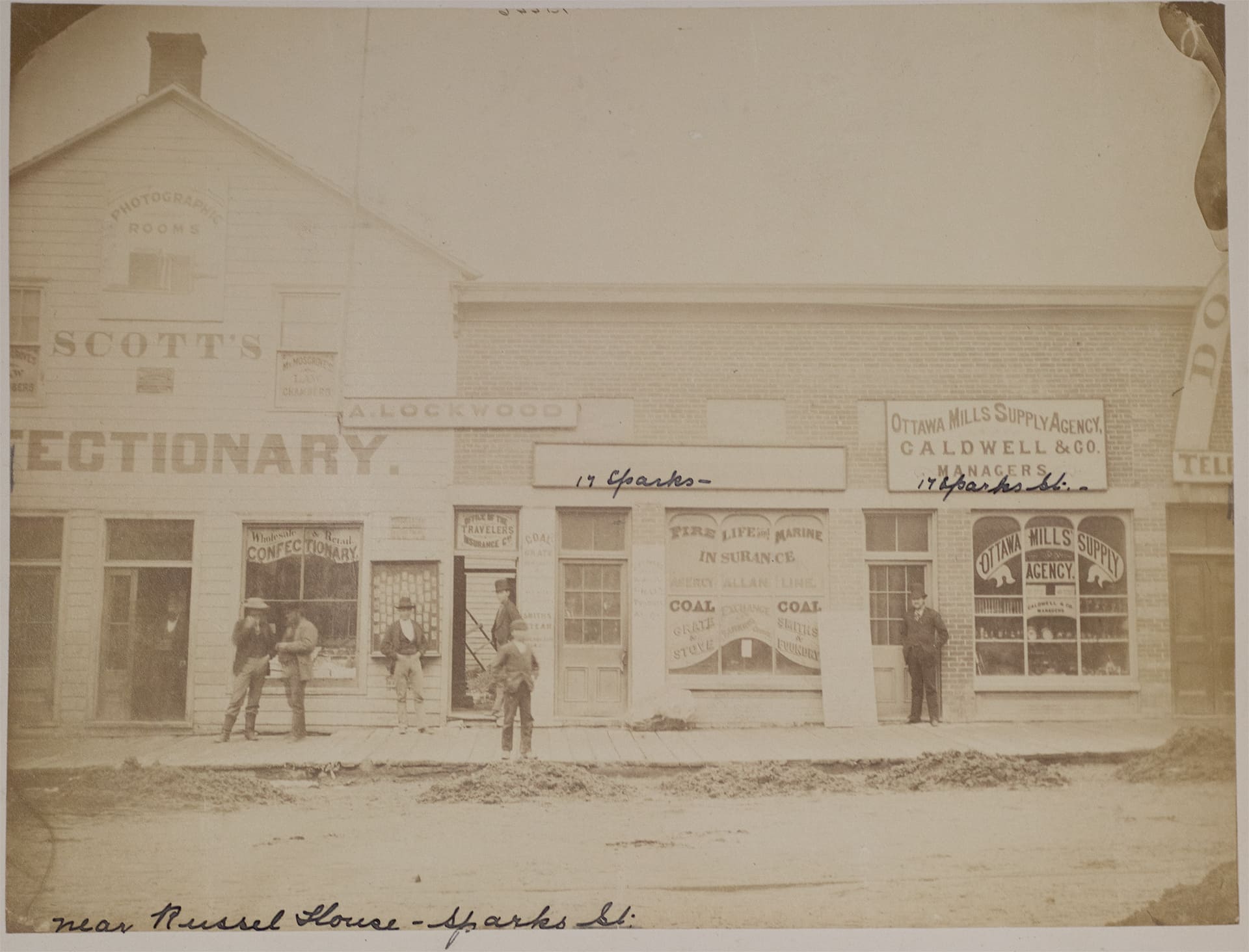 Figure 2 Notman Studios, William James Topley (attrib.), Sparks Street Storefront (detail), c.1870, City of Ottawa Archives, MG597.
By 1863 Alvira began operating the studio under her own name. Her studio at 15 Sparks Street (renumbered 44 Sparks Street after 1875) was adorned with a simple sign that read “A. Lockwood,” with a larger sign featuring an image of an old daguerreotype camera (a nod to her father’s earlier work) and reading “Photographic Rooms” at the building’s gable.[[6]] Alvira’s photographic work focused almost exclusively on portraiture. By the later part of the 1860s she was producing mostly carte-de-visite prints and cabinet cards, which were more accessible to the burgeoning middle class than earlier cased photographs.
In 1870, Alvira had built a house on Rideau Street (between Nelson and Friel Streets), where she lived with her mother, and where she also maintained both an office of sorts and her amateur painting studio.[[7]] On March 19, 1872, the home was destroyed by fire. In the aftermath, the Ottawa Journal reported that many citizens had “joined in making up a purse… as a tribute of their regard… to a most deserving lady on the occasion of [Alvira’s] recent trouble.”[[8]] Following the fire, Alvira continued her work in Ottawa, operating on Sparks Street while living in the up-and-coming Sandy Hill neighbourhood.[[9]]
Alvira closed her studio in 1883 to pursue an education in painting, a long-enduring passion which she had set aside in order to focus on the family business. She first relocated to New York, and then to Paris, where, according to a later interview in the Ottawa Citizen, she spent a further five years “under the great teachers of the eighties.”[[10]] Alvira returned to Ottawa in 1891 and opened a new studio in her home at 386 Rideau Street where she devoted considerable time to painting. For many years Alvira “taught oil painting, painting on china, charcoal work, burnt wood work, water colors, etc.” out of her home studio, which was judiciously hung with her own works.[[11]] She entered, and often won, competitions at local fairs, submitting works of embroidery, painting, charcoal, and more.[[12]] Later in life, Alvira continued her artistic endeavours, taking woodworking classes and remaining active within the community. She was a member of the Ottawa Horticultural Society and the Canadian Red Cross. An article in the Ottawa Citizen described an eighty-year-old Alvira as “not a bit” old fashioned: “She lives vigerously [sic] in the present and is right up to date.[[13]]
Alvira Lockwood died at the Perley Home for Incurables on April 5, 1925, at the age of 82. She had been suffering from hemiplegia (paralysis) for several months, eventually dying of heart failure. Her funeral was attended by her brother Joseph, as well as her sister Eliza Lockwood, Mrs. B. Billings, and Mrs. Jennie Russell Simpson, then-member of the Women’s Canadian Historical Society of Ottawa, among many others.[[14]] A handful of her portraits remain in museums and private collections, while an unsubstantiated portrait of the artist herself exists within the holdings of Library and Archives Canada. The Bytown Museum currently holds a collection of fifteen of her portraits. Alvira was pioneer in Ottawa’s burgeoning photography scene, Ottawa’s first professional female photographer and a beloved figure in the city’s artistic community.
Grant Vogl is the Senior Manager, Collections and Exhibitions, at the Bytown Museum. Grant has worked in the heritage sector since 2007, holding various positions relating to: collections management, curatorial research, and exhibition development. With the Bytown Museum since 2010, Grant has curated sixteen temporary exhibitions, co-curated twenty-two community-based exhibitions, and undertaken major updates throughout the Museum's permanent gallery. In addition, he has led the Museum's digital initiatives, including social media, virtual tours, video guided tour and vignette series, digitization, and more. Grant has contributed to numerous periodicals, publications, books, conferences, research papers, and partner exhibitions, and delivers regular public lectures throughout the heritage community. In 2022 Grant spearheaded the OMA award-winning "Permanent Gallery Renewal Project" in close collaboration in the Algonquin community, presenting the topic at the 2023 CMA conference.
Notes
[[1]] Curtis Gates, Our County and Its People: A Memorial Record of St. Lawrence County (New York: D. Mason, 1894), 88-89.
[[2]] Clint Hryhoijiw, “Clint’s Curio Corner,” Email Supplement to Photographic Canadiana for Volumes 10-12, January 2013, 7, https://phsc.ca/camera/wp-content/uploads/2013/01/PHSC-E-Mail-V12-10rev.pdf; Gates, Curtis, Our County and Its People, 88-89;“Along Sparks Street,” The Ottawa Citizen, November 9, 1907, 19, Newspapers.com.
[[4]] “View of the Southwest Corner of Sparks and Elgin Streets 55 Years Ago,” The Ottawa Citizen, June 20, 1925, 26, Newspapers.com.
[[6]] Notman Studios/William J. Topley, “Sparks Street storefront,” ca.1870s, City of Ottawa Archives, MG597.
[[7]] Cherrier & Kirwin's Ottawa Directory For1872-1873, (Ottawa: Cherrier & Kirwin 1872), 89,156, https://vitacollections.ca/ottawalibrary/3566634/page/3?n=.
[[8]] “Destructive Fire,” The Ottawa Daily Citizen, March 20, 1872, 3, Newspapers.com; “A Handsome Testimonial,” The Ottawa Daily Citizen, March 21, 1872, 3, Newspapers.com.
Songs & Stories of Ottawa's Past
Paul Weber entertains us with songs and stories from Ottawa's history.
Media
In January 2024, Andrea Bissonnette, Ben Weiss and myself had an extraordinary experience—the opportunity to sit down with Madame Adrienne Clarkson at the Château Laurier Hotel to have tea and chat about her past and Ottawa history more generally. For those who might need a reminder, after a stellar career as a journalist, Madame Clarkson was Canada’s governor general from 1999 to 2005, and the Historical Society of Ottawa’s patron.
The story began in the spring of 2023 when Andrea contacted the Historical Society of Ottawa regarding an old family photograph album that had originally belonged to her grandmother, Marie Albina Guilbeault. Andrea had inherited it following the passing of her mother, and offered the photos to the Society.
Although the Society no longer maintains a photo archive, we agreed to go through the album, scan photographs of interest, and then send the collection to the City of Ottawa Archives. Among Andrea’s fascinating photos was a picture of her great-grandfather, Arthur Guilbeault, who was a mayor of Eastview (Vanier) in the 1920s, and another of Zoë Laurier, the wife of Sir Wilfrid Laurier.
It took us some months to go through the album in detail. In January, Ben Weiss read a number of newspaper clippings, snipped by Andrea’s grandmother, about her son, Andrew (André) Bissonnette, who was Andrea’s father. Representing the Ottawa Technical Institute, Andrew had won third prize in a Rotary Club public-speaking contest held on April 1, 1955 at the Château Laurier Hotel. Perusing the articles more closely, Ben recognized the name of the second-place winner—16-year-old Adrienne Poy, the young immigrant girl from Hong Kong who was to become Canada’s 26 th governor general.
Ben contacted Madame Clarkson’s office and offered to send the newspaper clippings to her as a gift. Instead, Madame Clarkson graciously volunteered to receive them in person as she was soon to be in Ottawa to give an address on leadership at Carleton University.
After meeting at the City of Ottawa Archives where Andrea officially donated her grandmother’s photographs, Andrea, Ben and I trooped down to the Château Laurier, expecting a brief meeting with Madame Clarkson. Instead, she spoke with us for more than an hour. It seemed like she would have happily chatted longer had it not been for another appointment (which turned out to be with none other than Randy Boswell, the well-known journalist, professor and Society member!).
Madame Clarkson was delighted to receive the clippings and recalled the Rotary contest in detail. In the lead-up to the event, she had practised under the direction of her English teacher, Mr. Mann. She entered the Rotary inter-school contest by winning a similar public-speaking event at her school, Lisgar Collegiate. Madame Clarkson said that Mr. Mann had had a profound influence on her, giving her skills that had served her well through her life.
The topic of her young Adrienne Poy’s twelve-minute presentation was “The Problem of China.” She also had to speak extemporaneously for two minutes on the postal system. She clearly impressed the judges and the reporters covering the event. Indeed, her speech garnered more press coverage that that of the first-place winner, Tony Reynolds from Glebe Collegiate, who spoke on “Moral Rearmament.” Madame Clarkson recalled that “moral rearmament” had been a popular, neo-fascist philosophy during the 1950s. (A 1967 article that appeared in The Harvard Crimson called the movement simplistic, anti-intellectual, emotional, and irrational.) Madame Clarkson said that her second-place finish had come as a disappointment; she had hoped to take first place. Indeed, there had been a general feeling that she had performed better than Reynolds but lost owing to her gender. In the 1950s, women did not come first.
Responding to a question from Andrea, Madame Clarkson admitted that while she knew Andrea’s father, Andrew Bissonnette, she did not know him well. She gave Andrea a hug when Andrea revealed that she had never met her father as he had tragically died while her mother had been three months pregnant with her. To talk to somebody who had known her father, even a little bit, was very special.
Madame Clarkson went on to speak about her early life in Ottawa after her family arrived as refugees from Hong Kong in 1942. Her first recollection was falling off the steps of a streetcar. Landing in a snowbank, three-year old Adrienne Poy was fortunately uninjured. She also recalled that her mother didn’t know how to cook when they first arrived in the city. Francophone neighbours taught her how to prepare Western food. Later, Mrs. Poy learnt how to cook Chinese cuisine at a Chinese restaurant. Subsequently, the Poy family ate Chinese food on weekdays and Western food on weekends.
She also described the social and religious divides in Ottawa at the time—English versus French, Irish versus Francophones in Lowertown, and Catholics versus Protestants. One thing she did not experience was anti-Chinese bias, possibly because there were so few Chinese in Ottawa owing to the 1923 exclusion law that barred most Chinese from emigrating to Canada until 1947. But, even within Ottawa’s small Chinese community—just two Chinese restaurants—there was a divide between those who had owned land back in China and those with a water, or fishing background. Her mother would not allow young Adrienne to bring home Chinese children with a fishing heritage.
One thing that was strong in the Poy household was their attachment to the Anglican Church. Madame Clarkson’s parents had been married in Hong Kong by Bishop Ronald Hall, who became famous for the ordination of Florence Li, the Anglican Church’s first woman priest, in 1944. After living in an apartment on Sussex Avenue, the Poy family later moved to Laurier Avenue west to be closer to Christ Church Cathedral where her parents were active members.
When asked about why her family remained in Canada after the war, Madame Clarkson said that her parents had considered going back to Hong Kong. Indeed, many Hong Kong friends were expecting and hoping that they would return. However, her father, William Poy, was concerned about the future of the British colony given the rise of Mao Zedong, fearing that Hong Kong could not last more than two years after Mao’s takeover of mainland China. While his fears later proved to be mistaken, the family stayed in Ottawa.
Noting that her upcoming birthday fell on the Chinese New Year, Ben asked Madame Clarkson if that had any significance for her. She laughed, saying that it did for her mother. Mrs. Poy spent the last three weeks of her pregnancy in bed in the hope that her child would be born a “rabbit” instead of a “tiger.” Failing in that endeavour, she despaired that young Adrienne’s character would be too forceful, making it difficult for her to find a husband.
Madame Clarkson also talked about senior government positions. She said she had turned down an offer to become a senator as she felt that she didn’t have the temperament for the job. While she could do committee work, it wasn’t her preferred type of activity. The role of governor general was more in keeping with her leadership skills. One position she has particularly enjoyed is being Colonel-in-Chief of the Princess Patricia’s Canadian Light Infantry, a role she has had since 2007. Madame Clarkson noted that she was only the third Colonel-in-Chief since the formation of the regiment in 1914, and is proud to be the first Canadian.
With her assistant indicating that it was 3:30pm, and time for her next appointment, Andrea, Ben and I gave our thanks and said our goodbyes. Before going, Ben gave Madame Clarkson a copy of Dorothy Phillips’ book on the Duke and Dutchess of Devonshire, Victor and Evie, British Aristocrats in Wartime Rideau Hall as well as Bill Galbraith’s work on Lord Tweedsmuir titled John Buchan: Model Governor General. He also gave honorary membership certificates to both Madame Clarkson and Andrea. We hope that both are able to join us for future events.
We started 2024 off in grand style with a Zoom concert from noted singer / songwriter Paul Weber, which took place on the evening of January 10, 2024. Paul, who was also part of our 125 th anniversary celebration last summer, is a storyteller, a “people’s poet”, who uses his music to make history more accessible to the general public. He shared six songs with us and the stories behind them.
“The Great Fire” is a fictional tale based on the all too real Great Fire of 1870 that Paul described to us. This was Paul’s first historically based song, which he wrote after reading a book about the fire written by a friend’s father. He mentioned that writing songs around historic events presents some challenges to the songwriter, with the need to find the balance between fact and telling a compelling story. It is clear that Paul is a master of this.
Paul next performed his new song “The Heron Road Bridge”, which relates the story of a young man who is caught up in the collapse of the east-bound span of the bridge on the afternoon of 10 August 1966, while it was under construction. Paul mentioned that the collapse took the lives of nine workers who fell approximately five storeys and that it is the largest construction related disaster in Ottawa’s history.
Paul, who is half Franco-Ontarian, followed with a song in French, “La bataille des épingles à chapeaux” (The Battle of the Hatpins), that tells the story of the fight to protect French language rights in education after Regulation 17 was enacted by the Government of Ontario in 1912 to severely restrict the use of French in schools. Paul explained how the local mothers surrounded École Guigues and used their hatpins to drive off the police who had been sent to arrest the teachers. The Historical Society of Ottawa had a speaker session on this very topic, which can be reviewed on the HSO website.
“Ode to Gerry Barber” was Paul’s next selection. Gerry was the bouncer at the Chaudière Hotel on the Aylmer Road and is both a local legend and the best known member of this long-time Ottawa family. As with many of Paul’s songs he finds that when he performs this one, audience members will come up to him after the show to relate their own experiences. When Paul first put this song online he was surprised to receive a call from Gerry Barber, long then dead. It turned out to be Gerry Barber Jr, who graciously shared a number of family photos that Paul used in the video which accompanied the song. The Historical Society of Ottawa also held a Speaker Series presentation on the Barber family, as told to us by Thomas Barber, which can be reviewed on the HSO website.
Paul followed this with his song, “Circus Parade” that recounts the wonderment of a small boy standing on Bank Street and watching as the Barnum & Bailey Circus Parade goes by enroute to Lansdowne Park while visiting Ottawa. The boy marvels at all the animals and the sound of the calliope. The song brings to life an event that though annual at that time, will never be seen again.
Paul’s final song for the evening was “Le Mille Carré”, that tells part of the story of Eastview (later Vanier) and the Order of Jacques Cartier (La Patente), a secret society formed in Eastview to promote Francophone causes within the area. This was the first song that Paul had written in French.
Paul’s concert really must be watched to be fully enjoyed, for apart from being a talented musician, Paul is also a skilled videographer. As such, he has produced a video combining photos, film segments, and acting that support each song and the stories behind them.
You can watch Paul's presentation on the HSO YouTube channel.
Paul has released one CD so far, “Ode to Gerry Barber” and will release a second CD later this year. Paul also has “Ode to Gerry Barber” T-Shirts available and sends out a newsletter.
You can purchase his CD, T-Shirt and/or sign up for Paul’s newsletter on the Paul Weber website.
Our final speaker series session of 2023 was held via Zoom on the evening of November 29th. We were excited to welcome Peter Tilley as our guest to talk with us about The Ottawa Mission, its history, its role and the ongoing challenges that it and our community face. Given the housing and opioid crisis we are experiencing today, Peter’s presentation could not have been more timely.
Peter is the current CEO of The Ottawa Mission, having joined them in June 2013. Before this, he had spent 14 years as the Executive Director of the Ottawa Food Bank and has been a part-time professor at Algonquin College. Apart from this, Peter volunteers on community boards, including Ottawa Public Health, the Chair of the Ottawa Inner City Health and a Board member of the Alliance To End Homelessness and Soldiers Helping Soldiers as well as being a volunteer at Parkdale United Church. He is far more than an administrator, however, he takes the time to speak to shelter guests, lending them a friendly ear, and calling them by their first names.
Peter told us that there is a big safe in the basement of The Mission that contains a lot of their archives, including many old photos and ledgers. From these, he has been able to piece together the following history of The Ottawa Mission.
The Ottawa Mission can trace its origin to September 20, 1906 when a public meeting was held to discuss opening a shelter for homeless men camped along the Ottawa River. By January 1907, a shelter, The Union Mission for Men, had opened on George Street, moving to its current location on Waller Street in 1912. Peter provided some general context for the opening of the shelter in 1907, reminding us that at that date Canada had a population of 6.5 million of which over 50 % were rural, women and Indigenous people were not allowed to vote, life expectancy was 50 years and the population of Ottawa stood at 110,000. The first Superintendent of The Union Mission, James Joab, established its cornerstone principle by declaring that “No man would ever be turned away the first night they came to The Mission”.
Peter explained that the main focus of The Mission in those early days was “Three Hots and a Cot” (3 meals & a bed), which is still a key component of their services today. Peter shared a photo of the time, showing that the men were in suits with ties and their hats on their laps. Meals were then 10 cents, though you could get a voucher for a free meal. One of the first great challenges they faced was providing service to returning veterans of the First World War, many of whom were suffering from what was then called “shell shock” and what we now know as PTSD, broken men needing help.
On October 29, 1929, the “Roaring 20s” came to a “Roaring Halt” with the crash of the New York Stock Market and the resulting disruption of the world’s economies. Thousands of people lost their jobs and so had no income. This was reflected in the number of meals served by The Mission: in 1929, 73,000 but in 1932, 425,662. This was a time of constant struggle for the staff, with many appeals to the public, just to keep the doors open and stay true to their vow that no one would be turned away. Things were very basic, but they got through it.
Following the Second World War The Mission found that alcoholism was rampant among returning veterans suffering from PTSD. The Mission served as a refuge for those men who could only deal with the brutality of what they had experienced through a cycle of drink and sleep, before they passed on. Peter said that The Mission offered “Soap, Soup and Salvation”.
Canada experienced an economic boon from the 1950s through the 1970s, and The Mission continued to offer its services. It still supported those suffering with alcoholism, but found it was also providing a place for those who just needed a meal and a bed, and in some cases, Americans who had come north to avoid the draft for the war in Vietnam. By the late 1960s and into the 1970s, men dealing with drug addiction became a new population needing support.
Peter explained that by the mid-1980s the boom had ended and governments entered a period of cut-backs and downloading of services that had effects throughout the community. In particular, the Ontario government closed facilities such as Rideau Regional, that cared for individuals living with a variety of cognitive and emotional impairments, forcing many into the community without support. Peter explained that, under the leadership of Diane Morrison, the first female Director of The Mission, they grew by 60 beds in the mid-1990s to meet this new need.
The Pandemic hit The Mission hard. They transitioned some of their services, such as addiction and mental health counselling from in-person to virtual, handed out take-our meals to the community through their loading dock, delivered meals to others in the city through a food truck. Peter said that the staff team worked with little break and no vacation through the first 18 months of the pandemic to ensure that they continued to provide their services. The major projects they had planned were placed on hold and are only now being revived as the heaviest effects of the pandemic wane.
Peter shared a number of photos of The Ottawa Mission as it looks today, including images of the kitchen, dining hall, bedrooms, showers and one of the two apartment buildings they own and run as mixed-market rental buildings. The Ottawa Mission now has its own in-house maintenance team that takes care of its buildings, including the former Albert Inn, that is now the home for their Addiction Program and the former Rideau Bakery, which runs their Food Services training program.
Peter wrapped up his fantastic presentation by discussing the range of services now offered by The Ottawa Mission and the challenges they face. Today The Ottawa Mission offers a wide range of services. Although its overnight and addiction programs remain restricted to men, for reasons of safety, all of its other services are open to both men and women. These include: primary health care, mental health care, dental care, foot care, a wide range of education, job readiness and job training programs, housing support and a food truck program among others. Today, as well, the demand for these services is growing. With the opioid crisis, the housing shortage, the rapid rise in price of food and other necessities and the influx of refugees there is even greater pressure on The Mission and there staff than ever before.
The Ottawa Mission is “ALWAYS OPEN, NEVER CLOSED”, 24 / 7 every day of the year, for over 115 years, with over 1,000,000 hours of service to the most vulnerable in our community.
Its work must continue but for that to happen, they need your help. Only 25% of their funding comes from governments, the rest comes directly from members of the community. To volunteer or donate, please see The Ottawa Mission website.
To watch Peter’s full presentation, please see The Ottawa Mission: Supporting Our City's Most Vulnerable on the HSO YouTube channel.
Our final in-person speaker presentation of 2023 took place on the afternoon of November 12 and was again hosted by the Main Branch of the Ottawa Public Library. We were pleased to welcome Marc Aubin, author, community historian, former President of the Lowertown Community Association and member of the King Edward Avenue Task Force, who spoke to the 60 attendees about the devastating effects on the Lowertown community of urban renewal projects that took place between the 1950s and 1970s. He began by giving us a brief history and description of Lowertown.
Lowertown, which Marc explained had first been laid out by Colonel By in the 1820s, is bordered by the Ottawa River to the north, the Rideau River to the east, Rideau Street to the south and the Rideau Canal to the west. It was a working class community, primarily French Catholic, but with a significant Irish Catholic component, along with a Jewish community and the first Italian community in Ottawa. Sussex, Dalhousie and St. Patrick were the major local commercial streets, with the Byward Market and Rideau Street being frequented by all citizens of the city. It was a vibrant community, self-reliant and historically one that defended French language rights.
Following the Second World War, a planning policy known as “Urban Renewal” dominated the thinking around housing policy in the governments of western nations. The war had led to a decline in the condition of the housing stock, due to the diversion of the required materials to the war effort. The end of the war created an increased demand for housing from returning veterans starting families. Urban Renewal promoted the wholesale replacement of buildings in what it deemed as “blighted” areas with new social housing projects. It was believed that the clearing of these blighted areas would also yield social benefits by resolving issues including: immorality, vice, crime, juvenile delinquency, infant mortality, poor health and an apathetic population. The introduction of upgraded roadways was also a strong motivation. Not surprisingly, lower income neighborhoods were those chiefly targeted for these renewal projects. The City of Ottawa initially identified a number of communities, the National Capital Commission also being involved, and the affected communities had little to no options for appeal. One of these communities was Lowertown East.
Lowertown East is that section of Lowertown east of King Edward Avenue, covering about 186 acres and consisting of 3 sub-communities, Bishop’s Lots, (early smaller lots), Anglesea Square, (architecturally more similar to Lowertown West) and Macdonald Gardens, (a later community from the 1920s). In 1968 the population of the area was 9,400, 90% of which was French Catholic. There was also a strong Jewish presence and a study taken at that time found that 75% of the residents wanted to stay in the community.
The first large scale urban renewal project in Canada took place in Toronto starting in 1948. In 1956 Central Mortgage and Housing Corporation modified its policies to approve urban renewal projects, for which the City of Ottawa received funding in 1958. In 1962, the National Capital Commission expropriated the northern portion of Lowertown, destroying some 400 housing units. This was followed by the expansion of King Edward Avenue, cutting down 100 large elms, to support the new Macdonald-Cartier Bridge that opened in 1965. The City of Ottawa began expropriation in Lowertown East in 1967, continuing until 1977. In 1971 the first social housing project was opened in Lowertown East. The community had already begun to organize against these renewal projects, as early as 1965, as did other communities within Ottawa. In 1975 key members of the Housing Department resigned over a dispute relating to demolition policy with them Councillor Georges Bedard and Mayor Lorry Greenberg, bringing an end to Urban Renewal as a policy in the city.
The destruction of city centres across North America led to a backlash, Jane Jacobs being among the leaders of this movement. In Toronto, pressure from the public eventually forced Premier Bill Davis to cancel the proposed Spadina Expressway. Nationally, a 1968 Task Force led by Paul Hellyer concluded that between 70% - 80% of the buildings demolished under urban renewal projects could have been rehabilitated. As a result of these findings, Federal financial support of urban renewal projects ended in 1973.
Unfortunately for Lowertown East, it was the final project approved and one of the largest. Despite the efforts of resident committees to oppose the planned renewal, or to modify it, it proceeded without approval from the community. Between 1967 – 1977 there were 462 expropriations in Lowertown East, an estimated 1,400 families were forced to relocate at a cost of $31 Million ($250 Million in 2023 dollars). Among the issues identified by the community were: inconsistent / inadequate compensation, excessive rents in new buildings, the destruction of the French language character of the community, no provisions for elderly residents, an abandonment of a mixed income strategy leading to ghettoization. These concerns remained unaddressed.
There were a couple of positive outcomes of the urban renewal of Lowertown East. The community countered the planned redevelopment through the construction of three cooperative housing projects, the rebuilding of the Catholic Community centre and through the creation of a new French language High School, De La Salle Academy. There were however far more negative outcomes. These included the loss to the community of many of the more affluent and educated members, who fled to the suburbs or other parts of the city, the loss of the Irish and Jewish communities, the closure of the major churches and synagogues, the creation of a transient population who had little control over their own housing, the segmenting of the community by major roadways, the belief that the renewal had been an organized attempt to destroy the main Francophone community and a lingering distrust of municipal politicians and staff. Today, even though the community has regained much of its former strength through such organizations as the Lowertown Community Association, it still finds it difficult to achieve its community goals and finds itself fighting similar battles as it had in the past to preserve its heritage. The battle never ends.
Following Marc’s presentation, we were honoured to have Councillor Stephanie Plante answer a few questions. She promoted the idea of creating a Lowertown Museum, similar to those in other communities which are now part of Ottawa. She also spoke of the need for elected officials to obtain input on policies and programs that will affect them. She emphasized the responsibility of Councillors to seek out this input from those who may not normally provide it, due to their age, language, income or other factors.
Marc has written two books that relate to Lowertown:
- BLIGHT, published by Crow’s Nest Books in 2018 is a “fictional” account of the struggles of an activist against City Hall. It is available at Blight by Aubin, Marc .
- CUNDELL STABLES, THE LAST STABLE IN LOWERTOWN. (With Karen Bailey)
The Ottawa Mission: Supporting Our City's Most Vulnerable
Founded as the Union Mission in 1906, the Mission has grown as Ottawa has grown, supporting our community through the Great Depression, through the postwar years to present day, providing healing and hope to thousands every year.
Peter Tilley discusses the remarkable legacy of The Ottawa Mission.
Media
Quick Links
About
Supporting Partners