

Working to preserve Ottawa's past
for future generations.
Most of us think of “Dow’s Swamp” as having disappeared during the construction of the Rideau Canal, two centuries ago, leaving us with what we know today as “Dow’s Lake”.
But did you know that a remaining southern portion of Dow’s Swamp continued to thrive until Ottawa’s ever-expanding urban footprint brought about the final destruction of this vital and vibrant vestige of wetland in the 1950s?
Long-time naturalist and plant ecologist Joyce Reddoch reminds us of our tragic loss of that precious remnant of primaeval ecosystem, as is illustrated in the attached collection of articles, including a post-mortem of her own, published in a journal of the Ottawa Field Naturalists’ Club almost a half century ago.
Scientific studies show that this now-gone swamp – a low trough between Dow’s Lake and the Rideau River, bounded on the west by the old CPR track and on the east by the old Bronson Avenue – was a lake from about 7,000 until about 3,000 years ago when bog and swamp forest began to form, finally becoming tree-covered 1,000 to 1,500 years ago.
(A swamp is generally a wetland or peatland with standing water or water gently flowing through pools or channels. The water is rich in nutrients and the vegetation is characterized by a dense cover of deciduous or coniferous trees and shrubs, herbs and mosses. Oft-misunderstood and underappreciated, our swamps are crucial to maintaining biodiversity.)
John MacTaggart, Colonel By’s chief engineer observed of Dow’s Swamp in 1829 that “the cedar-trees… grow as thickly in the swamp as they possibly can grow, an average fourteen inches thick and seventy feet high”.
In the century+ old Ottawa Field Naturalists’ Club’s earlier days, this remaining southern remnant of Dow’s Swamp was cherished as a seemingly inexhaustible refuge for sightings of rare and flourishing flora and fauna, including rare and endangered orchids, rare butterflies, birds and frogs and other wildlife.
The terrain of Dow’s Swamp, as it still existed earlier last century, was well-described by renowned Canadian forester/zoologist C.H.D. Clarke as he noted the birds he had spotted “there, among the cedars, willows, alders and elms, in tangled glades that led over sodden ground to beds of cattails”.
More than a dozen species of native orchids had been excitedly recorded in this now-disappeared remnant of the Dow’s Swamp wetland complex. Alder flycatchers, Lincoln's sparrows, white-throated and clay-coloured sparrows, rusty blackbirds, ruby-crowned kinglets, veeries, vireos, scarlet tanagers, waterthrushes, warblers, Carolina and marsh wrens, purple finches and black ducks were among the sometimes-scarce birds that Dr. Clarke and other avid naturalists would add to their observation lists.
Through these attached articles, Dr. Reddoch invites us to better understand that swamps, in their undamaged state, are ecosystems crucial to the maintenance of ecological diversity (and for maintaining ground water levels) – not dismal, stagnant, fetid places as per our popular misconceptions.
(Even mosquitoes – such as those who had likely persuaded the Dow family to abandon their allotment in 1826 – perform crucial roles as plant pollinators and food for birds.)
Dow’s Swamp is a lost ecological gem that Joyce Reddoch urges us never to forget.
(As we mourn the loss of this one small urban-enclosed portion of primaeval wilderness, one can only reflect on the impact post-contact settlement has had across our nation, not only on the long-existing flora and fauna, but also on the Indigenous people, upon this land their lives and livelihoods had vitally depended.)
Here are the articles that Joyce has kindly provided for us to read and learn more:
HSO is pleased to showcase the writings of Barry Padolsky, architect, urban designer, heritage advocate, and Winnipeg native.
From Barry himself, an introduction to this venture:
Friends and colleagues,
I am pleased to share “A Winnipeg Boy’s Imaginings” (2021) , “Shoreline Poems”(2022) and “Alphabet Soup” (2024) , a collection of my sketches, graphics, architectural explorations, poems, essays short stories, urban research and other miscellanea. This little project launched when I was wondering what to do during the COVID-19 pandemic.
These volumes have also been published in hardcover, in a limited edition. They have been reserved and are being distributed to selected cultural institutions, libraries, and archives that contributed to my education. At the present time, they are not really available for purchase. I hope you enjoy this electronic version. You can even pass it on to someone else as a gift!
Best wishes, Barry
A WINNIPEG BOY’S IMAGININGS (VOLUME 1)
SHORELINE POEMS (AWBI VOLUME 2)
Barry Padolsky B.Arch.,M.Sc.Urban Design OAA, FRAIC, RCA, CAHP
Copyright © 2024 Barry Padolsky. All rights reserved. These volumes have been shared by The Historical Society of Ottawa with the express permission of the author. No part of this collection may be reproduced or used in any manner without permission of the copyright owner except for brief parts in a review.
In 2023 we asked ourselves the question – are there ways the Historical Society of Ottawa can be of assistance to teachers who would like to expand their students knowledge of the Ottawa area’s local history?
To that end, we have assembled an “Educational Resource List” and have made it available on our website. This Educational Resource List consists of more than 30 helpful links to specific stories from Ottawa’s past as well as links to additional resources. The links include short essays, pamphlets and video presentations from our own website, as well as links to third party resources that we strongly recommend. Various resources are suitable for group learning activities and/or independent study assignments.
We are happy to meet with teachers to further explore how we can be of assistance. We can also arrange for speakers to come to your classroom or to arrange walking tours. All free-of-charge. We are a non-profit, all-volunteer organization. It has been the Society's goal (since 1898!) to increase awareness of the Ottawa area’s fascinating history. (See Educational Resource List for full details and contact information.)
We welcome any suggestions you may have for the Educational Resource List. We hope to make it a resource that we can continually build upon.
Please let us know if you would like to part of the group of teachers who receive regular updates from us regarding our resources — and please feel free to share with other educators!
In January 2024, Andrea Bissonnette, Ben Weiss and myself had an extraordinary experience—the opportunity to sit down with Madame Adrienne Clarkson at the Château Laurier Hotel to have tea and chat about her past and Ottawa history more generally. For those who might need a reminder, after a stellar career as a journalist, Madame Clarkson was Canada’s governor general from 1999 to 2005, and the Historical Society of Ottawa’s patron.
The story began in the spring of 2023 when Andrea contacted the Historical Society of Ottawa regarding an old family photograph album that had originally belonged to her grandmother, Marie Albina Guilbeault. Andrea had inherited it following the passing of her mother, and offered the photos to the Society.
Although the Society no longer maintains a photo archive, we agreed to go through the album, scan photographs of interest, and then send the collection to the City of Ottawa Archives. Among Andrea’s fascinating photos was a picture of her great-grandfather, Arthur Guilbeault, who was a mayor of Eastview (Vanier) in the 1920s, and another of Zoë Laurier, the wife of Sir Wilfrid Laurier.
It took us some months to go through the album in detail. In January, Ben Weiss read a number of newspaper clippings, snipped by Andrea’s grandmother, about her son, Andrew (André) Bissonnette, who was Andrea’s father. Representing the Ottawa Technical Institute, Andrew had won third prize in a Rotary Club public-speaking contest held on April 1, 1955 at the Château Laurier Hotel. Perusing the articles more closely, Ben recognized the name of the second-place winner—16-year-old Adrienne Poy, the young immigrant girl from Hong Kong who was to become Canada’s 26 th governor general.
Ben contacted Madame Clarkson’s office and offered to send the newspaper clippings to her as a gift. Instead, Madame Clarkson graciously volunteered to receive them in person as she was soon to be in Ottawa to give an address on leadership at Carleton University.
After meeting at the City of Ottawa Archives where Andrea officially donated her grandmother’s photographs, Andrea, Ben and I trooped down to the Château Laurier, expecting a brief meeting with Madame Clarkson. Instead, she spoke with us for more than an hour. It seemed like she would have happily chatted longer had it not been for another appointment (which turned out to be with none other than Randy Boswell, the well-known journalist, professor and Society member!).
Madame Clarkson was delighted to receive the clippings and recalled the Rotary contest in detail. In the lead-up to the event, she had practised under the direction of her English teacher, Mr. Mann. She entered the Rotary inter-school contest by winning a similar public-speaking event at her school, Lisgar Collegiate. Madame Clarkson said that Mr. Mann had had a profound influence on her, giving her skills that had served her well through her life.
The topic of her young Adrienne Poy’s twelve-minute presentation was “The Problem of China.” She also had to speak extemporaneously for two minutes on the postal system. She clearly impressed the judges and the reporters covering the event. Indeed, her speech garnered more press coverage that that of the first-place winner, Tony Reynolds from Glebe Collegiate, who spoke on “Moral Rearmament.” Madame Clarkson recalled that “moral rearmament” had been a popular, neo-fascist philosophy during the 1950s. (A 1967 article that appeared in The Harvard Crimson called the movement simplistic, anti-intellectual, emotional, and irrational.) Madame Clarkson said that her second-place finish had come as a disappointment; she had hoped to take first place. Indeed, there had been a general feeling that she had performed better than Reynolds but lost owing to her gender. In the 1950s, women did not come first.
Responding to a question from Andrea, Madame Clarkson admitted that while she knew Andrea’s father, Andrew Bissonnette, she did not know him well. She gave Andrea a hug when Andrea revealed that she had never met her father as he had tragically died while her mother had been three months pregnant with her. To talk to somebody who had known her father, even a little bit, was very special.
Madame Clarkson went on to speak about her early life in Ottawa after her family arrived as refugees from Hong Kong in 1942. Her first recollection was falling off the steps of a streetcar. Landing in a snowbank, three-year old Adrienne Poy was fortunately uninjured. She also recalled that her mother didn’t know how to cook when they first arrived in the city. Francophone neighbours taught her how to prepare Western food. Later, Mrs. Poy learnt how to cook Chinese cuisine at a Chinese restaurant. Subsequently, the Poy family ate Chinese food on weekdays and Western food on weekends.
She also described the social and religious divides in Ottawa at the time—English versus French, Irish versus Francophones in Lowertown, and Catholics versus Protestants. One thing she did not experience was anti-Chinese bias, possibly because there were so few Chinese in Ottawa owing to the 1923 exclusion law that barred most Chinese from emigrating to Canada until 1947. But, even within Ottawa’s small Chinese community—just two Chinese restaurants—there was a divide between those who had owned land back in China and those with a water, or fishing background. Her mother would not allow young Adrienne to bring home Chinese children with a fishing heritage.
One thing that was strong in the Poy household was their attachment to the Anglican Church. Madame Clarkson’s parents had been married in Hong Kong by Bishop Ronald Hall, who became famous for the ordination of Florence Li, the Anglican Church’s first woman priest, in 1944. After living in an apartment on Sussex Avenue, the Poy family later moved to Laurier Avenue west to be closer to Christ Church Cathedral where her parents were active members.
When asked about why her family remained in Canada after the war, Madame Clarkson said that her parents had considered going back to Hong Kong. Indeed, many Hong Kong friends were expecting and hoping that they would return. However, her father, William Poy, was concerned about the future of the British colony given the rise of Mao Zedong, fearing that Hong Kong could not last more than two years after Mao’s takeover of mainland China. While his fears later proved to be mistaken, the family stayed in Ottawa.
Noting that her upcoming birthday fell on the Chinese New Year, Ben asked Madame Clarkson if that had any significance for her. She laughed, saying that it did for her mother. Mrs. Poy spent the last three weeks of her pregnancy in bed in the hope that her child would be born a “rabbit” instead of a “tiger.” Failing in that endeavour, she despaired that young Adrienne’s character would be too forceful, making it difficult for her to find a husband.
Madame Clarkson also talked about senior government positions. She said she had turned down an offer to become a senator as she felt that she didn’t have the temperament for the job. While she could do committee work, it wasn’t her preferred type of activity. The role of governor general was more in keeping with her leadership skills. One position she has particularly enjoyed is being Colonel-in-Chief of the Princess Patricia’s Canadian Light Infantry, a role she has had since 2007. Madame Clarkson noted that she was only the third Colonel-in-Chief since the formation of the regiment in 1914, and is proud to be the first Canadian.
With her assistant indicating that it was 3:30pm, and time for her next appointment, Andrea, Ben and I gave our thanks and said our goodbyes. Before going, Ben gave Madame Clarkson a copy of Dorothy Phillips’ book on the Duke and Dutchess of Devonshire, Victor and Evie, British Aristocrats in Wartime Rideau Hall as well as Bill Galbraith’s work on Lord Tweedsmuir titled John Buchan: Model Governor General. He also gave honorary membership certificates to both Madame Clarkson and Andrea. We hope that both are able to join us for future events.
The Historical Society of Ottawa is excited to announce we’re launching a blog! Are you a historian, heritage professional, or member of the public who is actively engaged in historical research related to the Ottawa area, who is interested in sharing your research? While you may be familiar with our other publications, including our pamphlets and Ottawa Stories, this platform provides a space for those interested in showcasing their work in a shorter blog format.
As a start, we will publish one blog post a month which will be posted on our website and promoted on our social media platforms.
Subscribe to our blog page and follow us on Facebook and Instagram to receive further details on contribution requirements.
History of Ottawa according to Phil Jenkins on Rogers TV
Historical Society of OttawaRogers TV kindly recorded the lecture series on Ottawa's history given by Phil Jenkins for the Historical Society of Ottawa in April 2023.
Here is a list of the episodes:
Phil Jenkins Lectures Series: The Arts in Ottawa - A Looking & Listening History
Ben WeissSorry, this event is full!
Phil Jenkins, renowned historian, author, columnist, lecturer, musician, and songwriter will explore the musical and visual arts and architectural movement throughout our city's past.
This will be a three part series, Saturday afternoons starting 1pm, at the Sunnyside Branch of the Ottawa Public Library on September 16, September 23, and October 7, 2023.
To register, visit the Ottawa Public Library website.
SORRY, this event is full!
The Historical Society of Ottawa, in partnership with the Ottawa Public Library and Rogers TV, is presenting a three-part lecture series, featuring renowned author, columnist, singer songwriter Phil Jenkins, which will take place at the Ottawa Public Library's Sunnyside Branch, on three consecutive Saturdays — April 15, 22 & 29, 2023 11 a.m. to 1 p.m. each day.
Through the years, many have enjoyed Phil Jenkins' music, his columns in the Ottawa Citizen and his award-winning books such as "An Acre of Time" and "River Song". We hope you'll join us!
Attendance is free but we strongly recommend signing up early as spaces are limited. You can choose from either of two links to pre-register, through Eventbrite or through the Ottawa Public Library's website.
(Rogers TV has been invited to video-record the three lectures to be preserved for posterity's sake.)
HSO Continues Partnership with Black History Ottawa
The Historical Society of OttawaIn 1793, a young Black woman named Choe Clooey, against her loud protests, was forced into a boat and across the Niagara River to be sold in the United States. Several witnesses, horrified by Cooley’s plaintive cries for help, resolved to petition the Executive Council of Upper Canada for her immediate return and the arrest of the perpetrators.
Lord Simcoe, Lieutenant Governor of the newly founded jurisdiction of Upper Canada, had for many years been a strong opponent of slavery and was outraged but powerless to intervene once Cooley had been removed across the border. Simcoe did, however, vow to introduce a bill to abolish slavery in Upper Canada. Simcoe's bill did eventually pass, but only after it had been weakened significantly by members of his own government, of which approximately half were enslavers of Black people themselves (or were members of families that enslaved people).
Simcoe's bill limited slavery Upper Canada, but not until further world events, including a revolt in Jamaica decades later, would slavery finally be abolished in Upper Canada and the rest of the British Empire.
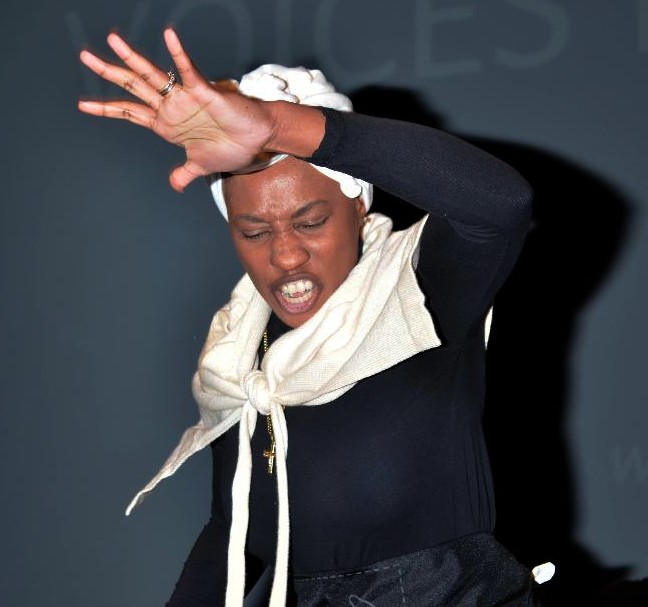 Jayeur Joseph performs as Chloe Cooley
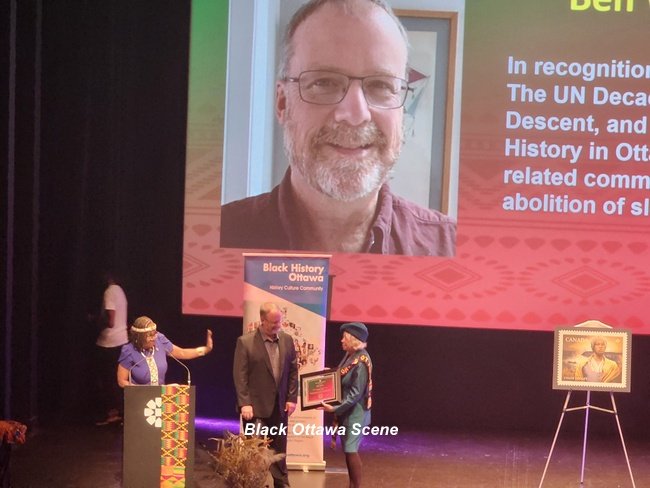 Ben Weiss receiving the Black History Ottawa President’s Award from BHO President June GirvanThe Chloe Cooley story was portrayed on stage at this year's opening event for Black History Month on January 28, 2023 at the National Gallery of Canada. Ben Weiss of the Historical Society of Ottawa was honoured to be asked to play the role of Lord Simcoe and, as he admits, was thankful to be surrounded by a cast of much better actors. It was, nonetheless, moving to be asked to take part in the performance.
Canada Post's 2023 stamp for Black History Month was also unveiled that afternoon, to great applause from the audience, featuring none other than Chloe Cooley herself.
Ben Weiss has for several years been the Historical Society of Ottawa's representative in its efforts to partner with Black History Ottawa and increase awareness of Black history. Ben was much honoured, during the afternoon's ceremonies, to be the recipient of Black History Ottawa's President's Award in recognition of ongoing contributions.
In celebration of our 125th anniversary, the Historical Society of Ottawa was recognized and honoured by being invited to contribute this year’s special Heritage Day “2023 Great Ottawa History Challenge”.
How well do you know Ottawa history? Take the challenge! https://ottawacitizen.com/news/heritage-day-try-the-2023-great-ottawa-history-challenge
Quick Links
About
Supporting Partners