

Working to preserve Ottawa's past
for future generations.
Dillon O’Connor: From Bytown Taverns to “Mr. O Canada”
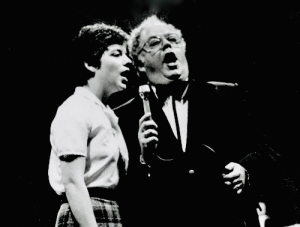
1 August 1968
Dillon O’Connor was beloved “Mr. O Canada” to a generation of Ottawa Rough Rider fans and Chateau Laurier patrons, renowned for uniting Canada’s “two solitudes” as the first solo artist to perform the official bilingual version of O Canada, on Parliament Hill in August of 1968.
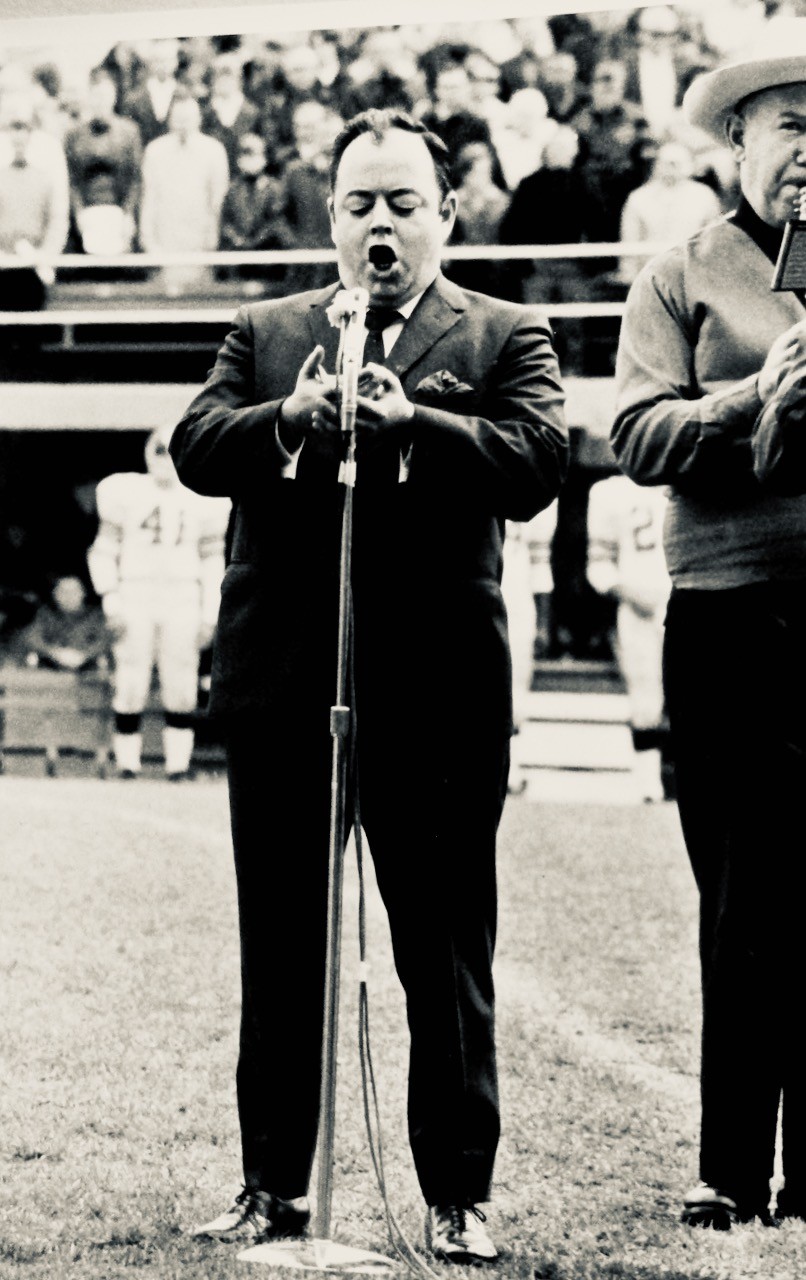 Dillon O'Connor on Landsdowne Park field 1968
Donna O’Connor recounts her father’s legacy, and reaches back into the days of Bytown to trace their family’s roots: The Goulden, Starrs, and OConnor families.
About the author: Donna O’Connor is a Toronto-based musician, vocal coach, and family historian, and the daughter of Ottawa-born vocalist Dillon O’Connor (“Mr. O Canada”). She is currently curating a digital archive and tribute website celebrating her father’s musical legacy alongside original historic drawings of early downtown Ottawa and the 19th-century Lowertown families who helped shape the capital.
Chateau Lafayette Pre-History (1849-1863) – Ashley Newall

Bytown’s taverns were notoriously abundant in number – but the Chateau Lafayette (“The Laff”) boasts the distinction of being the only of those Bytown era drinking houses to still remain in operation today. Founded in 1849 as “Grant’s Hotel”, Reformers took refuge inside during Bytown’s infamous Stony Monday Riot of that year.
Ashley Newall takes us back to when the tavern known today as the Chateau Lafayette was in the “thick of things” when our city was known as “brawling, rioting, lusting, wenching Bytown”.
Ashley Newall is an Ottawa singer-songwriter-musician and history writer, whose stories can be found his Capital History (CapHistOttawa) social media pages, his ashleynewall.ca website and on Apt613.ca.
uOttawa CRCCF – Vie Française dans la Capitale
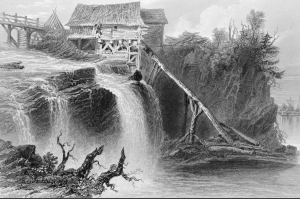
The goal of French Life in the Capital is to tell Canadians an untold Ottawa story about the participation of Francophones in building the nation's capital. An outcome of Chantier Ottawa, an initiative coordinated since 2011 by the Centre de recherche en civilisation canadienne-française (CRCCF) with the participation of over fifteen French Canadian specialists, the exhibition presents archival documents of diverse origins about Ottawa’s Francophone population, its institutions, its achievements, and its ambitions at various times in its history.
Join us in exploring the role of the Francophones in early Bytown, with these excerpts from the University of Ottawa’s excellent “Vie française dans la capitale” website:
Bytown and its First French Canadians
https://www.viefrancaisecapitale.ca/espace/bytown_and_its_first_french_canadians-eng
Lowertown’s First Resident
https://www.viefrancaisecapitale.ca/espace/lowertowns_first_resident-eng
From Loggers to Merchants
https://www.viefrancaisecapitale.ca/espace/loggers_merchants-eng
First Families
https://www.viefrancaisecapitale.ca/espace/first_families-eng
Religious Beginnings in Bytown
https://www.viefrancaisecapitale.ca/espace/first_families-eng
A Political Space is Born
https://www.viefrancaisecapitale.ca/pouvoir/political_space_born-eng
Michael McBane – Bytown 1847
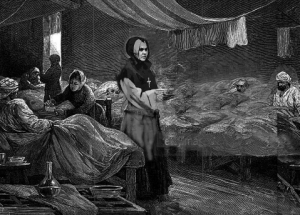
Historian Michael McBane, author of Bytown 1847: Élisabeth Bruyère & the Irish Famine Refugees, re-tells this important story for the "Time Travelling with the Historical Society of Ottawa" HSO/Rogers TV series: https://www.historicalsocietyottawa.ca/resources/videos/time-travelling-with-michael-mcbane-bytown-1847
Michael is also author of John Egan: Pine & Politics in the Ottawa Valley.
Curtis Wolfe – William Tormey
Curtis Wolfe researches local history and heritage and his writings have been featured in Lowertown’s Community Newspaper The Echo.
Curtis uncovers the history of a local street: What’s in a name? Uncovering the namesake of Tormey Street.
Lowertown East: Urban Renewal & the Aftermath

Our final in-person speaker presentation of 2023 took place on the afternoon of November 12 and was again hosted by the Main Branch of the Ottawa Public Library. We were pleased to welcome Marc Aubin, author, community historian, former President of the Lowertown Community Association and member of the King Edward Avenue Task Force, who spoke to the 60 attendees about the devastating effects on the Lowertown community of urban renewal projects that took place between the 1950s and 1970s. He began by giving us a brief history and description of Lowertown.
Lowertown, which Marc explained had first been laid out by Colonel By in the 1820s, is bordered by the Ottawa River to the north, the Rideau River to the east, Rideau Street to the south and the Rideau Canal to the west. It was a working class community, primarily French Catholic, but with a significant Irish Catholic component, along with a Jewish community and the first Italian community in Ottawa. Sussex, Dalhousie and St. Patrick were the major local commercial streets, with the Byward Market and Rideau Street being frequented by all citizens of the city. It was a vibrant community, self-reliant and historically one that defended French language rights.
Following the Second World War, a planning policy known as “Urban Renewal” dominated the thinking around housing policy in the governments of western nations. The war had led to a decline in the condition of the housing stock, due to the diversion of the required materials to the war effort. The end of the war created an increased demand for housing from returning veterans starting families. Urban Renewal promoted the wholesale replacement of buildings in what it deemed as “blighted” areas with new social housing projects. It was believed that the clearing of these blighted areas would also yield social benefits by resolving issues including: immorality, vice, crime, juvenile delinquency, infant mortality, poor health and an apathetic population. The introduction of upgraded roadways was also a strong motivation. Not surprisingly, lower income neighborhoods were those chiefly targeted for these renewal projects. The City of Ottawa initially identified a number of communities, the National Capital Commission also being involved, and the affected communities had little to no options for appeal. One of these communities was Lowertown East.
Lowertown East is that section of Lowertown east of King Edward Avenue, covering about 186 acres and consisting of 3 sub-communities, Bishop’s Lots, (early smaller lots), Anglesea Square, (architecturally more similar to Lowertown West) and Macdonald Gardens, (a later community from the 1920s). In 1968 the population of the area was 9,400, 90% of which was French Catholic. There was also a strong Jewish presence and a study taken at that time found that 75% of the residents wanted to stay in the community.
The first large scale urban renewal project in Canada took place in Toronto starting in 1948. In 1956 Central Mortgage and Housing Corporation modified its policies to approve urban renewal projects, for which the City of Ottawa received funding in 1958. In 1962, the National Capital Commission expropriated the northern portion of Lowertown, destroying some 400 housing units. This was followed by the expansion of King Edward Avenue, cutting down 100 large elms, to support the new Macdonald-Cartier Bridge that opened in 1965. The City of Ottawa began expropriation in Lowertown East in 1967, continuing until 1977. In 1971 the first social housing project was opened in Lowertown East. The community had already begun to organize against these renewal projects, as early as 1965, as did other communities within Ottawa. In 1975 key members of the Housing Department resigned over a dispute relating to demolition policy with them Councillor Georges Bedard and Mayor Lorry Greenberg, bringing an end to Urban Renewal as a policy in the city.
The destruction of city centres across North America led to a backlash, Jane Jacobs being among the leaders of this movement. In Toronto, pressure from the public eventually forced Premier Bill Davis to cancel the proposed Spadina Expressway. Nationally, a 1968 Task Force led by Paul Hellyer concluded that between 70% - 80% of the buildings demolished under urban renewal projects could have been rehabilitated. As a result of these findings, Federal financial support of urban renewal projects ended in 1973.
Unfortunately for Lowertown East, it was the final project approved and one of the largest. Despite the efforts of resident committees to oppose the planned renewal, or to modify it, it proceeded without approval from the community. Between 1967 – 1977 there were 462 expropriations in Lowertown East, an estimated 1,400 families were forced to relocate at a cost of $31 Million ($250 Million in 2023 dollars). Among the issues identified by the community were: inconsistent / inadequate compensation, excessive rents in new buildings, the destruction of the French language character of the community, no provisions for elderly residents, an abandonment of a mixed income strategy leading to ghettoization. These concerns remained unaddressed.
There were a couple of positive outcomes of the urban renewal of Lowertown East. The community countered the planned redevelopment through the construction of three cooperative housing projects, the rebuilding of the Catholic Community centre and through the creation of a new French language High School, De La Salle Academy. There were however far more negative outcomes. These included the loss to the community of many of the more affluent and educated members, who fled to the suburbs or other parts of the city, the loss of the Irish and Jewish communities, the closure of the major churches and synagogues, the creation of a transient population who had little control over their own housing, the segmenting of the community by major roadways, the belief that the renewal had been an organized attempt to destroy the main Francophone community and a lingering distrust of municipal politicians and staff. Today, even though the community has regained much of its former strength through such organizations as the Lowertown Community Association, it still finds it difficult to achieve its community goals and finds itself fighting similar battles as it had in the past to preserve its heritage. The battle never ends.
Following Marc’s presentation, we were honoured to have Councillor Stephanie Plante answer a few questions. She promoted the idea of creating a Lowertown Museum, similar to those in other communities which are now part of Ottawa. She also spoke of the need for elected officials to obtain input on policies and programs that will affect them. She emphasized the responsibility of Councillors to seek out this input from those who may not normally provide it, due to their age, language, income or other factors.
Marc has written two books that relate to Lowertown:
- BLIGHT, published by Crow’s Nest Books in 2018 is a “fictional” account of the struggles of an activist against City Hall. It is available at Blight by Aubin, Marc .
- CUNDELL STABLES, THE LAST STABLE IN LOWERTOWN. (With Karen Bailey)
Hatpins & Defiance: The Battle in Ottawa against Regulation 17
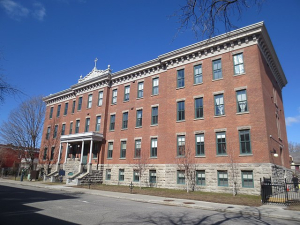
Members and guests who attended the October 2022, in-person, HSO presentation at the Auditorium of the Main Branch of the Ottawa Public Library were treated to a tour de force by Jean-François Lozier, Curator at the Canadian Museum of History. Jean-François told a story that, while familiar to Ottawa’s Francophone community, is mostly unknown in the city’s Anglophone community—the “Battle of the Hatpins” or la battaille des épingles. In this David-Goliath struggle, Francophone parents, in particular mothers, fought the Government of Ontario in 1916 to have their primary-aged children attending the Guigues School taught in French.
Jean-François began his account by providing useful background on the French presence in Ontario, noting that many Francophone families had moved to Ontario during the late 19th century, especially to the eastern part of the province, including Ottawa. While wanting their children to learn the language of the English majority, Francophone also parents desired that French be the language of instruction in “bilingual schools.”
Under the British North American Act of 1867, the provinces were assigned responsibility for education, with the proviso that they provide separate schools for Roman Catholics outside of Quebec, and for Protestants in Quebec. Using its constitutional authority, the Ontario Government, under pressure from those worried about the growing French presence in the Province, introduced Regulation 17 in 1912 which forbade the use of French as the language of instruction beyond Grade 2.
This sparked outrage amongst Ontario’s Francophone community, leading to, among other things, the birth of an Ottawa newspaper Le Droit that committed itself to the struggle for linguistic rights.
Jean-François explained the divisions within Ottawa’s Roman Catholic School Board between its French-speaking and English-speaking members over the issue, and how various schools responded both in Ottawa and in other parts of the Province to Regulation 17—a combination of obedience, non-compliance, and defiance.
The issue came to a head in January 1916 at the Guigues School when parents, mainly mothers, escorted two sisters, Béatrice and Diane Desloges, into the school to teach their children in French. This brought the parents into direct confrontation with the police and the government-appointed school board who were determined to block their entry and their occupation of the school. Jean-François noted that the extent to which the mothers used their hatpins to fend off the police is unclear. News reports said that in the Battle of the Hatpins, one constable had his thumb bitten, while another received a black eye.
In the end, calmer heads prevailed, with the issue going all the way to the Judicial Committee of the Privy Council in London to be settled. While the Privy Council ruled in favour of the Ontario Government in its use of English as the language of instruction in “bilingual schools,” it ruled against the government in its treatment of Ottawa’s French-led, Roman Catholic School Board.
French continued to be used at Guigues School as a language of instruction, with the Ontario Government losing its appetite for this divisive language battle in the midst of World War I. In the late 1920s, Ontario stopped trying to enforce Regulation 17, but it remained on the statute books until 1944.
In 2016, Ontario Premier Kathleen Wynne apologized to the province’s Francophone community.
A Personal History of Laroque's Department Store
Robert Vineberg, son of one of Laroque's co-owners, shares his personal stories and the history of one of Lowertown Ottawa's well-known and well-loved department stores.
A Genteel Woman in Need: Emma Maud Lampman
Dianne Brydon tells us about the life of Emma Maud (Playter) Lampman: married young to "Confederation Poet" Archibald Lampman, widowed at age 32, and being among the first women to work in Canada's civil service at the turn of the 20th century.
The Barber Family: Our Proud Place in Ottawa's History
Born into slavery in Kentucky, Paul Barber, was one of Ottawa’s earliest Black permanent residents and a renowned horse trainer, founding a family that has made its mark in the capital for over a century. Thomas Barber, Paul Barber's grandson, shares the remarkable story of his family and their important role in Ottawa’s past.
Quick Links
About
Supporting Partners