

Working to preserve Ottawa's past
for future generations.
CFRA Announcer and Producer Dave Watts reflects on his long career in the Ottawa radio scene
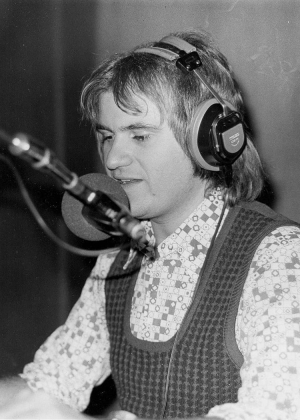
Dave Watts has had a long career on the Ottawa radio scene. In addition to being an on-air announcer, his career at CFRA included Music Director (CFRA) and Assistant to the Program Director (1976-1989) and Promotion Director (CFRA, CFMO and later KOOL FM).1989 to 1996.
In January 2025, John Leefe of the HSO’s Memory Project interviewed Dave about his career at CFRA, with a focus on the various well-known personalities he worked with and his observations on the transformations in the radio industry over the past 60 years. Below is an edited transcript of the interview.
1. How did your involvement in Ottawa radio begin?
To go right back to the beginning, in the fall of 1963 we had a high school project in our business class to find a company and learn about it to do a report. So I thought, I like radio and CFRA is the station I listen to, so I’ll write to them. I explained the project in a letter to the managers and they invited me down for a tour of the station. It was a great idea so I went down with a buddy of mine and in that tour, we met Gord Atkinson, who was probably my earliest connection to the radio station. Just before he was to go on air with his “Showbill” program that afternoon, we chatted a bit and subsequently stayed in touch from that point forward. In the coming days Gord invited me to join him on his “Campus Club” show to report on the latest Ottawa high school activities.
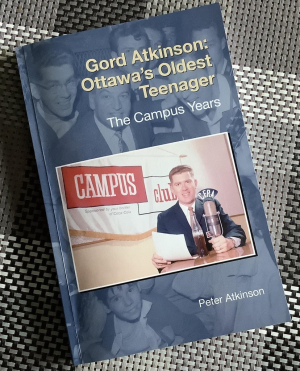
Gord Atkinson: Ottawa's Oldest Teenager
Almost 50 guests attended our first speaker presentation of the year, hosted by the Main Branch of the Ottawa Public Library on September 9, 2023. Prior to the presentation, Dianne Brydon, President of the British Isles Family History Society of Greater Ottawa took a few minutes to describe some of the outstanding events they have in their upcoming season. For more details on their organization and their presentations, please check out the BIFHSGO website.
We were then pleased to welcome Peter Atkinson, a retired educator from Ottawa, who spoke to us about his father, noted broadcaster Gord Atkinson. Peter focussed on a 13-year period of Gord’s extraordinary career when he introduced Rock & Roll music and the musicians who played it to Ottawa, to Canada and in some cases to North America. Gord was “Ottawa’s Oldest Teenager”.
Gord was recruited by radio station CFRA in Ottawa from radio station CHUM in Toronto in February 1954, based on the national success of his program featuring the music of Bing Crosby. Arriving in Ottawa, he soon determined that there was a market for the new music known as “Happy Beat”; the term “Rock and Roll” being considered as too risqué. The station attracted an older audience and their management was reluctant to try new things but eventually Gord convinced them to allow him to run a show of new music on Saturday afternoons, considered to be a dead time on the radio. He called his show the “Campus Corner”, a name he borrowed from the shoe department of the Ogilvy’s department store on Rideau Street. Gord ran the show from the Freiman’s department store in the Westgate Shopping plaza and it featured a mix of live performances and recordings. It was an immediate and overwhelming success soon outgrowing that venue and by 1963 changing to a Monday to Friday time slot and its name to the “Campus Club”, which eventually totalled some 30,000 members.
Gord created his own “Platter Poll” based on requests from his own listeners, rather than from nationally compiled lists of hits. Some of these listeners tuned in to late night radio from pioneering Rock & Roll hotbeds such as Buffalo and Rochester, allowing him to always be among the first to play new songs and new bands, often beating the major U.S. broadcasters by months.
Gord was also at the centre of the concert scene in Ottawa. He introduced the first “Happy Beat” concert in Ottawa, headlined by Bill Haley & His Comets, but also featuring Chuck Berry and the Platters. His best remembered concert was the April 3, 1957, appearance of Elvis Presley, one of only 3 such appearances outside of the United States throughout Elvis’ career. Elvis was eager to play Ottawa as he knew that his music was being well received and played here, based on the fan mail he had received. Later, in 1964, Gord took a group of some 40 Club members to see the Beatles in Maple Leaf Gardens. Returning home he told his family that he hadn’t heard them at all because of the constant screaming of the crowd.
Gord hosted a series of wildly successful talent shows at the Ottawa Coliseum, called the “Campus Hop”. This provided a venue for emerging local talent to perform and gain exposure – among many others, this helped launch the career of Vern Craig, later of the Staccatos, and the very popular Hugh Scott.
Speaking of the launching of careers, Gord introduced and promoted two local performers who would go on to become mega-stars in the entertainment world. Both Paul Anka and Rich Little owe their start to Gord Atkinson. Gord was the first in the world to play Paul Anka’s first big hit, Diana , Paul bringing the record to him for that purpose. Paul and Rich remained life-long friends with Gord and his family.
Life as a radio DJ, especially at that time, was highly competitive, demanding long hours and hard work. Gord maintained as successful a family life as he did a professional one, this due, in large part, to his wife Elaine, who raised their seven children and kept everything together and running.
Gord stepped away from the “Campus Club” in 1967 to run CFRA’s sister FM station, CFMO. He continued as a broadcaster with his other show “Show Bill” that he had started when first coming to Ottawa. Gord was also heavily involved in charitable work, most notably being one of the chief organizers, along with Rich Little of the 1982 Frank Sinatra concert that raised over $1,000,000 for a neo-natal unit at the Civic Hospital.
Peter has recorded many fascinating stories along with lots of photos, often previously unpublished, in his highly recommended book, “ Gord Atkinson: Ottawa’s Oldest Teenager”, which can be purchased at upcoming HSO in-person speaker series presentations at the library or through the Showbill website.
“Hello Ottawa–Hello Montreal”
20 May 1920
At the turn of the twentieth century, radio was the new, cutting-edge technology. Building on the work of others, including Nikola Tesla, Édouard Branly, and Jagadish Bose, the Italian inventor Guglielmo Marconi established in the early years of the century a wireless telegraph system using a spark-gap transmitter that could send transatlantic radio messages in Morse code. The first such radio transmission, greetings from U.S. President Roosevelt to King Edward VII, was sent in 1903. Subsequently, ships began to be equipped with radio transmitters and receivers; radio distress signals sent by the RMS Titanic using Marconi equipment are credited with saving hundreds of lives in 1912. The Canadian inventor Reginald Fessenden demonstrated the feasibility of audio radio using continuous waves by sending a two-way voice message in 1906 between Machrihanish, Scotland and Brant Rock, Massachusetts. On Christmas Eve of that year, he broadcasted a short programme of music by Handel, his own rendition of some Christmas carols, and a reading from the Bible to ships at sea along the eastern seaboard of the United States from his Brant Rock base of operations. World War I brought further major technological advances, including the invention of the vacuum tube and the transceiver (a unit with both a radio transmitter and receiver), that spurred the development of commercial radio. By 1920, the world stood on the cusp of a new radio age with instantaneous, wireless, audio communication and entertainment.
On 19 May 1920, the Royal Society of Canada convened in Ottawa for its 39th Annual Meeting. The Society had been founded in 1882 with the patronage of the Governor General, the Marquis of Lorne, to promote scientific research in Canada. Society fellows gathered at the Victoria Memorial Museum for the opening of the conference, chaired by the Society’s president, Dr R. F. Ruttan of McGill University, and for the election of new fellows. They subsequently broke into specialist groups, to hear addresses on a variety of topics, including plant pathology, and the properties of super-conductors. That evening, President Ruttan gave the presidential address in the ballroom of the Château Laurier Hotel. The topic of his speech was “International Co-operation in Science.” The general public was cordially welcomed to attend this presentation, and another to be held the following evening at the same venue by Dr A.S. Eve, also of McGill University.
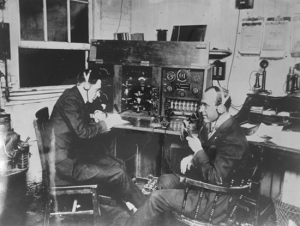
Dr Eve’s lecture commenced at 8.30pm on 20 May. Its intriguing title was “Some Great War Inventions.” Among the discoveries he discussed was the detection of submarines. Canadians had been on the forefront of this research, starting with Reginald Fessenden who pioneered underwater communications and echo-ranging to detect icebergs following the Titanic disaster. Subsequently, Canadian physicist Robert Boyle developed ASDIC in 1917, the first practical underwater sound detector machine, or sonar, for the Anti-Submarine Division of the Royal Navy. At the evening’s presentation, Dr Eve also demonstrated the advances made in the radio-telephone. At 9.44pm, the Society fellows and members of the public heard the words “Hello Ottawa—Hello Montreal” over a large loudspeaker called a “Magnavox,” set up in the Château Laurier’s ball room. The first public wireless conversation in Canada had begun.
For two days, engineers from the Canadian Marconi Company in Montreal and officers of the Naval Radio Station on Wellington Street in Ottawa had laboured to prepare for the event. The experimental radio station, located on the top floor of the Marconi building on William Street in Montreal, operated under the call letters “XWA” for “Experimental Wireless Apparatus.” It had first gone on the air on 1 December 1919 on an experimental basis. Another transmitting and receiver station was established at the Naval Radio Station, with a secondary receiving station set up at the Château Laurier, with an amplifier to ensure all attending Dr Eve’s presentation could hear the broadcast. At the Montreal end, Mr J. Cann, chief engineer for the Marconi Company, was in charge, while at the Naval Radio Station in Ottawa was Mr Arthur Runciman, also from the Marconi Company. Assisting Runciman were engineers, Mr D. Mason, and Mr J. Arial. Also present were Mr E. Hawken, the commanding officer of the Marine Department, and his wife. Stationed at the receiving station in the Château Laurier were Commander C. Edwards, director of the Canadian Radio Service and Lieutenant J. Thompson, his assistant. Journalists covering the historic radio broadcast were based at the Naval Radio Station.
Following the introductory exchange of words, the notes of “Dear Old Pal of Mine,” a 1918 hit song, sung by the Irish tenor John McCormick and played on a phonograph in Montreal, could be distinctly heard in Ottawa. This was followed by a one-step ballroom dance tune popular at the time. So well could the orchestra be heard, the Ottawa Journal reporter wrote that some of his colleagues listening to the broadcast at the Naval Station actually started an impromptu dance.
After the dance tune, one of the radio operators in Montreal delivered a speech prepared earlier by Dr Ruttan on behalf of the Royal Society of Ottawa in which he congratulated the Marconi Company and the Radio-Telegraph Branch of the Department of Naval Service for “their generous co-operation in this difficult scientific experiment.” Following a short pause, Society follows were treated to a live performance from Montreal of the early nineteenth century Irish folk ballad “Believe Me If All Those Endearing Young Charms,” written by the Irish poet Thomas Moore and sung by vocalist Dorothy Lutton. She sang a second song, “Merrily Shall I Live” as an encore.
It was then Ottawa’s turn to communicate to Montreal. The Ottawa operator first explained the radio experiment to his listeners. This was followed by Mr. E. Hawken singing the first verse of “Annie Laurie,” an old Scottish song that begins “Maxwelton’s braes are bonnie.” Receiving a wild round of applause from his Château Laurier audience, Hawken was persuaded to sing the second verse. Hawken’s performance was followed by the transmission of several dance tunes played on a phonograph. The evening’s programme concluded with hearty congratulations sent in both directions.
Dr Eve’s demonstration of radio telephony was deemed a huge success. The wireless operators in Ottawa and Montreal were elated. Never before had two-way radio communication had been achieved over such a long distance—110 miles (177 kilometres). The broadcast, at least at the Ottawa end, and especially at the Château Laurier where the signal was boosted by an amplifier, was generally clear and distinct. However, listeners at the Marconi station in Montreal had a more difficult time picking up the signal from Ottawa. Marconi officials explained that reception was adversely affected by interference from Montreal’s large buildings. There were apparently some tense minutes as Montreal listeners wearing headphones tried to decipher the sounds coming from the capital.
The broadcast launched Canada into the radio age. Some radio historians argue that the 20 May radio performance by Marconi’s XWA station to the Royal Society’s meeting in Ottawa was the first scheduled radio broadcast in Canada, and possibly the world. XWA became CFCF in November 1922. Reputedly, the call letters stood for “Canada’s First, Canada’s Finest.” The station’s call letters were changed to CIQC in 1991, and to CINW in 1999. The station went off the air in 2010.
Sources:
Broadcaster, 2001, 100 Years of Radio: Celebrating 100 years of radio broadcasting.
Historica Canada, Broadcasting.
The Citizen, 1920. “May Meeting of The Royal Society of Canada Opens,” 19 May.
The Gazette, 1920. “Wireless Concert Given For Ottawa,” Montreal, 21 May.
————–, 1920. “Heard In Ottawa.” Montreal, 21 May.
The Ottawa Journal, 1920. “Ottawa Hears Montreal Concert Over the Wireless Telephone, Experiment Complete Success,” 21 May.
Université de Sherbrooke, Bilan du Siècle, “Diffusion d’une émission radiophonique directe, ”.
Vipond, Mary, 1992. Listening In: The First Decade of Canadian Broadcasting, 1922-32, Carleton University Press: Ottawa.
Image: CFCF Radio, Montreal, author unknown, Université de Sherbrooke, Bilan du Siècle, “Diffusion d’une émission radiophonique directe,”.
Story written by James Powell, the author of the blog Today in Ottawa's History.
Retired from the Bank of Canada, James is the author or co-author of three books dealing with some aspect of Canadian history. These comprise: A History of the Canadian Dollar, 2005, Bank of Canada, The Bank of Canada of James Elliott Coyne: Challenges, Confrontation and Change,” 2009, Queen’s University Press, and with Jill Moxley, Faking It! A History of Counterfeiting in Canada, 2013, General Store Publishing House, Renfrew, Ontario. James is a Director of The Historical Society of Ottawa.
Quick Links
About
Supporting Partners