


Working to preserve Ottawa's past
for future generations.
Since September 2020, the Historical Society of Ottawa has presented a virtual speakers series using Zoom. A full recording of those presentations is available on the HSO YouTube channel and shown here as well.
The Historical Society of Ottawa does not necessarily subscribe to views expressed in these videos, nor take any responsibility for their content.

Richard Collins
Rawlson King Recounts Journey
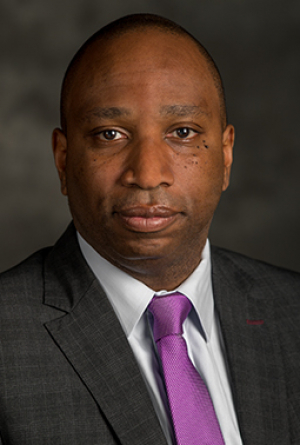
The speaker for the HSO presentation on February 12, 2020, not only brought to our event a more culturally diverse crowd than usual, but also a younger crowd. Rawlson King has recently become an inspiration not only for young Ottawans, but also to Ottawans of any culture who feel marginalized and who look up to people like Rawlson to provide a voice for their concerns and hopes in the city.
Rawlson was elected as Ottawa’s first black councillor in a 2019 municipal by-election in Ward 13.
The successful campaign for councillor propelled Rawlson into one of the most challenging jobs in the City of Ottawa. Rideau-Rockcliffe Ward, which wraps around the former City of Vanier, includes some of Ottawa’s richest people (in Rockcliffe Park), but is also home to some of Ottawa’s poorest, as well (in Overbrook).
Rawlson made it clear in his presentation that he wants to represent all Ottawans in his ward fairly, but how does one navigate a course of reconciliation in a ward with such divergent paths?
It is fitting that Rawlson had the opportunity to speak to us in February, which is Black History Month in Canada. History is important, Rawlson noted, because it helps marginalized people “go forward, guided by the past.”
As Canadians, we look to the past and see our nation as a safe haven for freed or escaped slaves from the U.S., but in the earliest days of Upper Canada, slave owners arriving as Loyalists at the end of the American Revolution could continue to own slaves 25 and older until each slave’s death.
Those under 25 became free at 25, but with no social network in place to provide jobs and education. Slavery was ended across the British Empire in 1834, but freedom from servitude didn’t necessarily mean freedom of opportunity. Even into the 1930s, the Ku Klux Klan thrived in many Canadian communities, using fear to diminish Canadians of black heritage.
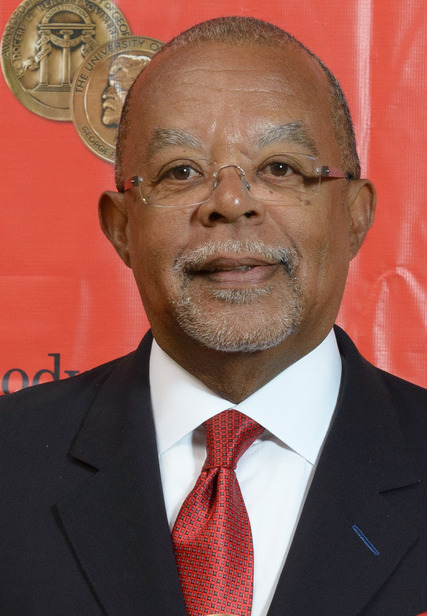 King counts U.S. writer Henry Louis Gates as a key influence.Today we call this same intimidation “erasure”, and Rawlson said he wants to do what he can to erase erasure. To this end, Coun. King read from a book, Talkin’ That Talk, by Henry Louis Gates Jr., which inspired him to join a local residents group, and later to run for the position of school board trustee. The proposed closure of a school in his ward, made up mostly of minority cultures and with one of the lowest graduation rates in the city, encouraged Rawlson to help define a “coherent poverty reduction strategy to help marginalized people gain access to public services and affordable housing.”
Rawlson spent a few moments to tell us of his own family’s history. Rawlson’s mom had to work hard to earn a scholarship to pay her way through teacher’s college in Saint Vincent and the Grenadines, where black people faced difficulties entering the workforce.
Both his parents were trained as teachers, but neither could find work in a Canadian school. Rawlson’s mom had to take a job in a paint factory in North York when she came to Canada.
Canada’s cautious acceptance of African and Caribbean peoples has helped define Rawlson as an opponent of erasure in our society today. He feels that young Canadians of minority cultures can oppose it through “economic inclusion”. Ottawa’s city council must do its part, he said, through “policies that focus on human potential.”
Rawlson didn’t get a chance to answer all the questions posed to him after the talk. But he assured those who didn’t get time, that he can always be contacted through his city e-mail address.
Thank you to Rawlson for a most enlightening and positive presentation, and thanks also to fellow councillor Tim Tierney of Ward 11, Beacon Hill-Cyrville, who introduced the evening’s guest speaker. The event drew other prominent members of the region’s black community, including Hull-Aylmer Liberal MP Greg Fergus, Black History Ottawa president Jean Girvan and Tom Barber, descendant of one of Ottawa’s first black residents, the renowned horse trainer Paul Barber.
HSO “Zooms” Ahead with Annual General Meeting
We do indeed live in interesting times. Normally HSO holds its Annual General Meeting in May, but with all of us putting our lives on hold, the decision was made in April to postpone the AGM until we could safely get together again. Once it became clear that a community gathering was not going to happen soon, the decision was made to invite as many members as possible to join us electronically for an Annual General Meeting on July 22, 2020. We’re aware that this is not a perfect solution, since some of our members may not have an internet connection, but at this “interesting time” we felt that an on-line AGM, via Zoom, was the best way to connect to members and get some much-needed housecleaning done.
If you’ve not heard of Zoom (I hadn’t until just a few months ago), it’s like a conference call but on your computer or tablet. Zoom allows those who have linked in to the meeting to post comments, ask questions and – most importantly for us – vote on motions.
Considering this was our first attempt at an on-line AGM, and a first-time experience for many of the 29 members who joined in, the event went smoothly. A glitch with the voting process early on was quickly resolved by having members vote through the “Chat” option. Special thank to one of our directors, Erik Foisy, for chairing the event under challenging circumstances.
Here’s an update of the AGM for those who were unable to “attend”.
James Powell ask for a motion, seconded by Randy Boswell, to approve the agenda. Lynn Payton moved to have the minutes of the 2019 AGM approved, seconded by Dylan Van Heck. (The agenda for the 2020 AGM and the minutes of the 2019 AGM had earlier been sent to members). Both motions were carried.
Then the members were asked to approve the President’s report, as well as the reports from the Membership committee, Regular Events committee, Special Events committee, Publications committee, and Communications committee. These reports were sent out to members prior to the AGM. A motion to approve these reports was made by Karen Lynn Ouellette, and seconded by Dylan Van Heck. The motion was carried.
James Powell was invited to present members with a brief explanation of our 2020 Budget, and a Special Financial Statement. Before voting to approve these, Karen Lynn made a motion (seconded by Dylan Van Heck) that monies in excess of $50,000 in the R&D fund and $10,000 in the Colonel By Fund be used to fund projects consistent with the HSO mandate. After discussion, the motion was present and carried. As a result of approval of this motion, Karen Lynn made another motion (seconded by Dorothy Phillips), that HSO develop a clear process to encourage and receive ideas from our members about how to utilize these liberated funds, reviewing the ideas based on clear criteria supporting the society’s mandate, and a clear process for decision-making. The participating members discussed this motion through Zoom’s “Chat” option. The motion was carried.
Next, a motion to approve the HSO’s 2020 Budget was made by Dylan Van Heck, and seconded by Lynn Payton. The motion was carried.
Last on the agenda was the nomination and election of directors. The slate of directors presented, alphabetically, is as follows: Dave Allston (Director at Large), Randy Boswell (Newsletter and Publications), Richard Collins (Director at Large), Erik Foisy (Treasurer), Kathy Krywicki (Secretary), George Neville (Past President), Karen Lynn Ouellette (President), Evlyn Payton (Special Events), and James Powell (Communications). Dylan Van Heck (who, as you can tell by now is an experienced Chat user and, as a result, quick to reply to motions) made the motion to accept the slate of directors as presented. I had the honour of seconding the last motion of the AGM. The motion was carried.
It took about 90 minutes to get through the meeting, but it was necessary, and those who participated generally agreed that our first “virtual AGM” was a unique experience and well worth their time.
Hope to see you all for our next AGM . . . in person.
A Tour of PMs’ Sandy Hill Homes
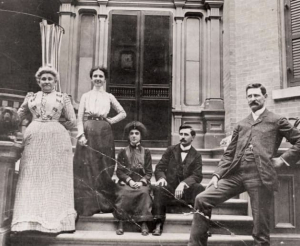
The Historical Society of Ottawa’s October 9, 2020 meeting was our first evening gathering at the main branch of the Ottawa library. We had many first-time attendees. Maybe the new time and location are the attraction. Or it may have been our guest speaker, who is well known in Ottawa for his passion for history.
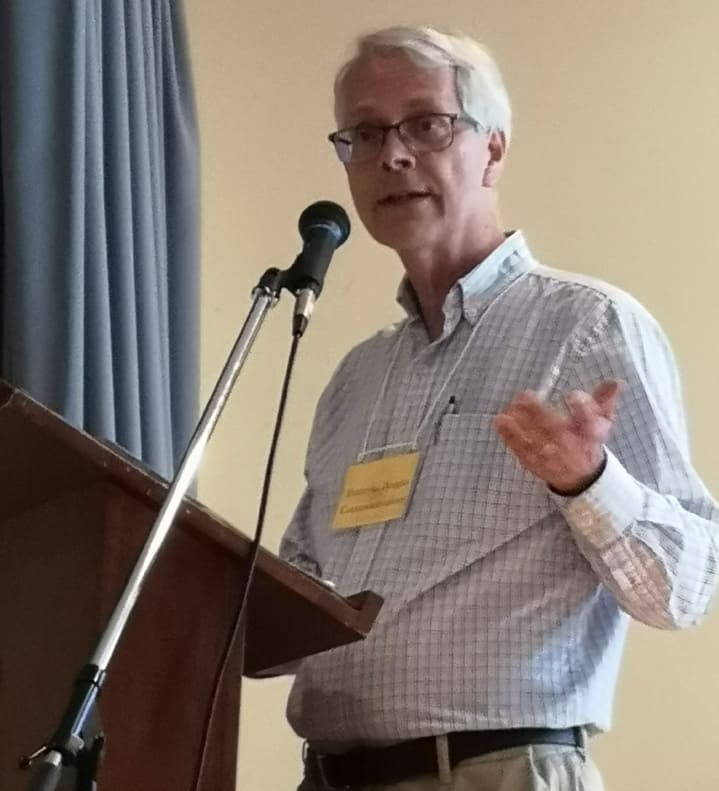 Neighbourhood historian François Bregha, described many prime ministerial homes during his Oct. 9 evening presentation.Sandy Hill is more than just a passing interest for François Bregha. He has lived in Sandy Hill for 34 years. In this time, François has undertaken research on ten prime ministers who have lived in his community, in over a dozen different homes. Many of these homes are still standing, and have become regular stops on François’ community walking tours.
Some of Sandy Hill’s prime ministerial homes are well known, like Stadacona, the Strathcona Apartments and Glensmere. The last of these three was the home of Canada’s eight prime minister, Sir Robert Borden. Built in 1894 for Indian Affairs superintendent Hayter Reed, Borden moved into the home in 1907, giving it the name Glensmere.
After prime minister Borden’s third son, Henry Clifford Borden, moved out in 1941, the home served for 27 years as the Chinese legation, back when the Canadian government considered Taiwan to be “China”. When the much bigger China came to be recognized as the proper “China” in 1972, they established an embassy at the former Our Lady of Charity of the Good Shepherd convent and Glensmere, suddenly empty, was demolished.
Sad, but everyone in attendance for François’ talk at least got a good laugh at the photo he showed of the towering monstrosity that replaced Borden’s elegant abode. Fortunately, Stadacona (Sir John A. Macdonald’s third Sandy Hill home) and the Strathcona Apartments continue to provide architectural dignity on Laurier Avenue East.
Probably the best-known home is Laurier House, built in 1878. Canada’s seventh and tenth prime ministers lived here, although it’s probably less well known that the museum that now honours Sir Wilfrid Laurier and William Lyon Mackenzie King was originally named Kininvie by the home’s first owner, jeweler John Leslie. Leslie named his Sandy Hill home after Kininvie Manor in Banffshire.
This Scottish castle has been in the possession of the Leslie clan since 1521. King renamed the home Laurier House in honour of his mentor, in 1923.
François did some considerable research to dig up information on the many less well-known homes in Sandy Hill. The 13th prime minister, John Diefenbaker not only lived in the Strathcona Apartments, he later rented a small apartment in a house on Wilbrod Street. Our 15th prime minister, Pierre Trudeau, rented an apartment on Besserer Street in the early 1950s, in a home built in 1896 for broker A.M. Sutherland. The home had just been converted to apartments when Trudeau moved in.
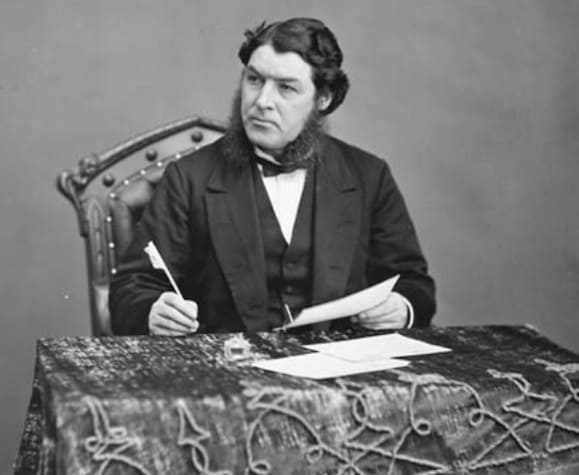 Future prime minister Charles Tupper lived at 274 Daly Ave. in 1872
Source: Library and Archives CanadaTrudeau’s predecessor, Lester Pearson, seems to have had a particular penchant for Sandy Hill. He lived in three homes in the neighbourhood. Sadly the last of these – the apartment he was living in when he won the Nobel Peace Prize – is slated for demolition. The Ugandan High Commission, which has occupied the building since 1985 has allowed the historic landmark to fall into disrepair.
During the Q&A session with François, special attention was drawn to Canada’s sixth prime minister Sir Charles Tupper who, while on his morning walk to the office at Parliament Hill took a daily diversion to meet up with a lady-friend on Chapel Street. François had hoped to exercise some discretion concerning the affair but was cajoled by the audience to offer some details.
Tupper is unique in having lived in two homes that had also been the home of other prime ministers.
Tupper’s 1872 home at 274 Daly Avenue was converted into apartments in 1982.
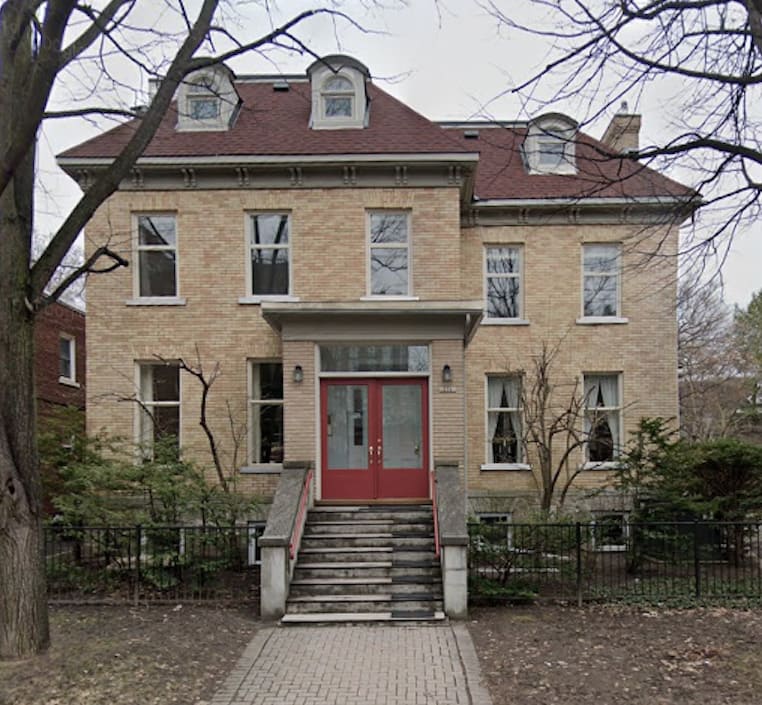 More than a century later, the home was converted into apartments and another future prime minister, Paul Martin, lived there from 1994 to 2003.Paul Martin (our 21st prime minister) lived in one of these units from 1994 until 2003, when he was able to move into 24 Sussex Drive.
As for Sir Charles, he later moved to a home named Cliffside, just west of the Parliament Buildings.
This same residence had earlier been the home of Canada’s second prime minister, Alexander Mackenzie. Cliffside was demolished in 1929.
If you’re interested to learn more about Sandy Hill’s many magnificent historic homes, visit the Sandy Hill History website. Here François has more stories, not just of prime ministers, but of business people, war heroes, architects and artists who called Sandy Hill home.
Quick Links
About
Supporting Partners