

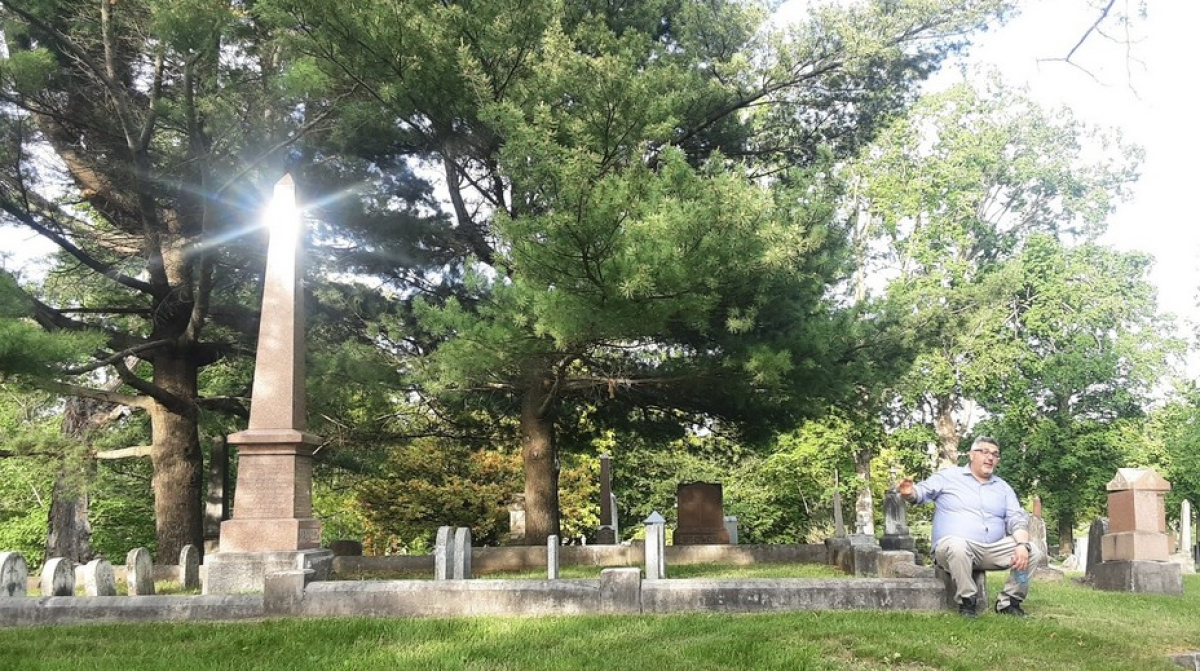
On Tuesday June 9. 2026, the HSO Museum Club had the privilege of visiting Beechwood Cemetery for a tour, led by Nicolas McCarthy, about the history of Bytown and the role that Beechwood played in it.
As the tour began, we learnt that Beechwood is a non-denominational cemetery which could be seen in the layout of the plots and in the symbols present throughout the cemetery. Our first stop as we walked was the gazebo on the property that provides a gorgeous view of Parliament Hill, which is fitting given the industry and jobs that Parliament Hill brought to Ottawa. The spot also showed us how integrated the cemetery is within Ottawa and Bytown history as Tommy Douglas, the man responsible for the preservation of that view, is buried at Beechwood.
Beechwood was founded in 1873 when lumber barons saw an opportunity in the farmland to make some money off of its lumber. The development was helped by the discussions at the time about building a cemetery that could stand the test of time, as Beechwood would go on to do. Nicolas then explained that Beechwood has always been a place of natural beauty. As early as the spring of 1874, it was supplying flowers to the governor general and was having to count its guests daily because the newspapers were encouraging people to come out and see the space. In Boston, it was mentioned how there weren’t as many green spaces, so as a result cemeteries played a dual role of a place to bury the dead and a green space, of which Beechwood was a prime example.
As we walked over to where some of the key members of Bytown are buried, we saw the original entrance to the cemetery marked by cobblestones. This entrance showed that people would carry their deceased loved ones up through the forest path and have to walk by all of the affluent families of Bytown that were buried there.
.jpeg) Monument photo by Emma Kent.
Monument photo by Emma Kent.
As we walked through the cemetery, we learnt the specifics of some of those families buried at Beechwood, particularly ones that were crucial to Bytown’s development. For instance, there was the Slater family who were part of the construction of the canal, and the Booth family who became big in the lumber business. Their two plots would have been easily seen when the dead were being brought in from the old entrance. The Booth family in particular was hoping to be noticed with its towering Italian marble monument that is the tallest one at Beechwood.
As we continued on our tour we discovered that it was not just the Booth family that had an elaborate monument. For instance, there’s the Bytown Mason burial plot, which is the oldest one in the city of Ottawa. It is shaped like a keystone, which has been used by stone masons for centuries, and includes the symbols of a compass, a slide ruler and other stone mason tools.
While many contributors to Bytown are buried at Beechwood, there are some who stuck out on the tour. For instance, there were quite a few who showed the entrepreneurial spirit of Bytown. There was Thomas Mackay, who convinced Colonel By that the stone at Major’s Hill Park was good enough to use for the Rideau Canal allowing them to save money. Another was Thomas Ahearn who was an inventor, developer, and businessman. He built a car company, tramways, and developed the electricity grid. He was also responsible for electric stoves as a response to his wife’s suggestion that women would love that invention due to the struggles of lighting a stove to cook.
There are others who weren’t as entrepreneurial but created lasting impacts, such as Ella Hobday Webster Bronson, who, among other things, founded and operated the Ottawa Maternity Hospital. There was George Hay who created the first Ottawa coat of arms which ushered in the ending of Bytown and the beginning of Ottawa.
The final piece of Bytown that can be seen at Beechwood is John Bower Lewis’ plot. He was the last mayor of Bytown, and when he died it was declared a national holiday and he was brought through all of Ottawa, which had been draped in black in his honour. The procession ended at Beechwood, thus ending Bytown and cementing Beechwood as ‘the’ Ottawa cemetery.
On Sunday, June 14, 2026, Nicolas McCarthy graciously repeated his tour, which allowed a second group of our members and other guests to learn the early history of Ottawa as it is preserved at Beechwood.
.jpeg) June 14th cemetery tour photo by Emma Kent.
June 14th cemetery tour photo by Emma Kent.
The history of Bytown that shines through at Beechwood is especially important to look at in the 200th anniversary Bytown this year. It is incredibly interesting to see how far this city has come to become the Ottawa we know today. A special thank you to Nicolas McCarthy for the tours, and to learn more about Beechwood go to the Beechwood Cemetery website for more information about the cemetery and tours. You can also check out the book written by Nicolas and Erika Wagner entitled “The Journey of Beechwood Cemetery: Canada's Legacy Written in Stone” that provides even more knowledge about Beechwood.