

Working to preserve Ottawa's past
for future generations.
Among the settlers who populated Bytown, many were francophones. By examining the stories of her own francophone ancestors, Sonja McKay reveals a window through which we obtain a glimpse of what life would have been like for many French-Canadians during that era.
Sonja McKay is a retired public servant and social policy analyst, an amateur genealogist, and member of the Historical Society of Ottawa.
Zéphérine Brunet, a French Canadian in Bytown, 1830s-1850s
Among the settlers who populated Bytown between 1826 and 1855, there were many francophones who came from what is now Quebec. Some of them were my ancestors. I will describe the experiences of a few of them in this article.
Many French-Canadians arrived in Bytown to work in the growing lumber industry in the 1840s and ‘50s. As well, some highly-educated French Canadians came to Bytown (e.g. physicians, lawyers, religious officials, business owners and their families). Lucien Brault’s 1941 in-depth thesis on the history of Ottawa recounts that by 1851, there were 2,056 French Canadians in Bytown, out of a total population of 7,760. Over 25% of the population were francophones.
We know too, that the land and waterways around Ottawa had already long supported Indigenous families and nations – notably the Algonquin Anishinabe nation on whose traditional lands Bytown emerged. Bytown was not a beginning for the Ottawa region, but it was the beginning of my personal family history here.
This article tells the stories some of my francophone ancestors and their friends who came to Bytown in the 1830s and ‘40s. A key figure is Zéphérine Brunet, my great-great-grandmother. In learning bits of information about her and her family, we can see a glimpse of what life was like for labouring French Canadians in those days.
A quest to learning about the origins of my grandpère, Adonias Robillard
I never met my grandfather, Adonias Robillard, because he died before I was born. Adonias was born in 1893 in Ottawa, and he did metalworking until his death in 1955. My mother, Carmen, remembers him as a kind and loving father. Carmen grew up in a franco-Ontarian family in Eastview (now Vanier). Her mother Eva Létourneau was born near Québec City and migrated to Ottawa with her parents when her father obtained a civil service job in the federal government. The couple married in 1930. My family has few photos of Adonias – one was taken on his wedding day. It shows him dressed in his best outfit, probably standing outside his bride’s home on Friel Street in Lowertown Ottawa.
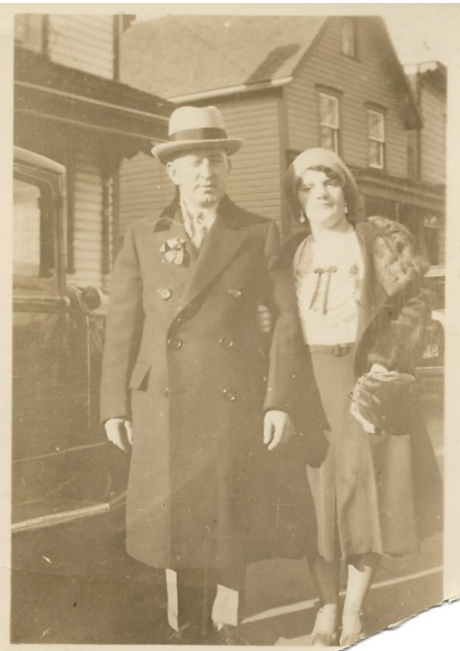 Figure 1: Adonias Robillard and Eva Létourneau, circa 1930. Photo courtesy Carmen McKay
When I searched for more information about Adonias, I found that both of his parents were born in the Ottawa area (one in Gatineau) and all four of his grandparents were either born in Bytown or moved to the town before 1855.
Bytown in the 1830s was in a period of transition from the building of the Rideau Canal in 1826-32 towards becoming a booming lumber town. Between 1835 and the mid-1840s, it seems there were more people than jobs in the lumber industry, and consequently conflict. It’s said that the Shiner’s War between mainly French-Canadian and Irish lumber workers took place then. There was no police force and no jail. What could go wrong?
1830s: Zéphérine Brunet, her family and friends
The earliest of my great-great-grandparents to arrive in Bytown was Zéphérine Brunet. She moved here with her parents in the year 1835, or possibly a year or two earlier, when she was just six years old.
Zéphérine’s approximate year of arrival in Bytown is decipherable because of records of her siblings (and her own) dates of birth and places of birth. The eldest of 9 children were born in St. Eustache (just north-east of Montreal) where her parents had married. Zéphérine and others were born in La Petite Nation (which includes what are now the towns of Papineauville and Montebello on the north side of the Ottawa River). Zéphérine was born in the summer of 1828. Her youngest two brothers were born in Bytown – one in 1835, the last in 1840. So, they were in Bytown by 1835.
Zéphérine’s father, Janvier Brunet, is identified as a “journalier” or labourer in various documents. The family migrated following employment opportunities, with mother Narcisse and children making a lively home wherever they went. It’s possible Janvier worked mainly in Bytown (rather than away in a lumber shanty), perhaps in a lumber yard, or assisting a merchant in the ByWard market.
The Brunet family knew another family that came to Bytown around the same time – the Brûlés. Both families spent a few years living in La Petite Nation east of Bytown on the north shore of the Ottawa river, a region named in reference to the Indigenous people that already lived there. That region of la Petite Nation was just beginning to be settled by Europeans in the early 1800s. Similarly to Bytown in the 1820s, there was not yet a permanent church or priest assigned to the area. Missionaries would travel to the area every few months. In fact, Zéphérine was not baptized until five months after her birth, probably due to the family’s distance from a priest.
The Brunet and Brûlé families may have held land leases in La Petite Nation, but I found no evidence of this. Possibly they were employed by leaseholders to cut trees, clear rocks or till the soil. Perhaps, once the trees were sold, they moved on. For whatever reason, both the Brunet and Brûlé families moved to Bytown in the 1830s.
My family’s picture starts to become more clear in the 1840s as more records of births, marriages, and deaths appeared in my family tree.
The 1840s
In 1843, a law was passed called the Vesting Act. This made the acquisition of land and establishment of public amenities more feasible in Bytown, where previously the residential lots had been merely available for lease to townsfolk. This encouraged people to invest more in building solid homes.
In this context, a still-standing heritage building on St. Patrick Street in Lowertown was built in approximately 1842 by Thomas Brûlé, a francophone blacksmith. Whether he began building it before or after the Vesting Act was passed, it seems likely he would have finished it as an owner of the lot, not just a tenant, as the building was solidly built enough to still stand today. Located at 288-290 St. Patrick Street, the building’s façade sits close to the street, and it has two front doors, indicating it formed two side-by-side homes. Behind the house one can glimpse a paved yard that once might have held a shed for a horse or a pig.
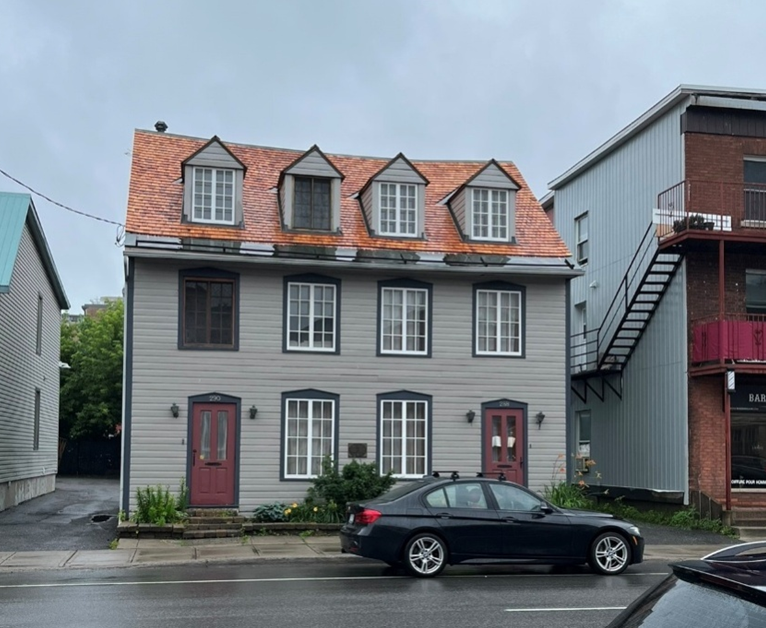 Figure 2: Brûlé House, 288-290 St. Patrick Street, 2024. Photo credit: Sonja McKay
As the Brunet and Brûlé families’ children grew up, well, they got married. Zéphérine Brunet married Edouard Brûlé on July 1, 1846, in Bytown. Edouard was a brother of Thomas, and Thomas served as a witness. The marriage would have taken place in a wooden church, the precursor of today’s Notre Dame Cathedral. (Construction of the cathedral had begun in 1841, and the walls and roof were completed in 1846, but it was not quite ready to host services yet.) Edouard made a living in the logging industry, and may probably have spent significant time away from his wife. They had two daughters by 1849. As I’ll show below, it’s very likely they lived in the Brulé house with Thomas and his family.
As author Michael McBane described in his excellent 2022 book, Bytown 1847: Elisabeth Bruyère and the Irish Famine Refugees , Lowertown was a muddy, crowded place in the 1840s. Most homes were built of wood and the streets were not paved. There was no municipal plumbing or electricity. Many households kept animals such as horses and pigs in their yards, the latter to eat the leftover scraps and to be butchered for food. Cows were allowed to feed on local grass. Land not yet built on served as vegetable gardens in summer. Ice hauled from the river in winter was stored and sold in summer to cool food. Potable drinking water was scarce, and outbreaks of communicable diseases occurred.
Another event of the 1840s is worth noting here: Thomas Brûlé participated in the “Stoney Monday” riot in September of 1849, another violent episode in our city’s past. He and another man were charged with murdering the only person to die that day, but both were acquitted. It turned out no one saw who shot the victim, David Borthwick. The riot had erupted between people of different political views, which had coalesced into a dispute over whether to invite the Governor General to Bytown or not. I imagine the trouble Thomas found himself in worried his family greatly. In the end, he was free to resume his livelihood.
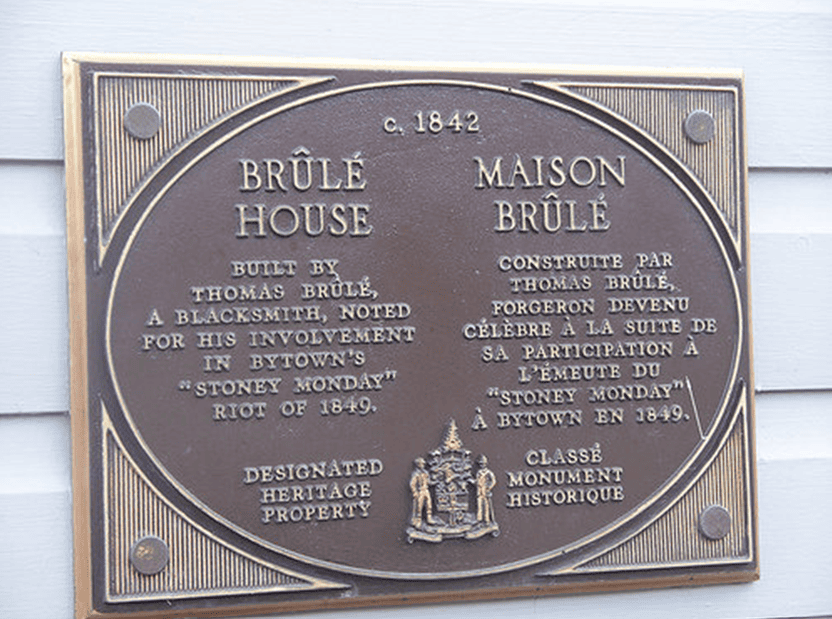 Figure 3: Plaque on Brûlé house 288-290 St. Patrick Street, Ottawa. Photo credit: Sonja McKay
The 1850s – A husband’s death, a new marriage
The 1851 census (taken in January 1852) shows that Zéphérine Brunet and her now three young children lived with Thomas Brûlé and his family -- see the orange circle in the census image, beside Zéphérine’s name, followed by her three daughters Heloise, Exina, and Theodosie. This residence must have been the 288-290 St. Patrick Street building, though no street addresses were given on the census. Sadly, Zéphérine was described as a widow. How could this be, I wondered?
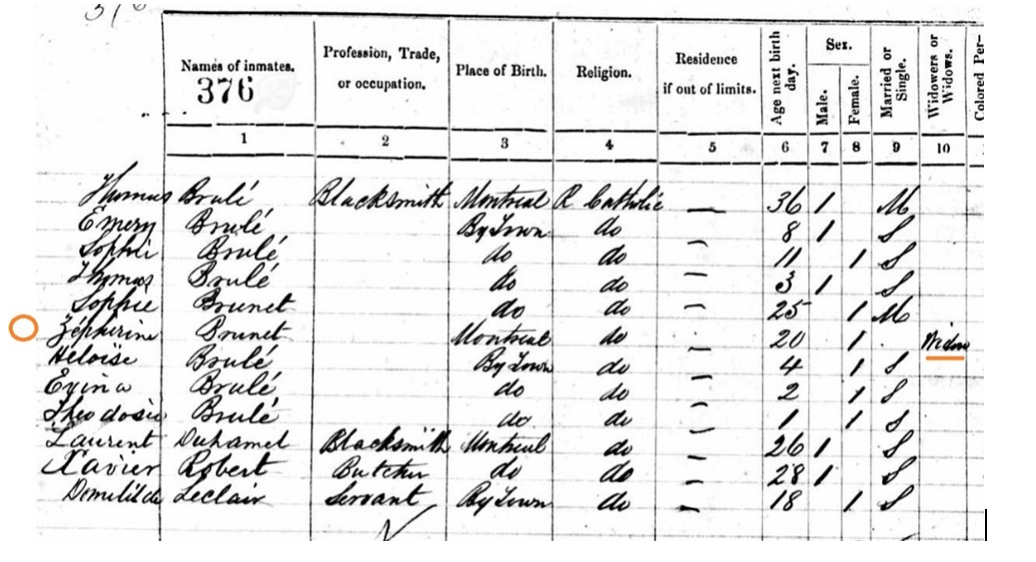 Figure 4: Excerpt of 1851 Census showing those living with Thomas Brûlé. Source: Library and Archives Canada.
Edouard had died a mere two months earlier, on November 14, 1851. A chilling note on the church register for his burial reads “tué par la chute d’un arbre” – Edouard was killed by a falling tree. It’s mainly because of this note that I assume Edouard worked in logging industry, and this was likely an accident in the forest while felling trees. The notation was written by father Damase Dandurand, a priest who arrived in Bytown in 1848 and who went on to serve the Roman Catholic community for the next 30 years. Thomas Brûlé was a witness to the ceremony.
This sad event had a silver lining, however, at least from my perspective. Edouard’s death paved the way for Zéphérine to remarry and have more children – one of whom became my great-grandmother Joséphine.
Zéphérine married her second husband, Eugène St. Jean, in Bytown on October 10, 1853. Eugène lived in Bytown, and he was from a town north of Montreal – St. Roch de l’Achigan. Again, the ceremony was performed by father Damase Dandurand, and Thomas Brûlé was a witness. The wedding likely took place inside the new Notre Dame cathedral, as it had been consecrated on September 4, 1853. Though the church’s decorate elements remained to be completed over the coming years, it already stood as solid beacon for the Roman Catholic community in the town.
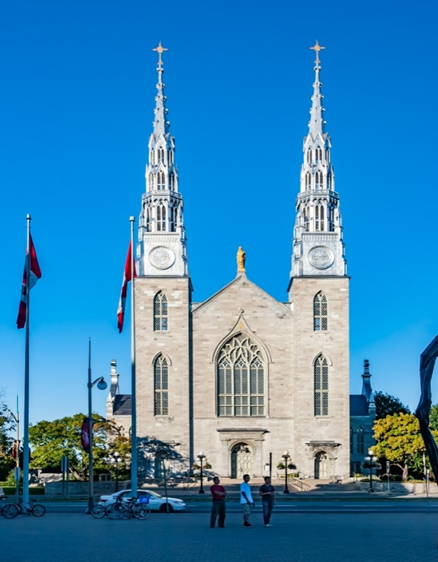 Figure 5: Notre Dame Cathedral, Ottawa. Photo by Michel Rathwell, CC BY 2.0, via Wikimedia Commons
The couple had five children together – a son and four daughters. Their youngest child, Joséphine, grew up to become my great-grandmother (Adonias’ mother). By the 1860s, the family had moved to the northern side of the Gatineau River – just across the Ottawa river in Pointe-Gatineau. This is where Joséphine was born in 1866.
Not much is known about Eugène St. Jean other than the interesting fact that he studied classics at the College de l’Assomption between 1839 and 1841 in Quebec. I imagine from this that he may have worked as a clerk or some other occupation which required education. Unfortunately, he too passed away before 1871 when Zéphérine appears in the 1871 census as a widow in Pointe-Gatineau.
Later, Zéphérine moved back to the Ottawa side of the river, showing how closely connected the two sides of the river were (as they are to this day). She married a third time, and lived to the ripe old age of 96.
Conclusion
This story focussed on the Bytown days of my family’s history. As we know, Bytown was renamed Ottawa in 1855, and soon was appointed by Queen Victoria to become Canada’s capital city. My family’s Ottawa story continued until my mother met my father in Ottawa. While I was raised primarily in an English-speaking household, I am proud of my francophone heritage and happy to share some of it with readers.
My heart is filled with gratitude to know that these relatives, and other settlers, survived in Bytown through the help they gave each other. It saddens me to know they also grieved the early deaths of loved ones, but this was common for the time. This story demonstrates in a concrete way how families survived by cooperating and sharing resources, and moving to where there was work. We can glimpse through them, much about what life in Bytown was like for its francophone settlers.
References:
Brault, Lucien (1941). Ottawa: Capitale du Canada de sesorigines à nosjours . PhD Thesis presented to University of Ottawa.
Brault, Lucien (1946). Ottawa Old and New. Ottawa Historical Information Institute. Available at the Ottawa Public Library.
Centre de recherche en civilisation canadienne-française.Vie française dans la capitale. A virtual museum website about Ottawa’s francophone history. Bilingual. https://www.viefrancaisecapitale.ca/ Accessed 2026-02-03.
McBane, Michael (2022).Bytown 1847, Elisabeth Bruyère and the Irish Famine Refugees.Available in bookstores and at the Ottawa Public Library.
Notre Dame Cathedral. https://notredameottawa.com/history . Accessed 2026-02-02.
Barbara Ann Scott, Queen of the Ice, was the subject of the Historical Society of Ottawa’s first Zoom presentation of 2026, which was held on the evening of January 14, 2026. We were joined that evening by Ryan Stevens, an award-winning author and noted figure skating historian. Ryan runs the Skate Guard Blog, has written for a number of leading skating magazines and his expertise are sought out by both journalists and museums. Ryan is the author of a number of books, including: Barbara Ann Scott: Queen of the Ice .
Ryan gave us a wonderful account of Barbara Ann’s life and her many accomplishments.
Barbara Ann was born on May 9, 1927, in Ottawa, the daughter of Clyde Rutherford Scott and Mary (née Purves). She asked Santa Claus for her first pair of skates when she was 3. Receiving a pair of double runner skates, not what she was hoping for, she begged for real skates, and on getting them, loved them so much that she took them to bed with her.
She began her formal skating at the Minto Skating Club on Waller Street, under the guidance of Melville Rogers, himself an Olympic skater and Otto Gold, a Czechoslovakian coach.Ryan gave us a quick timeline of her early career: 1939 - youngest skater at the Minto Skating Club to pass the Canadian First Class test; 1940 – Canadian Junior Ladies Champion; 1941 – Canadian Senior Ladies Silver Medalist; 1944 – Canadian Senior Ladies Champion; 1945 - North American Champion; 1947 was her breakthrough year internationally.
Barbara Ann won the European Championship in 1947. She followed this soon after by winning the World Championship in Stockholm. The competition was held on outdoor ice, a disadvantage for Canadians who did most of their training indoors. It was the first World Championship after the Second World War and Barbara Ann was the first North American skater to win the World Championship. She was welcomed by a huge crowd on her return to Ottawa, was the first skater honoured by the House of Commons and was presented with a canary yellow Buick convertible, with the license “47-U-1”, by the City of Ottawa. Barbara Ann had to return the car to retain her amateur status and so be eligible for the 1948 Olympics.
In 1948, Barbara Ann became the first Canadian woman to win a gold medal at the Winter Olympics in any sport.She was “Canada’s Sweetheart”, adored by the nation. On her return to Ottawa her train was met by Prime Minister Mackenzie King and Mayor Stanley Lewis. Over 150,000 well-wishers, about 2/3 the population of the city, packed her parade route. She had also had tea with Princess Elizabeth at Buckingham Palace and would later meet President Truman in the White House. She got her car back, this time licensed “48-U-1”.
Ryan explained that this fame came with a dark side.She was in the papers almost daily, rumours were reported as fact, nothing getting in the way of a good story. Unbelievable today, her address and phone number were published in the newspaper, leading to stalking incidents and police assistance being required.Barbara Ann had no manager or media training. She and her mother were left to the wolves.
Following her Olympic victory, Barbara Ann turned professional, making her debut in December 1948. A charitable organization had been set up as her employer and a large portion of her earnings went to the St. Lawrence Foundation for Crippled Children. Later she led the Skating Sensations of 1950 tour that played across Canada, not only in the major cities but in many small towns that had never experienced such a performance.
There was, of course, merchandizing associated with Barbara Ann. The most famous of these was the Barbara Ann Scott doll, produced by the Reliable Toy Company between 1948 and 1955. Each year featured a different skating costume, shoes as well as skates, and a letter from Barbara Ann. They quickly became collector’s items.
She retired from skating in 1955, married Tommy King, a retired basketball player & businessman, and moved to Chicago. She was a torch bearer at the 1988 Calgary Winter Olympics, marking the 40thanniversary of her Gold Medal performance. She also participated in the ceremonies of the 2010 Winter Olympics in Vancouver. She continued her life-long association with figure skating, frequently serving as a judge and always encouraging younger skaters. She was also an experienced equestrian. Barbara Ann died on September 30, 2012 at age 84, having received many honours including being a member of the Order of Canada.
Ryan’s presentation, which includes film clips of Barbara Ann skating, can be viewed on our YouTube channel. The presentation was followed by many interesting questions and personal memories that are well worth hearing.
Albert Dumont – The Kettle of Boiling Waters: Chaudière Falls, Algonquin Territory
HSOAlgonquin elder Albert “South Wind” Dumont speaks of the immense spiritual significance of the Chaudière Falls, and cautions on the importance of decisions made regarding their future:
The Kettle of Boiling Waters: Chaudière Falls, Algonquin Territory
On the evening of November 12, 2025, the Historical Society of Ottawa held its first Zoom presentation of the season. In partnership with The Centre for Holocaust Education and Scholarship - Ottawa (CHES), we were pleased that night to welcome Phil Emberley, who told us of his father whosurvived the Nazi Holocaust of the Second World War.
Mina Cohn, current Chair of CHES gave us some background on her organization before introducing Phil. CHES is an Ottawa-based volunteer organization which has, for the past 10 years, helped to sharethe memories of Holocaust survivors and their children, run educational programs,combat antisemitism and racism and promote Human Rights. One of their projects is a bilingual multi-media interactive AP that enhances visits to the National Holocaust Memorial. The HSO Museum Club is planning such a visit in spring 2026.
Phil Emberley is a pharmacist by profession and a long-time member of CHES.
Phil began his presentation with an overview of the Holocaust, recognizing that those attending would likely have different levels of knowledge. Following the First World War, the reparations demanded from Germany through the terms of the Treaty of Versailles lead to economic collapse, which was further intensified by the Great Depression. The economic failure and general despair proved to be fertile ground for political extremism.In 1933, Adolf Hitler, leader of the Nazi Party, became Chancellor of Germany. The Chancellor was then granted extended powers, under the pretext of an emergency, which Hitler used to suppress democracy and establish a dictatorship.
Phil described the main points of the antisemitic Nuremberg Laws which came into effect in 1935.
These were:
The Protection of German Blood and German Honour – which disallowed Jews from having relations or marrying German citizens;
Only those who were German, (i.e. not Jewish) could hold Reich citizenship;
The law also contained complicated provisions for establishing who were Jews.
There were also provisions that barred Jews from any role in management or ownership of German companies.
These laws created an environment where spying on your neighbour was encouraged and Jews were routinely arrested with little evidence or cause. Jews, who had always considered themselves to be Germans, were shocked at these changes. By 1941, Hitler enacted his Final Solution to the Jewish question, which meant an organized attempt to imprison, and eventual murder, all Jews within Germany’s grasp.
Phil told us that his father’s family name was Eger and that they had lived in the Frankfurt and Main area of Germany for many centuries. His father,Dieter, was born on November 11, 1925, the only child of Berthold, the Managing Director of a company that sold supplies to butchers. and his wife Mina, who was an accountant. Phil described how the applications of the laws and the resulting attitudes affected his family. Poverty, the lack of food and fuel, restrictions to education and activities, and physical intimidation were all part of family life.
On the night of 9/10 November 1938, Jewish homes, businesses and synagogues were vandalized and,in many cases, totally destroyed in what has been known as Kristall Nacht, but is now becoming known as the November Pogrom or the Reich Nacht Pogrom. The pretext for this night of terror was the shooting of a German diplomat in Paris by a 17 year old German Jew on the 7 th of November, the diplomat dying of his wounds on the 9th. Some 30,000 Jews were arrested, including Berthold, who was shipped to Buchenweld Concentration Camp, where he was held for 10 days before being released, as he was a decorated German veteran of the First World War.
After this, life in Germany got even worse for Jewish families, and Phil explained how it directly affected his own family and their attempts, like many other Jewish families to find some way to escape from Germany. Though this proved impossible for Berthold and Mina, Dieter was more fortunate. The British government, at the urging of U.K.based Jewish and Quaker groups, created a scheme whereby they would waive normal immigration requirements to allow unaccompanied children aged 4 to 17 to enter England. The scheme, known as the Kinder Transport, eventually allowed some 10,000 children to find safety in England.
Phil told us that Dieter left Frankfurt by train on the 24 th of August 1939, one week prior to the outbreak of war. He was one of 81 children on this trip that took them first to the Netherlands and from there by ferry to England. Dieter spent the next 3 months in a children’s refugee camp, learning little about life in England.
Many of the younger children were formally adopted, becoming part of their new English family, and many were converted to Christianity. Dieter, who was older, was fostered by a retired British military officer who enrolled him in Dulwich College, a private boy's school. Though no doubt well intentioned, Dieter’s lack of previous formal education and rudimentary knowledge of English must have posed difficulties, as he only stayed at the College for 2 terms.
In 1944 Dieter joined the British army and was posted back to Germany as part of the forces of occupation. In 1947, he officially changed his name to Denis Walter Emberley, maintaining the initials of his original name. In 1948, he became an officer in the Canadian army and while serving in Germany in 1953, met his future wife, Ursula Warmbier. In 1975 Major Denis Emberley was awarded the Order of Military Merit, one of the highest honours bestowed by the Canadian Armed Forces. In 1990 he was made a Member of the British Empire, (MBE).
With the exception of one uncle, Denis was the only member of his family to survive the Holocaust. His parents, Berthold and Mina were deported to Poland in October 1941 and were murdered, while his grandmother, who had lived with the family, was murdered in 1943. Though he escaped their fate, he did not escape the trauma, which remained with him until his own death in 2006 at age 80.
Phil noted that at age 55, his father began to write a journal, which included many short exerts that detailed his early life that had been unknown to the family. In the journal and in their discussions, Denis repeatedly emphasized two points: that those who ignore history are doomed to repeat it; and that democracies are fragile and we must be vigilant and prepared to protect them. Good lessons for our own time.
Watch Phil's presentation on the HSO YouTube channel.
David C. Martin – What a Surveyor Saw: John Burrows and the Rideau Canal
HSOWhat can we learn from the long-ago diaries of Rideau Canal surveyor John Burrows about how he perceived the landscape unfolding around him, through the lens of the British military, engineering, and colonial culture of the time?
Adapted from his recent lecture “Engineering Identity: John Burrows, Rideau Canal Landscapes, and Anglo-Canadian Ways of Seeing”, historian/researcher/writer David C. Martin looks beyond the many landscape paintings Burrows left behind, and instead explores what Burrows further revealed when he put pen to paper.
Read his account: Engineering Identity: John Burrows, Rideau Canal Landscapes, and Anglo-Canadian Ways of Seeing
André Pinard takes us back to a pivotal moment in a period of cultural tension in Bytown. Read the story (in French): Première réunion publique bilingue à Bytown
André Pinard is originally from Ottawa's Lower Town. He pursued a career in education in Northern Ontario and the Ottawa region.
Barbara Ann Scott: Queen of the Ice
Ryan Stevens shares the fairy tale story of “Canada’s Sweetheart” who astounded the world with her prowess and grace on ice – and endeared herself to generations of Canadians.
Media
Time Travelling with Jeff Wang - Under the Archway: A History of Ottawa’s Chinese Community
Enjoy this episode of the HSO/Rogers TV series Time Travelling with Jeff Wang – Under the Archway: A History of Ottawa’s Chinese Community.
Media
Time Travelling with Dominique Lajoie: The Château Laurier (If These Walls Could Talk!)
Enjoy this episode of the HSO/Rogers TV series Time Travelling with Dominique Lajoie: The Château Laurier (If These Walls Could Talk!).
Media
Larry Delaney: A Life Immersed in and Enriched by Country Music
John LeefeLarry Delaney is a builder, but don’t think bricks and mortar house construction. For over 32 years, the long-time New Edinburgh resident has been instrumental in helping to “build” the careers of hundreds of Canadian country musicians as the former editor/publisher of Country Music News . Launched on a shoestring budget (with local musician Neville Wells) in 1980, the CMM was the only country music publication with a national focus, ceasing publication in 2012. Delaney’s incalculable contribution to the country music industry was most recently recognized in May 2022 when he was awarded the “Impact Award” from the Country Music Association of Ontario as a “Builder”.
But that represents only a fraction of the numerous accolades he’s acquired over the years. Larry is an 11-time recipient of the CCMA’s Country Music Person of the Year award, an inductee into the Canadian County Music Hall of Fame in 1989, and the Hall of Honour in 1996. For a guy who never played an instrument, (“other than a turntable” he jokes), these are impressive accomplishments for the long-time resident of New Edinburgh.
Quick Links
About
Supporting Partners