

On the evening of November 12, 2025, the Historical Society of Ottawa held its first Zoom presentation of the season. In partnership with The Centre for Holocaust Education and Scholarship - Ottawa (CHES), we were pleased that night to welcome Phil Emberley, who told us of his father whosurvived the Nazi Holocaust of the Second World War.
Mina Cohn, current Chair of CHES gave us some background on her organization before introducing Phil. CHES is an Ottawa-based volunteer organization which has, for the past 10 years, helped to sharethe memories of Holocaust survivors and their children, run educational programs,combat antisemitism and racism and promote Human Rights. One of their projects is a bilingual multi-media interactive AP that enhances visits to the National Holocaust Memorial. The HSO Museum Club is planning such a visit in spring 2026.
Phil Emberley is a pharmacist by profession and a long-time member of CHES.
Phil began his presentation with an overview of the Holocaust, recognizing that those attending would likely have different levels of knowledge. Following the First World War, the reparations demanded from Germany through the terms of the Treaty of Versailles lead to economic collapse, which was further intensified by the Great Depression. The economic failure and general despair proved to be fertile ground for political extremism.In 1933, Adolf Hitler, leader of the Nazi Party, became Chancellor of Germany. The Chancellor was then granted extended powers, under the pretext of an emergency, which Hitler used to suppress democracy and establish a dictatorship.
Phil described the main points of the antisemitic Nuremberg Laws which came into effect in 1935.
These were:
The Protection of German Blood and German Honour – which disallowed Jews from having relations or marrying German citizens;
Only those who were German, (i.e. not Jewish) could hold Reich citizenship;
The law also contained complicated provisions for establishing who were Jews.
There were also provisions that barred Jews from any role in management or ownership of German companies.
These laws created an environment where spying on your neighbour was encouraged and Jews were routinely arrested with little evidence or cause. Jews, who had always considered themselves to be Germans, were shocked at these changes. By 1941, Hitler enacted his Final Solution to the Jewish question, which meant an organized attempt to imprison, and eventual murder, all Jews within Germany’s grasp.
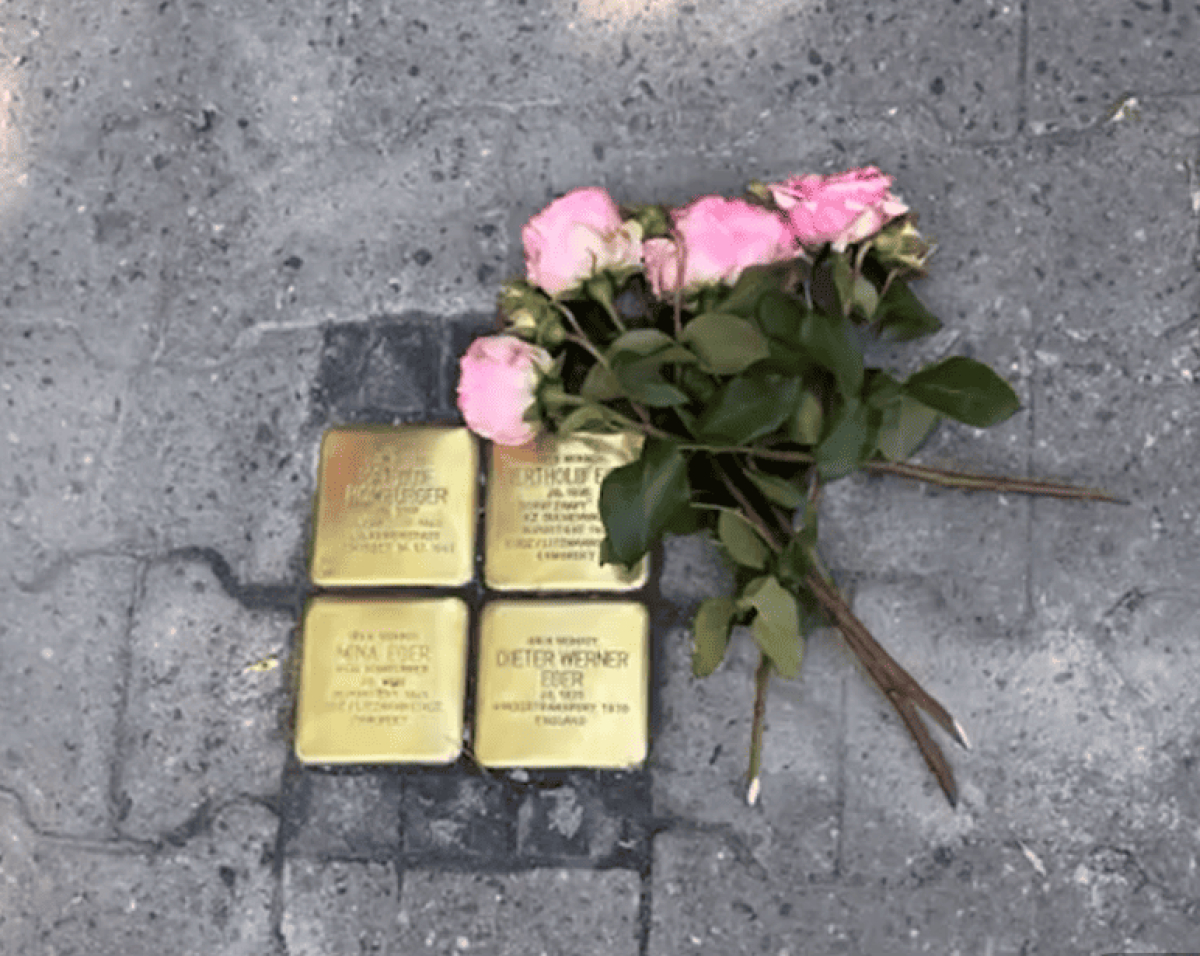
Phil told us that his father’s family name was Eger and that they had lived in the Frankfurt and Main area of Germany for many centuries. His father,Dieter, was born on November 11, 1925, the only child of Berthold, the Managing Director of a company that sold supplies to butchers. and his wife Mina, who was an accountant. Phil described how the applications of the laws and the resulting attitudes affected his family. Poverty, the lack of food and fuel, restrictions to education and activities, and physical intimidation were all part of family life.
On the night of 9/10 November 1938, Jewish homes, businesses and synagogues were vandalized and,in many cases, totally destroyed in what has been known as Kristall Nacht, but is now becoming known as the November Pogrom or the Reich Nacht Pogrom. The pretext for this night of terror was the shooting of a German diplomat in Paris by a 17 year old German Jew on the 7 th of November, the diplomat dying of his wounds on the 9th. Some 30,000 Jews were arrested, including Berthold, who was shipped to Buchenweld Concentration Camp, where he was held for 10 days before being released, as he was a decorated German veteran of the First World War.
After this, life in Germany got even worse for Jewish families, and Phil explained how it directly affected his own family and their attempts, like many other Jewish families to find some way to escape from Germany. Though this proved impossible for Berthold and Mina, Dieter was more fortunate. The British government, at the urging of U.K.based Jewish and Quaker groups, created a scheme whereby they would waive normal immigration requirements to allow unaccompanied children aged 4 to 17 to enter England. The scheme, known as the Kinder Transport, eventually allowed some 10,000 children to find safety in England.
Phil told us that Dieter left Frankfurt by train on the 24 th of August 1939, one week prior to the outbreak of war. He was one of 81 children on this trip that took them first to the Netherlands and from there by ferry to England. Dieter spent the next 3 months in a children’s refugee camp, learning little about life in England.
Many of the younger children were formally adopted, becoming part of their new English family, and many were converted to Christianity. Dieter, who was older, was fostered by a retired British military officer who enrolled him in Dulwich College, a private boy's school. Though no doubt well intentioned, Dieter’s lack of previous formal education and rudimentary knowledge of English must have posed difficulties, as he only stayed at the College for 2 terms.
In 1944 Dieter joined the British army and was posted back to Germany as part of the forces of occupation. In 1947, he officially changed his name to Denis Walter Emberley, maintaining the initials of his original name. In 1948, he became an officer in the Canadian army and while serving in Germany in 1953, met his future wife, Ursula Warmbier. In 1975 Major Denis Emberley was awarded the Order of Military Merit, one of the highest honours bestowed by the Canadian Armed Forces. In 1990 he was made a Member of the British Empire, (MBE).
With the exception of one uncle, Denis was the only member of his family to survive the Holocaust. His parents, Berthold and Mina were deported to Poland in October 1941 and were murdered, while his grandmother, who had lived with the family, was murdered in 1943. Though he escaped their fate, he did not escape the trauma, which remained with him until his own death in 2006 at age 80.
Phil noted that at age 55, his father began to write a journal, which included many short exerts that detailed his early life that had been unknown to the family. In the journal and in their discussions, Denis repeatedly emphasized two points: that those who ignore history are doomed to repeat it; and that democracies are fragile and we must be vigilant and prepared to protect them. Good lessons for our own time.
Watch Phil's presentation on the HSO YouTube channel.