

Working to preserve Ottawa's past
for future generations.
Sam Laprade is a graduate in Public Relations from Algonquin College and a Certified Fund Raising Executive. Her passion is to help non-profit organizations achieve their missions through effective fund raising. Her diverse life experience, including work with non-profits, work in the corporate sector, support for municipal politicians and broadcasting, has led her to believe that the most effective journalist is the one who puts their whole-self into their work. Sam does this, appearing daily on both radio and television.
On Friday, March 13, 2020, the Global Pandemic, what we now call Covid 19, hit Canada hard and all our lives suddenly changed. On Monday, March 16, Sam approached the station management at CityNews suggesting that she take the 2-hour slot usually featuring a podcast and use it to inform and talk with their listeners about the pandemic. They agreed, giving her the slot for 2 weeks, confident that it would then all be over.
Turns out, it wasn’t.
Unlike many, who were able to work from home, Sam went into the studio every day from then on, her first day-off being Mother’s Day, May 10. During that time, the small team at the station lived in fear, eventually stringing shower curtains between themselves in an attempt to remain safe. They also developed a set of contingency plans, should they lose colleagues on their team or in their sister stations. Sam’s 12-year-old daughter was equally gripped, watching as her mother went off each morning, not knowing if she would return home infected.
Sam’s approach to the situation was “Kind Radio”. She spoke with everyone, health professionals, politicians, restaurateurs, business owners, seniors, mothers' groups, even a 12-year-old girl who was painting rocks and leaving them around her community as a sign of hope. It was important to give everyone a voice, to listen to their concerns, to let them share their own stories and to become their virtual neighbor sitting at their kitchen table with them. The success of Sam’s approach locally led to her program being broadcast on other stations in different parts of the country.
Sam recalled that it was a divisive time and when mask and vaccine mandates came into effect, some segments of the population transitioned from fear and frustration to anger and hate. As tempers rose, Sam tried to keep things calm by ensuring those who just wanted to spread misinformation could not use her station as their platform. Despite this, the station faced protests, needing to call for police assistance on at least one occasion. They were also targets of online abuse. One case involved an anonymous regular listener routinely contacting them with a one-word attack, “Sheep”. It would seem that Sam’s reporting did not agree with the views of that particular listener.
There were some very hard days. On April 19, 2020, a mass shooting took place in the Halifax area. Sam’s show was, at that time, being broadcast in Ottawa, Kitchener and Nova Scotia. Sam struggled to maintain the balance of providing the “normal” Covid coverage to her Ontario listeners, while supplying the critical news updates needed by her listeners in Nova Scotia.
It is now three years on and hard to remember when the news cycle was suddenly restricted to just one story. It was a time when we were not concerned about the price of groceries, but if we could safely get groceries, a time when we found we could only see our loved ones through a window, a time when all we knew for certain was that we knew nothing for certain. It was a time when the vaccine we most needed was hope, something Sam injected into our community on a daily basis.
You can hear the Sam Laprade Show on City News.
With Grapefruit League baseball now underway in Florida, the Historical Society of Ottawa offered its own double header on March 8, 2023, at the Main Branch of the Ottawa Public Library. Both sessions focused on the importance of making connections and building the community. Leading off was Phil Rossy who spoke on the long and continuing involvement of the Kiwanis Club of Ottawa in the development and delivery of community services in Ottawa. Next up was Sam Laprade who reflected upon her role as a radio host during the early days of the pandemic. Both Phil and Sam knocked it out of the park.
Phil Rossy has been a member of the Kiwanis Club of Ottawa for 23 years, having served both as Club President and as the President of the Kiwanis Eastern Canada and Caribbean District. He has over 40 years of Hospitality experience in Hotel and Restaurant Management as well as contract management and consulting in Hospitals, Long-term Care and Retirement Communities. Among his many roles, Phil is also an educator, being the coordinator and principal developer of the Retirement Communities Management Program at Algonquin College.
Phil gave us some of the highlights of the long history of the Kiwanis Club of Ottawa. Sixty-two members attended the Club’s first regular Friday lunch, which took place on the 7th of December 1917 at the Chateau Laurier. These bimonthly lunches continue to this day, now at the Ottawa Hunt and Golf Club. Receiving their official Charter in 1918, with W. G. Keddie becoming the first President, they set right to work by providing transportation from Union Station for returning veterans. Like many organizations founded at that time, membership was restricted to men. This changed in 1990, when Shirley Tomblin became the Club’s first female member.
The Club has always had a sharp focus on the needs of children. It founded the Kiwanis Boys Club, now the Ottawa Boys and Girls Club, in 1924 and Camp Banting, a special summer camp for children living with Diabetes, in 1953. In 1942, the Club established the 211 Kiwanis Air Cadet Squadron, which it supports to this day. Club members currently provide a reading program for kindergarten students, while the Club also supports 8 Key Clubs in local High Schools, and two Circle K Clubs in our local universities, providing leadership opportunities for these youth.
The autonomous nature of Kiwanis allows individual Clubs the flexibility to respond to the specific needs of their own community. Thus, over the years, the Club has supported the Kiwanis Music Festival and Special Olympics and supports the Youville Centre, providing services to young mothers and, much earlier, the Club even recommended the formation of the Better Business Bureau to our City Council.
Though Kiwanians are far from shy about rolling up their own sleeves, volunteer hours being a membership requirement, they are also well known as effective fundraisers. Many fondly remember the Kiwanis TV Auction and the Kiwanis Duck Race, from years gone by, and today, the Kiwanis TV Bingo is very popular, and provided a much-needed diversion during the early days of the pandemic. The funds raised stay in our community, with organizations such as C.H.E.O. being major recipients.
The Kiwanis Club of Ottawa remains a vibrant organization. There are 120 current members, with King Charles III being their most notable honorary member. The members, bound in fellowship and their determination to help where needed, stand ready and willing. Phil reminded us that there will always be those in our community who fall through the cracks and so always a need for those, like the Kiwanis Club of Ottawa who are prepared to step in where needed. Ottawa Kiwanians can be justly proud of their long and ongoing contribution to the betterment of life within our city and they welcome any interested in lending their hearts and hands to join them in their work.
You can learn more about the Kiwanis Club of Ottawa at www.ottawakiwanis.org
SORRY, this event is full!
The Historical Society of Ottawa, in partnership with the Ottawa Public Library and Rogers TV, is presenting a three-part lecture series, featuring renowned author, columnist, singer songwriter Phil Jenkins, which will take place at the Ottawa Public Library's Sunnyside Branch, on three consecutive Saturdays — April 15, 22 & 29, 2023 11 a.m. to 1 p.m. each day.
Through the years, many have enjoyed Phil Jenkins' music, his columns in the Ottawa Citizen and his award-winning books such as "An Acre of Time" and "River Song". We hope you'll join us!
Attendance is free but we strongly recommend signing up early as spaces are limited. You can choose from either of two links to pre-register, through Eventbrite or through the Ottawa Public Library's website.
(Rogers TV has been invited to video-record the three lectures to be preserved for posterity's sake.)
The End of Slavery in Upper Canada
Glenn Sweazey and June Girvan explain why attempts to abolish slavery in Upper Canada failed and why it required a revolution decades later in Jamaica before slavery finally came to an end throughout the British Empire.
Media
HSO Continues Partnership with Black History Ottawa
The Historical Society of OttawaIn 1793, a young Black woman named Choe Clooey, against her loud protests, was forced into a boat and across the Niagara River to be sold in the United States. Several witnesses, horrified by Cooley’s plaintive cries for help, resolved to petition the Executive Council of Upper Canada for her immediate return and the arrest of the perpetrators.
Lord Simcoe, Lieutenant Governor of the newly founded jurisdiction of Upper Canada, had for many years been a strong opponent of slavery and was outraged but powerless to intervene once Cooley had been removed across the border. Simcoe did, however, vow to introduce a bill to abolish slavery in Upper Canada. Simcoe's bill did eventually pass, but only after it had been weakened significantly by members of his own government, of which approximately half were enslavers of Black people themselves (or were members of families that enslaved people).
Simcoe's bill limited slavery Upper Canada, but not until further world events, including a revolt in Jamaica decades later, would slavery finally be abolished in Upper Canada and the rest of the British Empire.
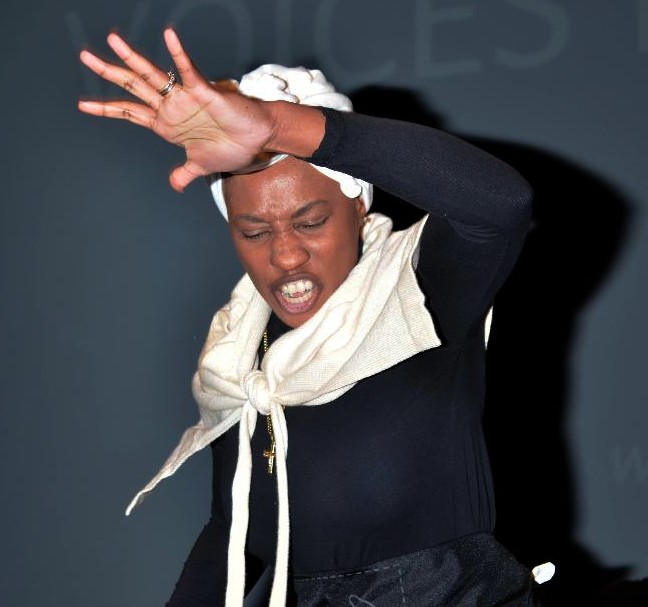 Jayeur Joseph performs as Chloe Cooley
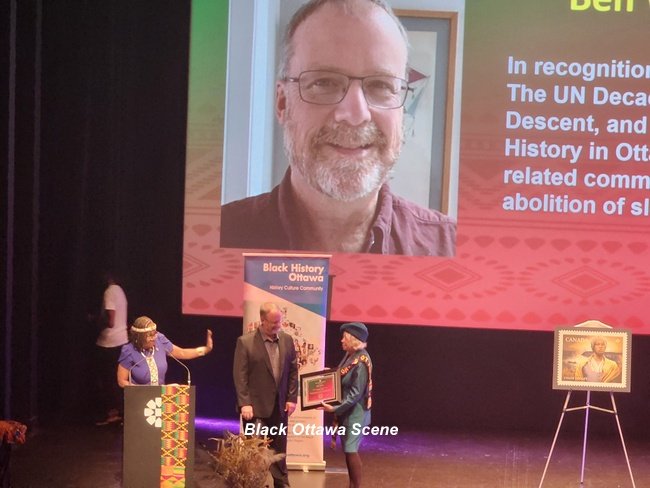 Ben Weiss receiving the Black History Ottawa President’s Award from BHO President June GirvanThe Chloe Cooley story was portrayed on stage at this year's opening event for Black History Month on January 28, 2023 at the National Gallery of Canada. Ben Weiss of the Historical Society of Ottawa was honoured to be asked to play the role of Lord Simcoe and, as he admits, was thankful to be surrounded by a cast of much better actors. It was, nonetheless, moving to be asked to take part in the performance.
Canada Post's 2023 stamp for Black History Month was also unveiled that afternoon, to great applause from the audience, featuring none other than Chloe Cooley herself.
Ben Weiss has for several years been the Historical Society of Ottawa's representative in its efforts to partner with Black History Ottawa and increase awareness of Black history. Ben was much honoured, during the afternoon's ceremonies, to be the recipient of Black History Ottawa's President's Award in recognition of ongoing contributions.
In celebration of our 125th anniversary, the Historical Society of Ottawa was recognized and honoured by being invited to contribute this year’s special Heritage Day “2023 Great Ottawa History Challenge”.
How well do you know Ottawa history? Take the challenge! https://ottawacitizen.com/news/heritage-day-try-the-2023-great-ottawa-history-challenge
Our in-person speaker session of February 8, 2023, hosted by the Main Branch of the Ottawa Public Library, featured two speakers – double the pleasure, double the fun! One of our speakers related fascinating stories of places, many of which we can no longer see, while the other encouraged us all to get out and look at what we still can, at least for now.
We welcomed Hagit Hadaya as our first speaker of the afternoon. Hagit holds a Master of Canadian Heritage Conservation and a High Honours BA in Architectural History, both from Carleton University. Since the completion of her formal education, she has been researching, writing, and lecturing on a variety of topics dealing with Canadian architectural history and currently serves on the National Capital Commission Advisory Committee on the Official Residences of Canada.
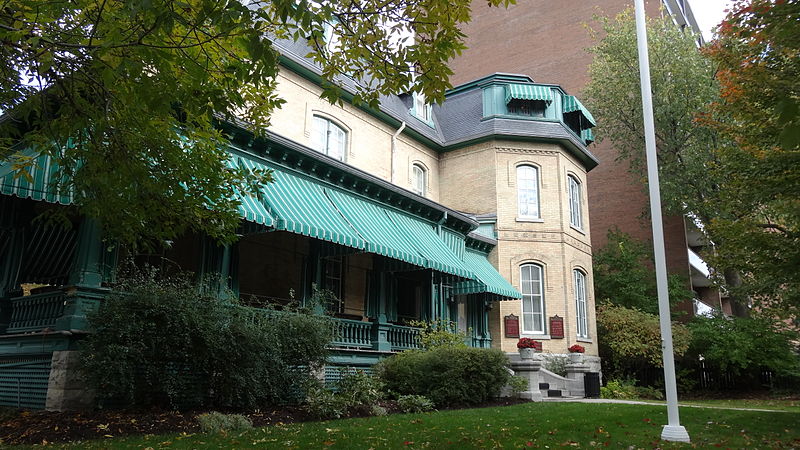 Laurier House. Photo: Suwannee.payne, CC BY-SA 3.0, via Wikimedia Commons.After a visit to the grave of Lester B. Pearson and his wife Maryon (Moody), Hagit became interested in the family life of our Prime Ministers and so began her quest to discover how and where in Ottawa they lived. Hagit focused her extensive research on the period prior to the adoption of 24 Sussex Drive, as the official residence in 1952. Limited by available time, she centered her talk on five of our Prime Ministers, Alexander Mackenzie, John Abbott, Wilfred Laurier, R. B. Bennett and William Lyon Mackenzie King, but also included some materials on Charles Tupper and Louis St. Laurent. Working forward through time, she described through words and images where in the community each had chosen to live, whether that be a private home or hotel. Many of the locations she revealed have vanished and so were likely previously unknown to many of the members of the audience. Blending details of the individual lodgings, historical and community context and humorous incidents, Hagit both informed and entertained.
In her presentation, Hagit noted that many of the Prime Ministers faced a degree of financial hardship, as they needed to maintain both a home in Ottawa and in their own riding, at their own expense. She did point out, however, that one of them was able to afford a monthly rent of $400 when the average Canadian family could only afford $27 per month. To learn his identity, along with the details of the residences of the remaining Prime Ministers and other fascinating stories of those covered, we strongly recommend her book, At Home with the Prime Minister: Ottawa Residences of the Prime Ministers Prior to 1952, available through the HSO for $30.
Our second presenter for the afternoon was Emma Kent. Emma, a graduate in History from Carleton University, is the current President of the Historical Society of Ottawa and a self-confessed art-nerd.
 Photo by Emma Kent.Emma discussed the role and evolution of Public Art in Ottawa, highlighted by a virtual walking tour through the Street Art of Hintonburg. She explained that public art, aka street art, is any piece of art, whether indoors or out, that was created or funded through a public process and is accessible for everyone to enjoy. Emma pointed out that the distinction between street art and graffiti is only one of legality, not quality.
Emma provided some historical context to the development of street art, which was initially predominated by statuary, such as the statue of Colonel By funded by the HSO. More recently, limitations of open space, coupled with technical developments in spray paint and the availability of vertical surfaces, have led to the evolution of tagging, (placing your name on a surface), throw-ups, (quick and simple designs), and murals. She explained that the artist community generally respects this hierarchy and will normally only cover one piece with another of a higher quality.
Commissioned street art is an easy way for a community to reflect its heritage and values, to add colour to drab areas and even enhance safety. The great variety of forms it offers, including decorated hydrants and traffic boxes, stickers, murals, and countless others, provide a feast for our eyes. Ottawa is fortunate to have many talented artists working in the field and Emma highlighted the works of Arpi and Daniel Martelock in particular.
Emma’s invitation to us all is to become explorers of the art in our communities, to spend a summer’s afternoon strolling through Hintonburg, the Glebe, or other parts of the city to view the art that is now on display. The transient nature of street art means that there will always be something new to see and enjoy.
Check out Prime Ministers' Row for a photo gallery of residences located in Sandy Hill of past prime ministers.
Check out this Capital Current arts & culture story about Emma's presentation: History Society 'tour guide' explores how street art enlivens city neighbourhoods
The Historical Society of Ottawa’s first speaker series of 2023 was an exciting debate on who was Ottawa’s most remarkable mayor: Charlotte Whitton or Marion Dewar? In one corner we had Dave Mullington, a former journalist, author, and long time member of the HSO defending Whitton. In the other corner, defending Dewar, we had a last-minute substitution of Robert Fox. Fox was Dewar’s chief of staff, Oxfam Canada’s representative in Central America, Communications Manager for CUPE, National Director of the NDP, and is presently co-chair of the Ottawa People’s Commission on the Convoy Occupation. Both experts in their chosen champion, the audience was really in for a treat.
Mullington was up first and jokingly pointed out it’s lucky that the subject of the debate was Ottawa’s most remarkable mayor rather than its kindest because in this debate of saint versus sinner he had chosen the sinner. He gave the audience great details on Whitton’s life and career before she became mayor. Whitton was elected to the Ottawa Board of Control in 1950, and, after the mayor Grenville Goodwin’s unexpected death the same year, she was immediately appointed acting mayor, becoming the first woman mayor of a major Canadian city. For those wishing to learn more about Whitton’s achievements it’s worth checking out Mullington’s book ‘Charlotte: The Last Suffragette’ published in 2010, which the HSO will have a few copies for sale at the next in-person speaker series.
Fox was up next and came dressed in two campaign buttons he wore while campaigning with Dewar back in the late 70’s and early 80’s. As Dewar's Chief of Staff, Fox spent a lot of time with Dewar and spoke emotionally about her love of the city and its people. Dewar served as mayor from 1978 to 1985 and is well known for leading Project 4000, where in 1979, when Ottawa pledged to sponsor 4000 Vietnamese, Cambodian and Laotian refugees. For those wishing to learn more about the project the HSO has a recorded speaker series from co-authors of the book "Running on Empty" by Michael Molloy and Robert Shalka, and Rivaux Lay, former Cambodian refugee, on the HSO YouTube page.
To finish up the afternoon, the two joined together on stage for a question period with questions from the audience. Both were incredible speakers and I was left unable to choose a winner. Special thanks again to Robert Fox, who filled in at the last minute for Elisabeth Arnold, Ottawa City Councillor, Somerset Ward, 1994-2003.
Additional Info
- Year 1897
- Date February 10
As most of our older members, but few of our newer members know, the Historical Society of Ottawa is in strong financial shape because of former president George Neville’s prudent leadership. And now the next generation of directors are having fun finding meaningful projects to support around town that showcase local history.
On September 30, 2022, on only the second ever National Day for Truth and Reconciliation, Ottawa Historical Society partnered with the Ottawa-based First Nations Child and Family Caring Society and Beechwood Cemetery for its annual educational activities.
Our donation provided a ride in style on the Lady Dive between Beechwood and Sparks Street where hourly walking tours were led up to St. Andrew’s at the corner of Wellington and Kent Streets.
Over 100 participants gathered at Beechwood at 10 am on the beautiful fall day, including HSO president Emma Kent and myself. First, we took in a children’s film produced by the First Nation Child and Family Caring Society to educate little ones about the history and enduring legacy of residential schools.
After the film we took the Beechwood tour which started off at Nicholas Floor Gavin’s memorial and ended at Peter Henderson Bryce’s. What most impressed me was the speaker’s focus on both their contributions and shortcomings. Gavin was a proponent of both women’s suffrage and the removal of Indigenous children from the “influence of the Wigwam”. Bryce documented and reported health abuses and high death rates in the residential school system while the chief medical officer of the Department of Indian Affairs; however, didn’t follow up on his observations with the publication of “The Story of a National Crime: An Appeal of Justice to the Indians of Canada” until after he had retired from the public service. Along the path down to Dr. Bryce’s memorial, there were 93 signs bearing the Truth and Reconciliation Commission Calls to Action.
We then headed over to Sparks Street on the Lady Dive where we learned more about the upcoming installation of the plaque “Reconciling History: Dr. Peter Henderson Bryce” – a trilingual (Algonquin, English, and French!) text that will be installed where his offices were located at 61 Sparks Street. The downtown tour ended at St. Andrew’s Presbyterian Church, which was built in 1828, and which is now a strong supporter of the Every Child Matters movement. We were also provided with snacks and chats at St. Andrew’s and had the chance to take in the beautiful interior.
Many thanks to Nick McCarthy, Beechwood’s Director of Marketing, Communications and Community Outreach, for all of his support, and we hope to participate again next year!
You can see a very nervous yours truly and sincere Emma speaking about her experience on that day in this video: www.youtube.com/watch?v=hgpI0INDgKo
Quick Links
About
Supporting Partners