

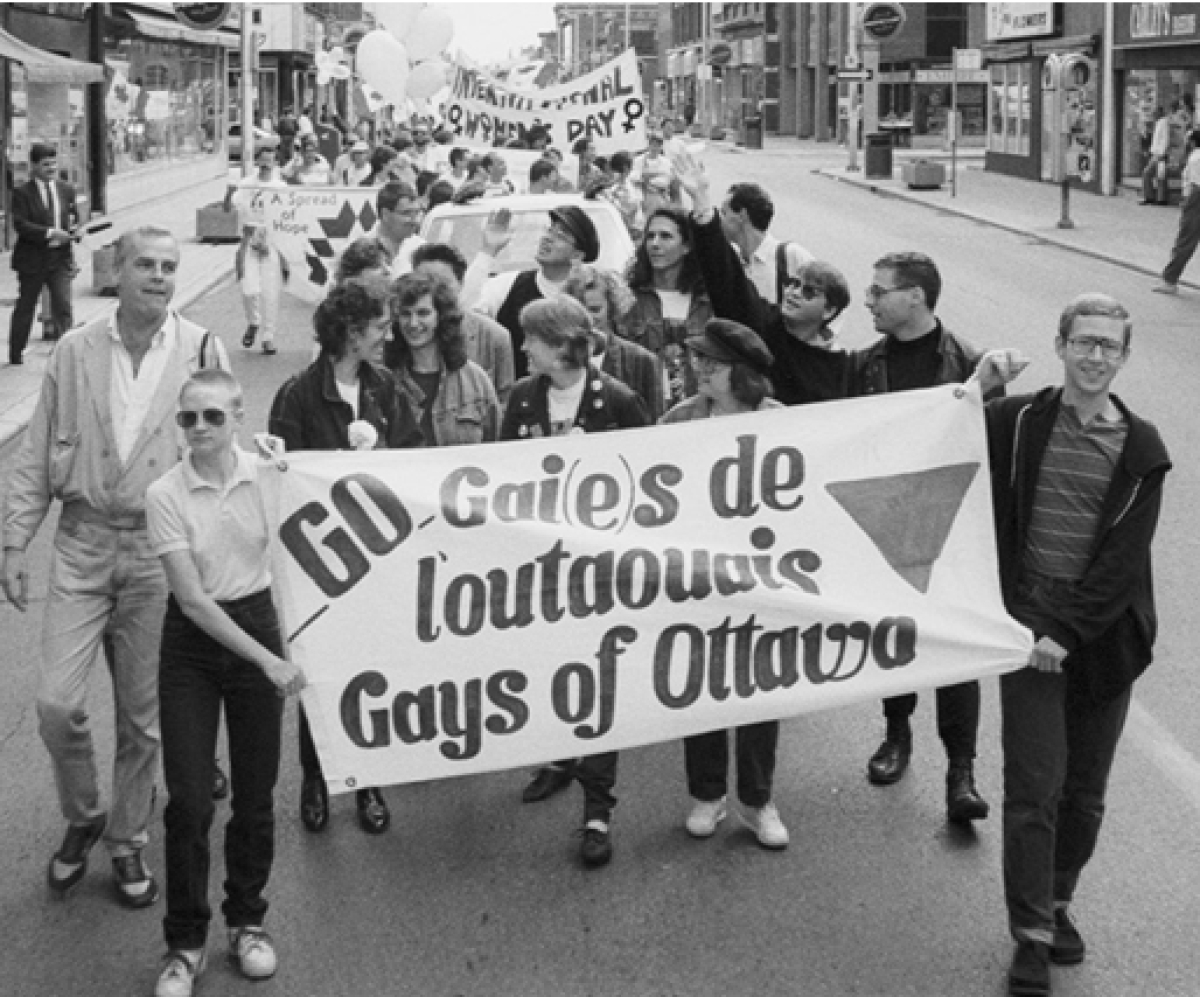
Sixty of us gathered in the auditorium of the Main Branch of the Ottawa Public Library on the afternoon of June 20, 2026 to hear a presentation from Glenn Crawford on the history of “Gays of Ottawa”, (GO), the first major social and political 2SLGBTQI+ organization in Ottawa. The presentation was timed to coincide with Pride Month.
Glenn was born in Edmonton but has lived in Ottawa since he was three. He is an entrepreneur/designer with an extensive background in design, service, journalism, art, communications and marketing. In 2021, he relocated his home and business. Jack Of All Trades, to Gatineau. Glenn has been an activist within the 2SLGBTQ+ community in the National Capital area for the past 20 years. In 2007, Glenn won the Capital Extra’s Hero award as Community Activist of the Year and in 2010 he was the Grand Marshall of the Capital Pride Parade. Since 2015, Glenn has been the researcher and creator of the Village Legacy project that documents Queer history in the Ottawa area: The Village Legacy Project | Le Projet de legs du village.
Glenn began by discussing, what he called the “touchy subject” of the various acronyms and abbreviations that are used to describe his community, including: LGB, LGBT, 2SLGBTQ+ and Queer. He explained that there is no term agreed to within the community, but that he would use “Queer” as an umbrella term to represent the whole community, noting that it is not always embraced by all members.
Glenn then described some of the risks of being Queer before the “Liberation Movement”. The risks were many upon discovery: loss of employment, loss of family and friends, loss of housing and the risk of physical assault, even from the police. Isolation was a serious problem, leading to depression, self-destructive behaviours, such as alcohol and drug usage, and suicide. With no organizations and no formal communications, word of mouth was the only means of communications available. There were few Gay bars, many being allegedly Mafia owned. A “Cruising Culture” developed in the male community exposing members and non-members to additional risks. Major’s Hill Park became a well-known venue. The risks faced were tragically illustrated when, on August 21, 1989, 33-year-old Alain Brosseau was assaulted and thrown to his death from the Alexandra Bridge. Brosseau, a waiter at the Château Laurier, and not Gay himself, was attacked by a gang of teens in a targeted homophobic hate crime. The same teens were involved in another targeted attack the same night. The tragic incident sparked public outrage and eventually forced the Ottawa police to start to take anti-Gay violence more seriously.
At the height of the Cold War in the 1950s &1960s, Glenn explained, the RCMP became focused on national security and saw the 2SLGBTQ community as a potential risk. What followed was “The Purge” in which individuals suspected as being queer were hunted down, exposed, threatened, and fired. A special device was “invented” to detect these individuals, known as "The 'Fruit Machine", though its use was more as a tactic of intimidation than any scientific merit. The irony was, of course, that it was the risk of persecution at the hands of the RCMP and other government agencies that created the very threat they feared.
Change was coming, if slowly, and perhaps remarkably it was starting at the top. On February 21, 1967, then Minister of Justice, Pierre Trudeau commented in a press scrum “there’s no place for the state in the bedrooms of the nation” while discussing Bill C-150, which came into effect on August 26, 1969. This was a broad modernization and liberalization of the criminal code and most famously legalized private, consensual sexual acts between adults 21 and older, the age restriction being lowered to 18 in 1972. Another incident that raised public awareness of the persecution being inflicted upon the community was the June 28, 1969 raid on the Stonewall Inn in New York City. The subsequent spontaneous demonstrations are widely regarded as the start of the liberation movement in North America.
With this background, Glenn went on to explain that, sparked by the “We Demand Rally” of August 28, 1971 on Parliament Hill, which had been organized by Gay groups from Toronto to present a list of 10 demands,Gays of Ottawa (GO) was formed on September 14, 1971. The first meeting was held in an apartment on Sommerset Street West, subsequent meetings also being held in private homes, until a space was obtained in the basement of St, George’s Church a few months later. By 1975, GO had moved, and along with public awareness, advocacy and social programming, it had created a newsletter, a helpline and had started a library.
Glenn explained that not all members of the Gay community were comfortable with the efforts of GO. Some believed that the new openness being promoted by GO risked “rocking the boat” and threatened their own carefully balanced double-lives. Despite this, by 1975, and after another move, GO became increasingly involved in the support of the legal defence of individuals being charged with criminal offences or dismissed from their jobs, based solely on their sexual orientation.
Glenn described GO in its early days as primarily a male organization, queer women having different needs and goals and not always being comfortable with the culture of GO. They were also not always welcomed by other feminist organizations, though they shared many of the same objectives. In June 1976, Lesbians of Ottawa Now, (LOON), was formed in preparation for the National Lesbian Conference, which was held in Ottawa that October, with over 300 delegates from across the country. By 1981, however, GO had established gender parity on their Board of Directors.
After two more moves, one the result of a fire of uncertain origins that destroyed all of GO’s materials and records, it settled again and in 1984 split its social services components, such as the helpline and library, away from its political and social activities to form Pink Triangle Services, the first 2SLGBTQ+ registered charity in Canada.
Glenn told us that, in August 1982, near the start of the AIDS epidemic, GO hosted a meeting of over 70 concerned members. Later, in 1985, two of their members were key in forming the AIDS Committee of Ottawa. In total, there were over 350 AIDS related deaths in Ottawa between 1984 and 1995 with almost 9,000 AIDS related deaths in Ontario during the epidemic.
GO moved for the last time in 1985, when their landlord refused to renew their lease. It remained at the new location, above a laundromat, until it ceased operations in 1995, changing its name twice, first to the Association of Lesbians and Gays of Ottawa, and then to the Association of Lesbians, Bisexuals and Gays of Ottawa. Though gone, GO’s legacy lives on in the organizations it spawned, the leaders it inspired and the attitudes it changed.