

Working to preserve Ottawa's past
for future generations.
Our first virtual speaker session of the year was held on September 27, 2023, and featured a pre-recorded presentation by Jim Stone, supported by Merv Sarazin who introduced Jim and remained with the presentation to answer questions and provide additional background. Jim, a retired Foreign Service officer and amateur historian, focussed his presentation on the life of Grand Chief Pierre Louis Constant Pinesi (1768 – 1834) and the turbulent times in which he lived. Jim also provided a more general history of the Alongkin* peoples of the Ottawa area in the 150 years or so prior to Chief Pinesi’s birth. Jim is not Indigenous himself and assembled the information for his presentation from published and archival sources, not traditional Alongkin knowledge, though he has consulted with the people of Pikwakanagan First Nation where a number of Chief Pinesi’s descendants live.
Jim described that, starting in the early 1600s, things began to go badly for the Alongkin people of the Ottawa valley. They were ravaged by a series of European diseases and their consequences. Later, they were driven from their lands by the Iroquois who were expanding their territory. As a result, the Ottawa valley became nearly depopulated. It was not until the signing of the Grand Peace of 1701 between the French, Alongkin, Iroquois and others, that the Alongkin began to return to this area.
Jim explained that prior to the influx of settlers, Alongkin family hunting grounds were fairly fixed and well respected. Chief Pinesi described his hunting grounds as being south of the Ottawa River, centered on the Rideau River. The exact boundaries, which would have followed natural land forms, are today unknown. Based on a meeting documented by Philemon Wright that he had with two Chiefs who were protesting his logging activities, it is possible that Chief Pinesi had some access to or use of lands to the north of the Ottawa River. Chief Pinesi and his family, he had 12 children, many of whom died young, would have travelled widely in his hunting grounds. He would also have travelled throughout the greater territory, especially to the Lake of Two Mountains, now Oka, where there was a summer gathering of Alongkin, Nipissing and Mohawk peoples, along with a French Catholic Mission.
Just prior to the 1800s, settlers began arriving in the Ottawa watershed. This resulted from the British domination of North America established by the Treaty of Paris in 1763 and spurred on by the American Revolution, which ended in 1783. Loggers cleared the forests, destroying the habitat of the animals hunted by the Alongkin, and settlers divided the land for farming. Both groups also competed for the same fish and animals that fed Chief Pinesi, his family and the other Alongkin people. Construction of the Rideau Canal was especially devastating. The dams required for the waterway, such as at Hog’s Back, transformed the river into a series of essentially long lakes, destroying fishing grounds at the base of rapids and flooding traditional camping and cultural sites along the shores and on its islands. The large workforce also accessed the same natural food sources, driving some species to near extinction in the area.
Chief Pinesi and four of his sons were among the many Indigenous warriors, Alongkin, Nipissing and Iroquois, who fought with the British in the war of 1812. Indigenous warriors are known to have fought at Queenston (October 13, 1812), Odeltown (August 19, 1812), Chateauguay (October 26, 1813) and Beaver Dams (June 24, 1813). Alongkin and Nipissing warriors were prominent in the capture of Colonel Boerstler's Detachment of 512 US soldiers at Beaver Dams. Jim emphasized that these warriors fought as allies, not as soldiers of the British army. Merv Sarazin commented that had it not been for the impact of Indigenous warriors, Canada as we know it might not exist, having fallen to the Americans at that time.
Jim pointed out that much of Chief Pinesi’s life was dedicated to attempting to protect his people’s rights to their ancestral lands and to their way of life. He submitted about 20 petitions, in conjunction with other Alongkin and Nipissing Chiefs, to the governments of Upper and Lower Canada seeking their acknowledgement to Alongkin title to their lands, compensation for lands already lost to settlers, and restrictions on further settlement. The governments did not act upon these petitions, despite the observation by Chief Pineisi that the Alongkins had helped defend the British interest in the area. In 1819, in response to pressure from the increasing number of settlers, the government of Upper Canada signed a treaty with Mississauga Chiefs that included the Alongkin lands of the Rideau River watershed, including Chief Pinesi’s family hunting grounds. No treaty for land compensation was ever signed with the Alongkin.
Chief Pinesi and his wife both died in August 1834 as a result of a Cholera epidemic that was sweeping Upper and Lower Canada. Jim believes that they are buried in the second Catholic cemetery at Lake of Two Mountains, though no record of the exact location of these graves survives.
You can watch Jim’s full presentation on the HSO YouTube channel.
A more complete written version of Jim’s work with footnotes can be downloaded from Grand Chief Constant Pinesi – Kichi Sibi Trails (kichisibiancienttrails.ca) .
Additional, Merv Sarazin referred to the book “The Ancestors are Arranging Things”, by Noreen Kruzich, available for purchase online or from the Ottawa Public Library.
*The term “Algonkin” is used to refer to the Anishinabeg living in the land claimed by Chief Pinesi on both sides of the Ottawa River and all its tributaries from Oka to Mattawa, including the headwaters of the latter river. The term Algonquin refers to a much larger group of Indigenous people. This term parallels that used by Noreen Kruzich in her book "The Ancestors are Arranging Things".
Almost 50 guests attended our first speaker presentation of the year, hosted by the Main Branch of the Ottawa Public Library on September 9, 2023. Prior to the presentation, Dianne Brydon, President of the British Isles Family History Society of Greater Ottawa took a few minutes to describe some of the outstanding events they have in their upcoming season. For more details on their organization and their presentations, please check out the BIFHSGO website.
We were then pleased to welcome Peter Atkinson, a retired educator from Ottawa, who spoke to us about his father, noted broadcaster Gord Atkinson. Peter focussed on a 13-year period of Gord’s extraordinary career when he introduced Rock & Roll music and the musicians who played it to Ottawa, to Canada and in some cases to North America. Gord was “Ottawa’s Oldest Teenager”.
Gord was recruited by radio station CFRA in Ottawa from radio station CHUM in Toronto in February 1954, based on the national success of his program featuring the music of Bing Crosby. Arriving in Ottawa, he soon determined that there was a market for the new music known as “Happy Beat”; the term “Rock and Roll” being considered as too risqué. The station attracted an older audience and their management was reluctant to try new things but eventually Gord convinced them to allow him to run a show of new music on Saturday afternoons, considered to be a dead time on the radio. He called his show the “Campus Corner”, a name he borrowed from the shoe department of the Ogilvy’s department store on Rideau Street. Gord ran the show from the Freiman’s department store in the Westgate Shopping plaza and it featured a mix of live performances and recordings. It was an immediate and overwhelming success soon outgrowing that venue and by 1963 changing to a Monday to Friday time slot and its name to the “Campus Club”, which eventually totalled some 30,000 members.
Gord created his own “Platter Poll” based on requests from his own listeners, rather than from nationally compiled lists of hits. Some of these listeners tuned in to late night radio from pioneering Rock & Roll hotbeds such as Buffalo and Rochester, allowing him to always be among the first to play new songs and new bands, often beating the major U.S. broadcasters by months.
Gord was also at the centre of the concert scene in Ottawa. He introduced the first “Happy Beat” concert in Ottawa, headlined by Bill Haley & His Comets, but also featuring Chuck Berry and the Platters. His best remembered concert was the April 3, 1957, appearance of Elvis Presley, one of only 3 such appearances outside of the United States throughout Elvis’ career. Elvis was eager to play Ottawa as he knew that his music was being well received and played here, based on the fan mail he had received. Later, in 1964, Gord took a group of some 40 Club members to see the Beatles in Maple Leaf Gardens. Returning home he told his family that he hadn’t heard them at all because of the constant screaming of the crowd.
Gord hosted a series of wildly successful talent shows at the Ottawa Coliseum, called the “Campus Hop”. This provided a venue for emerging local talent to perform and gain exposure – among many others, this helped launch the career of Vern Craig, later of the Staccatos, and the very popular Hugh Scott.
Speaking of the launching of careers, Gord introduced and promoted two local performers who would go on to become mega-stars in the entertainment world. Both Paul Anka and Rich Little owe their start to Gord Atkinson. Gord was the first in the world to play Paul Anka’s first big hit, Diana , Paul bringing the record to him for that purpose. Paul and Rich remained life-long friends with Gord and his family.
Life as a radio DJ, especially at that time, was highly competitive, demanding long hours and hard work. Gord maintained as successful a family life as he did a professional one, this due, in large part, to his wife Elaine, who raised their seven children and kept everything together and running.
Gord stepped away from the “Campus Club” in 1967 to run CFRA’s sister FM station, CFMO. He continued as a broadcaster with his other show “Show Bill” that he had started when first coming to Ottawa. Gord was also heavily involved in charitable work, most notably being one of the chief organizers, along with Rich Little of the 1982 Frank Sinatra concert that raised over $1,000,000 for a neo-natal unit at the Civic Hospital.
Peter has recorded many fascinating stories along with lots of photos, often previously unpublished, in his highly recommended book, “ Gord Atkinson: Ottawa’s Oldest Teenager”, which can be purchased at upcoming HSO in-person speaker series presentations at the library or through the Showbill website.
The May Court Club of Ottawa Celebrates 125 Years & The Bytown Museum Opens for the 2023 Season
David KentOur final in-person speaker session of the year, hosted by the Main Branch of the Ottawa Public Library on May 10th 2023, featured presentations from two organizations with whom we have some past connections.
Grant Vogl has been with the Bytown Museum since 2010 and is now the Senior Manager, Collections and Exhibitions. He spoke to us about the changes that have taken place at the museum over the last couple of years and their upcoming season.
 Bytown Museum Grant explained that, like most organizations, the pandemic disrupted the plans of the Bytown Museum. Closed for their 2020 and 2021 seasons, they opened for a shortened 7 week season in 2022 and were pleased to welcome some 12,000 visitors to the museum. They are very excited to be opening this Friday, May 12, 2023 for a full season. Though mostly out of the public view, much was done behind those closed doors. Grant described the work undertaken by the museum toward Reconciliation. Working with the Algonquin communities of Kigitan Zibi and Pikwakanagan, the museum reviewed their exhibits to ensure that Indigenous perspectives are included. It is important to the museum that visitors with an Indigenous heritage see themselves, their symbols, their culture and their language represented in the displays. As such, the museum has a new mural created by Indigenous artists and has 31 new tri-lingual information panels carrying English, French, and Algonquin language explanations.
Grant also gave us a “sneak peak” into their 2023 season. The Community Gallery hosts an exhibit by artists Gary Blundell and Victoria Ward entitled “Sourcing the Canal”. The exhibit highlights the natural and human landscapes that have been created by resource development whose resources would very likely have travelled through the Ottawa River and the canal. The temporary gallery features an exhibit entitled “City in Flames: Ten Fires that (Re)shaped Ottawa “. Grant explained that Ottawa’s history and landscape have been shaped and re-shaped by fire. Prominent buildings, industrial areas, landmark businesses, homes, and indeed entire neighbourhoods have all fallen victim to flames. These destructive fires not only devastated, but also renewed, allowing for architectural growth, the evolution of the cityscape, new iconic tourism locales, the passing of new laws, and more.
The Bytown Museum and the Historical Society of Ottawa share a common ancestry, both starting by the Women’s Canadian Historical Society of Ottawa. Grant reminded us that the Bytown Museum still recognises this shared heritage by offering free admission to Historical Society of Ottawa members.
To learn more about the Bytown Museum and their 2023 season, please visit their website: bytownmuseum.ca.
We were then pleased to be joined by Donna Shields-Poë, the President of the May Court Club of Ottawa, who introduced their Past President, Nancy Pyper. Nancy is one of those who has spent her life volunteering at whatever was needed, where ever she was, having been almost everywhere across the country as a military wife. She joined the May Court Club of Ottawa in 2013 and soon found herself drafted into leadership roles with them. She started her talk by giving us some background on their founder.
 Lady Aberdeen (née Ishbel Marjorbanks) - Topley Studio / Library and Archives Canada / PA-025771Ishbel Maria Hamilton-Gordon, Marchioness of Aberdeen and Temair, GBE, was a truly remarkable person. She had been a social activist in England and Scotland promoting education, health care and women’s suffrage. So when Lady Aberdeen, who also became the Patron to the WCHSO, came to Canada in 1893 as the wife of the Governor-General and discovered that there was no social safety net or supports for women, founded the National Council of Women of Canada, the Victorian Order of Nurses and on April 30, 1898, held an elaborate garden party at Rideau Hall to which she invited young women of prominent families and challenged them to use their time and skills to provide service to those less fortunate. Thus a May Queen was crowned, her Court established, becoming the May Court Club of Ottawa, the oldest women’s service club in Canada. The May Court Club of Ottawa is one of nine now operating in Ontario.
Lady Aberdeen’s call to the young ladies of leisure to do good works was taken up then and has been equally well responded to by subsequent generations of Ottawa women. Nancy shared that there has been a transition, as the world has changed, from single women, an initial requirement for membership, to (still only) women who are now mainly retired. This has in no way dampened their enthusiasm or commitment, their most senior member, now with 66 years of service to our community, at age 93, still does her weekly shift in the Bargain Box nearly-new store. Their motto, “Enriching the lives of others as well as our own”, is clearly heartfelt and heeded.
Nancy explained that the Club has always focused their services on women, children, and the disabled and told us some of what they have done in their century and a quarter of service to the families of Ottawa. These include support to the Victorian Order of Nurses, help in and funding for hospitals, creation of an early lending library for hospital patients (now at the Civic Campus but still closed due to Covid), help to the Red Cross, operation of one of the first (1905) Tuberculosis clinics and the creation, expansion, and operation of a Convalescence Home. Doing things “The May Court way” has allowed the Club to continue to support the families in our city and the many new Canadians who now make their homes with us.
Knitting has always been a major activity of the May Court Club. Nancy told us that this continues today with items being made for sale at artisan festivals, or items such as tuques for preemies or hats for cancer patients made and given as needed. She said that during the two World Wars the Club knitted thousands of pairs of socks for our soldiers, sailors and airmen, as well as cutting fabric and doing much other work for the war effort.
Nancy explained that some confusion exists in the mind of the public between “The May Court Club of Ottawa” and “The Hospice at May Court”. When the Club closed their Convalescents Home, in 1997 after 80 years of operation, they looked for another use for their building. The outcome was a partnership between the Club and All Saints, (now Hospice Care Ottawa); the Club provides the building, looks after maintenance etc. and makes an annual donation of $100,000, but does not actually operate the Hospice. Club members do, however, volunteer their time providing some administrative and other support services.
Traditionally, with the exception of the two World Wars, the Club funded their activities through balls, galas, vaudeville shows and other social events, which were attended by Ottawa’s leading citizens. Times change and now the Bargain Box, which has been open on Laurier Avenue East for 50 years, is the major source of their funds. It survived all the closures and restrictions of the pandemic and is well supported by the local community, especially the students at the University of Ottawa, who appreciate the quality and love the prices.
Like HSO, the May Court Club of Ottawa is celebrating their 125th anniversary this spring. To mark the occasion the Club has just announced a donation of $125,000 to the Crossroads Children’s Mental Health Centre. A wonderful gift from an organization that has certainly more than net the challenge laid down to them by Lady Aberdeen all those years ago.
To learn more about the May Court Club of Ottawa, please visit their Facebook page at maycourtclubottawa or their website at maycourt.org.
On April 26, 2023, Jim Burant led us on a brisk virtual walk through the history of art in the Ottawa area. Jim was an Adjunct Professor of Art History at Carleton University as well as the Director of the Ontario Region of the National Archival Appraisal Board of Canada. He is a member of the Algonquins of Pikwakanagan, the co-curator of three major exhibitions of Ottawa art at the Ottawa Art Gallery and author of the recently published digital book, Ottawa Art & Artists: An Illustrated History, for the Art Canada Institute, with whom we were pleased to partner for this presentation. His book is the first in a series planned by the Art Canada Institute which will focus on art from a particular community in Canada. Jim pointed out that this will partially fill a gap in our understanding of art in Canada, as the two major references, Painting in Canada: A History by John Russell Harper and A Concise History of Canadian Painting by Dennis Reid, primarily reflect the work done in Montreal, Toronto, and Vancouver, making no mention of Ottawa.
Jim started us in the distant past, showing us the rock art of Mazinaw Rock in Bon Echo Provincial Park and the 77 pictographs of Oiseau Rock, many of which have been defaced by graffiti. This damage to sacred sites demonstrates a shocking disrespect for the culture and history of our Indigenous peoples. Jim explained that Indigenous artists have a long tradition of creating artifacts of cultural interest and worth. They worked with a variety of forms and materials, including baskets, copper and silver, ceramics and clothing, such as moccasins. Jim showed us a jacket made for him by his grandmother in 1969, which he still proudly possesses.
The arrival of European colonists resulted in the production of thousands of pieces of settler art that document their history. By showing us different works of similar subjects produced by different artists, Jim pointed out the importance of understanding the who, what, when, where, and why of a work’s creation, as they may have a very different take-away depending on the artist’s intent. These early works tell us a lot about Ottawa’s past as a lumbering and small industrial centre, an aspect of our city that has now vanished.
Jim explained that the selection of Ottawa as the capital in 1857 changed the nature of its art. There was an influx of artists into the city seeking patronage and employment or to teach at such organizations as the University of Ottawa and the Ottawa School of Art. There was, however, a dichotomy created between Ottawa as the nation’s capital and Ottawa as a local community. This was reflected in the fact that local politicians were content to abandon the promotion and collection of art to federal authorities. Thus, it was not until 1988 that the Ottawa Art Gallery was founded. Jim showed us a number of works by artists of the late 1800s, with a special emphasis on the work of Franklin Brownell, who Jim remarked to be his favourite.
The first half of the 20th Century brought massive changes to Ottawa. Spurred by two World Wars, there was a tremendous growth in the public service and public institutions leading to more opportunities for employment for artists and for them to display their works. Many artists found war work creating pamphlets, posters, maps and manuals. The National Film Board employed many notable artists at this time. Jim also pointed out that many well-known artists including Florence McGillivray, Fred Varley and Pegi Nicol MacLeod, who are not generally associated with Ottawa, did spend parts of their careers working here.
The second half of the 20th Century saw further developments to support the growing art community within Ottawa. These included the creation of art schools, such as the Algonquin College Art School and the Visual Arts Department of the University of Ottawa. Artists continued gathering as groups to work and exhibit together and to lobby for the creation of a municipal art gallery. Artist controlled exhibition venues such as the SAW Gallery opened, as did commercial galleries, such as the Blue Barn and the Robertson Gallery, which was among the first to exhibit Inuit art. As well at this time, art collectors, such as O. J. Firestone became prominent.
Jim also discussed the development of photography within Ottawa, starting with William Topley who ran his own studio in Ottawa from the mid-1870s to 1923. Topley is likely best known for his thousands of portraits, but he was also an innovator and a founder of the Ottawa Camera Club. Later, Yousuf Karsh came to Ottawa in 1932 and opened his studio somewhat later. He became involved in the local photographic community and the Ottawa Little Theatre. His best known work, a portrait of Winston Churchill taken in December 1941 was used on the cover of Life magazine and made him world famous. He continued to work in Ottawa into the 1990s.
In the past few decades there has been increasing interest in the works of Indigenous artists, such as Barry Ace, Rosalie Favell, Ron Noganosh, and Annie Pootoogook. As Canada has become increasingly multi-cultural and inclusive, there has been a corresponding increase in interest in works of artists from diverse cultural backgrounds.
In his closing, Jim reminded us that art challenges our notion of ourselves and allows us to see alternative points of view as we all attempt to negotiate our place in today’s Canada.
You can obtain a free download of Jim’s fantastic book on the Art Canada Institute website.
You can also see a full recording of his presentation on the video section of the HSO website.
The Historical Society of Ottawa was honoured to welcome back Dr. Jean-Luc Pilon as the featured speaker at the April 12, 2023, speaker series session, hosted by the Main Branch of the Ottawa Public Library. Dr. Pilon is a renowned archeologist, long-time curator of Central Canada archaeology at the Canadian Museum of History, an educator, and was the first recipient of the J.V. Wright Lifetime Achievement Award from the Ontario Archaeological Society.
Dr. Pilon, who had spoken to us in November 2016, led us through some of the history of archeological activities in the Ottawa area along with the views of some individuals, organizations and governments. He pointed out that Europeans immediately grasped the importance of this location, Champlain making note of it in his journal in 1613. A Royal Proclamation of 1763 offered a degree of protection to Indigenous lands west of the Appalachian Mountains, but land grants from the Crown and later questionable Crown treaties and purchases, such as the Rideau Purchase of 1819, served to strip the Indigenous peoples of their land and heritage. Philemon Wright noted the objection of the local Indigenous population as he expanded his own enterprises in the area in the early 1800s, especially logging in support of the Napoleonic Wars. Later, about 1843, Dr. Edward van Courtland, a local medical doctor, naturalist and archeologist, identified a major ceremonial and burial site in the area, collecting many artifacts from his find. Archeology, at that time, had little concept of context and would from today’s perspective be more closely associated with looting than science. In describing the site, Dr. Courtland failed to mention on which side of the Ottawa River it fell, leading to a misunderstanding about the location of his discovery that was to endure and propagate for over 170 years. Writing for the Women’s Canadian Historical Society of Ottawa in 1901, Gertrude Kenny provided an anecdotal account of the Indigenous culture that had existed in the area for hundreds of years, but provided no sources for her account. Dr. Pilon noted many others who found artifacts or provided their own interpretations.
Dr. Pilon described how the artifacts flowed to and through a series of museums including the Bytown Mechanics Institute, the Literary and Scientific Society of Ottawa, the Geological Survey of Canada, and now the Canadian Museum of History. The artifacts that have been collected in the valleys of the Ottawa and Rideau rivers have a story to tell. Implements of stone quarried from deposits in Labrador, the Hudson Bay / James Bay and New York State areas, copper from west of Lake Superior, pottery of the Middle Woodland period, virtually identical to that found in the Lake of the Woods area, speak to a broad-based and sophisticated trading network with a critical hub in the Ottawa / Gatineau area that had been active for more than 4,500 years before the arrival of European settlers. The meeting of the Gatineau, Rideau, and Ottawa rivers made this an ideal location for the exchange of goods and ideas, while the presence of the Chaudière Falls, also known as Akikodjiwan, made this a significant spiritual location as well.
During excavations associated with the renovation of the Centre Block of the Parliament Buildings, a stone knife, dated between 2,500 and 4,000 years old was discovered. The knife has been returned to the stewardship of the Algonquin Anishinabe peoples and it is expected that it will be displayed in the Center Block when it reopens.
Dr. Pilon reminded us that as we think about our city, we must remember that this was a center of commerce and culture for thousands of years before anything we see today.
Following Dr. Pilon’s presentation, we were privileged to be joined by several students from Anishinàbe Odjìbikan. Anishinàbe Odjìbikan is an Indigenous Archaeological Field School that provides First Nations students from Pikwakanagan and Kitigan Zibi the phenomenal opportunity to take part in archaeological digs along the shorelines and uncover and better understand their own ancestral past. Jenna and Kyle gave us some background to their program,. Planned in 2019, it, like most things, was delayed by Covid. In 2021, 8 students, 4 from each community participated, while in 2022, 16 students, 10 from Kitigan Zibi and 6 from Pikwakanagan took part. Their hope is to continue the program for at least another three years. The program has strong support from the communities, financial support from the federal government and archeological mentoring from the National Capital Commission. It is hoped that some financial independence can be achieved through access to bid on government contracts.
Jenna and Kyle explained some of the differences between their approach and that of traditional archeology, which has largely ignored First Nation’s voices and their traditional knowledge. They explained that while recovering their own people’s artifacts, they adopt appropriate cultural practices, such as ceremonies to thank the land for its care of the items before and after their recovery and the renewed use of the recovered items as they had been originally intended. In recovering the artifacts, the students and their communities recognize that they are also recovering their own heritage, allowing them their own interpretation not one from a colonial perspective. These artifacts also provide an undeniable proof of the occupation of this land by indigenous peoples for thousands of years before the arrival of the first colonists.
Jenna and Kyle expressed the urgency of their undertaking. Climate change, high water levels and urbanization are damaging and destroying potential sites. They see this program as critical in providing the skills and trained individuals needed to perform the work ahead.
Following their presentation, the students displayed a number of the artifacts they had uncovered and responded to many questions posed by audience members who came down to the stage for a closer look and a chat.
This in-person session, the most popular this season with over 90 people attending, left all of us with a thirst to learn more about the earlier history of the land on which we live and the peoples to whom it belongs.
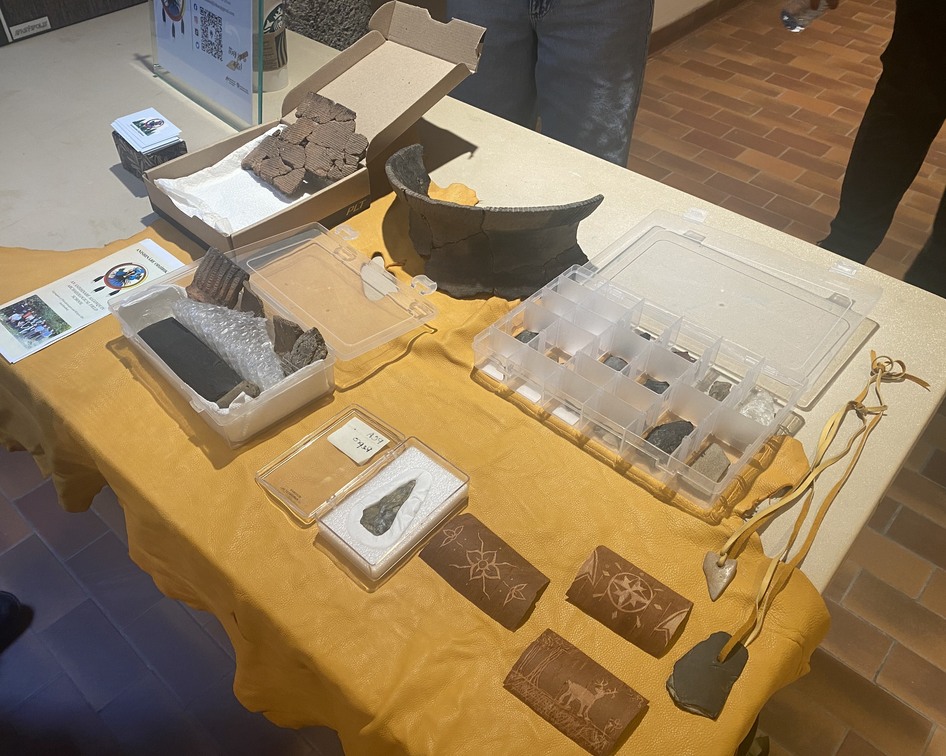 Artifacts presented by Anishinàbe Odjìbikan.
Dr. Jean-Luc Pilon has shared this excellent video, a guided tour as he explores the heart of our region: Paddling through the past - Ottawa-Gatineau's Ancient Cultural Landscape.
To mark Black History Month, our February 22, 2023 Virtual Speaker Series presentation featured Glenn Sweazey, who revealed to us the (gradual) end of slavery in Upper Canada. Glenn spent his career as a High School English teacher and is now a writer living in Ottawa. His work weaves elements of poetry and prose to create a narrative tapestry. He is a teller of stories with a story to tell.
Glenn was introduced to us by June Girvan, President of Black History Ottawa, with whom HSO is proud to partner for this presentation. June, originally from Jamaica, has spent over 6 decades in Canada and is a noted educator and activist. She established the J’Nikira Dinqinesh Education Centre (JDEC), named for her children, in Ottawa. The JDEC commemorates pioneers who championed anti-slavery, human rights and social justice in Canada, and bequeathed to us, our North Star legacy. June remained with us through the evening, adding additional information and valuable insight, especially during the question and answer period that followed Glenn’s formal presentation.
Glenn reminded us that what we generally know and learn is often a narrative myth in which some facts, and some voices, are selectively forgotten. In the case of slavery in Upper Canada, what we “know” is that Upper Canada was the terminus of the Underground Railroad, a safe and welcoming sanctuary for slaved people escaping the plantations of the southern United States. As Ontarians, what we have forgotten is our own history of slavery and the voices of those who were enslaved.
Slavery in Upper Canada, (part of Quebec until 1791), took a dramatic jump following the end of the American Revolution in 1784. In 1790, the British Government passed the Imperial Act, which encouraged loyal subjects to move north with their "possessions", which included their enslaved people. This led to an estimated 500 – 700 slaves being held in Upper Canada in the 1790s.
Glenn related the story of Chloe Cooley, an enslaved person living in the Niagara-on-the-Lake area. In March of 1793, she was beaten, bound and taken by boat across the Niagara River to the USA by her owner Adam Vrooma and sold. Her cries of protest did not help her, but they were heard and reported to the authorities, and served as a spark to the anti-slavery movement in Upper Canada. In July 1793, John Graves Simcoe, the first Lieutenant-Governor of Upper Canada signed into law “An Act to Prevent the further Introduction of Slaves and to limit the Term of Contracts for Servitude” (also known as the Act to Limit Slavery in Upper Canada).
Glenn explained that the Act was, by necessity, a compromise, as many members of the Legislature were themselves slave owners. Thus the Act did not free existing slaves, but did ban the import of new slaves, and freed those born into slavery in Upper Canada subsequent to the Act, once they reached the age of 25. Even this was too much for some and an attempt was made in 1798 to effectively overturn the 1793 Act; the attempt failed when the Legislative Session came to an end before it could be voted on by the upper chamber, the Legislative Council.
Slavery continued in this modified form and Glenn recounted the story of Peggy Pompadour, who with her three children was owned by a prominent member of the Legislature, Peter Russell. Glenn read to us an ad placed by Russell in February 1806 offering Peggy for sale for $150 and her son, Jupiter, for $200. Financing could be arranged and a discount for a straight cash payment was offered.
Slavery might have continued to carry on in this manner for quite some time had events in another British Colony not raised the alarm. In December 1831, a slave revolt erupted in Jamaica led by Samuel Sharpe (aka Archer), himself a slave and a Baptist Deacon. The violent uprising shocked the British Parliament, and on August 28, 1833 the Slavery Abolition Act received Royal Assent, ending slavery in most of the British Empire. The Act became effective the following year, August 1, 1834, but in implementation most slaves remained indentured as “apprentices”, for four more years while they “learnt how” to be free. Glenn and June pointed out that the freeing of the slaves came with compensation, to their former owners for the loss of their property, not to the former slaves, who were left to fend for themselves.
The year 2023 marks the 230th anniversary of the Act to Limit Slavery in Upper Canada and the 190th anniversary of the Slavery Abolition Act. Despite this passage of time, echoes of the era of enslavement remain. We still choose to honour those who owned slaves through the use of their names as places and streets within our communities.
To view a complete recording of Glenn’s presentation, see the video on the HSO YouTube channel.
Our Zoom presentation of March 29, 2023, attended by over 100 participants, featured noted author Michael McBane. Michael, a staunch advocate for public health care and improved public services, was the first recipient of the Social Justice award from the Canadian Centre for Policy Alternatives. His extensive research, including personal letters, memoirs, proceedings of the Legislature and the British Parliament and contemporary newspaper coverage painted a vivid picture of the typhus outbreak in Bytown in 1847. Michael pointed out that the events can be seen as the coalescence of three different stories: the story of the Great Irish Famine, the story of early Bytown, and the remarkable story of Élisabeth Bruyère.
The Great Famine, 1845 – 1852, was focused on Ireland’s poorest people in the west and south of the island and resulted in the death of approximately 1,000,000 and created about 1,900,000 refugees. The worst year of the famine, 1847, also known as “Black 47”, alone saw 100,000 emigrants to British North America, with 20,000 of these dying on the voyage. British North America was a convenient destination, as lumber ships crossing to the British Isles did not want to return empty, and the Irish made a ready cargo. Michael discussed the three prevailing views on why the famine was so deadly. The Nationalist view that the famine was primarily politically motivated and should be considered as a genocide perpetrated against the Irish people by the Government of the United Kingdom; the Revisionist view that the famine was primarily a natural occurrence and that little blame can be placed on the politicians of the day, and finally, the post-Revisionist view that the famine resulted from a combination of factors including poor economic practices and political mishandling.
Michael described Bytown in the 1840s as a rough-and-tumble town of about 5,000. Though small, it was both physically and socially divided. Uppertown, to the west of the Rideau Canal, was primarily powerful, prosperous and Protestant, while Lowertown was primarily a mix of the poorer Irish and French Catholic working class. Bytown and the greater Ottawa Valley was an attractive destination for Irish immigrants. The Irish had come to the area in several waves, including veterans of Wellington’s army after the Napoleonic wars and the workers involved in the building of the Rideau Canal. The Ottawa Valley had become an Irish diaspora. These strong family ties would become critical to the survival of many of those who fled the famine in Ireland only to find that a plague had accompanied them.
In 1845, the 27 year old Élisabeth Bruyère came to Bytown, leading a small party of Sisters of the Grey Nuns of Montreal. Highly motivated, skilled and organized, the Sisters soon recognized the needs of the community, which lacked any social services at that time. In response, they soon opened the General Hospital, a home for the aged, an orphanage, a bilingual school, and were delivering home services to the poor. Michael read part of a letter to us from Élisabeth Bruyère written in May 1847 which revealed her awareness of the looming tragedy, her fears for her own life, and her steadfast commitment to care for all those who needed it.
The typhus outbreak began in Bytown in June 1847 as the Irish refugees arrived. They came from Montreal, either up the Ottawa River, or up the St. Lawrence to Kingston and then along the Rideau Canal, journeys of between 3 and 7 days. The immigrants were packed onto barges, standing room only, and towed by steamboat. This profit-driven treatment of the newcomers was stated by one observer as being “shameful cruelty”.
Élisabeth Bruyère had prepared. She had opened a temporary hospital, which would grow to three wards and accommodate 60 patients. Each ward was staffed by a French nurse, an Irish nurse, and two volunteers. When the refugees arrived they entered one of four Fever Sheds, which Michael pointed out were located approximately where the National Arts Centre is today. The Sisters bathed, shaved and deloused all the newcomers, transferring the most serious cases by cart to their temporary hospital. When the Fever Sheds became full, military tents on Barracks Hill, now Parliament Hill, held the overflow. As no one else would handle the Irish newcomers, the Sisters not only cared for the living, but for the dead as well. The Sisters placed them into coffins, gave them funeral services, and transported them to the cemetery, now MacDonald Gardens Park.
Though the community grew in general to admire and support the work of the Sisters, there were those who found fault. Three Protestant Ministers accused the Sisters of proselytizing, apparently because one patient did convert to Catholicism during their treatment. Michael pointed out however, that it seems likely that the real motivation behind the complaint was that the work was being headed by a Catholic, and even worse, a young woman.
A year later, the epidemic had passed and the temporary hospital was closed. Of the 531 victims of all faiths treated in the hospital, 163 had died, with over 400 dying in the community as a whole. The Sisters had 17 of their number infected, but fortunately (miraculously?), none died. A Presbyterian minister, Reverend William Durie, who worked closely with the Sisters, did however die from typhus and is now buried in Beechwood Cemetery. With the crisis now passed, the government refused to repay the Sisters for their expenses, roughly £925, claiming them to be “unnecessary and extravagant”. Public admiration of the heroic work done by the Sisters and sympathy for their cause was reflected in the Bytown Packet, now the Ottawa Citizen, which encouraged voters to take out their anger with the government at the polls in the upcoming election. Three days later, the bill was paid, but the government was still defeated.
Michael suggested that the compassion shown by the community, as led by Élisabeth Bruyère, established a standard of behaviour to newcomers that is reflected to this day. Their commitment may well be seen in Ottawa’s welcome to the newcomers from South East Asia through Project 4000, and by Canadians as a nation when we welcome refugees from Syria and the Ukraine.
You can order a copy of Michael’s excellent book “Bytown 1847: Élisabeth Bruyère & the Irish Famine refugees” by emailing him at This email address is being protected from spambots. You need JavaScript enabled to view it..
You can view Michael’s full presentation here on the HSO YouTube Channel.
Sam Laprade is a graduate in Public Relations from Algonquin College and a Certified Fund Raising Executive. Her passion is to help non-profit organizations achieve their missions through effective fund raising. Her diverse life experience, including work with non-profits, work in the corporate sector, support for municipal politicians and broadcasting, has led her to believe that the most effective journalist is the one who puts their whole-self into their work. Sam does this, appearing daily on both radio and television.
On Friday, March 13, 2020, the Global Pandemic, what we now call Covid 19, hit Canada hard and all our lives suddenly changed. On Monday, March 16, Sam approached the station management at CityNews suggesting that she take the 2-hour slot usually featuring a podcast and use it to inform and talk with their listeners about the pandemic. They agreed, giving her the slot for 2 weeks, confident that it would then all be over.
Turns out, it wasn’t.
Unlike many, who were able to work from home, Sam went into the studio every day from then on, her first day-off being Mother’s Day, May 10. During that time, the small team at the station lived in fear, eventually stringing shower curtains between themselves in an attempt to remain safe. They also developed a set of contingency plans, should they lose colleagues on their team or in their sister stations. Sam’s 12-year-old daughter was equally gripped, watching as her mother went off each morning, not knowing if she would return home infected.
Sam’s approach to the situation was “Kind Radio”. She spoke with everyone, health professionals, politicians, restaurateurs, business owners, seniors, mothers' groups, even a 12-year-old girl who was painting rocks and leaving them around her community as a sign of hope. It was important to give everyone a voice, to listen to their concerns, to let them share their own stories and to become their virtual neighbor sitting at their kitchen table with them. The success of Sam’s approach locally led to her program being broadcast on other stations in different parts of the country.
Sam recalled that it was a divisive time and when mask and vaccine mandates came into effect, some segments of the population transitioned from fear and frustration to anger and hate. As tempers rose, Sam tried to keep things calm by ensuring those who just wanted to spread misinformation could not use her station as their platform. Despite this, the station faced protests, needing to call for police assistance on at least one occasion. They were also targets of online abuse. One case involved an anonymous regular listener routinely contacting them with a one-word attack, “Sheep”. It would seem that Sam’s reporting did not agree with the views of that particular listener.
There were some very hard days. On April 19, 2020, a mass shooting took place in the Halifax area. Sam’s show was, at that time, being broadcast in Ottawa, Kitchener and Nova Scotia. Sam struggled to maintain the balance of providing the “normal” Covid coverage to her Ontario listeners, while supplying the critical news updates needed by her listeners in Nova Scotia.
It is now three years on and hard to remember when the news cycle was suddenly restricted to just one story. It was a time when we were not concerned about the price of groceries, but if we could safely get groceries, a time when we found we could only see our loved ones through a window, a time when all we knew for certain was that we knew nothing for certain. It was a time when the vaccine we most needed was hope, something Sam injected into our community on a daily basis.
You can hear the Sam Laprade Show on City News.
With Grapefruit League baseball now underway in Florida, the Historical Society of Ottawa offered its own double header on March 8, 2023, at the Main Branch of the Ottawa Public Library. Both sessions focused on the importance of making connections and building the community. Leading off was Phil Rossy who spoke on the long and continuing involvement of the Kiwanis Club of Ottawa in the development and delivery of community services in Ottawa. Next up was Sam Laprade who reflected upon her role as a radio host during the early days of the pandemic. Both Phil and Sam knocked it out of the park.
Phil Rossy has been a member of the Kiwanis Club of Ottawa for 23 years, having served both as Club President and as the President of the Kiwanis Eastern Canada and Caribbean District. He has over 40 years of Hospitality experience in Hotel and Restaurant Management as well as contract management and consulting in Hospitals, Long-term Care and Retirement Communities. Among his many roles, Phil is also an educator, being the coordinator and principal developer of the Retirement Communities Management Program at Algonquin College.
Phil gave us some of the highlights of the long history of the Kiwanis Club of Ottawa. Sixty-two members attended the Club’s first regular Friday lunch, which took place on the 7th of December 1917 at the Chateau Laurier. These bimonthly lunches continue to this day, now at the Ottawa Hunt and Golf Club. Receiving their official Charter in 1918, with W. G. Keddie becoming the first President, they set right to work by providing transportation from Union Station for returning veterans. Like many organizations founded at that time, membership was restricted to men. This changed in 1990, when Shirley Tomblin became the Club’s first female member.
The Club has always had a sharp focus on the needs of children. It founded the Kiwanis Boys Club, now the Ottawa Boys and Girls Club, in 1924 and Camp Banting, a special summer camp for children living with Diabetes, in 1953. In 1942, the Club established the 211 Kiwanis Air Cadet Squadron, which it supports to this day. Club members currently provide a reading program for kindergarten students, while the Club also supports 8 Key Clubs in local High Schools, and two Circle K Clubs in our local universities, providing leadership opportunities for these youth.
The autonomous nature of Kiwanis allows individual Clubs the flexibility to respond to the specific needs of their own community. Thus, over the years, the Club has supported the Kiwanis Music Festival and Special Olympics and supports the Youville Centre, providing services to young mothers and, much earlier, the Club even recommended the formation of the Better Business Bureau to our City Council.
Though Kiwanians are far from shy about rolling up their own sleeves, volunteer hours being a membership requirement, they are also well known as effective fundraisers. Many fondly remember the Kiwanis TV Auction and the Kiwanis Duck Race, from years gone by, and today, the Kiwanis TV Bingo is very popular, and provided a much-needed diversion during the early days of the pandemic. The funds raised stay in our community, with organizations such as C.H.E.O. being major recipients.
The Kiwanis Club of Ottawa remains a vibrant organization. There are 120 current members, with King Charles III being their most notable honorary member. The members, bound in fellowship and their determination to help where needed, stand ready and willing. Phil reminded us that there will always be those in our community who fall through the cracks and so always a need for those, like the Kiwanis Club of Ottawa who are prepared to step in where needed. Ottawa Kiwanians can be justly proud of their long and ongoing contribution to the betterment of life within our city and they welcome any interested in lending their hearts and hands to join them in their work.
You can learn more about the Kiwanis Club of Ottawa at www.ottawakiwanis.org
Our in-person speaker session of February 8, 2023, hosted by the Main Branch of the Ottawa Public Library, featured two speakers – double the pleasure, double the fun! One of our speakers related fascinating stories of places, many of which we can no longer see, while the other encouraged us all to get out and look at what we still can, at least for now.
We welcomed Hagit Hadaya as our first speaker of the afternoon. Hagit holds a Master of Canadian Heritage Conservation and a High Honours BA in Architectural History, both from Carleton University. Since the completion of her formal education, she has been researching, writing, and lecturing on a variety of topics dealing with Canadian architectural history and currently serves on the National Capital Commission Advisory Committee on the Official Residences of Canada.
 Laurier House. Photo: Suwannee.payne, CC BY-SA 3.0, via Wikimedia Commons.After a visit to the grave of Lester B. Pearson and his wife Maryon (Moody), Hagit became interested in the family life of our Prime Ministers and so began her quest to discover how and where in Ottawa they lived. Hagit focused her extensive research on the period prior to the adoption of 24 Sussex Drive, as the official residence in 1952. Limited by available time, she centered her talk on five of our Prime Ministers, Alexander Mackenzie, John Abbott, Wilfred Laurier, R. B. Bennett and William Lyon Mackenzie King, but also included some materials on Charles Tupper and Louis St. Laurent. Working forward through time, she described through words and images where in the community each had chosen to live, whether that be a private home or hotel. Many of the locations she revealed have vanished and so were likely previously unknown to many of the members of the audience. Blending details of the individual lodgings, historical and community context and humorous incidents, Hagit both informed and entertained.
In her presentation, Hagit noted that many of the Prime Ministers faced a degree of financial hardship, as they needed to maintain both a home in Ottawa and in their own riding, at their own expense. She did point out, however, that one of them was able to afford a monthly rent of $400 when the average Canadian family could only afford $27 per month. To learn his identity, along with the details of the residences of the remaining Prime Ministers and other fascinating stories of those covered, we strongly recommend her book, At Home with the Prime Minister: Ottawa Residences of the Prime Ministers Prior to 1952, available through the HSO for $30.
Our second presenter for the afternoon was Emma Kent. Emma, a graduate in History from Carleton University, is the current President of the Historical Society of Ottawa and a self-confessed art-nerd.
 Photo by Emma Kent.Emma discussed the role and evolution of Public Art in Ottawa, highlighted by a virtual walking tour through the Street Art of Hintonburg. She explained that public art, aka street art, is any piece of art, whether indoors or out, that was created or funded through a public process and is accessible for everyone to enjoy. Emma pointed out that the distinction between street art and graffiti is only one of legality, not quality.
Emma provided some historical context to the development of street art, which was initially predominated by statuary, such as the statue of Colonel By funded by the HSO. More recently, limitations of open space, coupled with technical developments in spray paint and the availability of vertical surfaces, have led to the evolution of tagging, (placing your name on a surface), throw-ups, (quick and simple designs), and murals. She explained that the artist community generally respects this hierarchy and will normally only cover one piece with another of a higher quality.
Commissioned street art is an easy way for a community to reflect its heritage and values, to add colour to drab areas and even enhance safety. The great variety of forms it offers, including decorated hydrants and traffic boxes, stickers, murals, and countless others, provide a feast for our eyes. Ottawa is fortunate to have many talented artists working in the field and Emma highlighted the works of Arpi and Daniel Martelock in particular.
Emma’s invitation to us all is to become explorers of the art in our communities, to spend a summer’s afternoon strolling through Hintonburg, the Glebe, or other parts of the city to view the art that is now on display. The transient nature of street art means that there will always be something new to see and enjoy.
Check out Prime Ministers' Row for a photo gallery of residences located in Sandy Hill of past prime ministers.
Check out this Capital Current arts & culture story about Emma's presentation: History Society 'tour guide' explores how street art enlivens city neighbourhoods
Quick Links
About
Supporting Partners