

Working to preserve Ottawa's past
for future generations.
On the 6 th of April, 2024, the Historical Society of Ottawa in conjunction with the Sunnyside Branch of the Ottawa Public Library was pleased to present the first of a three part lecture series by noted historian, author, columnist and musician, Phil Jenkins. This is the third such series that Phil has given and this one is focussed on four immigrant communities that settled in and helped to build Ottawa. This session covered the contributions of the Irish community along with an introduction to Jewish settlement in the area. Part two will complete the Jewish community and introduce the Chinese community, while the final session will complete the discussion of the role of the Chinese community and then focus on the Italian immigrant community.
Prior to Phil’s session, Ben Weiss of the Historical Society did a Land Acknowledgement, which he used to remind the audience of over 50 attendees that apart from our Indigenous peoples, the rest of us are immigrants or descendants of immigrants. As such, though HSO has had a Speaker Series session on Algonquin Grand Chief Pinesi and that many of our speakers have dealt with the immigrant experience. In February 2024, for example, the Caribbean community was the subject of our presentation Ottawa's Caribbean Community , while in 2021, Indochinese refugees and Project 4000 was discussed.
Phil told us that the Irish emigrated for the same reasons that all choose to leave their homeland, to escape hardship and find a better life. The spur to Irish immigration in the mid 1800 was the famine that struck the island. Canada was a favoured destination, not only because passage was cheap, but because there was a heavy demand in England for lumber, required to build ships for the Napoleonic War, thus there were many ships from Canada that had delivered lumber and were now looking for any cargo for the return trip. The Irish were an available cargo. The trip was hazardous, not only because some 20% failed to reach port, but also because many ships became infected with “Ship’s Fever”, Typhus. In Ottawa, Elisabeth Bruyère and the Grey Nuns treated the sick. HSO held a session on this in 2023 Élisabeth Bruyère in Ottawa-Bytown .
It was the young who risked the voyage and Phil related the story of how grandmothers would hold a skein of wool at the dockside in Liverpool while her grandchild boarded the ship holding onto one end. As the ship sailed away and the wool unspooled, it would be reeled in by the departing family member and eventually made into a scarf. This being the last gift they would ever receive from their family.
Phil went through some of the contributions of some of the early Irish immigrants, such as the navvies, who built the Rideau Canal under the direction of Lieutenant-Colonel John By, himself an Irishman. Perhaps as many as 1,000 workers and members of their families would die primarily due to malaria, the survivors going on to work in the logging industry. Phil highlighted many specific individuals including:
Nicholas Sparks, who became very prosperous through the purchase, sale and sometimes resale of land, as well as by providing loans and then collecting the debts.
Henry Friel, who started the Ottawa police force and was an early owner of “The Packet”, the newspaper that would become The Ottawa Citizen.
Thomas Ahearn was one of Ottawa’s earliest electrical entrepreneurs. He brought the electric streetcar and the first automobile to Ottawa. He is also credited for preparing the first meal fully cooked by electricity in his demonstration at the Windsor Hotel.
Thomas D’Arcy McGee, a noted orator and parliamentarian who was assassinated on Sparks Street. He was allegedly shot by another Irishman, Patrick Whelan, who was later executed for the crime.
Samuel Bingham, who held logging rights on the Gatineau River and drowned in it after clearing a logjam. He is also noted as opening the first city playground for boys.
Many of these individuals served on Council or as Mayor. The impact of the Irish in the late 1800s can be easily seen by the population statistics of the time: 35% Irish, 34% French, 18% English, 11% Scottish and 2% Others.
Phil reminded us that the contributions of the Irish continue to enrich our community, making special note of local author Brian Doyle, whose works were familiar to many in the audience.
Phil concluded his section on the Irish with his guitar and a wonderful rendition of “Cockles and Mussels” (aka “Molly Malone”).
Phil then went on to start his talk about Jewish immigration to Ottawa. Like others, they sought a better life, but in this case many were fleeing political persecution, especially in Russia and the Ukraine. Many settled and opened businesses in the Byward Market. These included small grocery stores, shoe stores, and, in the case of Max Cohen, a Kosher butchery. Four of Max’s sons continued in the meat business, but two decided to go into used furniture and demolition, Cohen & Cohen, becoming famous across the city.
Perhaps Ottawa’s most successful and best known merchant was A. J. Freiman, a Jewish immigrant from Lithuania, who owned and operated Ottawa’s premier department store on the north side of Rideau Street, which is now the site of The Bay. Caplan’s, another Jewish-owned department store, operated for many years just a bit further east on Rideau Street.
Phil commented that most of the “Rag and Bone” men in the city were Jewish immigrants. The rags they collected going into the manufacture of paper, while the bones went to produce glue.
Phil highlighted the contributions of two particular families. Moses Bilsky ran a jewelry store and pawn shop beside the old Union Station. He was a key community organizer, welcoming new Jewish immigrants, finding them lodging and employment. He even donated and personally delivered a 100-pound sack of potatoes to each new family to ensure they had something to get them started. He also brought the first Torah scroll to Ottawa.
The Greenberg family settled outside of Ottawa on the Billings estate, south of the Rideau River where they grew vegetables for the community and eventually opened a feed store. They were also key in welcoming Jewish immigrants, providing employment and supporting Jewish education. Later, one of their number, Lorry Greenberg, would become the first Jewish mayor of Ottawa serving from 1975 to 1978.
We all look forward to next Saturday, April 13, 2024, when Phil will complete his story of the Jewish immigrants and begin his tale of the origins of our Chinese community.
It was just coincidental, though perhaps entirely appropriate, that the presentation on March 23, 2024, at the Main branch of the Ottawa Public Library titled “Ottawa Women on Ice” took place against the backdrop of the World Figure Skating Championships in Montreal and a game between Ottawa and Toronto in the newly-formed Professional Women’s hockey League. James Powell, the speaker that afternoon, told an enthusiastic audience of 44 about Ottawa’s lengthy and often glorious history in women’s hockey and the achievements of two Ottawa women in figure skating—Barbara Ann Scott and Elizabeth Manley. James is a frequent speaker at HSO and community events; runs the blog “Today in Ottawa’s History” and was awarded the Historical Society of Ottawa’s Story Teller award in 2023 for his fine work in telling Ottawa’s history.
Few probably realize that women’s hockey started in Ottawa when Isobel Stanley, the daughter of Lord Stanley, Canada’s Governor General from 1888-1893, strapped on a pair of skates in 1889 and stick-handled around other Rideau Hall women in the first ever women’s hockey game in an outdoor rink at Government House. That same year, Isobel Stanley and other ladies from Rideau Hall triumphed over a team from the Rideau Rink in the first ever women’s hockey game covered by the press. With a vice-regal stamp of respectability helping to alleviate concerns about the appropriateness of women playing hockey, women’s hockey teams multiplied in the Ottawa-Hull area and throughout the Ottawa Valley, this included the “Alphas” of New Edinburgh, the Rideau Rink Ladies, the Vestas of Hull, and the Cliffside Ladies, also known as the “Busy Bees,” who claimed the first city championship when they defeated the Sandy Hill Ladies in 1908. Away games by Ottawa teams to play teams in Smiths Falls and Cornwall were chaperoned to keep the young ladies in line. Long skirts and tam-o-shanters were the uniforms of the day.
Women’s hockey received a major boost with the outbreak of World War I. With the men away, scarce rink time opened up for women. As well, rink owners looked for new ways to rent out the ice and fill seats. In Montreal, a women’s hockey league brought in thousands of fans attracted by the high calibre of the game. Many also came to see the Cornwall Victorias, led by their superstar Albertine Lapensée, also known as the “Miracle Maid” and “Étoile des étoiles”, and the Ottawa Alerts, the formidable team from the Capital. Lapensée was likely the first professional female hockey player.
The origins of the Ottawa Alerts are obscure but the team, captained by Edith Anderson burst onto the scene in 1916. Their most fierce local rivals were the Westboro Pats led by Tena Turner. The two teams fought for the city championship in 1917 with the Alerts prevailing in a two-game, total goal series. The Alerts then defeated the Westerns, Montreal’s hockey champions, to win the Dey Cup.
The Ottawa Alerts joined the Ladies’ Ontario Hockey Association (LOHA) in 1922 when the league formed, bringing together fifteen teams from across the province. Behind their star player, the all-round athlete Shirley Moulds, the team won two consecutive championships in 1923 and 1924. The Alerts went into decline when Moulds moved to the Ottawa Rowing Club as the team’s captain. The “Scullers” defeated the Alerts to take the city championship in 1927, and subsequently won the provincial title, defeating the Toronto Pats.
The Great Depression was the death knell for women’s hockey in Ottawa and in Canada more generally. Both the Alerts and the Scullers disappeared into history as did the LOHA and the Dominion Women’s Amateur Hockey Association, the latter founded in 1933. By the onset of World War II, organized women’s hockey was no more. However, before the end came, the 1930s saw the emergence of the most powerful women’s hockey team of the era—the Preston Rivulettes. During its short career, the team lost only two out of 350 games.
Women’s hockey didn’t re-emerge as a significant sport until the 1970s. However, leading the way in the post-war era was ten-year old Dee Dee Hamilton who stepped into the breach in 1956 when the goalie on her brother’s team, the St. Pat’s, couldn’t play in a game hosted by Ottawa’s Cradle Hockey League. So good was Dee Dee that she played in the 1957 All-Star Game. For two years, she was the only girl amidst 800 boys in the league.
With the establishment of a new professional women’s hockey league at the beginning of 2024 with a team in Ottawa, it is possible that the old “Alerts” name may be revived. In the lead-up to the formation of the league, a number of trademarks were registered for potential names of its clubs. In addition to such monikers as the Toronto Torch and the Montreal Echo was the Ottawa Alert.
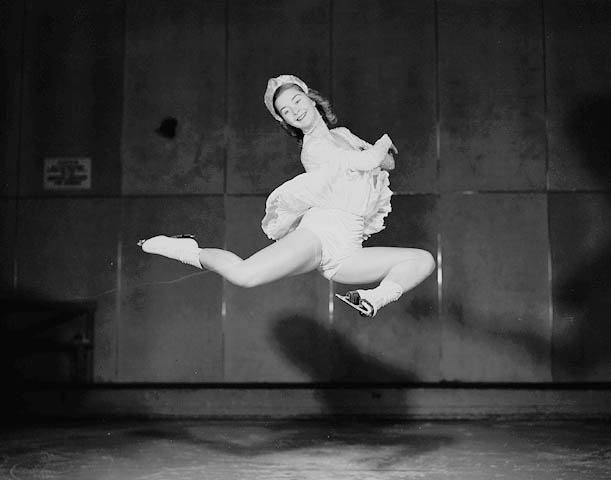 Credit: Frank Royal / National Film Board of Canada / Library and Archives Canada / PA-112691.Switching to figure skating, James traced the career of Canada’s sweetheart, Barbara Ann Scott, from winning the Canadian Junior Figure Skating crown in 1940 to taking the gold medal at the 1948 Winter Olympics held in St. Moritz, France. But it didn’t come easily for Scott. Her success required long hours of practice and hard work, training at the Minto Skating Club, the skating club founded by Lord and Lady Minto in 1903. James showed a short film of her performance at St Moritz which displayed her grace and form as a gold-medal figure skater.
Returning to Ottawa as a national hero after the Olympics, some 70,000 fans met her train at Union Station, where she was personally greeted by Prime Minister Mackenzie King and Ottawa Mayor Stanley Lewis. Schoolchildren were given a half-day holiday. In honour of her victory, Ottawa gave Scott a car with the licence plate 48-U-1. She then started her professional career, ousting Sonja Henning, her arch rival, from the Hollywood Ice Review. In 1950, the most desired Christmas gift was a Barbara Ann Scott doll, complete with white figure skates, costing a steep $5.95.
Scott retired from skating in 1955 when she married Tom King. In 1991, she was appointed to the Order of Canada. Scott passed away in 2012 in Florida at age 84. She bequeathed her sports memorabilia to the City of Ottawa.
James ended his presentation with the career of another daughter of Ottawa, Elizabeth Manley, who won the silver medal at the 1988 Olympics in Calgary. Like Scott forty years earlier, it took years of grit and determination to achieve perfection—and that was what she achieved in her long program in Calgary. Although she came first in that section of the competition, she lost overall by a hair to East Germany’s, Katerina Witt. At the end of a short video of her long program, people in the library auditorium broke out into applause, indicative of the power of Manley’s performance thirty-four years ago. Manley was appointed to the Order of Canada in 1988, and, following her skating career, has devoted considerable time to charity.
In the usual question and answer section that followed, three descendants of Shirley Moulds, the Ottawa Alerts’ star player, identified themselves in the audience. They indicated Moulds had been a very private person who had not talked about her hockey career. Her niece said that it was only after Shirley’s death that she became aware of her prowess as a hockey player. The only thing she knew was that Aunt Shirley was a great bowler! Shirley Moulds’ great-nephew was instrumental in Moulds being named to Ottawa’s Sports Hall of Fame in 2010.
February 22 nd is the birthday of Baron Robert Baden-Powell, (1857-1941), the founder of the Scouting Movement. Coincidentally, it is also the birthday of his wife, Olave (1889-1977), the first Chief Guide. As such, the day has special meaning for Scouts, who call it BP Day, and Guides, who call it Thinking Day. It was thus very appropriate that the Historical Society of Ottawa used their February 24, 2024, in-person speaker session to explore the history of Scouting and Guiding. There were many members of both organizations among the 50 who gathered in the auditorium of the Main Branch of the Ottawa Public Library to listen to the presentations of Dave Truemner from Scouts Canada and Emma Kent from the Girl Guides of Canada.
Dave started as a Cub in 1953 and has spent most of the past 70 years in Scouting, in one capacity or another. He is currently a volunteer researcher at the Scouts Canada National Museum, located at the Scouts Canada National Headquarters, 1345 Baseline Road in Ottawa.
Dave explained that Scouting officially began in England in 1908 and spread quickly throughout the country, then through the British Empire and finally throughout the world. One of the first great events for Scouting was the 1911 Coronation of King George V, when it was decided that Scouts from around the Empire should line the parade route, providing both an Honour Gard and crowd control. Between 50 and 60 Canadian Scouts made the trip, including six from Ottawa. The Canadian contingent remained in touch over the years holding reunions every decade until 1981.
In the early years, Scouting in Canada was simply a part of Scouting in England. On June 12, 1914, however, The Canadian General Council of the Boy Scout Association was incorporated by an act of the Canadian Parliament. This gave Scouting in Canada some degree of independence while giving the government of Canada some degree of control.
Dave pointed out that this control soon came into play. Though Scouting was never a military organization, unlike Cadets, its members were pressed into service during both World Wars, though not in actual combat. During the First World War, Scouts were valued due to their First Aid training and for their fundraising. The money raised by the Scouts was used for the purchase of ambulances, it being considered inappropriate to use it to buy weapons. Dave explained that in the Second World War the role of Scouts was expanded to include many civil defense duties, including that of air raid patrol. Dave related a cute story about a former Mayor of Ottawa. J. E. Stanley Lewis (1888 – 1970) who served as our mayor from 1936 to 1948. As he was born on February 29, he celebrated his 12 th birthday in 1940 when he was 52 years old and the local Scouts invested him as a Boy Scout. In 1942 he participated as a Scout in Apple Day, the annual fundraiser when Scouts give away apples and accept donations. Given the state of things in the Second World War at these times, this must have provided a well needed relief from the more serious and tragic news that dominated the papers of the day.
Dave showed us two sculptures of Scouts on the Confederation Building, one accompanied by a rose and the other by a fleur de-lis. The sculptures acknowledge that this was the site of the original Scout Headquarters, expropriated in 1926. The use of two Scouts and their accompanying flowers denote that there are both English and French Scouting organizations in Canada. Les Scouts du Canada run their programs in French, primarily in Quebec, where there are also Scouts Canada groups. The World Organization of the Scouting Movement (WOSM) will only recognise a single Scouting organization per country, so today Les Scouts du Canada operates as a semi-autonomous organization under the Scouts Canada umbrella.
Dave explained that the National Headquarters didn’t move far, just over to the historic Birkett Castle at 306 Metcalfe Street, now the Embassy of Hungary, where it would remain from 1931 through 1960. He then related a couple of stories about the site. A large addition was added onto the house and served for many years as the Scouts warehouse for uniforms, books, and all other Scouting materials. Later one of the local volunteers, E. R. Fisher who ran a successful retail clothing business, convinced Scouts to allow him to sell uniforms through his four local stores. This proved so successful that it led to uniforms being sold through 142 different stores across the country. The Scouts National leadership realized that they could open their own stores instead, and so, in 1975 began to open Scout Shops. As times changed, and finally due to the pandemic, the world switched to online shopping, so uniform sales have, in a sense gone full circle, back to a warehouse. The second story involved a “totem pole” which stood outside Birkett Castle from 1935 to 1960. This was, in fact, a fake. A local volunteer worked for Bell Telephone and got them to donate a telephone pole, which he and other volunteers carved. When Scout Headquarters moved, this pole was cut down and into four sections, three of which are now preserved in the Scout Museum.
This led to another story of another totem pole, this one genuine. The totem pole that stands outside the current Scout Headquarters was carved by Chief Mungo Martin in 1960 and donated by the British Columbia Scouts to celebrate the opening of the new headquarters building. It was erected in 1961, with 60 feet above ground and 10 feet below ground anchored by 78 tons of concrete. When originally erected, Baseline Road was just 2 lanes, a few years later, in 1966, however, it was widened to 4 lanes with a median, and the totem pole had to be dug out again and moved back 15 feet. Today, with work-from-home being common, Scouts Canada no longer needs its headquarters building and is in the process of having the 4.5 acres on which it sits rezoned for sale. Coincidentally, the City of Ottawa is planning a further widening of Baseline Road, which will necessitate the totem pole, now fragile, be moved once more. At this time, the ultimate fate of this landmark is unknown.
Scouts Canada does have other land holdings in the greater Ottawa area. Camp Opemikon on Christie Lake near Perth is the largest and most developed Scout camp in the area. Opened in 1937 with 100 acres, it has since grown to cover 200 acres. Now accessible by road, the Scouts originally took the train to Christie Lake and crossed on a flat-bottomed cargo barge, which was still on the property, though unused, into the 1960s.
Dave told us of a number of other Scout adventures that have taken place in Ottawa. These range from a Scout hockey league that operated in the 1940s to participation in the first tour of Canada by Princess Elizabeth in 1951. Connaught Ranges was the home to three of the first Canadian Jamborees in which Scouts from across the country, and often from other nations, gather for a week or more of activities and fellowship. These took place in 1949, 1953, and 1961. Over the years, Scouts have also provided services to the community, including toy repair and distribution, Lost Children services at the Central Canada Exhibition, Canada Day and during Winterlude, and tree planting.
Scouting in Canada strives to remain relevant. In 1971 it started its move to become co-ed when girls were officially accepted as Rovers (ages 18 – 26). By 1992 all Scouting Sections were made co-ed. It has created specialized programs for some older youth. Dave explained that in Ottawa there are PoliceVents, who work with the police, FireVents, MedVents, who provide First Aid services at many community events and even SARVents, who are learning Search and Rescue. Although the Venturers (ages 15 – 17) are not directly involved in the actual work, they do learn the skills, provide support and prepare themselves for careers in these fields.
Scouting is still a major activity in the world with over 200 countries and territories participating. Dave noted how the movement of the World Headquarters has mirrored the politics and membership within the movement. Originally in London, it was moved to Ottawa in the 1960 so that it would be less British. Later it was moved to Geneva and Dave said that it is now being moved to Kualalumpur in Malaysia which better reflects the dominant numbers of members outside of North America and Europe.
Emma’s mother, a long-time Guider herself, enrolled her as a Spark at age 5 and she has never left, with now more than 25 years in Guides. She is a graduate in history from Carleton University, a frequent HSO Speaker and the current President of the Historical Society of Ottawa. Emma led us on a virtual walking tour of downtown Ottawa using various locations to tell the story of the Gul Guides.
Emma started us off at the South African War Memorial in Confederation Park. It was while serving in South Africa that Baden-Powell first became aware of how useful boys could be if they had received some training. Returning to England he discovered that a book he had written for military training, “Aids to Scouting” had become popular with boys. He rewrote the book as “Scouting for Boys” and the two movements soon followed. The Memorial was paid for by donations from 30,000 local school children, many of whom would become Ottawa’s first members of Scouting and Guiding. Many veterans of the war also became Ottawa’s first leaders in the movements, some like the Woolsey family becoming active in both. Camp Woolsey, Ottawa’s Guide camp which operated from 1937 to 2021 was named in their honour.
She then took us to the Laura Secord statue at 53 Elgin Street. Laura Secord was viewed as an inspiration and role model for girls because of her courage and especially her patriotism and loyalty to the British Empire. An early Guiding Pamphlet written by Agnes Baden-Powell, the sister of Robert, was entitled “How Girls Can Help to Build Up the Empire”. Emma pointed out the importance of recognizing the colonial roots of Guiding, a theme to which she would return. She also noted that the first official Guide Company in Canada, formed in St. Catharines in 1910, focused many of their activities around a statue of Laura Second in Queenston Heights Park in Niagara.
We then “walked” on to the National War Memorial. Emma reminded us that wars affect all members of a society. This ranges from a loss of normal opportunities, Camp Woolsey was closed for the final two years of the Second World War, through to involvement on the home front, and in some cases, overseas activities. Among other things, Guides rolled bandages, raised funds for the Red Cross and worked in Red Cross canteens. A National War Service Project called “The Guides Overseas Gift Project” saw the Guides sew and knit some 30,000 pieces of clothing for English children who had endured The Blitz.
We then moved down Wellington Street to the statue of Terry Fox. Each fall the running community in Ottawa hold “The Great Big Cookie Run” which raises funds for local Guiding, especially camperships to allow all girls the opportunity to participate. Emma noted that this was the first 5K she ever ran and that one of the best things about the event is that runners get a cookie as they cross the finish line.
From here, Emma took us to the other side of Wellington Street, to the Confederation Building at the corner of Bank Street. She showed us the two sculptures of Scouts on the building and recounted an early incident in the history of both the Scout and Guide Movements that led to their separation. With the growing popularity of Scouting in England, Baden-Powell decided to hold a gathering at the Crystal Palace in September 1909. There he was confronted by a troop of girls who proclaimed themselves to be “Girl Scouts”. Baden-Powell soon responded. He believed that boys would object to the name Scouts being used by the girls and also felt that the name Guides represented a more traditional and nurturing role, so the would-be Girl Scouts became the Gil Guides. Baden-Powell also stepped away from the Guides, turning the new Movement over to his sister Agnes. These changes of name and leadership were not universally accepted, many preferring the name “Scouts”. In the United States, the movement rejected the change and returned to the use of the name “Girl Scouts”. Internationally, WAGGGS is the World Association of Girl Guides and Girl Scouts.
Emma then took us back to gather around the Centennial Flame, which she pointed out was originally intended as a temporary monument for 1967 but has remained due to public demand. Parliament Hill has witnessed many gatherings of Guides, dating back to as early as 1917. More recently it hosted large gatherings to celebrate the 95 th and 100 th anniversary of Guiding, which took place in 2010. This celebration featured a campfire sing-along around the Centennial Flame led by two local Guiders which has now become an annual event in the early fall.
In Major’s Hill Park, we stopped at the statue of Lieutenant-Colonel John By. Funds were raised for it by the Historical Society of Ottawa and it was erected in 1971. The current Historical Society of Ottawa came into being as the Women’s Canadian Historical Society of Ottawa in 1898. It and the Girl Guides were only two of a number of organizations that were founded and run by women in the late 19 th and early 20 th centuries that focussed on social improvement, reform, and patriotism. Among the other organizations that appeared at the same time include the May Court Club, the YWCA, and the International Order of the Daughters of the Empire. Like Guiding, these organizations were formed by affluent women, wives of successful husbands who had time to give to the service of others who were less fortunate. Emma noted that today’s volunteers are not so privileged and we need to acknowledge and celebrate the contributions they make today.
Emma then took us to see the Three Watchmen on Sussex Drive, which is a casting of an original work in wood by sculptor and Haida Chief, James Hart. It is carefully positioned so that it can watch the Parliament Buildings, the American Embassy, and Notre Dame Cathedral, representing groups that have done great harm to Indigenous peoples. Emma pointed out, that by extension, they watch all of us who come from a settler background. She explained that the Girl Guide program was used in 34 Residential Schools between 1910 and 1970, as were many other recreation programs. Girl Guides of Ca nada officially apologised for this in 2021 and has since created their National Indigenous Advisory Circle to ensure that Guiding is a welcoming place for Indigenous girls and women.
Emma ended our tour at the National Gallery at Maman, one of six sculptures made by Louise Bourgeois as an ode to her Mother. Maman, a mother herself, symbolizes the role of the Guiding Movement in creating a safe, caring and nurturing space for all girls, women and openly transgender and non-binary people who feel comfortable in a space focused on girls and women.
Emma, an experienced tour guide, made sure to have a snack to share with all her participants at the end of her presentation, Girl Guide cookies, of course.
On February 7, 2024, the Historical Society of Ottawa was pleased to feature Dave Tulloch on our Zoom Speaker series, who spoke to us about the history of Ottawa’s Caribbean Community. Dave came to Ottawa from Jamaica as a student in 1970, graduating from Algonquin College, the University of Ottawa, and finally received a Masters of Business Administration from Concordia University in Montreal. He has worked as a computer engineer, information systems consultant, and as a lecturer and tutor. He is also a columnist, author, and a volunteer musician and cameraman. Dave’s interest in the history of the Caribbean community in Ottawa was sparked by a visit, some years ago, to the Gloucester Branch of the Ottawa Public Library. He had taken his daughter to the library to help her with her school research project on black history in Canada, and discovered that the library had no resources on the subject. The situation remained at the back of his mind, and some years later, he took action.
Dave started us off with a brief background of early black settlement in the Ottawa area. Philemon Wright led five families to this area in 1800. His own, that of his brother, those of his two sisters, and a fifth headed by London Oxford, our first black settler. Relatively little is known about Oxford, he was a land owner and a raftsman, but left the region around 1809. Our next known black family, headed by Robert Richardson, arrived in Bytown about 1836, and may still have descendants in the area. A third followed in 1844 led by Perry Adams and later still, in 1885, Paul Barber arrived in Ottawa, where his family has remained. Dave pointed out that all these families came from the United States not the Caribbean.
Dave explained that Canadian government policy largely prevented black immigration until 1952, with some restrictions remaining for another decade. Thus it was not until 1952 that Herbert Brown, who was born in Jamaica but served with the Canadian Armed Forces during the Second World War, moved to Ottawa, after short stays in Montreal and Hull. He opened Browns Cleaners in 1957, growing the business, which he finally sold in 1978. At one time he maintained a book with information on black residents of Ottawa that he had met, but this has vanished.
Dave explained that there were three groups that came from the Caribbean to Canada starting in the 1950s. There were domestic workers, who came to Canada under the West Indies Domestic Scheme, there were students, primarily those with some economic means seeking post-graduate degrees and finally there were professionals, who from 1967 were granted entry based upon a point system. No matter the group, nor the variant processes they needed to follow to become citizens, they shared a common goal, to find a better life for themselves and their families, members of whom they could then sponsor.
Dave then gave us some examples of individuals who had come from the Caribbean, taken advantage of the educational opportunities available to them, and went on to make major contributions to their community and the country. Dr. Jean Augustine, who came to Canada under the West Indies Domestic Scheme, obtained degrees from Carleton University and undertook a career in education. She went on to be the first black woman elected to Parliament, and later served as the Parliamentary Secretary to Prime Minister Jean Chretien. Dr. Rudolph Gittens was born in Trinidad and came to Canada as a student in 1953. He would go on to be the team doctor for the Ottawa Rough Riders for over 20 years and then for Canada’s National Soccer teams. Gilbert Scott came to Canada in 1968 as a meteorological technician. As a community builder he was the first president of the Jamaica-Ottawa Community Association, and professionally, he joined the Federal Public Service and eventually served as the Commissioner of the Public Service between 1988 and 1994.
Although the Caribbean immigrants found success, it was rarely easy. Most relate instances of opportunities denied to them because of their race. They persevered and thrived, building their own support networks and associations.
Dave then gave us three examples of children of Caribbean immigrants that had gone on to extraordinary success. He noted that as the years pass, the new generations simply consider themselves to be Canadian, though they still value their heritage.
You can watch Dave’s full presentation on the HSO's YouTube channel .
Dave has also written a book based on personal interviews with many of the key community members, and, when necessary, on secondary sources. We highly recommend “Ottawa's Caribbean Community History and Profiles - since 1955”, which can be purchased at the following link: Dave Tulloch Ottawa's Caribbean Community since 1955 by Dave Tulloch, Hardcover | Indigo Chapters | The Pen Centre
Dave Allston is a ‘trash talker’. Specifically, on the afternoon of Saturday, January 27, 2024, he talked to the Historical Society of Ottawa at our first in-person presentation of 2024 on how the Ottawa River shoreline was reshaped during the early 1960s using garbage. Dave is the senior asset manager (heritage) at National Defence and also an author, columnist, researcher, and runs the blog, The Kitchissippi Museum. He was making his 3 rd presentation to the Society. The session, which was hosted by the Main Branch of the Ottawa Public Library, received a record turnout of 113 attendees, who were captivated by Dave’s account.
Dave explained to us that in 1959 the City of Ottawa was facing a major problem. The two municipal dumps, one on Riverside Drive and the other on Raven Road, were both reaching capacity and would need to be closed within two years. A solution was urgently needed. Likely inspired by Toronto’s redevelopment of their waterfront and similar work in other cities, in February 1959 the Ottawa Works Commissioner, Frank Ayers, recommended to the Board of Control that Nepean Bay, which lay just to the west of the current site of the Canadian War Museum, could be used as their new landfill site. The Board directed him to approach the National Capital Commission with the idea. Their response was immediate and enthusiastic. The NCC had envisaged creating a giant beach along the Ottawa River along with a large playground and other recreation facilities, but had no clear plan for how to proceed. The City’s proposal was approved in one week. The scheme, part of the NCC’s implementation of the Greber Plan, would eventually also encompass Lazy Bay just north of Laroche Park and Bayview Bay between the Lemieux Island Bridge and the Chief William Commanda Bridge.
The plan was simple. Build a causeway across the mouth of the bay that would both seal it off from the river and provide a roadway for the garbage trucks to dump their loads. They would then pump out the water from behind the causeway; the bay was only 4 or 5 feet deep. Ignore the many feet of water-rotted sawdust that covered the bottom of the bay, a by-product from the lumber industry. Then fill the whole thing with garbage, finally to be covered by rock and a thick layer of soil. Presto, 50 acres of new land created and a temporary end to the garbage crisis. Work commenced on the causeway in the early months of 1962 and the dump was opened during the week of March 4, 1963.
There would be a massive amount of rock required to build the causeway, which would extend west to Lazy Bay. Dave explained that fortunately, there were other major projects underway in Ottawa at that time, which both provided the necessary rock for the causeway and a convenient disposal solution for the other projects. Tunnelling for the Ottawa Interceptor and Outfall Sewer project would create millions of tons of rock. The tunnels ran from Booth Street under Wellington past the Chateau Laurier and east through to the new sewage disposal plant at Green’s Creek. At this time, Ottawa pumped all its raw sewage directly into the Ottawa River. The new treatment plant would partially treat this sewage, the City feeling that it was not worth the additional expense to fully treat the sewage as the communities upstream continued to pump their sewage into the river untreated. A second excavation project to entrench what is now the OC Transpo’s Trillium Line and take it underneath Dow’s Lake, also provided rock for the causeway. Finally, the major excavation project involved in the construction of the National Arts Centre would provide the fill needed to cover all the garbage once the dump was full.
With the closure of the Riverside Drive landfill on March 9, 1963, all city garbage was sent to the new site, which was expected to have a lifespan of two years. The city even placed ads in the newspaper to encourage their citizens to bring their own garbage to the new dump. Dave revealed that there were other factors at play that would dramatically shorten the life of the new landfill. The National Capital Commission had begun an urban renewal project in LeBreton Flats in 1962 and as residents of the area moved away, their former homes and businesses remained empty. It didn’t take long until this proved to be a problem, encouraging squatters, cases of arson and a range of other undesirable activities. As such, the NCC began demolishing the structures as soon as they became vacant, and as the new city dump in Nepean Bay was handy, the remains were carted there. The result was that the dump filled quickly and was closed on February 1, 1964, less than a year after it opened.
By this time the NCC had abandoned their grandiose beach plans in favour of simple parkland, other uses, and a parkway, now known as the Kichi Zībī Mīkan. This meant excavation of thousands of tons of the recently buried garbage and transferring it west to either Bayview Bay or Lazy Bay. Although the parkway provided a scenic drive and a much needed west – east link, it also separated the communities from the river and areas that had traditionally formed part of their neighborhood.
Dave reminded us that this all happened over the span of a few years some 60 years ago and that today few are even aware that this took place. This is true even for some members of the National Capital Commission. As new development is proposed and eventually undertaken in these areas, such as the construction of a number of embassies on Lazy Bay Commons, do the planners know what to expect? Will the solution to our garbage crisis of 1959 come back to haunt us in the years ahead, and, as we face the same problem again, what lessons are to be learned from our response back then?
Earlier on the morning of January 27, 2024, CBO-FM featured an interview between Dave and the host of their program “In Town and Out”, Giacomo Panico. The interview carries additional information on the topic and can be heard at: Ottawa River shoreline made out of garbage | In Town and Out with Giacomo Panico | Live Radio | CBC Listen.
We started 2024 off in grand style with a Zoom concert from noted singer / songwriter Paul Weber, which took place on the evening of January 10, 2024. Paul, who was also part of our 125 th anniversary celebration last summer, is a storyteller, a “people’s poet”, who uses his music to make history more accessible to the general public. He shared six songs with us and the stories behind them.
“The Great Fire” is a fictional tale based on the all too real Great Fire of 1870 that Paul described to us. This was Paul’s first historically based song, which he wrote after reading a book about the fire written by a friend’s father. He mentioned that writing songs around historic events presents some challenges to the songwriter, with the need to find the balance between fact and telling a compelling story. It is clear that Paul is a master of this.
Paul next performed his new song “The Heron Road Bridge”, which relates the story of a young man who is caught up in the collapse of the east-bound span of the bridge on the afternoon of 10 August 1966, while it was under construction. Paul mentioned that the collapse took the lives of nine workers who fell approximately five storeys and that it is the largest construction related disaster in Ottawa’s history.
Paul, who is half Franco-Ontarian, followed with a song in French, “La bataille des épingles à chapeaux” (The Battle of the Hatpins), that tells the story of the fight to protect French language rights in education after Regulation 17 was enacted by the Government of Ontario in 1912 to severely restrict the use of French in schools. Paul explained how the local mothers surrounded École Guigues and used their hatpins to drive off the police who had been sent to arrest the teachers. The Historical Society of Ottawa had a speaker session on this very topic, which can be reviewed on the HSO website.
“Ode to Gerry Barber” was Paul’s next selection. Gerry was the bouncer at the Chaudière Hotel on the Aylmer Road and is both a local legend and the best known member of this long-time Ottawa family. As with many of Paul’s songs he finds that when he performs this one, audience members will come up to him after the show to relate their own experiences. When Paul first put this song online he was surprised to receive a call from Gerry Barber, long then dead. It turned out to be Gerry Barber Jr, who graciously shared a number of family photos that Paul used in the video which accompanied the song. The Historical Society of Ottawa also held a Speaker Series presentation on the Barber family, as told to us by Thomas Barber, which can be reviewed on the HSO website.
Paul followed this with his song, “Circus Parade” that recounts the wonderment of a small boy standing on Bank Street and watching as the Barnum & Bailey Circus Parade goes by enroute to Lansdowne Park while visiting Ottawa. The boy marvels at all the animals and the sound of the calliope. The song brings to life an event that though annual at that time, will never be seen again.
Paul’s final song for the evening was “Le Mille Carré”, that tells part of the story of Eastview (later Vanier) and the Order of Jacques Cartier (La Patente), a secret society formed in Eastview to promote Francophone causes within the area. This was the first song that Paul had written in French.
Paul’s concert really must be watched to be fully enjoyed, for apart from being a talented musician, Paul is also a skilled videographer. As such, he has produced a video combining photos, film segments, and acting that support each song and the stories behind them.
You can watch Paul's presentation on the HSO YouTube channel.
Paul has released one CD so far, “Ode to Gerry Barber” and will release a second CD later this year. Paul also has “Ode to Gerry Barber” T-Shirts available and sends out a newsletter.
You can purchase his CD, T-Shirt and/or sign up for Paul’s newsletter on the Paul Weber website.
Our final speaker series session of 2023 was held via Zoom on the evening of November 29th. We were excited to welcome Peter Tilley as our guest to talk with us about The Ottawa Mission, its history, its role and the ongoing challenges that it and our community face. Given the housing and opioid crisis we are experiencing today, Peter’s presentation could not have been more timely.
Peter is the current CEO of The Ottawa Mission, having joined them in June 2013. Before this, he had spent 14 years as the Executive Director of the Ottawa Food Bank and has been a part-time professor at Algonquin College. Apart from this, Peter volunteers on community boards, including Ottawa Public Health, the Chair of the Ottawa Inner City Health and a Board member of the Alliance To End Homelessness and Soldiers Helping Soldiers as well as being a volunteer at Parkdale United Church. He is far more than an administrator, however, he takes the time to speak to shelter guests, lending them a friendly ear, and calling them by their first names.
Peter told us that there is a big safe in the basement of The Mission that contains a lot of their archives, including many old photos and ledgers. From these, he has been able to piece together the following history of The Ottawa Mission.
The Ottawa Mission can trace its origin to September 20, 1906 when a public meeting was held to discuss opening a shelter for homeless men camped along the Ottawa River. By January 1907, a shelter, The Union Mission for Men, had opened on George Street, moving to its current location on Waller Street in 1912. Peter provided some general context for the opening of the shelter in 1907, reminding us that at that date Canada had a population of 6.5 million of which over 50 % were rural, women and Indigenous people were not allowed to vote, life expectancy was 50 years and the population of Ottawa stood at 110,000. The first Superintendent of The Union Mission, James Joab, established its cornerstone principle by declaring that “No man would ever be turned away the first night they came to The Mission”.
Peter explained that the main focus of The Mission in those early days was “Three Hots and a Cot” (3 meals & a bed), which is still a key component of their services today. Peter shared a photo of the time, showing that the men were in suits with ties and their hats on their laps. Meals were then 10 cents, though you could get a voucher for a free meal. One of the first great challenges they faced was providing service to returning veterans of the First World War, many of whom were suffering from what was then called “shell shock” and what we now know as PTSD, broken men needing help.
On October 29, 1929, the “Roaring 20s” came to a “Roaring Halt” with the crash of the New York Stock Market and the resulting disruption of the world’s economies. Thousands of people lost their jobs and so had no income. This was reflected in the number of meals served by The Mission: in 1929, 73,000 but in 1932, 425,662. This was a time of constant struggle for the staff, with many appeals to the public, just to keep the doors open and stay true to their vow that no one would be turned away. Things were very basic, but they got through it.
Following the Second World War The Mission found that alcoholism was rampant among returning veterans suffering from PTSD. The Mission served as a refuge for those men who could only deal with the brutality of what they had experienced through a cycle of drink and sleep, before they passed on. Peter said that The Mission offered “Soap, Soup and Salvation”.
Canada experienced an economic boon from the 1950s through the 1970s, and The Mission continued to offer its services. It still supported those suffering with alcoholism, but found it was also providing a place for those who just needed a meal and a bed, and in some cases, Americans who had come north to avoid the draft for the war in Vietnam. By the late 1960s and into the 1970s, men dealing with drug addiction became a new population needing support.
Peter explained that by the mid-1980s the boom had ended and governments entered a period of cut-backs and downloading of services that had effects throughout the community. In particular, the Ontario government closed facilities such as Rideau Regional, that cared for individuals living with a variety of cognitive and emotional impairments, forcing many into the community without support. Peter explained that, under the leadership of Diane Morrison, the first female Director of The Mission, they grew by 60 beds in the mid-1990s to meet this new need.
The Pandemic hit The Mission hard. They transitioned some of their services, such as addiction and mental health counselling from in-person to virtual, handed out take-our meals to the community through their loading dock, delivered meals to others in the city through a food truck. Peter said that the staff team worked with little break and no vacation through the first 18 months of the pandemic to ensure that they continued to provide their services. The major projects they had planned were placed on hold and are only now being revived as the heaviest effects of the pandemic wane.
Peter shared a number of photos of The Ottawa Mission as it looks today, including images of the kitchen, dining hall, bedrooms, showers and one of the two apartment buildings they own and run as mixed-market rental buildings. The Ottawa Mission now has its own in-house maintenance team that takes care of its buildings, including the former Albert Inn, that is now the home for their Addiction Program and the former Rideau Bakery, which runs their Food Services training program.
Peter wrapped up his fantastic presentation by discussing the range of services now offered by The Ottawa Mission and the challenges they face. Today The Ottawa Mission offers a wide range of services. Although its overnight and addiction programs remain restricted to men, for reasons of safety, all of its other services are open to both men and women. These include: primary health care, mental health care, dental care, foot care, a wide range of education, job readiness and job training programs, housing support and a food truck program among others. Today, as well, the demand for these services is growing. With the opioid crisis, the housing shortage, the rapid rise in price of food and other necessities and the influx of refugees there is even greater pressure on The Mission and there staff than ever before.
The Ottawa Mission is “ALWAYS OPEN, NEVER CLOSED”, 24 / 7 every day of the year, for over 115 years, with over 1,000,000 hours of service to the most vulnerable in our community.
Its work must continue but for that to happen, they need your help. Only 25% of their funding comes from governments, the rest comes directly from members of the community. To volunteer or donate, please see The Ottawa Mission website.
To watch Peter’s full presentation, please see The Ottawa Mission: Supporting Our City's Most Vulnerable on the HSO YouTube channel.
Our final in-person speaker presentation of 2023 took place on the afternoon of November 12 and was again hosted by the Main Branch of the Ottawa Public Library. We were pleased to welcome Marc Aubin, author, community historian, former President of the Lowertown Community Association and member of the King Edward Avenue Task Force, who spoke to the 60 attendees about the devastating effects on the Lowertown community of urban renewal projects that took place between the 1950s and 1970s. He began by giving us a brief history and description of Lowertown.
Lowertown, which Marc explained had first been laid out by Colonel By in the 1820s, is bordered by the Ottawa River to the north, the Rideau River to the east, Rideau Street to the south and the Rideau Canal to the west. It was a working class community, primarily French Catholic, but with a significant Irish Catholic component, along with a Jewish community and the first Italian community in Ottawa. Sussex, Dalhousie and St. Patrick were the major local commercial streets, with the Byward Market and Rideau Street being frequented by all citizens of the city. It was a vibrant community, self-reliant and historically one that defended French language rights.
Following the Second World War, a planning policy known as “Urban Renewal” dominated the thinking around housing policy in the governments of western nations. The war had led to a decline in the condition of the housing stock, due to the diversion of the required materials to the war effort. The end of the war created an increased demand for housing from returning veterans starting families. Urban Renewal promoted the wholesale replacement of buildings in what it deemed as “blighted” areas with new social housing projects. It was believed that the clearing of these blighted areas would also yield social benefits by resolving issues including: immorality, vice, crime, juvenile delinquency, infant mortality, poor health and an apathetic population. The introduction of upgraded roadways was also a strong motivation. Not surprisingly, lower income neighborhoods were those chiefly targeted for these renewal projects. The City of Ottawa initially identified a number of communities, the National Capital Commission also being involved, and the affected communities had little to no options for appeal. One of these communities was Lowertown East.
Lowertown East is that section of Lowertown east of King Edward Avenue, covering about 186 acres and consisting of 3 sub-communities, Bishop’s Lots, (early smaller lots), Anglesea Square, (architecturally more similar to Lowertown West) and Macdonald Gardens, (a later community from the 1920s). In 1968 the population of the area was 9,400, 90% of which was French Catholic. There was also a strong Jewish presence and a study taken at that time found that 75% of the residents wanted to stay in the community.
The first large scale urban renewal project in Canada took place in Toronto starting in 1948. In 1956 Central Mortgage and Housing Corporation modified its policies to approve urban renewal projects, for which the City of Ottawa received funding in 1958. In 1962, the National Capital Commission expropriated the northern portion of Lowertown, destroying some 400 housing units. This was followed by the expansion of King Edward Avenue, cutting down 100 large elms, to support the new Macdonald-Cartier Bridge that opened in 1965. The City of Ottawa began expropriation in Lowertown East in 1967, continuing until 1977. In 1971 the first social housing project was opened in Lowertown East. The community had already begun to organize against these renewal projects, as early as 1965, as did other communities within Ottawa. In 1975 key members of the Housing Department resigned over a dispute relating to demolition policy with them Councillor Georges Bedard and Mayor Lorry Greenberg, bringing an end to Urban Renewal as a policy in the city.
The destruction of city centres across North America led to a backlash, Jane Jacobs being among the leaders of this movement. In Toronto, pressure from the public eventually forced Premier Bill Davis to cancel the proposed Spadina Expressway. Nationally, a 1968 Task Force led by Paul Hellyer concluded that between 70% - 80% of the buildings demolished under urban renewal projects could have been rehabilitated. As a result of these findings, Federal financial support of urban renewal projects ended in 1973.
Unfortunately for Lowertown East, it was the final project approved and one of the largest. Despite the efforts of resident committees to oppose the planned renewal, or to modify it, it proceeded without approval from the community. Between 1967 – 1977 there were 462 expropriations in Lowertown East, an estimated 1,400 families were forced to relocate at a cost of $31 Million ($250 Million in 2023 dollars). Among the issues identified by the community were: inconsistent / inadequate compensation, excessive rents in new buildings, the destruction of the French language character of the community, no provisions for elderly residents, an abandonment of a mixed income strategy leading to ghettoization. These concerns remained unaddressed.
There were a couple of positive outcomes of the urban renewal of Lowertown East. The community countered the planned redevelopment through the construction of three cooperative housing projects, the rebuilding of the Catholic Community centre and through the creation of a new French language High School, De La Salle Academy. There were however far more negative outcomes. These included the loss to the community of many of the more affluent and educated members, who fled to the suburbs or other parts of the city, the loss of the Irish and Jewish communities, the closure of the major churches and synagogues, the creation of a transient population who had little control over their own housing, the segmenting of the community by major roadways, the belief that the renewal had been an organized attempt to destroy the main Francophone community and a lingering distrust of municipal politicians and staff. Today, even though the community has regained much of its former strength through such organizations as the Lowertown Community Association, it still finds it difficult to achieve its community goals and finds itself fighting similar battles as it had in the past to preserve its heritage. The battle never ends.
Following Marc’s presentation, we were honoured to have Councillor Stephanie Plante answer a few questions. She promoted the idea of creating a Lowertown Museum, similar to those in other communities which are now part of Ottawa. She also spoke of the need for elected officials to obtain input on policies and programs that will affect them. She emphasized the responsibility of Councillors to seek out this input from those who may not normally provide it, due to their age, language, income or other factors.
Marc has written two books that relate to Lowertown:
- BLIGHT, published by Crow’s Nest Books in 2018 is a “fictional” account of the struggles of an activist against City Hall. It is available at Blight by Aubin, Marc .
- CUNDELL STABLES, THE LAST STABLE IN LOWERTOWN. (With Karen Bailey)
We were fortunate to have two guest presenters for our Zoom speaker session of October 25, 2023. Paul Litt, an author and Professor of Public History at Carleton University, (cross-appointed to the School of Indigenous and Canadian Studies), met with us live via Zoom while Brenda Norris, daughter of Phyllis Turner Ross, sister of John Turner and a remarkable individual in her own right, graciously pre-recorded an interview with Paul Litt and Ben Weiss to share with us.
Paul told us that Phyllis Gregory’s parents were both from the Maritimes. Her father was a mining-hoist engineer and her mother was the daughter of a ship owner. They had moved to British Columbia as part of the gold rush and had settled in Rossland. Phyllis was bright, hard-working and ambitious, so in 1921, aged 17, and encouraged by her mother, she enrolled in the University of British Columbia, then a small and relatively new institution in Vancouver. This was an unusual step for a woman at this time, not only that she chose to go to university but in her selection of programs. Paul explained that, in general, society still held to traditional gender roles, although it was beginning to accept women as professionals in the field of Health Care, Social Work, Education or other “nurturing” applications. Phyllis, however, chose Economics and Political Science, fields which were considered to be appropriate only for men. After graduation she went on to graduate school, winning a scholarship to study Economics and Politics at Bryn Mawr College near Philadelphia. In 1927 she received another scholarship and entered the college’s doctoral program. She studied at the London School of Economics in 1927-1928 and then travelled to the University of Marburg in Germany to do research for her thesis. While in England, she met Leonard Turner. The couple had three children: John, (who became our 17 th Prime Minister), Brenda, (our pre-recorded guest this evening) and a middle child, Michael, who died in infancy. In late 1932 another tragedy befell the family when Leonard, aged 28, died from complications following a thyroidectomy. This left Phyllis alone, far from home, unemployed, in the middle of the Depression and with two children to support.
Returning to her parents in Rossland, Phyllis took some time to consider her future. By the fall of 1933, however, she had moved to Ottawa to take a trial position with the newly formed Tariff Board. Brenda remarked that Phyllis had been told not to bring her children along, in case things didn’t work out, but she did anyway, and things certainly worked out well. Paul explained that the Civil Service at that time was becoming more professional, transitioning from one based on patronage appointments to one based on merit, and so becoming one of the best Civil Services in the world. Its senior ranks were also exclusively male. Women were allowed to work in the Civil Service but were required to resign when they married. Widows, recognized as heads-of-households, and so needing to work, were accepted, if not welcomed. Phyllis, as a devote Catholic, was also unusual in what was a predominantly Protestant and Anglican organization.
Charming and attractive, Phyllis quickly became well known and well liked in Ottawa. Paul noted that she frequently served as the official escort for R. B. Bennett, who Brenda revealed had romantic interests in her, and for Mackenzie King, who did not. Phyllis, for her part, was focussed on her work and her family. Paul recounted that by 1939 her hard work and ability saw her rise to the role of Chief Research Economist for the Tariff Board. The outbreak of the Second World War only added to the demands that work placed upon her. She was seconded to the Wartime Prices and Trade Board, which Paul explained was established at the start of the war to stop the inflation and war profiteering that had taken place during the First World War. Phyllis was initially responsible for the acquisition and allocation of sugar. Hoarding of sugar by consumers, coupled with a drop in supply as the ships generally used to carry it became unavailable, was creating a crisis. Phyllis worked tirelessly to restore the supply and then determine how it should be distributed between Canadian consumers, Canadian industry and Great Britain. Later, she became the “Oils and Fats Administrator”, an unattractive title, but a vital role. Paul listed some of the uses of oils and fats, which included: as lubricants, paints, polishes, soaps, shampoos, ink, adhesives and explosives, as well as being a food product. To conserve the supply, Phyllis imposed production controls, rationing and recycling. To increase the supply, she encouraged the development of a cod liver oil industry on the east coast and a dogfish liver oil industry on the west coast. She also persuaded farmers to plant flax to prevent an anticipated shortage of linseed oil. She was increasingly involved in negotiations with the British and Americans, travelling frequently to Washington. Paul pointed out that Phyllis was the highest ranking woman in the federal public service at that time, though paid less than her male counterparts.
Paul described how the press, anxious to protect and support the existing gender stereotypes, dealt with the power and success of a woman. One NBC radio host remarked that Phyllis, who was very attractive was “Not at all the movie version of a woman economist”, while Maclean’s magazine wanted to assure their readers that despite her career success, she was still beautiful, had a great fashion sense and could cook, clean and sew. Nor did it interfere with her role as a mother. Brenda recalled that her mother had hired a much-loved Scottish housekeeper, Isabelle Kennedy, who handled most of the daily domestic duties. Brenda went on to say that she and John had a wonderful childhood. Their mother always put the children first, though she expected them to do their best. When asked if it mattered that there was no father in the home, Brenda observed that during the war, most families had no father in the home, so they were no different than anyone else.
Brenda told us that Phyllis met Frank Ross, a B.C. based industrialist and millionaire, who asked her to marry him in 1943. At her insistence, however, they waited until 1945, when their war work was done. Phyllis left the Public Service, aged 41, and they moved to Vancouver, where she turned her talents to volunteer work. She served on the executive of the Canadian Federation of University Women and the senate of the University of British Columbia, becoming their Chancellor in 1961, the first woman in the Commonwealth to hold such a position. In 1955, Frank was appointed as Lieutenant-Governor of British Columbia, Phyllis throwing herself into this new challenge. Brenda commented that they entertained frequently, noting that they became close to several members of the Royal Family.
Paul revealed that by 1981, Phyllis was beginning to suffer from the effects of Alzheimer’s and died in 1988, never knowing that John had gone on to become Prime Minister.
In conclusion, Paul noted that there is still much we don’t know about Phyllis Turner Ross, especially about her private life. As a career-woman, Phyllis was a trail-blazer and it is strange that no biography has yet been written, and that today she is largely unknown. Paul expressed his hope that the interest shown by the Historical Society of Ottawa in the life of Phyllis Turner Ross will spark a graduate student to undertake the thorough research demanded of a thesis and warranted by the career and life of this remarkable woman.
To view the full presentation by Paul and Brenda, please see Phyllis Turner Ross Career Woman and Single Mother on the HSO YouTube channel .
To read the Historical Society of Ottawa pamphlet # 120 “Phyllis Turner Ross - Career Woman and Single Mother”, by Paul Litt and Christine F. Jackson, please see the publication section of our website .
Randy Boswell, noted journalist, educator, researcher and frequent presenter for the Historical Society of Ottawa was our guest speaker at our in-person session of October 21, 2023, hosted again by the Main Branch of the Ottawa Public Library. Randy, who estimates that he has written some 400 – 500 animal based stories throughout his career, thoroughly entertained his audience, which despite inclement weather and Queensway closures, numbered 37.
Randy noted that Ottawa has lots of green space, waterways and semi-wilderness areas and as such is a wonderful place for animals and animal encounters. He pointed out that many of our most meaningful animal encounters happen not with wild animals but with our own pets. Randy showed us photos and related stories about a number of pets, including his own, with celebrity connections.
Pat was, for 17 years, the strength, inspiration, confidant and partner of his human companion, who wrote of Pat almost daily in his diary. On the 17 th July, 1941, just two days after Pat’s death, his grief-ridden companion, compelled by his own duties, officiated at the opening of the Lord Elgin Hotel. Dressed in a gray suit, a black tie in mourning of Pat, and with bright flowers in the buttonhole of his coat, that he had picked from Pat’s grave that very morning, he managed to get through the ceremonies, nearly breaking down toward the end. Prime Minister William Lyon MacKenzie King went on to have two more dogs, both of which he also named Pat.
Rustie, an orange cat, (her name often being misspelled as Rusty), who also lived for some 17 years, was widely reported to have gotten too heavily into the catnip one night, going on a bender and becoming totally intoxicated, while celebrating the first Mayoral victory of her companion, Charlotte Whitton. Charlotte created the “Rustie Whitton Memorial Trophy” in Rustie’s honour and presented it annually for the National Capital Cat Club, of which she was a member. Christine Columbus was another cat of whom Charlotte was a companion.
Cats, it would seem, not only celebrated election victories but for some 40 years, took over Parliament Hill. The Parliament Hill Cat Colony, a popular attraction, was formally started in 1970 by Irène Desormeaux. Upon her death, her work was continued by René Chartrand and other volunteers. The cats received food, medical care and even custom-built housing. The sanctuary was closed in 2013, the remaining residents being adopted into good homes.
Randy told us of several animals who held key roles at Rideau Hall and of a little known feature of that property.
George, an Irish Setter whose companion was the Right Honourable Vincent Massey, our first Canadian-born Governor General, is well remembered for the help he gave to Queen Elizabeth II. During the 1957 Royal Visit, George carried her handbag on a short walk around the grounds of Rideau Hall. Cashew joined the staff of Governor General Jules Leger, after the latter had suffered a serious stroke. It was Cashew’s job to walk the Governor General around the grounds and so aid in his recovery. A press conference was held to introduce Cashew to the public, but, unfortunately, he was somewhat overshadowed by the arrival of Margret Trudeau, who as an aspiring photo-journalist had decided to attend the event. Perhaps strangest of all animals who found themselves in a role at Rideau Hall were two moose presented to the Marquess of Lorne, while he served as Governor General. He decided that these animals should be put to harness and used to pull his carriage. The Rideau Hall coachman, Harry Bristow, was given the task, which seems to have met with some, though limited success. On one occasion, in order to demonstrate how well trained the moose were, one was brought into the dining room at Rideau Hall, where it apparently behaved. Randy went on to let us know about a dark sidebar to this story. The two moose were the gift of Edgar Dewdney, a key figure in the development of the Residential School system in Canada and someone who used access to food to starve Indigenous peoples into submission.
The grounds of Rideau Hall hold within them an unexpected feature, a pet cemetery. George, Vincent Massey’s dog, is one of about a dozen pets of former Governors General that are buried here. Included in this number is the Black Lab of H.R.H. The Duke of Connaught, who served as our Governor General from 1911 to 1916. This particular Black Lab had a name, although common for black dogs at that time, we now recognize to be a very offensive racial slur. Upon the dog’s death it was buried in the pet cemetery, a tombstone marking his grave and proudly displaying its name for all to see. Finally, in 1993, almost 80 years after it had been erected, Ray Hnatyshyn, during his term as Governor General, ordered the removal of the offending marker.
Randy explained that not all animal stories relate to recent animals, some involve those from the long past.
Elkanah Billings, of our local Billings family, was educated and worked briefly as a lawyer. Later, he became the editor of the Ottawa Citizen, but his true passion was the natural sciences. He was hired as the first paleontologist for the Geological Survey of Canada . While in this role he received some unusual samples of rocks from Newfoundland, which after careful examination, he identified as fossils of animals. As these fossils were found in a Precambrian deposit, a time when life on earth was not thought to exist, Elkanah’s claims were hotly disputed and dismissed. Time however proved his analysis correct and these samples are now among the most significant in the world.
More recently, some 13,000 – 10,000 years ago, as the last ice-sheets retreated, much of Eastern Ontario, Western Quebec and the northern portions of New York and Vermont were covered by the Champlain Sea. Randy told us of some dramatic evidence of this, the discovery in 1948, of the bones of a Beluga whale that were uncovered in a gravel pit near Uplands. The Beluga has since found a home in the Museum of Nature.
As we were running short of time, we reluctantly, (or maybe not), chose to skip the undoubtedly charming stories about lice and tapeworms. Fortunately, you can read these, along with many other fabulous stories and view the photos, for yourself as Randy has generously shared his complete presentation with us — see the featured document: A Menagerie of Ottawa Animal Tales.
Quick Links
About
Supporting Partners