

Working to preserve Ottawa's past
for future generations.
Lest We Forget
An exploration of the valour and unequal Treatment of Algonquin who have served in Canada's Armed Forces
Featuring Wendy Jocko Sgt. CD (Ret’d), Former Chief of the Algonquins of Pikwakanagan First Nation. Canadian Forces Veteran & Lynn Gehl Ph.D, Anishinaabe Algonquin Advocate, Academic, Author & Artist
Media
The Rideau Canal
In her March 28, 2026 HSO Speaker Series presentation, historian/documentary film maker Allison Margot Smith introduces her new 15-minute film, “Two Wars, Three Watersheds, a Slew of Surveys and a Canal”, which she had produced especially in response to the HSO’s 2026 Bytown200 Bicentennial Storytelling Challenge.
Following the film, Allison takes us behind the scenes and reflects on some of challenges inherent in creating historical documentaries, and innovations occasionally necessary to provide the viewer with illustrative images in order to bring the past to life.
Media
HSO member Ben Weiss tells his family story, and invites others to come forward to do the same, as part of the HSO Memory Project. Almost all our family stories are those of immigrants and refugees of some kind, and Ben’s family story is certainly no exception, his mother a WWII Dutch war bride and his father the son of early 1900s Jewish refugees from Eastern Europe.
HSO volunteer Emily Basseville interviews Ben about his parents’ story. Many thanks to David McEvoy who produced this episode of the HSO Memory Project: The Weiss Family Story.
On September 25, 1826, hoping to obtain vice-regal confirmation of his chosen route for the Rideau Canal, Lt.-Col. John By led the Governor-in-Chief of British North America, Lord Dalhousie, on an arduous 13-km hike through the then tangle of forests and swamps that we have come to know today as Centretown, the Glebe and Old Ottawa South, quite likely reaching the point where the Rideau Canal would eventually meet up with the Rideau River at what we know today as Mooney’s Bay.
At one point during their round-trip trek back to that morning's starting point at Sleigh Bay (today’s Ottawa Locks), By and Dalhousie were graciously welcomed into the log cabin home of one of Old Ottawa South’s earliest settlers, Lewis Williams.
“After feasting on his potatoes,” Dalhousie wrote in his journal, “after our hot walk we asked for a little rum, but he had none. We drank water from his well as cold as any ice. I need not say that our visit gave the old man unbounded joy, tho’ we left without giving the least hint who we were.”
The following day, September 26, 1826, Lord Dalhousie recorded in an official letter that he had met with Colonel By at Sleigh Bay, below the future Parliament Hill, and confirmed that site’s selection to be the northern starting point of the Rideau Canal at the Ottawa River.
In that same meeting, the letter stated, plans were also approved for the town site for the future Bytown, divided by the intended canal into Lower Town and Upper Town; for a series of bridges across the Ottawa River to connect Upper and Lower Canada; and, at the request of the region’s fledgling logging industry, a dredged canal at Richmond Landing to ease the passage of timber rafts around the turbulent Chaudière Falls.
In this comprehensive and fascinating new essay, Carleton University professor and longtime Ottawa journalist Randy Boswell, a former HSO board member and HSO newsletter editor, chronicles these and more of the extraordinary events surrounding the “birth” of Bytown and the Rideau Canal two centuries ago this past month, including detailing long-overlooked interactions with the Indigenous people at the time, and the long-term impact of this uninvited settlement on the future of the Anishinaabe Algonquin:
Bytown 200 – The Birth of Bytown
An abridged version of this essay appeared as an article in the September 26, 2026 edition of the Ottawa Citizen and is also featured in a new book by Randy Boswell and Ottawa photographer John McQuarrie, “Ottawa, Spirit of Place — 200th Anniversary Edition”.
Ottawa... Then & Now
Artist Catherine Willis-O’Connor began contemplating how the arrival of the Ottawa’s LRT would soon impact neighbourhood culture, and so she set out to capture the memories of the businesses, houses, parks and streetscapes that have come to define our city’s ambiance.
Join Catherine as she animates Ottawa’s past by guiding us through her joyous paintings, each of which promises to unleash a treasure trove of memories.
Media
On Tuesday, August 18, 2026, the Museum Club undertook its final outing of the season, a trip to Perth to visit the Perth Museum and to learn the history of the Tay Canal. We were welcomed on our arrival by Kathryn Jamieson, Manager of Tourism & Culture for the Town of Perth, who had been instrumental in making all the arrangements for our visit. Though 24 of our members had registered, only 17 were able to attend on the day, but boy!, were they ever treated to a wonderful time.
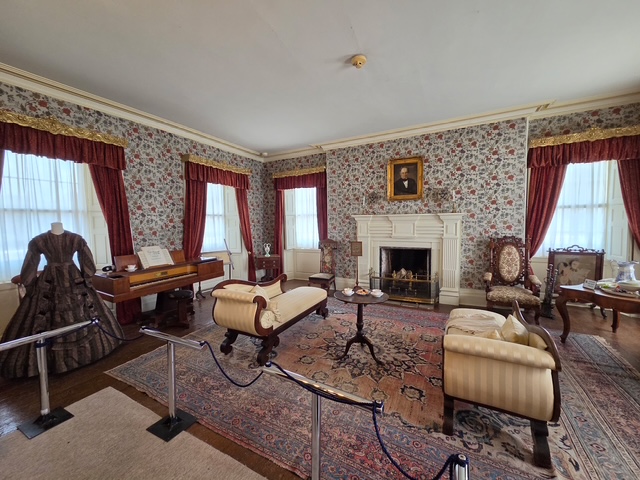 Perth Museum 2nd floor parlor photo by Justin Lacasse.
We started our day with a guided tour of the 1 st and 2 nd floor of the Perth Museum, 11 Gore Street East, the former Matheson House. Our guide, Debbie Sproule, had an encyclopedic knowledge of the history of the Matheson family, the house and seemingly every artifact contained there-in. Her presentations as she led us through the rooms were both highly informative and often amusing as she revealed the history of the house, and the community as a whole. Following the tour, we were invited to explore the other artifacts on display on the 3 rd floor and to visit the Information Centre and gift shop on the ground floor. We all took advantage.
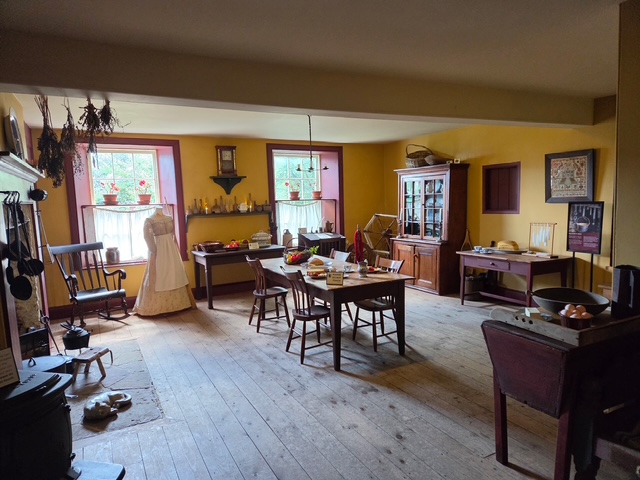 Perth Heritage Museum kitchen photo by Justin Lacasse.
After our tour, we took the short walk to Fiddleheads, 53 Herriott Street, accompanied by Debbie and Susan Code McDougall, who was our guide for the afternoon walking tour. Once our orders had been placed, and many of us were happily sipping on a locally produced beverage, Susan gave us a talk on the history of the two Tay Canals. The first Tay Canal was completed in 1834 and connected Perth to the mouth of the Tay River. Built by the Tay Navigation Company to take advantage of the economic opportunities offered by linking to the now completed Rideau Canal, the Tay Canal consisted of 5 locks and was narrower and shallower than the Rideau Canal. Though suitable for barge traffic hauled along a tow path, it was not suitable for steamship use and was never a commercial success. It soon fell into disrepair and was abandoned. In the 1880s, there was renewed interest in a Tay Canal, initiated by the local M.P., John G. Haggart. The canal would be known locally as “Haggart’s Ditch”. It was built to the same specifications as the Rideau Canal, using a revised route from Perth to a set of 2 locks at Beveridge Bay on the Lower Rideau Lake. The canal is run today by Parks Canada and is part of their Rideau Canal system.
Susan then took us on a walk through Code Park and Stewart Park, explaining their industrial heritage, mainly in distilling, and noted that Stewart Park had been gifted to the Town of Perth with several conditions, one being that no economic activity could take place within the park. As such, the annual Stewart Park Music Festival is free, and the vendors, including the food trucks, line up along the street outside of the park. Crossing Gore Street East, Susan pointed out a number of the historic buildings in the downtown, including the beautiful Town Hall and the former Carnegie Library. As we walked beside the canal, we passed the “Crystal Palace” an event venue, that in its previous life was the ill-fated OC Transpo Bus shelter that stretched along both sides of Rideau Street, east from the Rideau Centre for a couple of blocks. Reaching the old tow path at the swing bridge at Beckwith Street, we ended the formal part of our visit, several of us stopping in at Bridge Masters Brewing Company, 29 Beckwith Street East, for a final taste of Perth before heading home.
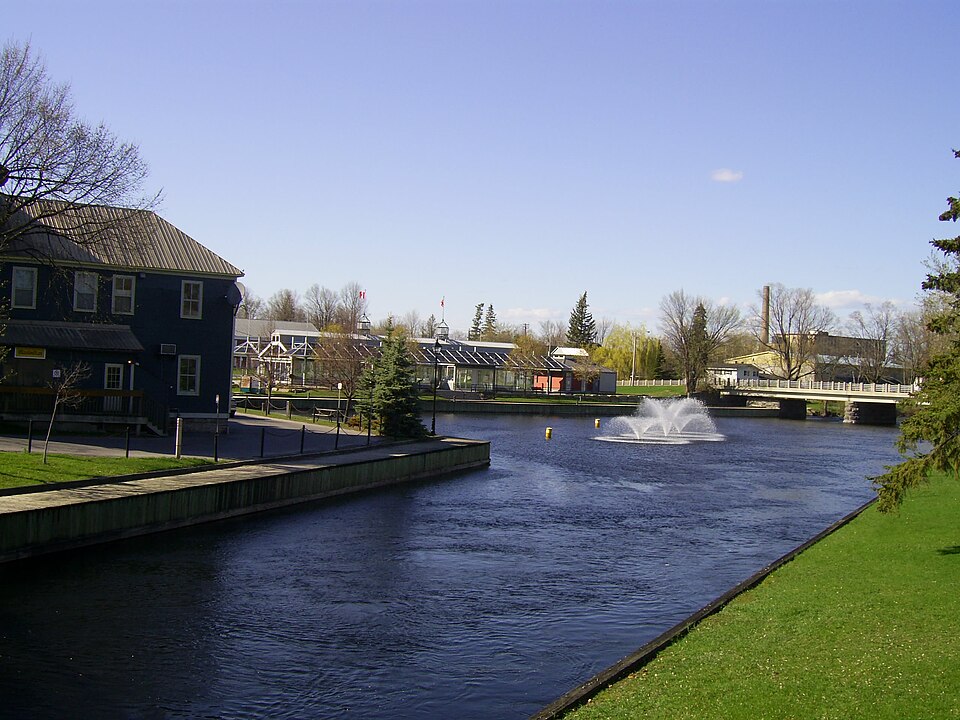 Tay Canal Basin, Perth Ontario. Photo by Kenn Chaplin from Toronto, Canada, CC BY-SA 2.0 , via Wikimedia Commons
Sixty of us gathered in the auditorium of the Main Branch of the Ottawa Public Library on the afternoon of June 20, 2026 to hear a presentation from Glenn Crawford on the history of “Gays of Ottawa”, (GO), the first major social and political 2SLGBTQI+ organization in Ottawa. The presentation was timed to coincide with Pride Month.
Glenn was born in Edmonton but has lived in Ottawa since he was three. He is an entrepreneur/designer with an extensive background in design, service, journalism, art, communications and marketing. In 2021, he relocated his home and business. Jack Of All Trades, to Gatineau. Glenn has been an activist within the 2SLGBTQ+ community in the National Capital area for the past 20 years. In 2007, Glenn won the Capital Extra’s Hero award as Community Activist of the Year and in 2010 he was the Grand Marshall of the Capital Pride Parade. Since 2015, Glenn has been the researcher and creator of the Village Legacy project that documents Queer history in the Ottawa area: The Village Legacy Project | Le Projet de legs du village.
Glenn began by discussing, what he called the “touchy subject” of the various acronyms and abbreviations that are used to describe his community, including: LGB, LGBT, 2SLGBTQ+ and Queer. He explained that there is no term agreed to within the community, but that he would use “Queer” as an umbrella term to represent the whole community, noting that it is not always embraced by all members.
Glenn then described some of the risks of being Queer before the “Liberation Movement”. The risks were many upon discovery: loss of employment, loss of family and friends, loss of housing and the risk of physical assault, even from the police. Isolation was a serious problem, leading to depression, self-destructive behaviours, such as alcohol and drug usage, and suicide. With no organizations and no formal communications, word of mouth was the only means of communications available. There were few Gay bars, many being allegedly Mafia owned. A “Cruising Culture” developed in the male community exposing members and non-members to additional risks. Major’s Hill Park became a well-known venue. The risks faced were tragically illustrated when, on August 21, 1989, 33-year-old Alain Brosseau was assaulted and thrown to his death from the Alexandra Bridge. Brosseau, a waiter at the Château Laurier, and not Gay himself, was attacked by a gang of teens in a targeted homophobic hate crime. The same teens were involved in another targeted attack the same night. The tragic incident sparked public outrage and eventually forced the Ottawa police to start to take anti-Gay violence more seriously.
At the height of the Cold War in the 1950s &1960s, Glenn explained, the RCMP became focused on national security and saw the 2SLGBTQ community as a potential risk. What followed was “The Purge” in which individuals suspected as being queer were hunted down, exposed, threatened, and fired. A special device was “invented” to detect these individuals, known as "The 'Fruit Machine", though its use was more as a tactic of intimidation than any scientific merit. The irony was, of course, that it was the risk of persecution at the hands of the RCMP and other government agencies that created the very threat they feared.
Change was coming, if slowly, and perhaps remarkably it was starting at the top. On February 21, 1967, then Minister of Justice, Pierre Trudeau commented in a press scrum “there’s no place for the state in the bedrooms of the nation” while discussing Bill C-150, which came into effect on August 26, 1969. This was a broad modernization and liberalization of the criminal code and most famously legalized private, consensual sexual acts between adults 21 and older, the age restriction being lowered to 18 in 1972. Another incident that raised public awareness of the persecution being inflicted upon the community was the June 28, 1969 raid on the Stonewall Inn in New York City. The subsequent spontaneous demonstrations are widely regarded as the start of the liberation movement in North America.
With this background, Glenn went on to explain that, sparked by the “We Demand Rally” of August 28, 1971 on Parliament Hill, which had been organized by Gay groups from Toronto to present a list of 10 demands,Gays of Ottawa (GO) was formed on September 14, 1971. The first meeting was held in an apartment on Sommerset Street West, subsequent meetings also being held in private homes, until a space was obtained in the basement of St, George’s Church a few months later. By 1975, GO had moved, and along with public awareness, advocacy and social programming, it had created a newsletter, a helpline and had started a library.
Glenn explained that not all members of the Gay community were comfortable with the efforts of GO. Some believed that the new openness being promoted by GO risked “rocking the boat” and threatened their own carefully balanced double-lives. Despite this, by 1975, and after another move, GO became increasingly involved in the support of the legal defence of individuals being charged with criminal offences or dismissed from their jobs, based solely on their sexual orientation.
Glenn described GO in its early days as primarily a male organization, queer women having different needs and goals and not always being comfortable with the culture of GO. They were also not always welcomed by other feminist organizations, though they shared many of the same objectives. In June 1976, Lesbians of Ottawa Now, (LOON), was formed in preparation for the National Lesbian Conference, which was held in Ottawa that October, with over 300 delegates from across the country. By 1981, however, GO had established gender parity on their Board of Directors.
After two more moves, one the result of a fire of uncertain origins that destroyed all of GO’s materials and records, it settled again and in 1984 split its social services components, such as the helpline and library, away from its political and social activities to form Pink Triangle Services, the first 2SLGBTQ+ registered charity in Canada.
Glenn told us that, in August 1982, near the start of the AIDS epidemic, GO hosted a meeting of over 70 concerned members. Later, in 1985, two of their members were key in forming the AIDS Committee of Ottawa. In total, there were over 350 AIDS related deaths in Ottawa between 1984 and 1995 with almost 9,000 AIDS related deaths in Ontario during the epidemic.
GO moved for the last time in 1985, when their landlord refused to renew their lease. It remained at the new location, above a laundromat, until it ceased operations in 1995, changing its name twice, first to the Association of Lesbians and Gays of Ottawa, and then to the Association of Lesbians, Bisexuals and Gays of Ottawa. Though gone, GO’s legacy lives on in the organizations it spawned, the leaders it inspired and the attitudes it changed.
Lillian Scott Desbarats – Bytown Mayor Richard W. Scott, “Peace Maker” on July 12, 1852
HSO“My father, R. W. Scott (an Irish Catholic) was Mayor of Bytown in 1852, being but 27 at the time. The (Protestant) Orangemen asked him if they could walk in procession through the streets of Bytown on the 12th of July.
He gave them permission to do so. The other (Catholic) Irishmen said, ‘If you let those (Protestant) Orangemen walk, there will be trouble, we will stone them’.
My father said: ‘If you do, you will stone me, I am going to head the procession’ and so he did. (I have heard it said that he rode a white horse, but I am sorry to say that is not true.)
He lived in Lower Town; from there he drove a horse and buggy on to the Sappers Bridge, and when the Orange Parade came along he joined it, leading them all through Lower Town.
Not a stone was thrown, but he was defeated for Mayor when the elections came around. The Irish Catholics wouldn't vote for him because he joined an Orange procession, and the Orangemen wouldn't vote for him because he was Catholic."
The above is a short excerpt from “The Irish Settlers of Bytown and Early Ottawa", a chapter from Lillian Scott Desbarats' fascinating memoir, “Recollections", published in 1957, in which she recalls the time her father, Richard Scott, tried to play “peace maker” in pre-Confederation Bytown.
View the accompanying document for her full text regarding her father’s exploits on July 12, 1952: The Irish Settlers of Bytown.
Richard W. Scott survived this defeat and went on to an extraordinary career in the Ontario Legislature and Canadian Parliament, serving as Secretary of State in the Cabinets of both Alexander Mackenzie (1874-1878) and Wilfrid Laurier (1895-1908) and serving in the Senate until 1913.
Sir Richard Scott was one of the leading proponents behind Ottawa’s eventual choice as Canada's capital. He was also responsible for the 1863 Scott Act guaranteeing the right to separate schools in Ontario and the 1878 Scott (Temperance) Act allowing counties and municipalities to prohibit the sale of liquor.
In Bytown Pamphlets #80, #81, #82 and #84 we have published further excerpts from Lillian Scott Desbarats’ 1957 memoir “Recollections”: www.historicalsocietyottawa.ca/publications/bytown-pamphlets
Billings Estate National Historic Site Tour: Seeing History Preserved
Zoe-Elizabeth CookOn July 3rd 2026, the Museum Club visited the Billings Estate National Historic Site. Our guide Aiden led us through a detailed tour of the estate that went over the contributions of the five generations that lived in this house, on the property and to the surrounding community.
The home had been built by Braddish Billings, after his wife Lamira Dow didn’t like the home that he had on the shores of the Rideau River. We began the tour in what used to be the family kitchen, with the original stove still installed. The family later installed a second kitchen (where the lobby of the estate now is), to be used during the summer, as the stove would get too hot to use. Eventually the stove was boarded over, to be found later and the summer kitchen was the only one in use. The room also contained the complete family tree of the Billings family with details about their life. Braddish and Lamira had 9 children, 7 of whom reached adulthood.
Here we got our first insight into the contributions of the Billings family to their community, as we learned that Lamira had been a schoolteacher who was heavily involved in education so her children were quite well educated and the Billings family built the first schoolhouse in Ottawa. Braddish also made contributions with his ice business and by selling goods to lumber workers for the Rideau Canal.
In the second room we went into there were numerous artifacts on display and we learnt a bit more about two of Braddish and Lamira’s children, Sabra and Sally Billings. Braddish had gone against the societal norms with the ownership of his property as he left the home to his two eldest daughters rather than his oldest son. The daughters continued the Billings family style of contributions to their community with both of them helping with the dairy business and helping with the fruit and vegetable gardens on the property whose goods were sold in the Byward Market. The sisters ended up splitting the house, with each of them getting a half. This led to the addition of another room which was Sally’s dining room (now used to display information about the dairy business that the Billing’s had), which still has its original windows to this day.
The last room that we went to on the first floor was one that served multiple purposes over the years. It was initially built for Lamira and Braddish as they grew too old to go up the stairs, then it was used as Sabra’s music room, and later it was used by Sally and Sabra’s nephew Charles Murray Billings as an office.
Our tour continued upstairs as we entered what was referred to as “the green room”. The room has had multiple uses over the years and its wallpaper demonstrates the care that the Billings Estate has taken to preserve its historical accuracy. The wallpaper colour was determined by taking paint chips from around the house to figure out what the most used colour was, resulting in the green colour visible in the room. There were also maple leafs on the wallpaper to represent the contributions that the Billings family had on Canada. Currently this room is serving as a temporary exhibition called “Beyond the Brim: Tales Told Through the Hats We Wore” which has numerous hats on display with the stories of the individuals who wore them and their impact on Canada. Using this room as an exhibition room was another way of giving back to the community the same way that the Billings Family did.
The final room that we went into had been Beatrice Lindsay Billings’ (wife of Charles Alexander Billings). The room has two key pieces to it that showed the historical touches still present in the house. One of them is the original flowered wallpaper that was kept in one area behind a door in the room (pictured below). The other connects the generations together, it’s the ceramic doorknob leading to the room. One side is from Beatrice’s time, and the other side contains the Cypher of William, showing that it was from the first generation of this house.
 The preserved wallpaper at the Billings Estate. Photo by Emma Kent.
A big thank you to our tour guide Aiden, and to the Billings Estate for having us. Our tour was so popular that it sold out, but there is another opportunity to see this amazing property with the Museum Club on August 7, 2026!
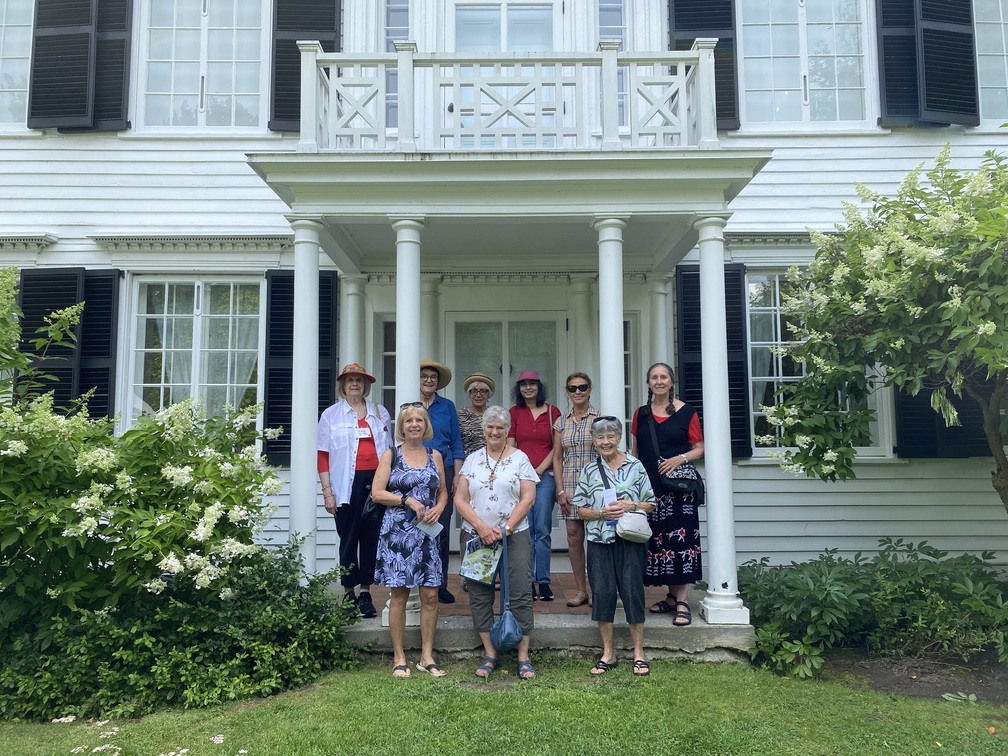 The Museum Club at the Billings Estate National Historic Site on August 7, 2026. Photo by Zoe-Elizabeth Cook.
On August 7th, the Museum Club returned to Billings Estate for another tour, this time given by Nyah. A big thank you to her and to the Billings Estate National Historic Site for having us back for a second time.
Hamnet Pinhey Hill – LeBreton’s Influence on the Route of the Rideau Canal: Historical Fact… or Myth?
HSOA favourite tale of Ottawa lore, re-told repeatedly, is the intriguing story that a plan to place the Rideau Canal entrance at LeBreton Flats was changed because of Lord Dalhousie’s anger at Captain John LeBreton, who the Governor General believed had used privileged information of the plan to purchase Lot 40 (the planned location) for personal gain.
Historians, however, as far back as Hamnet Pinhey Hill in 1919, have persevered to dispel the apparently groundless legend that this dispute actually had any impact on plans for the Rideau Canal.
Reproducing primary sources, including the full written accounts of both Dalhousie and LeBreton, Hill attests that the story of canal plans playing a part in the matter is without basis – the only plan figuring into Dalhousie’s anger having been one for placement of a storehouse to serve the terminus of the Richmond Road.
As per Hill: “There was however, an unpleasant misunderstanding between Lord Dalhousie and LeBreton over his purchase of Lot 40 at the sale, and the freedom with which Dalhousie vented his indignation probably accounts for the distorted story”.
Hill maintains that the land purchase disputed between Dalhousie and LeBreton had been in regard to planned use of the lot for a storehouse, not for the Rideau Canal.
Here is the link to the essay penned in 1919 by Hamnet Pinhey Hill, a local lawyer, MLA for Ottawa West and great-grandson of early March Township landowner Hamnet Pinhey.
We invite you to read Chapter V (pages 28-39), which will prove to be of particular interest to this long-running debate, as to whether the legend of the Dalhousie/LeBreton/Rideau Canal "scandal" is historical fact... or myth.
Quick Links
About
Supporting Partners