

Working to preserve Ottawa's past
for future generations.
Following WWII, approximately 40,000 Holocaust survivors resettled in Canada. Ottawa became home to many of those Holocaust survivors and hundreds of their descendants.
Phil Emberley shares his father Dieter's experience as one of the 10,000 Jewish children evacuated by the British government before the start of WWII from his home in Germany.
View this recording our Phil Emberley’s November 2025 HSO Speaker Series presentation: www.historicalsocietyottawa.ca/resources/videos/speaker-series/a-holocaust-testimonial-my-father-s-story
The Barber Family: Our Proud Place in Ottawa’s History / Tom Barber
-Born into slavery in Kentucky, Paul Barber, was one of Ottawa’s earliest Black permanent residents and a renowned horse trainer, founding a family that has made its mark in the capital for over a century.
Tom Barber, Paul Barber's grandson, shares the remarkable story of his family and their important role in Ottawa’s past, as well as reflecting on other immigrant groups that have come to make the nation’s capital their home.
View this recording of Tom Barber’s February 2022 HSO Speaker Series presentation: www.historicalsocietyottawa.ca/resources/videos/speaker-series/the-barber-family-our-proud-place-in-ottawa-s-history
Although never very numerous, Danish immigrants to Ottawa quickly found each other and gathered socially, thus forming a distinct Danish community. They integrated quickly and effortlessly, while remaining proud of their background and heritage.
In this 2023 HSO digital pamphlet, author Rolf Buschardt Christensen focusses on 12 families who represent fairly the community and provided its agenda and leadership.
The Algonquin Anishinaabeg of the Ottawa River Valley: Yesterday, Today & Tomorrow / Lynn Gehl
-Long before the recent arrival of non-Indigenous settlers, the Ottawa River Valley had, for millennia, been home to the Algonquin Anishinaabe people and their ancestors.
Dr. Lynn Gehl, an Algonquinmakes the case that we have yet to resolve crucial issues such as that our national capital – the “heart of Canada” continues to trespass on the traditional and unceded territory of the Algonquin Anishinaabeg and that violation of Algonquin rights continue.
View this recording of the HSO’s February 2026 conversation with Dr. Lynn Gehl, Anishinaabe Algonquin advocate, academic, artist, and author:
Archaeological evidence suggests that the Ottawa Valley has been home to the AlgonquinAnishinaabe people and their ancestors for as many as 8,000 years.
Long before the arrival of Europeans, the Algonquin people lived, hunted, trapped, fished, socialized and traded on both sides of the Ottawa River and along its tributaries.
Over the years, First Nations across North America had been persuaded to sign treaties to hand their land over to the Europeans (frequently on less than favourable terms). The Algonquin, however, were never party to any such agreement.
As a result, we must acknowledge that the Ottawa Valley, including the city of Ottawa and the national capital region, remain the unceded territory of the Algonquin people -- the rest of us mere guests of the Algonquin Anishinaabe people at best, trespassers at worst.
James Powell, Historical Society of Ottawa member and author of the “Today in Ottawa’s History” blog, shares the story of Algonquin Anishinaabe people:
An HSO story collection celebrating the diverse communities that constitute Ottawa’s cultural mosaic.
Throughout our history, Ottawa’s (and Canada’s) cultural fabric has been continually diversified and enriched as its population has grown and flourished to represent peoples, cultures and languages from around the world.
Do you have a story to tell about your community, the joys and adversities experienced, and the proud contributions your community has made to Ottawa’s cultural mosaic? We invite you to add your story for the HSO Ottawa Million Strong Project!
All submissions are welcome and those selected will be added to this special HSO Ottawa Million Strong Project story collection. Submissions can be in a variety of formats, including written or audio/video. We welcome submissions of new as well as updated or previously published materials. Contributors will allow the Historical Society of Ottawa the right to publish these materials while also retaining the right to do so themselves.
In addition, the HSO Memory Project team will be recording a limited number of oral histories as part of the HSO Ottawa Million Strong Project. Please let us know if you might like to share your community’s story through an interview with the HSO Memory Project team.
Contact us to learn more: This email address is being protected from spambots. You need JavaScript enabled to view it.
Lest We Forget
An exploration of the valour and unequal Treatment of Algonquin who have served in Canada's Armed Forces
Featuring Wendy Jocko Sgt. CD (Ret’d), Former Chief of the Algonquins of Pikwakanagan First Nation. Canadian Forces Veteran & Lynn Gehl Ph.D, Anishinaabe Algonquin Advocate, Academic, Author & Artist
Media
The Rideau Canal
In her March 28, 2026 HSO Speaker Series presentation, historian/documentary film maker Allison Margot Smith introduces her new 15-minute film, “Two Wars, Three Watersheds, a Slew of Surveys and a Canal”, which she had produced especially in response to the HSO’s 2026 Bytown200 Bicentennial Storytelling Challenge.
Following the film, Allison takes us behind the scenes and reflects on some of challenges inherent in creating historical documentaries, and innovations occasionally necessary to provide the viewer with illustrative images in order to bring the past to life.
Media
HSO member Ben Weiss tells his family story, and invites others to come forward to do the same, as part of the HSO Memory Project. Almost all our family stories are those of immigrants and refugees of some kind, and Ben’s family story is certainly no exception, his mother a WWII Dutch war bride and his father the son of early 1900s Jewish refugees from Eastern Europe.
HSO volunteer Emily Basseville interviews Ben about his parents’ story. Many thanks to David McEvoy who produced this episode of the HSO Memory Project: The Weiss Family Story.
On September 25, 1826, hoping to obtain vice-regal confirmation of his chosen route for the Rideau Canal, Lt.-Col. John By led the Governor-in-Chief of British North America, Lord Dalhousie, on an arduous 13-km hike through the then tangle of forests and swamps that we have come to know today as Centretown, the Glebe and Old Ottawa South, quite likely reaching the point where the Rideau Canal would eventually meet up with the Rideau River at what we know today as Mooney’s Bay.
At one point during their round-trip trek back to that morning's starting point at Sleigh Bay (today’s Ottawa Locks), By and Dalhousie were graciously welcomed into the log cabin home of one of Old Ottawa South’s earliest settlers, Lewis Williams.
“After feasting on his potatoes,” Dalhousie wrote in his journal, “after our hot walk we asked for a little rum, but he had none. We drank water from his well as cold as any ice. I need not say that our visit gave the old man unbounded joy, tho’ we left without giving the least hint who we were.”
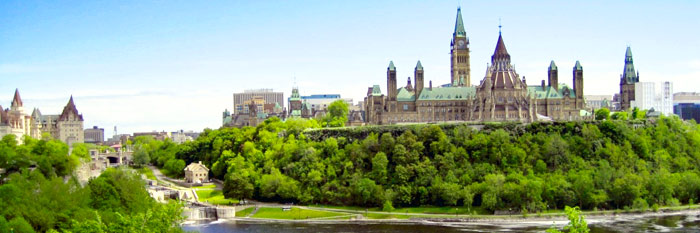
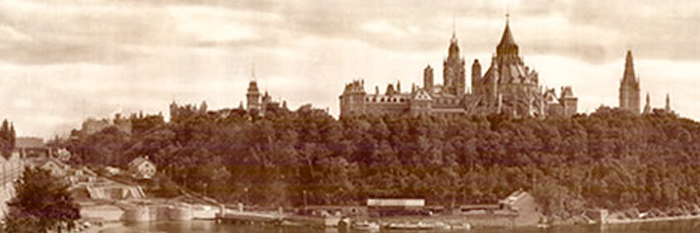
The following day, September 26, 1826, Lord Dalhousie recorded in an official letter that he had met with Colonel By at Sleigh Bay, below the future Parliament Hill, and confirmed that site’s selection to be the northern starting point of the Rideau Canal at the Ottawa River.
In that same meeting, the letter stated, plans were also approved for the town site for the future Bytown, divided by the intended canal into Lower Town and Upper Town; for a series of bridges across the Ottawa River to connect Upper and Lower Canada; and, at the request of the region’s fledgling logging industry, a dredged canal at Richmond Landing to ease the passage of timber rafts around the turbulent Chaudière Falls.
In this comprehensive and fascinating new essay, Carleton University professor and longtime Ottawa journalist Randy Boswell, a former HSO board member and HSO newsletter editor, chronicles these and more of the extraordinary events surrounding the “birth” of Bytown and the Rideau Canal two centuries ago this past month, including detailing long-overlooked interactions with the Indigenous people at the time, and the long-term impact of this uninvited settlement on the future of the Anishinaabe Algonquin:
Bytown 200 – The Birth of Bytown
An abridged version of this essay appeared as an article in the September 26, 2026 edition of the Ottawa Citizen and is also featured in a new book by Randy Boswell and Ottawa photographer John McQuarrie, “Ottawa, Spirit of Place — 200th Anniversary Edition”.
Then & Now
Quick Links
About
Supporting Partners