

Working to preserve Ottawa's past
for future generations.
If you like podcasts – and you like learning about Ottawa’s past – you’re going to enjoy Brendan Ray’s new Ottawa History Hub podcast series.
Going back to the very beginning, when the Ottawa Valley was submerged under the Champlain Sea, and then carrying us forward to the arrival of the Anishinaabe Algonquin people, followed inevitably by that of the first European explorers, we are eventually brought to the time of Bytown and beyond.
Follow the HSO Facebook page or subscribe directly to Ottawa History Hub to make sure you don’t miss each week’s new episode: ottawahistoryhub.com
Did early Bytown bear witness to the work of a Saint? April 5, 2026, marks the 150th anniversary of Mother Élisabeth Bruyère’s death, yet her selfless spirit lives on and her mission continues to inspire important work in health care, education, social services and the promotion of social justice.
On April 14, 2018, by decree of Pope Francis, Élisabeth Bruyère was declared Venerable, in recognition of her heroic practice of faith, hope and charity.
Sister Louise Charbonneau invites us to fully appreciate the legacy of this innovative and virtuous pioneer of Bytown, the Venerable Élisabeth Bruyère, and the cause for her beatification and ultimate canonization.
- In English – As Bytown Celebrates 200 Years, Let Us Remember Our Founders Venerable Élisabeth Bruyère: An Innovative and Virtuous Pioneer of Bytown 1845-1876
- In French – Alors que Bytown célèbre ses 200 ans, souvenons-nous de ses fondatrices: La vénérable Élisabeth Bruyère : une pionnière innovante et vertueuse de Bytown, 1845-1876
Sister Louise Charbonneau is a Sister of Charity of Ottawa (SCO). The Sisters of Charity of Ottawa, known as the Grey Nuns of the Cross, have been following in the footsteps of their foundress Élisabeth Bruyère since her arrival in Bytown in 1845.
To mark Ottawa's 200th Anniversary, Andrew King, curious as always, decides to determine which settler may have been the first to build a permanent family home in Ottawa, and if any remains of that first house can be found.
ottawarewind.com/2026/03/11/in-search-of-ottawas-first-house
Andrew King is an Ottawa artist and historian and author of the Ottawa Rewind blog.
Lynn Gehl – Algonquin Anishinaabeg of the Ottawa River Valley: Yesterday, Today & Tomorrow
Dave KentThe Historical Society of Ottawa’s Zoom presentation of February 11th, 2026, was the 1 st of a 3 part series on the beginning of the Rideau Canal, (March 28), and the founding of Bytown, (April 25), in recognition of 2026 being the 200 th anniversary of both. We started the series with a look at the effects these events had on the Algonquin Anishinaabeg peoples. We were pleased to welcome Dr. Lynn Gehl, noted academic, author, artist, and advocate. She is a member of the Algonquins of Pikwàkanagàn First Nation . Dr. Gehl holds a Doctorate in Philosophy in Indigenous Studies as well as a Masters in Canadian Studies and Indigenous Studies and an Undergraduate degree in Cultural Anthropology. She is also the recipient of a Governor-General’s award.
The evening’s presentation took a conversation format, with questions being posed by Ben Weiss, long time member of the Historical Society of Ottawa, and Dr. Gehl, both providing specific answers and using the questions as a lead to discuss related issues. To get the full impact of the information and perspective provided by Dr. Gehl, we encourage you to watch the presentation or check out her other works through the links provided below.
Ben Weiss: Can you start off by telling us about your early life?
Dr. Gehl: Dr. Gehl started us back with her Great-grandfather, Joseph Gagnon and Great-grandmother Annie Jane. They lived on what was then known as the Golden Lake Reserve, but after returning wounded from the First World War, Joseph was advised by the government to move off the reserve to receive benefits. Dr. Gehl’s father grew up in the area and was a fisherman on the lake. Her mother went to Residential School in the Montreal area. Dr. Gehl is the 5 th of 8 children, and after the breakup of her parents, her mother raised the 8 children in the Toronto area. She suffered through poverty, housing and food insecurity and a series of operations that attempted, unsuccessfully, to correct a medical issue. As a youth, she found reading and writing difficult, both due to a vision impairment and because her focus was, by necessity, more on physical survival than intellectual development. She wanted to share these aspects of her personal story so others would recognize that she is not approaching these issues as a person of privilege.
Ben Weiss: You are now our foremost Indigenous scholar. Could you take us through a bit of your academic journey?
Dr. Gehl: Dr. Gehl confirmed that reading is still a burden for her, but she does a lot of it and has what may be the largest Algonquin library existent. At 30, she decided to leave her job monitoring water quality for the Ontario Provincial government to pursue her desire to understand what had happened to the Algonquin people. She started as a part-time student in Psychology, later switching to anthropology that better matched her interests. Her studies in anthropology revealed to her that there are many ways to be a human being and that poverty is often related to the power system in place. For her Masters work, she investigated the question of identity and the way it has been assessed. Are you Indigenous because you look Indigenous? Are you Indigenous as the result of a blood test or are you Indigenous because the government has said you are Indigenous. She was concerned how this assessment, especially when the identity is denied, affects the spirit of the individual. For her PhD, Dr. Gehl switched topics and studied the Algonquin Land Claims Process. Her findings were later converted into a book, The Truth that Wampum Tells: My Debwewin on the Algonquin Land Claims Process – Fernwood Publishing . Unlike most who find the results of her PhD a happy one, Dr. Gehl characterized hers as brutal, as an understanding that Canada has yet to move past its colonial period.
Ben Weiss: Could you tell us about your decades- long struggle around the key issue of unknown or unstated paternity inside the Indian Act, Gehl v Canada ?
Dr. Gehl: Dr. Gehl explained that in 1985, the government amended the Indian Act and she thought that they would remove sex discrimination from the Act, which they did not. They instead added additional stipulations that they falsely claimed would bring the definition in line with the Charter. As a result, Dr. Gehl, then 23, approached the Aboriginal Legal Services of Toronto to see if they would accept her case challenging the Act. She found herself, one individual taking on the Department of Justice. After much archival research, a dismissal in 2012, a verdict against her in 2014, she finally received a partial victory from the Ontario Court of Appeal in 2017. Dr. Gehl explained that at this time, Sharon McIvor was going through a similar struggle and, in 2010, had petitioned the United Nations Human Rights Commission, who found in her favour in 2019 (McIvor Case | The Canadian Encyclopedia). Dr. Gehl pointed out that though her fight lasted 34 years, her Great-grandmother had written a letter, in 1945, asking about her status following the death of her husband and was informed that she was now a “White Woman”.
Ben Weiss: Can you take us through the concepts of Indigenous knowledge and the Debwewin Journey?
Dr. Gehl: Dr. Gehl explained that when she was completing her Indigenous Studies PhD, she made the decision to do so through Indigenous knowledge and Indigenous ways of knowing and being. She did this by getting as much exposure to Indigenous knowledge as she could, through the literature, ceremonies, talking with Elders and by learning the language. In this process, she learned of the concept of “Heart Knowledge” and gave the example of looking at each other when we talk so we can tell that we are being truthful. Dr. Gehl discovered that truth exists when our “Mind Knowledge (reasoned knowledge) and our “Heart Knowledge” agree. She developed this understanding into a Methodology, the Debwewin Journey .
Ben Weiss: Can you tell us something about Algonquin contact and pre-contact history?
Dr. Gehl: Dr. Gehl reminded us that the history of Canada is taught as the French and English being the benevolent founders of the nation. This is obviously untrue. She noted that the Algonquin territory covers some 200,000 square miles, larger than the combined lands of Prince Edward Island, New Brunswick and Nova Scotia, yet the Algonquin peoples have little control over this territory. The European historic record dates as far back as 1613, when Champlain documented the control of the territory by the Algonquin. After the British defeated the French to gain control over these lands, they signed a treaty in 1760, vowing to protect Indigenous lands, which they later broke. Dr. Gehl detailed a number of treaties and a Royal Proclamation, that defined Algonquin lands, as far as the governments of the day were concerned, eventually resulting in 2 federally recognized Algonquin First Nations in Ontario and 9 in Quebec, though some actually have no land associated with them. There are also 4 unrecognized Algonquin collectives in Ontario. The Algonquin lands in Ontario were lost through a series of treaties signed by the Mississauga peoples, not the Algonquin. Dr. Gehl noted additional pieces of legislation that granted Algonquin lands to settlers, but not to Algonquin peoples, and remarked that Parliament itself is built on stolen Algonquin land.
Ben Weiss: Do the Algonquin have any land treaties?
Dr. Gehl: No. Dr. Gehl explained that the only treaties that cede their lands are those signed by the Mississaugas. There are, however, Peace Treaties, such as the Treaty of Niagara, which identified the 24 Indigenous nations attending as Nations, but also as Subjects. They were, in fact, allies, of equal status to the British.
Ben Weiss: What is the significance of the Wampum Belt in Indigenous culture?
Dr. Gehl: Dr. Gehl explained that a Wampum Belt is a form of symbolic literacy, just like words on a page. Though many believe that only the Haudenosaunee used Wampum Belts, this is not true; Wampum Belts were used by a number of peoples including the Algonquin. Wampum Belt Diplomacy was often used to codify agreements, such as those between Indigenous Nations and the British Crown.
Ben Weiss: Why is it important to understand the significant difference between what Canada calls the Modern Treaty process and the Land Claims process?
Dr. Gehl: It is crucial. Dr. Gehl explained that a Treaty Process is about sharing the land and resources in equal and equitable ways. A Land Claims process is about extinguishing Indigenous Rights. Canada’s Modern Treaty process is simply a Land Claims process. The Canadian government is currently offering the Algonquin Nation only 1.7% of their territory and a one-time buy-out of $800 Million.
Ben Weiss: Can you tell us about the Algonquins of Ontario and the 2016 agreement in principle?
Dr. Gehl: Dr. Gehl explained that the Agreement in Principle, which includes transfers of funds, ownership of some lands and jurisdictional rights over resource exploitation, was signed by the Algonquins of Ontario and the governments of Ontario and Canada. She told us that this happened when only 47% of those eligible to vote participated and it was opposed by the Pikwàkanagàn First Nation. Later, a tribunal removed over 2,000 ‘pretendians’ who had been eligible to vote on the Agreement.
Ben Weiss: Can you talk about the harmful effect of ‘pretendians’?
Dr. Gehl: Dr. Gehl explained that some 2,500 members had been removed as Algonquins from the Pikwàkanagàn / Sharbot Lake communities along with the 2,000 previously mentioned. A CBC investigation discovered that about 1,000 of these had been signed-up through a fraudulent document. This means that at least 4,500 non-Algonquins were corrupting the Land Claim process. Pretendians’ are often in positions of influence, such as university professors, and so control such things as scholarships and research funds. If Indigenous peoples are to have a better world, they don’t need ‘pretendians’ telling them how. The ‘pretendians’ are white people and it should be the responsibility of white people and the government to deal with them, not the Indigenous community, who have many other issues to address.
Ben Weiss: Can you finish off by talking about the important work you’ve been doing regarding Indigenous Women and girls with disabilities?
Dr. Gehl: Dr. Gehl explained that when you are discriminated against by sex, race and disability, your life is “extra extra miserable”. Being oppressed by three layers of structural oppression can, and does, lead to death. Rates of disability are higher in Indigenous communities because they lack housing, lack nutrition, and are frequent victims of sexual violence.
Dr. Gehl then shared some images of various maps that relate to her research, as well as a diagram and a video that help to explain Indigenous Knowledge.
For those interested in reading more, Dr. Gehl is offering her books as a bundle for $100, including shipping within Canada.
This presentation was the most attended of the year, with over 130 participants, and was exceptionally well received.
The full presentation can be viewed at: Lynn Gehl Ph.D. - Algonquin Anishinaabeg of the Ottawa River Valley:Yesterday, Today & Tomorrow.
Dr. Gehl’s website can be found at: Lynn Gehl, PhD, Algonquin Anishinaabe-Ikwe.
On the afternoon of Monday, February 23rd, the Historical Society of Ottawa offered its first English language in-person Speaker presentation for 2026, generously hosted by the Main Branch of the Ottawa Public Library. That afternoon, we were honoured to welcome Mohamed Ghadban, former member of Tannis Food Distributors and current Vice-President of the Ottawa Muslim Association. He has been recognized by the awarding of the King Charles III Medal for his community work, Mohamed told us the history of the Ottawa Mosque, the oldest Mosque in the City and the second oldest in Canada.
Mohamed Ghadban was born in Lebanon, coming to Canada in 1956, aged 2 ½, with his parents and 11-month-old brother. Some older siblings remained in Lebanon, rejoining the family a couple of years later. Mohamed was one of 8 children, and after the marriage of his eldest sister and the death of his father, his mother raised Mohamed and his 6 siblings on her own. Fortunately, his father had always insisted that in a family all members had responsibilities, so together they managed. It had been Mohamed’s father’s dream that Ottawa have a Mosque and so he sees himself as helping to fulfill that dream.
Mohamed stated that when his family arrived in Ottawa, after a month at sea and a train trip from Halifax, they found themselves in a city with only about 200 other Muslims. The community had been so small that they had initially held their prayer meetings outside in Vincent Massey Park. In 1962, they began renting the basement of the Western United Church, 545 Wellington Street, every Sunday afternoon for these services. The church was expropriated in 1963 and later demolished as part of the National Capital Commission “rehabilitation” of the LeBreton Flats, and a new church was built on Northwestern Avenue, and simply called the Northwestern United Church, which began services in September 1964. Mohamed explained that the Ottawa Muslim Association, which was founded in 1965, decided that they would follow their friends, and so began renting the basement of the Northwestern United Church on Sunday afternoons, for their 500 members, as they had done before.
The dream of a mosque for Ottawa remained, and after considering other sites, Mohamed explained that, in 1967, they decided to purchase the ½ acre lot adjacent to the Northwestern United Church. One of the two old houses on the lot was demolished to make way for the Mosque, while the other was retained and used by the community. Mohamed told us that it was really thanks to the work of the Muslim Women’s Auxiliary, who, from the mid-1960s, undertook much of the required fundraising that the project proceeded. He said that they raised enough to complete the basement, but not the entire $700,000 for the mosque. Many governments of predominantly Muslim countries, notably Pakistan, contributed funds to allow the project to continue and the Mosque to be completed. They continued to hold their services of worship on Sundays until they were able to obtain an imam in the 1990s, who instituted the more traditional Friday observance.
Mohamed showed us a photo of the ceremony in September 1973, at which two children, Basher Ghadban and Yasmine Ismaily, broke ground for the mosque, at 251 Northwestern Avenue, as G. K. Chaudhry, the then president of the Ottawa Muslim Association looked on. The Ottawa Mosque began offering prayer services in the basement in the fall of 1975, with the upper portions being completed in the spring of 1977. He then gave us a brief description of the Mosque. Its three levels, including the basement, can accommodate about 1,000 people, the main hall itself with room for 700. Its large dome is copper clad and is supported by 16 wooden beams. Its minaret, the only one in the city, stands some 35M (115ft) in height and has, on occasion, been used to call the faithful to prayer. Since its construction, some upgrades have been made including the addition of air conditioning and enhancements to the parking lot. During the Covid 19 lockdown, when all other mosques were closed, the Ottawa Mosque was able to conduct its prayer services, the worshipers sitting in their cars in their parking lot, where by great fortune, all the parking spots faced to the east.
Declining attendance at the United Church in the early 2000s, led to the amalgamation of three neighbouring congregations, those of Kingsway, Westboro and Northwestern United, which was decommissioned in 2016 – see: A farewell to Northwestern United Church . Rather than seeing the church which had befriended them and supported them in the early years demolished, the Ottawa Mosque purchase the Northwestern United Church, preserving it for the community, and has renamed it as The Hall of Peace. It provides many of the social services offered by the Ottawa Muslim Association and is used for overflow on major services.
The Ottawa Mosque follows the teachings of Sunni Islam, but welcomes all Muslims to come and join them in prayer. There are now over 150,000 Muslims in Ottawa, almost 15% of the population, and there are now many mosques in the city, though the Ottawa Mosque is considered to be the Mother Mosque.
The Ottawa Mosque received heritage status in 2025 and the Ottawa Muslim Association invites all members of the public to come and visit, not only at Doors Open, but on any day.
Learn of “Williams House” located in present-day Old Ottawa South, the frame structure which dates back to 1827 (the first full year of construction of the Rideau Canal) and of early settler Lewis Williams’ original farm property that at one time covered 200 acres, extending from to today’s Bronson Avenue to Main Street, north from Sunnyside Avenue and encompassing today’s Lansdowne Park. The Crown expropriated part of Williams' property in order to accommodate the construction of the canal.
The Ottawa South History Project is a group of local historians and heritage enthusiasts who research, document, and present information about the history of Old Ottawa South.
Imagine spending £95 sterling to purchase 200 acres of what would one day constitute the heart of downtown Ottawa – a swath extending from Wellington Street to present-day Laurier Avenue, from Bronson Avenue to Waller Street.
In addition, Nicholas Sparks’ house, on the north side of Sparks Street between Lyon and Bay Streets, would be the first stone house built in Ottawa, in 1829, and would remain standing until 1954.
Ashley Newall delves further into the story and shares fascinating series of colourized images: apt613.ca/capital-history-ottawa-nicholas-sparks-house/
Ashley Newall is an Ottawa singer-songwriter-musician and history writer, whose stories can be found his Capital History (CapHistOttawa) social media pages, his ashleynewall.ca website and on Apt613.ca.
The City of Ottawa Archives joins in marking 200 years since the founding of Bytown, by presenting a serialized look at the community’s early development.
“Bytown: Construction Camp to Fledgling City” explores the transformation of a frontier settlement into a vibrant urban centre. Through archival records, historical insights, and profiles of key figures, follow this series as the Archives brings Bytown’s story to life—one chapter at a time: https://ottawa.ca/en/node/3042265
The City of Ottawa Archives are the custodians of permanent and historical civic government records on behalf of the City of Ottawa and its many departments, as well as local, community records with historical value. They preserve, acquire and make these documents accessible for City staff, the public, and other researchers, for present and future generations.
Join us as we (carefully) flip through the withering pages of a (barely) surviving copy of the August 16, 1926 edition of the Ottawa Evening Citizen -- and travel back a century and explore some of the news items and advertisements published in the newspaper’s special “Centenary Edition”, kicking off Ottawa’s celebration of its first 100 years.
FRONT PAGE “CENTENARY EDITION”
.jpeg)
August 16, 1926
Bold headlines announce that “Mayor Hands ‘Key’ of City to Visitors”, “Throng on Parliament Hill for Centenary Official Opening Ceremonies” and “Sunday Scenes at Lansdowne Park When Centenary Opened with Garrison Church Parade”.
(Let’s not be confused! A fourth unrelated headline is inserted reporting that “Empty Casket in Case Alleged to Contain the Body of Kitchener”, a story that has nothing to do with Ottawa’s Centenary but rather a discovery at a train station in London, England.)
On the same page, the Citizen boasts that “1,400 pounds of ink will be consumed” publishing this special 128-page Centenary edition.
For more on that week’s celebration of Ottawa’s 100 th birthday, check out James Powell’s “Ottawa’s Centenary”: todayinottawashistory.wordpress.com/2019/07/20/ottawas-centenary/
FIRST SHOWING OF “BEN HUR” IN THE BRITISH EMPIRE
.jpeg)
August 16, 1926
This silent-era MGM classic, showing at Ottawa’s Auditorium, accompanied by a touring symphony classic is the “first time shown in the British Empire” and “will not be shown here again for at least 12 months”.
James Powell tells us more about the remarkable legacy of the Auditorium (1923-1967): todayinottawashistory.wordpress.com/2024/08/31/the-auditorium-the-aud/
CENTENARY STAMPEDE
.jpeg)
An advertisement for the week-long Centenary Stampede, the highlight of Centenary celebrations at Lansdowne Park. James Powell tells us more about this “Most Thrilling Sporting Event!”: todayinottawashistory.wordpress.com/2025/10/25/the-centenary-stampede/
A CENTENARY “WELCOME!”
.jpeg)
August 16, 1926
We were being promised “Two Big Weeks of Fun and Merriment” August 16-28, with the Centenary celebrations – the Stampede and Historical Pageant – at Lansdowne Park the first week, with the Central Canada Exhibition (the “Ex”) hoping to capitalize on the wave of momentum when it takes over the venue the second week.
Note: “Reserved Seats for all events on sale at Centenary Headquarters, Russell House Block, Phone Q. 1127”.
On the same page, an ad for Fournier’s noting that the retailer will be closed Wednesday (August 18) for “Ottawa’s Birthday” but offering broadcloth shirts for as low as $1.79 and neckties and socks for under a dollar for those who shop on Tuesday.
Also on the same page, a listing of “Radio Programs” from stations broadcasting as far away as Philadelphia and New York City, including a report on the previous two nights’ radio reception, courtesy of the Department of Marine and Fisheries: “Sunday – Reception good. Saturday – Fair, with some static and slight fading”.
“OTTAWA CENTENARY AWAY TO SPLENDID START”
.jpeg)
August 16, 1926
“Impressive Church Parade Features Sunday Ushering City’s Big Celebration”, “Thousands of Visitors From Near and Far in Capital”, “Crowded Streets, Gaily Decorated and Illuminated”.
On the same page:
A Bishop visiting from England for the Centenary, preaching at Christ Church Cathedral, pleads with the congregation to “Keep Canada British”, stating “We welcome those from other countries, and God knows where they call come from, but don’t let us, for God’s sake, lose the British ties of blood which once bound the early settlers of Canada.”
Mackenzie King (leading the Opposition during Arthur Meighen’s brief 3-month tenure as Prime Minister that summer) is accused by one of Meighen’s ministers as repeating “false statements” accusing the Customs Department of “maladministration”.
Saturday night’s “annual sweet pea show”, put on by the Westboro Horticultural Society is deemed “a signal success, as evidenced by the large attendance and the many entries”.
SPORTS PAGE – TWO HOMERS FOR BABE

August 16, 1926
“Babe Ruth and his mighty bat were busy over the week-end” against the Washington Senators,”Babe Brings Home Run Total Up to 39”. (The Babe would finish 1926 with 47 home runs, the fifth highest in his career, batting a career-high 60 homers the following year.)
Also on the same sports page:
Four new “Dominion” records were established in swim meet held in the Rideau Canal this past weekend.
Toronto’s team in baseball’s International League narrowly remained in first place (the Toronto “Maple Leafs” would go on to win 29 of the next 38 games and win the league championship for their last time until 1943.
The local “Lauriers” of the Independent Baseball League were beaten by Wakefield before a crowd of 2,000 on Porter’s Island.
Four Canadian and three U.S. power boats competing in a regatta on the Ottawa River.
Centenary motorcycle and bicycle races drew a large crowd at Lansdowne Park.
Almonte beat the Defence HQ in cricket at Rideau Hall.
Also on the same page, the day’s “Our Boarding House” cartoon featuring the tall-tale-telling “Major” Hoople.
“O.E.R. (OTTAWA ELECTRIC RAILWAY) NEWS”
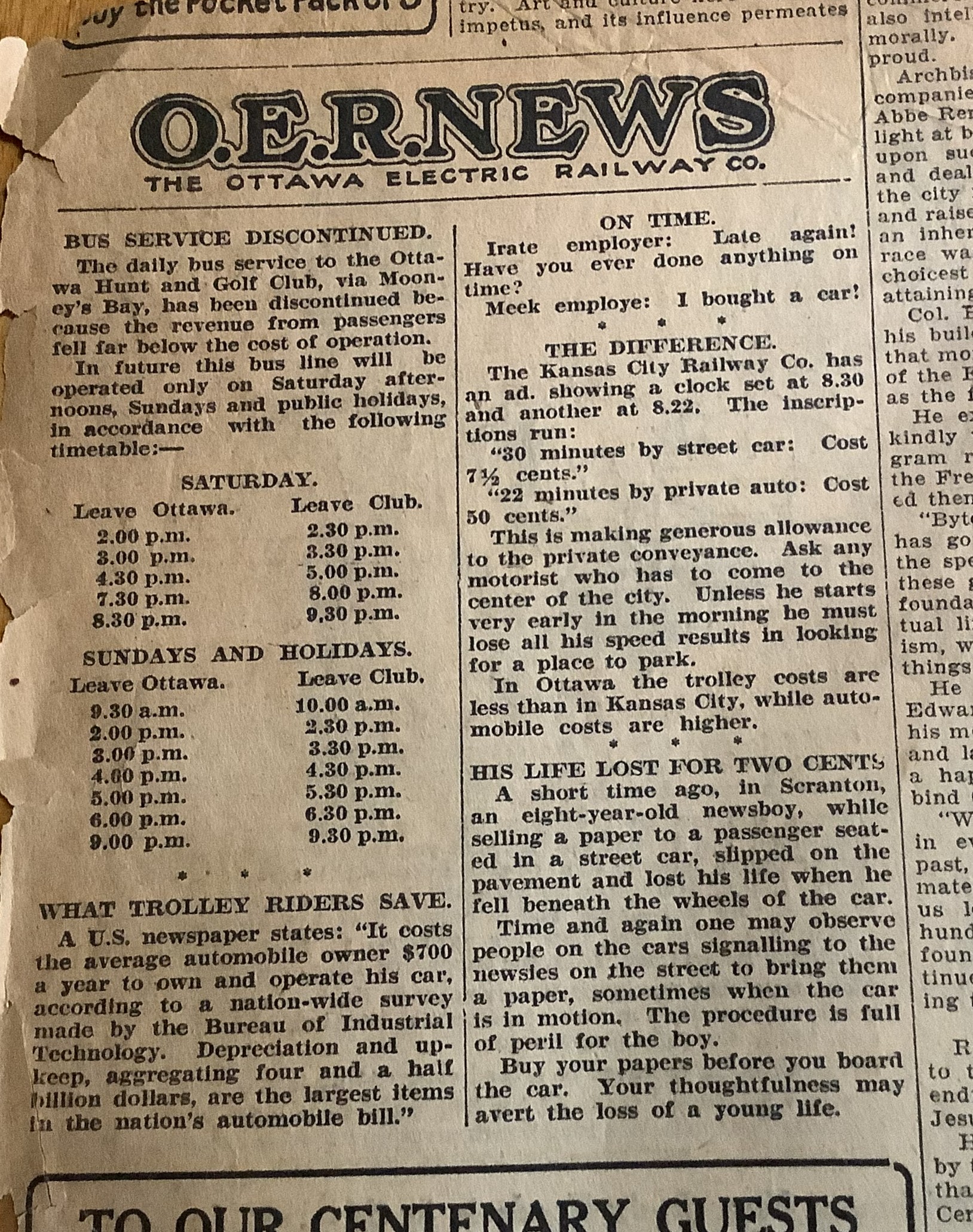
August 16, 1926
“The daily bus service to the Ottawa Hunt and Golf Club, via Mooney’s Bay, has been discontinued because the revenue form passengers fell far below the cost of operation.”
This sort of blunt announcement may have become frequent in the 1920s, as the rapid increase in automobile ownership began to precipitate a correspondingly sharp decline in street car ridership, eventually leading to the termination of Ottawa’s street car system by 1959.
In a valiant effort to reverse the trend, “O.E.R. NEWS” goes on to quote a national U.S. survey reporting that, with depreciation and upkeep “it costs the average automobile owner $700 and year to own and operate a car”.
Also quoted is a Kansas City Railway Co. ad that claims one of its main routes is “30 minutes by street car: cost 7 ½ cents” vs. “22 minutes by private auto: cost 50 cents”. The O.E.R. NEWS goes on to comment “this is making generous allowances to the private conveyance. Ask any motorist who has to come to the center of the city. Unless he starts very early in the morning he must lose all speed results in looking for a place to park.”
This unflattering verdict against the automobile is followed by the grim story of an eight-year old newsboy from Scranton, Pennsylvania who lost his life when he slid under the wheels of a car while trying to sell a newspaper to one of its passengers.
Finally, in a separate advertisement on this same page, the Ottawa Electric Railway lets potential customers know that it is now offering the services of motorized coaches, in addition to its street car service.
The late Cliff Scott wrote about the rise and fall of the Ottawa Electric Railway: www.historicalsocietyottawa.ca/publications/ottawa-stories/significant-technological-changes-in-the-city/ottawa-s-street-railways
RETAILERS HOP ON BOARD THE CENTENARY BANDWAGON
August 16, 1926
.jpeg)
Poulin’s, Max Feller, Freiman’s, Devlin’s, Fisher’s, Murphy-Gamble, Bryson-Graham and the Ottawa Beach Motor Company were among the Ottawa merchants to take out ads in this special Centenary edition.
 Max Feller.jpeg)
Devlin’s welcomes “visitors to Ottawa” to the “fair village of Colonel By”. With stores required to close Wednesday for the Centenary, Murphy-Gamble and Freiman’s advertise Tuesday-only specials.
 - Devlin's.jpeg)
.jpeg)
.jpeg)
 Murphy Gamble.jpeg)
James Powell writes about some of these icon retailers of Ottawa’s past:
todayinottawashistory.wordpress.com/2017/10/07/bryson-graham-ltd-ottawas-greatest-store/
Algonquin Anishinaabeg of the Ottawa River Valley: Yesterday, Today & Tomorrow
The year 2026 marks the 200th anniversary of the start of the Rideau Canal and Bytown – but how did this impact the Algonquin people, for whom the Ottawa Valley has been home for millennia?
Dr. Lynn Gehl makes the case that, two centuries later, we have yet to resolve crucial issues such as that our nation’s capital – the “heart of Canada” – continues to trespass on the traditional and unceded territory of the Algonquin Anishinaabeg and that the violation of Algonquin rights continues.
Additional links:
Website: www.lynngehl.com
Email: This email address is being protected from spambots. You need JavaScript enabled to view it.
Public social media: https://www.facebook.com/LynnGehlAlgonquin/
Speaking Agent: https://speakerscanada.com/keynote-speaker/dr-lynn-gehl/
The Truth that Wampum Tells: https://fernwoodpublishing.ca/book/the-truth-that-wampum-tells
Anishinaabeg Stories: https://www.amazon.ca/Anishinaabeg-Stories-Featuring-Petroglyphs-Petrographs/dp/0988157802
Claiming Anishinaabeg: https://uofrpress.ca/Books/C/Claiming-Anishinaabe
Gehl v Canada: https://uofrpress.ca/Books/G/Gehl-v-Canada
Policy Options: https://policyoptions.irpp.org/authors/lynn-gehl/
Briarpatch: https://briarpatchmagazine.com/contributors/view/gehl-lynn
Rabble: https://rabble.ca/author/lynn-gehl/
Canadian Dimension: https://canadiandimension.com/articles/author/lynn-gehl
Sentinel: https://watershedsentinel.ca/article/akikodjiwan/
The Gehl Report: https://www.lynngehl.com/indigenous-women-and-girls-with-disabilities-are-bigger-targets-of-sexual-violence.html
Media
Then & Now
Quick Links
About
Supporting Partners