

Working to preserve Ottawa's past
for future generations.
Phil Jenkins Lectures Series: The Arts in Ottawa - A Looking & Listening History
Ben WeissSorry, this event is full!
Phil Jenkins, renowned historian, author, columnist, lecturer, musician, and songwriter will explore the musical and visual arts and architectural movement throughout our city's past.
This will be a three part series, Saturday afternoons starting 1pm, at the Sunnyside Branch of the Ottawa Public Library on September 16, September 23, and October 7, 2023.
To register, visit the Ottawa Public Library website.
On Saturday June 3, 2023, members of the Historical Society of Ottawa accompanied the Gatineau Valley Historical Society on a bus trip to the Kitigan Zibi Pow Wow. Departing from Chelsea, Quebec, the bus trip stopped at the Centre Wakefield La Pêche for more pick-ups and proceeded to make its way through the vast Quebec wilderness along the Gatineau River.
Upon our arrival at the Pow Wow, we were delighted to see a very large turn out. Vehicles parked along the roads and in yards and parking lots. It was a great way for us to get in the mindset for the day ahead. As we stepped off the bus at the entrance to the Pow Wow, we were met with the sounds of people chatting and laughing, jingle dresses jingle-jangling, the smell of the rows of food vendors and, importantly a welcoming feeling.
The Kitigan Zibi Pow Wow started in 1986 as a social gathering, becoming an official Pow Wow only three years later in 1989 and after 37 years it was no surprise that this celebration has been practised, rehearsed and perfected over time.
Food vendors were the first thing we saw before continuing on into the larger dancing area, and more vendors. I can not continue without saying something about the food at Kitigan Zibi. Incredible options ranging from beans and bannock, to “Indian tacos”, to wild game, and some of the freshest, sweetest lemonade one could ask for on such a beautiful day. It is safe to say that a generous amount of time was dedicated to sampling the food from these vendors with only positive reviews.
 Photo by Ben Weiss.After making our way through the food area we were welcomed to an area with two circular sections. The outer section was dedicated to vendors selling t-shirts and hats, jewellery and crafts. The inner section was dedicated to spectators watching the various dances. The grass had been worn down clockwise as dancers expressed themselves to the sounds of the music coming from the branch-covered structure in the centre. One could feel the emotion in the sounds that flowed through the air and the energy that vibrated through the ground with every step and jump from the dancers. This continued for an indeterminable amount of time, as I was completely entranced, and followed by moving speeches from members of the Kitigan Zibi Reserve talking about the tragedy of the ever-growing number of missing and murdered Indigenous women, girls and two-spirit people. ‘Powerful’ and ‘moving’ are two words that best describe the tone of these speeches. The hurt that the speakers felt was felt by everyone listening, and the intended message was heard loud and clear. Minister of Crown-Indigenous Relations, Mark Miller was in attendance and the presence of him and his staff helped drive home the message that was being broadcast. If you or someone you know has been affected by the issue of murdered and missing Indigenous women, girls and two-spirit people, a hotline exists for those who need immediate emotional support and can be reached at 1-844-413-6649.
Later, HSO met with members of the Gatineau Valley Historical Society and their president Gilbert Whiteduck who was able to answer our many questions about the history of Pow Wows and their significance within Indigenous culture. We are thankful for the opportunity to start building a relationship with our sister society and look forward to working together in the future.
We finished our time at Kitigan Zibi watching the Grass Dances and the Jingle-Dress Dances, which were both incredible. The Grass Dances were performed by dancers in fantastic regalia with passion and reverence, and the Jingle-Dress Dancers performed harmoniously with the beat of the songs.
After a long day of fantastic food and dance it was time to head home. The bus – half silent with sleeping patrons, half noisy with excited recounts of the day – was a vessel of positive energy after our experience at the Kitigan Zibi Pow Wow. It was truly a rewarding experience and an incredibly significant piece of the history of Ottawa and the Gatineau Valley.
We would also like to thank long-time HSO member Evelyn Burke for joining us on this trip and hope she had a great experience.
Additional Info
- Year 1912
- Date July 1
The Secret Murder of Country Constable John Morrison
Ivan Tanner and Gerard Boyer of the Cumberland Township Historical Society highlight stories from Cumberland Township including the murder of County Constable John Morrison.
Media
The May Court Club of Ottawa Celebrates 125 Years & The Bytown Museum Opens for the 2023 Season
David KentOur final in-person speaker session of the year, hosted by the Main Branch of the Ottawa Public Library on May 10th 2023, featured presentations from two organizations with whom we have some past connections.
Grant Vogl has been with the Bytown Museum since 2010 and is now the Senior Manager, Collections and Exhibitions. He spoke to us about the changes that have taken place at the museum over the last couple of years and their upcoming season.
 Bytown Museum Grant explained that, like most organizations, the pandemic disrupted the plans of the Bytown Museum. Closed for their 2020 and 2021 seasons, they opened for a shortened 7 week season in 2022 and were pleased to welcome some 12,000 visitors to the museum. They are very excited to be opening this Friday, May 12, 2023 for a full season. Though mostly out of the public view, much was done behind those closed doors. Grant described the work undertaken by the museum toward Reconciliation. Working with the Algonquin communities of Kigitan Zibi and Pikwakanagan, the museum reviewed their exhibits to ensure that Indigenous perspectives are included. It is important to the museum that visitors with an Indigenous heritage see themselves, their symbols, their culture and their language represented in the displays. As such, the museum has a new mural created by Indigenous artists and has 31 new tri-lingual information panels carrying English, French, and Algonquin language explanations.
Grant also gave us a “sneak peak” into their 2023 season. The Community Gallery hosts an exhibit by artists Gary Blundell and Victoria Ward entitled “Sourcing the Canal”. The exhibit highlights the natural and human landscapes that have been created by resource development whose resources would very likely have travelled through the Ottawa River and the canal. The temporary gallery features an exhibit entitled “City in Flames: Ten Fires that (Re)shaped Ottawa “. Grant explained that Ottawa’s history and landscape have been shaped and re-shaped by fire. Prominent buildings, industrial areas, landmark businesses, homes, and indeed entire neighbourhoods have all fallen victim to flames. These destructive fires not only devastated, but also renewed, allowing for architectural growth, the evolution of the cityscape, new iconic tourism locales, the passing of new laws, and more.
The Bytown Museum and the Historical Society of Ottawa share a common ancestry, both starting by the Women’s Canadian Historical Society of Ottawa. Grant reminded us that the Bytown Museum still recognises this shared heritage by offering free admission to Historical Society of Ottawa members.
To learn more about the Bytown Museum and their 2023 season, please visit their website: bytownmuseum.ca.
We were then pleased to be joined by Donna Shields-Poë, the President of the May Court Club of Ottawa, who introduced their Past President, Nancy Pyper. Nancy is one of those who has spent her life volunteering at whatever was needed, where ever she was, having been almost everywhere across the country as a military wife. She joined the May Court Club of Ottawa in 2013 and soon found herself drafted into leadership roles with them. She started her talk by giving us some background on their founder.
 Lady Aberdeen (née Ishbel Marjorbanks) - Topley Studio / Library and Archives Canada / PA-025771Ishbel Maria Hamilton-Gordon, Marchioness of Aberdeen and Temair, GBE, was a truly remarkable person. She had been a social activist in England and Scotland promoting education, health care and women’s suffrage. So when Lady Aberdeen, who also became the Patron to the WCHSO, came to Canada in 1893 as the wife of the Governor-General and discovered that there was no social safety net or supports for women, founded the National Council of Women of Canada, the Victorian Order of Nurses and on April 30, 1898, held an elaborate garden party at Rideau Hall to which she invited young women of prominent families and challenged them to use their time and skills to provide service to those less fortunate. Thus a May Queen was crowned, her Court established, becoming the May Court Club of Ottawa, the oldest women’s service club in Canada. The May Court Club of Ottawa is one of nine now operating in Ontario.
Lady Aberdeen’s call to the young ladies of leisure to do good works was taken up then and has been equally well responded to by subsequent generations of Ottawa women. Nancy shared that there has been a transition, as the world has changed, from single women, an initial requirement for membership, to (still only) women who are now mainly retired. This has in no way dampened their enthusiasm or commitment, their most senior member, now with 66 years of service to our community, at age 93, still does her weekly shift in the Bargain Box nearly-new store. Their motto, “Enriching the lives of others as well as our own”, is clearly heartfelt and heeded.
Nancy explained that the Club has always focused their services on women, children, and the disabled and told us some of what they have done in their century and a quarter of service to the families of Ottawa. These include support to the Victorian Order of Nurses, help in and funding for hospitals, creation of an early lending library for hospital patients (now at the Civic Campus but still closed due to Covid), help to the Red Cross, operation of one of the first (1905) Tuberculosis clinics and the creation, expansion, and operation of a Convalescence Home. Doing things “The May Court way” has allowed the Club to continue to support the families in our city and the many new Canadians who now make their homes with us.
Knitting has always been a major activity of the May Court Club. Nancy told us that this continues today with items being made for sale at artisan festivals, or items such as tuques for preemies or hats for cancer patients made and given as needed. She said that during the two World Wars the Club knitted thousands of pairs of socks for our soldiers, sailors and airmen, as well as cutting fabric and doing much other work for the war effort.
Nancy explained that some confusion exists in the mind of the public between “The May Court Club of Ottawa” and “The Hospice at May Court”. When the Club closed their Convalescents Home, in 1997 after 80 years of operation, they looked for another use for their building. The outcome was a partnership between the Club and All Saints, (now Hospice Care Ottawa); the Club provides the building, looks after maintenance etc. and makes an annual donation of $100,000, but does not actually operate the Hospice. Club members do, however, volunteer their time providing some administrative and other support services.
Traditionally, with the exception of the two World Wars, the Club funded their activities through balls, galas, vaudeville shows and other social events, which were attended by Ottawa’s leading citizens. Times change and now the Bargain Box, which has been open on Laurier Avenue East for 50 years, is the major source of their funds. It survived all the closures and restrictions of the pandemic and is well supported by the local community, especially the students at the University of Ottawa, who appreciate the quality and love the prices.
Like HSO, the May Court Club of Ottawa is celebrating their 125th anniversary this spring. To mark the occasion the Club has just announced a donation of $125,000 to the Crossroads Children’s Mental Health Centre. A wonderful gift from an organization that has certainly more than net the challenge laid down to them by Lady Aberdeen all those years ago.
To learn more about the May Court Club of Ottawa, please visit their Facebook page at maycourtclubottawa or their website at maycourt.org.
On April 26, 2023, Jim Burant led us on a brisk virtual walk through the history of art in the Ottawa area. Jim was an Adjunct Professor of Art History at Carleton University as well as the Director of the Ontario Region of the National Archival Appraisal Board of Canada. He is a member of the Algonquins of Pikwakanagan, the co-curator of three major exhibitions of Ottawa art at the Ottawa Art Gallery and author of the recently published digital book, Ottawa Art & Artists: An Illustrated History, for the Art Canada Institute, with whom we were pleased to partner for this presentation. His book is the first in a series planned by the Art Canada Institute which will focus on art from a particular community in Canada. Jim pointed out that this will partially fill a gap in our understanding of art in Canada, as the two major references, Painting in Canada: A History by John Russell Harper and A Concise History of Canadian Painting by Dennis Reid, primarily reflect the work done in Montreal, Toronto, and Vancouver, making no mention of Ottawa.
Jim started us in the distant past, showing us the rock art of Mazinaw Rock in Bon Echo Provincial Park and the 77 pictographs of Oiseau Rock, many of which have been defaced by graffiti. This damage to sacred sites demonstrates a shocking disrespect for the culture and history of our Indigenous peoples. Jim explained that Indigenous artists have a long tradition of creating artifacts of cultural interest and worth. They worked with a variety of forms and materials, including baskets, copper and silver, ceramics and clothing, such as moccasins. Jim showed us a jacket made for him by his grandmother in 1969, which he still proudly possesses.
The arrival of European colonists resulted in the production of thousands of pieces of settler art that document their history. By showing us different works of similar subjects produced by different artists, Jim pointed out the importance of understanding the who, what, when, where, and why of a work’s creation, as they may have a very different take-away depending on the artist’s intent. These early works tell us a lot about Ottawa’s past as a lumbering and small industrial centre, an aspect of our city that has now vanished.
Jim explained that the selection of Ottawa as the capital in 1857 changed the nature of its art. There was an influx of artists into the city seeking patronage and employment or to teach at such organizations as the University of Ottawa and the Ottawa School of Art. There was, however, a dichotomy created between Ottawa as the nation’s capital and Ottawa as a local community. This was reflected in the fact that local politicians were content to abandon the promotion and collection of art to federal authorities. Thus, it was not until 1988 that the Ottawa Art Gallery was founded. Jim showed us a number of works by artists of the late 1800s, with a special emphasis on the work of Franklin Brownell, who Jim remarked to be his favourite.
The first half of the 20th Century brought massive changes to Ottawa. Spurred by two World Wars, there was a tremendous growth in the public service and public institutions leading to more opportunities for employment for artists and for them to display their works. Many artists found war work creating pamphlets, posters, maps and manuals. The National Film Board employed many notable artists at this time. Jim also pointed out that many well-known artists including Florence McGillivray, Fred Varley and Pegi Nicol MacLeod, who are not generally associated with Ottawa, did spend parts of their careers working here.
The second half of the 20th Century saw further developments to support the growing art community within Ottawa. These included the creation of art schools, such as the Algonquin College Art School and the Visual Arts Department of the University of Ottawa. Artists continued gathering as groups to work and exhibit together and to lobby for the creation of a municipal art gallery. Artist controlled exhibition venues such as the SAW Gallery opened, as did commercial galleries, such as the Blue Barn and the Robertson Gallery, which was among the first to exhibit Inuit art. As well at this time, art collectors, such as O. J. Firestone became prominent.
Jim also discussed the development of photography within Ottawa, starting with William Topley who ran his own studio in Ottawa from the mid-1870s to 1923. Topley is likely best known for his thousands of portraits, but he was also an innovator and a founder of the Ottawa Camera Club. Later, Yousuf Karsh came to Ottawa in 1932 and opened his studio somewhat later. He became involved in the local photographic community and the Ottawa Little Theatre. His best known work, a portrait of Winston Churchill taken in December 1941 was used on the cover of Life magazine and made him world famous. He continued to work in Ottawa into the 1990s.
In the past few decades there has been increasing interest in the works of Indigenous artists, such as Barry Ace, Rosalie Favell, Ron Noganosh, and Annie Pootoogook. As Canada has become increasingly multi-cultural and inclusive, there has been a corresponding increase in interest in works of artists from diverse cultural backgrounds.
In his closing, Jim reminded us that art challenges our notion of ourselves and allows us to see alternative points of view as we all attempt to negotiate our place in today’s Canada.
You can obtain a free download of Jim’s fantastic book on the Art Canada Institute website.
You can also see a full recording of his presentation on the video section of the HSO website.
The Role of Art & Artists in Ottawa's History
Jim Burant, author of 'Ottawa Art & Artists: An Illustrated History', takes us on a tour of Ottawa's surprising artistic past.
Media
The Historical Society of Ottawa was honoured to welcome back Dr. Jean-Luc Pilon as the featured speaker at the April 12, 2023, speaker series session, hosted by the Main Branch of the Ottawa Public Library. Dr. Pilon is a renowned archeologist, long-time curator of Central Canada archaeology at the Canadian Museum of History, an educator, and was the first recipient of the J.V. Wright Lifetime Achievement Award from the Ontario Archaeological Society.
Dr. Pilon, who had spoken to us in November 2016, led us through some of the history of archeological activities in the Ottawa area along with the views of some individuals, organizations and governments. He pointed out that Europeans immediately grasped the importance of this location, Champlain making note of it in his journal in 1613. A Royal Proclamation of 1763 offered a degree of protection to Indigenous lands west of the Appalachian Mountains, but land grants from the Crown and later questionable Crown treaties and purchases, such as the Rideau Purchase of 1819, served to strip the Indigenous peoples of their land and heritage. Philemon Wright noted the objection of the local Indigenous population as he expanded his own enterprises in the area in the early 1800s, especially logging in support of the Napoleonic Wars. Later, about 1843, Dr. Edward van Courtland, a local medical doctor, naturalist and archeologist, identified a major ceremonial and burial site in the area, collecting many artifacts from his find. Archeology, at that time, had little concept of context and would from today’s perspective be more closely associated with looting than science. In describing the site, Dr. Courtland failed to mention on which side of the Ottawa River it fell, leading to a misunderstanding about the location of his discovery that was to endure and propagate for over 170 years. Writing for the Women’s Canadian Historical Society of Ottawa in 1901, Gertrude Kenny provided an anecdotal account of the Indigenous culture that had existed in the area for hundreds of years, but provided no sources for her account. Dr. Pilon noted many others who found artifacts or provided their own interpretations.
Dr. Pilon described how the artifacts flowed to and through a series of museums including the Bytown Mechanics Institute, the Literary and Scientific Society of Ottawa, the Geological Survey of Canada, and now the Canadian Museum of History. The artifacts that have been collected in the valleys of the Ottawa and Rideau rivers have a story to tell. Implements of stone quarried from deposits in Labrador, the Hudson Bay / James Bay and New York State areas, copper from west of Lake Superior, pottery of the Middle Woodland period, virtually identical to that found in the Lake of the Woods area, speak to a broad-based and sophisticated trading network with a critical hub in the Ottawa / Gatineau area that had been active for more than 4,500 years before the arrival of European settlers. The meeting of the Gatineau, Rideau, and Ottawa rivers made this an ideal location for the exchange of goods and ideas, while the presence of the Chaudière Falls, also known as Akikodjiwan, made this a significant spiritual location as well.
During excavations associated with the renovation of the Centre Block of the Parliament Buildings, a stone knife, dated between 2,500 and 4,000 years old was discovered. The knife has been returned to the stewardship of the Algonquin Anishinabe peoples and it is expected that it will be displayed in the Center Block when it reopens.
Dr. Pilon reminded us that as we think about our city, we must remember that this was a center of commerce and culture for thousands of years before anything we see today.
Following Dr. Pilon’s presentation, we were privileged to be joined by several students from Anishinàbe Odjìbikan. Anishinàbe Odjìbikan is an Indigenous Archaeological Field School that provides First Nations students from Pikwakanagan and Kitigan Zibi the phenomenal opportunity to take part in archaeological digs along the shorelines and uncover and better understand their own ancestral past. Jenna and Kyle gave us some background to their program,. Planned in 2019, it, like most things, was delayed by Covid. In 2021, 8 students, 4 from each community participated, while in 2022, 16 students, 10 from Kitigan Zibi and 6 from Pikwakanagan took part. Their hope is to continue the program for at least another three years. The program has strong support from the communities, financial support from the federal government and archeological mentoring from the National Capital Commission. It is hoped that some financial independence can be achieved through access to bid on government contracts.
Jenna and Kyle explained some of the differences between their approach and that of traditional archeology, which has largely ignored First Nation’s voices and their traditional knowledge. They explained that while recovering their own people’s artifacts, they adopt appropriate cultural practices, such as ceremonies to thank the land for its care of the items before and after their recovery and the renewed use of the recovered items as they had been originally intended. In recovering the artifacts, the students and their communities recognize that they are also recovering their own heritage, allowing them their own interpretation not one from a colonial perspective. These artifacts also provide an undeniable proof of the occupation of this land by indigenous peoples for thousands of years before the arrival of the first colonists.
Jenna and Kyle expressed the urgency of their undertaking. Climate change, high water levels and urbanization are damaging and destroying potential sites. They see this program as critical in providing the skills and trained individuals needed to perform the work ahead.
Following their presentation, the students displayed a number of the artifacts they had uncovered and responded to many questions posed by audience members who came down to the stage for a closer look and a chat.
This in-person session, the most popular this season with over 90 people attending, left all of us with a thirst to learn more about the earlier history of the land on which we live and the peoples to whom it belongs.
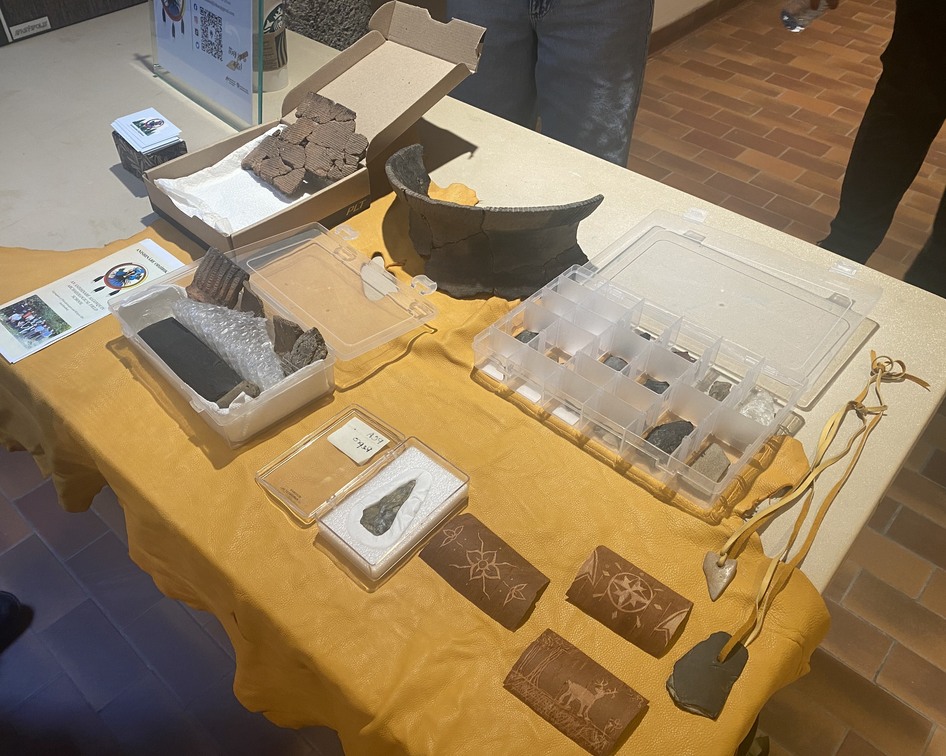 Artifacts presented by Anishinàbe Odjìbikan.
Dr. Jean-Luc Pilon has shared this excellent video, a guided tour as he explores the heart of our region: Paddling through the past - Ottawa-Gatineau's Ancient Cultural Landscape.
For thousands of years before colonial times, the members of Indigenous communities travelled from far and wide to gather at the meeting of the three rivers: the Ottawa, the Gatineau, and the Rideau; from the Chaudière Falls to the mouth of the Gatineau River.
This area is rich in natural resources — plants, animals, and fish, and also provided a convenient meeting place for trade and communication among communities.
Of special significance are the burial place at Hull Landing and the Chaudière Falls, a sacred place for meeting and sharing in ceremonies.
The burial grounds in the Ottawa-Gatineau corridor including Hull Landing were important for rituals of respect and bonding with the landscape. Victoria Island, located under the Portage Bridge, continues to provide this sacred space to local and visiting Indigenous people.
The National Capital Region, which includes the city of Ottawa, remains unceded Algonquin-Anishnaabeg territory.
We encourage our members and guests to reflect on this, our connected history, and ways we can contribute to reconciliation.
 Charles Ramus Forrest Chat Falls, Lake Chaudière on the Ottawa 1822
Source: HSO Member Margaret Back’s summary of Canadian Museum of History Archeologist (retired) Jean-Luc Pilon’s April 2017 presentation to our Society.
WCSHO Scrapbooks
Check out the Ottawa University project that digitized and analyzed selected scrapbooks from the Women's Canadian Historical Society of Ottawa: Scrapbooking Ottawa Historytemporarily unavailableScrapbooking Ottawa History.
Annual Reports
Several years of annual reports from the Women’s Canadian Historical Society of Ottawa (WCHSO), the precursor to the Historical Society of Ottawa, are available via the Internet Archive:
Women’s Canadian Historical Society of Ottawa: Annual Report 1910-11
Women’s Canadian Historical Society of Ottawa: Annual Report 1913-14
Women’s Canadian Historical Society of Ottawa: Annual Report 1914-15
Women’s Canadian Historical Society of Ottawa: Annual Report 1915-16
Women’s Canadian Historical Society of Ottawa: Annual Report 1916-17
Women’s Canadian Historical Society of Ottawa: Annual Report 1917-18
Women’s Canadian Historical Society of Ottawa: Annual Report 1918-19
Women’s Canadian Historical Society of Ottawa: Annual Report 1919-20
Women’s Canadian Historical Society of Ottawa: Annual Report 1920-21
Women’s Canadian Historical Society of Ottawa: Annual Report 1921-22
Thesis
In 2016, Connie Gunn wrote an incisive thesis regarding the WCHSO’s early decades. In her paper, Gunn credited the diligence of our early members in creating a personal, nuanced and meaningful depiction of our area’s history.
Gunn also noted how the fact that our early members were drawn from the elite, often with ancestral ties to the area, inevitably shaped their interpretation of history.
Empire and colonial society were frequently revered and romanticized. Clearly, certain issues (such as the residential school system, with which some of their husbands were closely connected) might have been worthy of greater attention.
As the first few decades passed, Gunn noted the eventual diversification of the WCHSO’s membership, and also a diversification of the Society’s storytelling, including more emphasis on some of the women of history.
See this link to view the full text of Connie Gunn’s detailed study of the contributions as well as shortfalls of our well intentioned founders and early members:
Transactions of the Women’s Canadian Historical Society of Ottawa
Transactions of the Women’s Canadian Historical Society of Ottawa - by Emma Kent
Between 1901 and 1928, ten volumes of articles or transcripts of talks presented at Women's Canadian Historical Society of Ottawa meetings were published under the series of 'Transactions’. According to the AGM reports the first 8 volumes appear to have titles and themes with this practice being dropped for the last few volumes. A reprint of Volume One was issued after Volumes Six and Seven. Under the presidency of Margaret Wilson, an eleventh volume was published in 1954.
Currently, we only have a few volumes that cannot scan the entries without destroying our copies. Still, for those interested in using the articles for research, here is a list of what each volume contains, any notes added by the Society, and we could provide photos of the article’s text upon request.
Volume One - “Early History of Ottawa and Counties”
Volume Two - “The Water Ways of Canada”
Volume Three - “ Early History of Ottawa and Hull”
Volume Four - “Early History of Townships, etc.”
Volume Five - “The Battlegrounds of Canada” - 1912 - Printed in Ottawa by The Esdale Press, Limited. C or Kent and Sparks Sts. Engravers, Printers ETC.
Page 5 - The Plains of Abraham by Mrs. Wilfred Campbell.
Paper read before the Women’s Canadian Historical Society of Ottawa, February 9th, 1912.
Page 19 - The Battlegrounds of Niagara Peninsula by Mrs. Thomas Ahearn
Paper read before the Women’s Canadian Historical Society of Ottawa, November 1909.
Page 37 - Battle of the Windmill, 1838 by Miss Amey Horsey
Paper read before the Women’s Canadian Historical Society of Ottawa,
Page 43 - Battles of St. Denis and St. Charles by Miss Kathleen O’Gara
Paper read before the Women’s Canadian Historical Society of Ottawa, January 14th, 1910.
Page 51 - Siege of the Long Sault by Miss Magdalen Casey
Paper read before the Women’s Canadian Historical Society of Ottawa, February 10th, 1911.
Page 61 - Battlegrounds of the North-West Rebellions by A.E. Attwood
Paper read before the Women’s Canadian Historical Society of Ottawa, December 9th, 1910
Page 71- The Heroine of Vercheres by Mrs. Walter Armstrong
Paper read before the Women’s Canadian Historical Society of Ottawa, January 13th, 1911.
Page 80 - Madame de la Tour by Miss M. A. Northwood
Paper read before the Women’s Canadian Historical Society of Ottawa, January 12th, 1912.
Page 89 - Louisburg - its two Sieges by Miss Eva G. Read.
Paper read before the Women’s Canadian Historical Society of Ottawa, March 8th, 1913.
Page 96 - The Hero of Chateauguay by Madame S. Lelievre
Paper read before the Women’s Canadian Historical Society of Ottawa, March 12, 1909.
Volume Six - “Treaties Relating to Canada, 1632 - 1872” - Printed in 1915
Page 5 - Forward on the General Subject of Treaties.
Being the Introduction to Mrs, Bayly’s Paper on “The Treaty of Paris,” the first of the series as arranged to be given before the Society.
Page 11 - St. Germain-en-Laye.
A Treaty between Lewis XIII King of France and Charles I King of Great Britain the Restitution of New France, Acadis and Canada, and the Ships and Merchandises taken on Both Sides, March 29, 1632.
Page 25 - The Treaty of Breda (1667) - Rysmick (1697)
(Page 25) Treaty of Ryswick, 1687.
(Page 31) Treaty of Ryswick, 1697.
(Page 37) Treaty of Breda, 1667.
(Page 38) Treaty of Ryswick, 1697.
Page 40 - Treaty of Utrecht by Cordelie E. Rheaume given on March 12th, 1915.
Page 46 - Treaty of Aix-la-Chapelle, 1748. By Alice B. Lelievre .
Page 52 - The Treaty of Paris, 1763 by E.D. Bayly.
Page 62 - Treaty of Versailles, 1783 by Jenny Russell Simpsom
Page 73 - Treaty of Ghent by Muriel G. Shortt. Given on Dec 12th, 1913.
Page 84 - The Ashburton Treaty by Hazel Biggar given in January, 1914.
Page 92 - Treaty of Washington, 1871 by Edith M. McLean given on March 14, 1913.
Page 104 - Reciprocity Treaty of 1854 by Agnes M. Davis given on February 13th, 1914.
Page 113- Some Confederation Reminiscences of the Hon. Senator Costigan by his daughter Teresa Contigan Armstrong Given on March 10th, 1914.
Reprint of Volume One
Volume Seven - “Historical Collection”
Page 5 - Reminiscences of Bytown by Mrs. Jenny Russell Simpson
Read before the WCHSO on Feb 11th, 1916.
Page 12 - Toronto University by Helen McLean of 292 Daly Ave, Ottawa
Read before the WCHSO on March 10th, 1916.
Page 16 - The Settlement of the Country of Lennox and Addington by Mrs. Annie Rothwell Christie
Page 26 - My Native County - Glengarry by Mary Gerenish H. Foran - December 10th, 1915
Page 38 - The Cairn by Mary Masson
Page 42 - Nova Scotia by Alberta T. Somerville
Page 59 - The History of Canada in Sixty Lines by T. Chisholm, M.D., ex-MP and read before the WCHSO by Mrs. Simpson, Nov 10, 1917.
Volume Eight - “Personal Recollections of Bytown and Early Ottawa”
Page 5 - Philemon Wright and the Settlement of Hull by Hon. Justice Latchford.
Read February, 1921 before the WCHSO.
Page 20 - Notes on some of the Prominent Citizens of the Early Days of Bytown by Leopoldine Beauchamp Pigeon.
Page 23- Bytown to Ottawa, 1827- 1877 by William Pittman Lett.
Short Panoramic View of Ottawa History, Written in its Jubilee Year by William Pittman Lett, City Clerk.
Page 34 - Reminiscences - How Peace was Preserved in the Days Gone by.
This paper, read some years ago before the Perth Historical Society, has been presented to the WCHSO by Miss Clara B. Armstrong, Perth, Ont.
Page 38 - Bytown in 1837. By H. P. Hill
Page 52 - Bytown Election of 1841 by H.P. Hill
Page 63 - Memories of Bytown by W.H. Cluff - January 1920.
Our First Telegraph Line (page 68)
Road from Upper Town to Lower Town (page 69)
Freight and Passengers in the Old Days (page 72)
The Military Graveyard (page 74)
The High Cost of Living in the 1840’s and 50’s (page 74)
When the Spark Estate was put on the Market (page 75)
Page 77 - History of The Ottawa Fire Department - Showing its development with the Growth of the city, from its Earliest Volunteer Organization up to the Present Time by John W. Graham, Chief Fire Department.
Page 89 - A Glimpse of the Capital in 1849 by Marion Jamieson
Page 94 - On Early Patents for Inventions Granted to the Residents of Ottawa by William J. Lynch, I.S.O., Chief of the Canadian Patent Office.
Volume Nine - 1925
Page 5 - Bytown, 1834 to Ottawa, 1854 by George R. Blyth.
A copy of the reminiscences of Mr. Geo R. Blyth of the City of Ottawa. They were given to Mrs. Ells of the committee appointed to collect the memories of old residents of the City. - M. A. Northwood, Secretary of the Committee.
Page 16 - Burning of the Parliament Buildings at Montreal in 1849 by J.Jones Bell
Page 21 - The Chelseas on the Gatineau by Mary MacKay Scott
Page 26 - Early Settlements of the Meach Lake by Ethel Penman Hope
Page 34 - The First Missionaries of Hull by Louise Belisie
Page 40 - Hugh Macdonell by Kate Casgrain
A United Empire Loyalist of the Revolutionary War, 1775-83 (Lieutenant, 1st Battalion, Kings’ Royal Regiment of New York). M.P. for Glengarry in the first Parliament of Upper Canada, Volunteers Regiment of Foot, 1796-1802. First Adjutant-General of the Militia in Canada and founder of the Militia system, 1792-9. British Consul- General at Algiers, 1811-1820.
A great record of splendid service of a pioneer Canadian and his family.
Page 48- Castine by Lucienne C. Roy
Page 56 - The Founder of Toronto by Lucienne C. Roy
Page 59 - The Duke of Kent and a Famous Minuet by Lucienne C. Roy
Page 61 - The Colours of the Fenian Invasion, 1870 by Luceienne C. Roy
Page 62 - The Indian Chapel of Tadoussac by Edith M. Maclean
Page 67 - A Social Life in Old Quebec by Edith M. Maclean
Page 79 - The Fur Trader’s Better Half by Lawrence J. Burpee
Page 91 - Sir William Johnson by Mary Garenish H. Foran
Page 98 - Some Canadian Women of 1812-14 by Ernest of Green
An Address delivered before the Society in the Bytown Museum, December 14th, 1923.
Page 110 - Experiences in the Yukon, 1901 by O.P.R Ogilvie
At the conclusion of the paper, about thirty-five very attractive pictures of the Yukon were shown.
Page 116 - The Iroquois, An Historical and Ethnological Sketch by F. W. Waugh, Division of Anthropology, Geological Survey.
Page 126 - The Naskopi Indians of Labradors and their Neighbors by F. W. Waugh, Division of Anthropology, Geological Survey.
Page 137 - The Eskimos, Their History and Future by D. Jenness
Paper read before the Women’s Historical Society, January 12, 1923.
Page 142 - Indian Legends From Vancouver Island by Edward Sapir
Then Dr. Sapir then gave two interesting examples of the type of myths and legends prevalent among the Nootka Indians of Vancouver Island. He read his own literal translation of a myth entitled: “What Mosquitoes Are Made Of” and a legend “Always-Lifts-Up” and “Sore-Headed Whales”. These valuable examples of Indian folk-lore are in the Articles of the Museum and may be seen and read on request.
Volume 10
Page 5 - Ottawa. 1867-1927. Something of her history during the sixty years since Confederation by Mrs. C. H. Thorburn
Written for and read before The Women’s Canadian Historical Society of Ottawa, February 10th, 1928, by Mrs. Charles H. Thornburn.
Page 30 - North West Rebellion. By Grig-Gen. General C. F. Winters
January 9th, 1926.
Page 39 - Governors of Canada by C.A. Gullock
Page 55 - Lecture on the Choice of Ottawa as the Capital of Canada by Mr. Arthur Beaucheane, M.A., F.R.S.C, Clerk of the House of Commons.
Page 62 - The Celebration of the Diamond Jubilee of Confederation by C.G Cowan, Honorary Secretary of the National Diamond Jubilee Committee, Ottawa, September, 1927
Page 74 -The Peace Bridge and Confederation Celebration Elsewhere in Canada by Eva G. Read
Page 84- Some Historic Buildings in Ottawa by Mary McKay Scott
Paper read before The Women’s Canadian Historical Society of Ottawa, Jan. 13, 2028.
Page 93 - Early British Canadian Heroines by Mrs. J.R. Hill
Page 94 - Mrs. Susanna Moodie.
Page 99 - E. Pauline Johnson, condensed from “Flint and Flatter”
Page 102 - Barbara Heck From Barbara Heck by Dr. Withrow
Page 114 - Some Pioneer Women of French Canada by Mrs. G. J. Desbarats
Read at the Meeting of The Womens’ Canadian Historical Society of Ottawa, Friday, January 14th, 1927.
Page 136 - The First State Trail in Lower Canada by Col. Rene de Salaberry
Page 147- Sketch Life of Thomas D’arcy McGee by Mrs. E. J. Doyle
Page 152- The First Jesuit Mission of Fort Ste. Marie by Mrs. E.J Ashton
Read before the Women’s Canadian Historical Society of Ottawa.
Page 163 - Canadian Art and Artists by Mrs. O.J. Jolliffe
Page 170- Canadian Unity ad Quebec by Dr. S. Marion
Volume 11 - 1954 - Printed by Leclerc Printers Limited, Hull, Canada
Page 5 - The Bytown Museum
Page 7 - Side-lights on the Ottawa-Rideau Waterway to Upper Canada by Thomas Dunbabin
Page 17 - Sarah Olmstead by Brigadier R.M. Gorsline
Page 20 - St. James Anglican Church, Hull, Quebec by Annie M. Findlay Fee
Page 24 - John Burrows Honey (An Early Resident of Bytown) by Dr. H. T. Douglas
Page 27 - The Last Days of Bytown by Anne Dewar
Page 37 - The Choice and Acceptance of Ottawa as the Capital of Canada by Sheila I. Stewart
Page 42 - Ottawa in the Seventies by Lieutenant-Colonel C. P. Meredith
Page 46 - My Recollections of Laurier House by Lilian Scott Desbarats
Page 51 - The History of the Blue Church by Barbara Jones
Page 55 - A Pioneer Community in Beckwith Township, Lanark County Upper Canada 1818 Locally Known as “The Derry” by Bertram Reid MacKay
Page 63 - Terminal Note
Historical Reflections Relating to the War by Sir Clifford Sifton, K.C.M.G, P.C, K.C. Chairman of Commission of Conservation Canada - November 4th, 1915.
- Address delivered by Sir Clifford Sifton under the auspices of the Women's Canadian Historical Society of Ottawa, November 4th, 1915
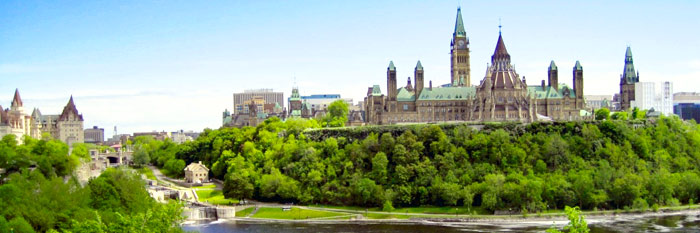
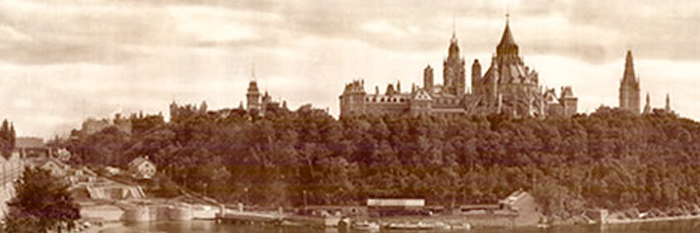
Then & Now
Quick Links
About
Supporting Partners