

Working to preserve Ottawa's past
for future generations.
Additional Info
- Year 1857
- Date December 31
Additional Info
- Year 1965
- Date December 5
Discoveries Unearthed Prior to the Renovations on Parliament Hill
Historical Society of OttawaWow! Did you miss our virtual Speaker Series presentation "Uncovering Canada's Past: Digging Up Parliament Hill" with Stephen Jarrett? What an amazing presentation it was!
The good news is... here is the video link to enjoy Stephen's talk in its entirety!
Our apologies to those who were unable to attend Stephen's presentation due to Zoom's 100 attendee limit. We had processed the request to increase attendance but we seem to have experienced a technical glitch.
We're so sorry! The November 2020 presentation was our third foray into the new world of virtual talks and we're still learning the ropes. We hope you enjoy this recorded version of this excellent talk:
We’ve all been obligated to face many new challenges this year, and it was with some concern that the Historical Society of Ottawa chose to make a transition to on-line meetings so that we can continue to reach out to our members and the community during this difficult time. We weren’t certain how well the transition would go. Perhaps people might pass on HSO presentations if they were to be presented via computer. However, for our second online lecture we gathered 86 participants. That compares favourably to some of our most well-attended live meetings.
Our October guest speaker is no stranger to on-line communication. As a part-time teacher at the University of Ottawa, Jo-Anne McCutcheon has been working with her students through Zoom since COVID restrictions began.
Jo-Anne talked about the many resources available to students, historians, genealogist and researchers online. Her presentation, which you can watch anytime at the HSO website, shows how to link to newspapers (current and historical), photo galleries, documents, academic papers, and records of meetings of Parliament. Jo-Anne’s presentation walks you through the process of creating your own files for storing information and even adding and sharing your own content.
You may be surprised to find out just how much is out there to help you do research or just surf the web for sites with unique, authentic historical content. In this HSO presentation, Jo-Anne has picked out some of her favourite sites and shows how to take advantage of their features.
You can link to Jo-Anne’s presentation by visiting our website, and choosing Videos on the ‘Resources’ tab.
The September 14th 2020 presentation of the Historical Society of Ottawa took us on two journeys. One was to the Middle East; but more on that in a moment. The other journey was shorter in distance but was a big step technologically. With recent social restrictions forcing us to cancel live presentations at the Main branch of the Ottawa Public Library (for the time being) our Regular Events coordinator, Ben Weiss, asked guest speaker Michael Kent if he’d be interested in making a presentation online through a video conferencing application called Zoom, so that HSO members and the community could link in and make the journey half way around the world from their own home.
And so HSO hosted its first on-line lecture. Fortunately, Michael’s presentation included a number of videos, so the digital platform was perfect. (Zoom allows presenters to show photos, videos, and slides.) This allowed Michael to tell about his personal research of ancient Hebrew texts from Canada’s own large collection at Library and Archives Canada, here in Ottawa, as well as the many efforts being made around the world to reconstruct ancient texts that survive often only as small shards of paper; sometimes with only a few words, or even a few letters. It’s like putting a puzzle together when many of the pieces are blank.
While international in scope Michael also talked about, and was asked questions about, Jewish artifacts from Ottawa. There are a number of active synagogues in Ottawa today, including the beautiful and historic Adath Jeshurun Synagogue on King Edward Avenue, but others, like the Machzikei Hadas Synagogue on Rideau Street are gone. Fortunately texts from many old synagogues, Talmud schools, and homes survive and have been catalogued by Library and Archives Canada. Ancient books are still being reconstruction in Cairo today from pieces found in Egypt decades ago.
One advantage of online presentations is that they can be recorded and played back later. This allows those unable to participate live to watch later. So if you think you’ve missed Michael’s presentation, you haven’t! You can watch it now by going to our website at www.historicalsocietyottawa.ca and choosing the ‘Resources’ link on the top toolbar. On the drop-down box, choose ‘Videos’ and you can watch this and other presentations.
Additional Info
- Year 1949
- Date November 18
Additional Info
- Year 1893
- Date November 2
Additional Info
- Year 1835
- Date October 20
Additional Info
- Year 1880
- Date October 2
Élisabeth Bruyère: Caring and Daring Bytown Pioneer
Sister Louise Charbonneau, SCOVenerable Élisabeth Bruyère — 175th Anniversary
Gravely needed in Bytown, Élisabeth Bruyère (aged 26) and her small entourage of young Grey Nuns bravely journeyed the frozen Ottawa River by sleigh from Montreal.
Within three months of their arrival in rugged Bytown, Mother Bruyère and her group had founded a school, a general hospital, a home for the aged and an orphanage; and within another two years Mother Bruyère and the sisters would defy the risk of deadly contagion and tend to the sick as Bytown found itself in the midst of a severe typhus epidemic.
Mother Élisabeth Bruyère was a woman with a caring and compassionate heart and of daring faith. She founded the first congregation of religious women in the Archdiocese of Ottawa, the Sisters of Charity of Ottawa (also called Grey Nuns of the Cross until 1968).
Élisabeth Bruyère was born in L’Assomption, Que., on March 19, 1918. Her father died when she was six years old. She spent her childhood in Montreal where her mother became a household servant to earn a living for her family. Élisabeth was educated by the Sisters of the Congregation of Notre Dame.
Spiritual Daughter of Marguerite d’Youville
In 1839, Élisabeth, attracted by Saint Marguerite d’Youville’s charisma, entered the Congregation of the Grey Nuns of Montreal. In 1841, she pronounced her vows of religion; for the next four years, she was given the responsibility of educating 40 young orphan girls.
Her remarkable qualities were admired by her Superiors who chose her as the founding Superior of the mission in Bytown.
Arrival in Bytown: Founder by the Will of God
Astonished to receive this assignment, Sister Élisabeth Bruyère saw in this nomination the expression of God’s will. On February 19, 1845, she left with three professed Sisters, 1 postulant and 1 aspirant. On February 20, 1845, they arrived in Bytown where the caring and daring Bytown pioneer’s mission of love, service and compassion began.
Absolute Trust in Providence
Grace nurtured faith which led Mother Bruyère to seek God’s will. Her unconditional trust in Divine Providence opened her hands to all those in need. Pain never failed to resonate in Mother Bruyère’s caring heart as she reached out to everyone the Lord placed on her path.
Heroism of Charity
Mother Bruyère’s daring faith never failed her. The Sisters’ accomplishments went far beyond the imaginable, given their meagre resources. Barely 3 months after the Sisters’ arrival, the first bilingual school in Eastern Ontario, a General Hospital (today Bruyère Continuing Care), a Home for the Aged, an orphanage and a home for foundlings came into existence.
Mother Bruyère was a woman of heroic charity. During the typhus epidemic of 1847, 17 of the 22 Sisters contracted the disease while caring for the Irish immigrants, but none of them died. The same heroism was manifested during a smallpox epidemic in 1871.
No one wanted to care for the victims; the Sisters secretly set up a “lazaretto” in the convent yard. For over two years, 5 Sisters and 2 aides lived in isolation to care for the contagious patients.
Specific Charism
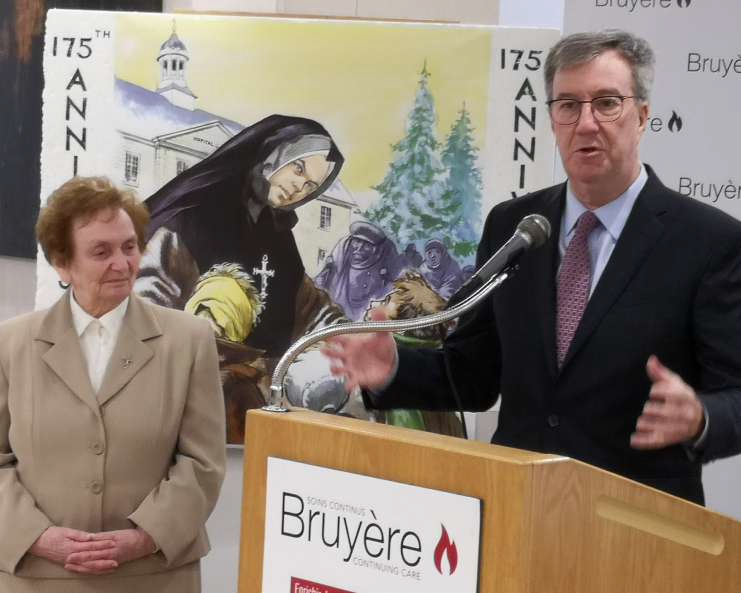 Alongside Sister Rachelle Watier, Superior General of the Sisters of Charity, Ottawa Mayor Jim Watson declares Mother Élisabeth Bruyère Day on February 25, 2020, during a ceremony at the Bruyère Hospital in Lowertown. Bruyère’s arrival in Bytown in 1845 marked the beginning of organized healthcare in the city.Spiritual daughter of Saint Marguerite d’Youville, “Mother of Universal Charity”, Mother Bruyère sowed the seed of this legacy in the hostile soil of Bytown. Incarnating Marguerite d’Youville’s charism of compassion for the poor, she added a new dimension: education, a priority need in Bytown. The Congregation’s distinctive character gradually became evident: on the one hand service to the poor, the forsaken, the suffering; and on the other hand, education adapted to all levels of society and to all human needs.
A Caring and Daring Bytown Pioneer
Mother Bruyère’s pastoral initiatives responded to the urgent needs discerned in Bytown: classes for the children and for mothers, home visits to the poor and the sick, assistance to the dying. During the epidemic, she did not hesitate to bury the dead. She paid close attention to the repentant wayward girls, opened St Raphael’s house for immigrants and regularly visited prisoners. Sensitive to the spiritual needs of the Church and to the social needs of the citizens of Bytown and beyond, she opened new houses, not only in Ontario and Quebec, but also in the U.S. so as to provide schools for the Franco-American population.
Mission Well Accomplished
For 31 years Mother Bruyère was a witness to the Father’s tender love while also bearing the responsibility for her young Congregation. At the end of her life, she said: “All was blessed by God because all has been accomplished in conformity with His Holy Will.” (Dec 24, 1875). Mother Bruyère entered eternal rest on April 5, 1876; she was 58 years old.
The Sisters of Charity of Ottawa Continue her Mission
The seed planted by Mother Bruyère in Bytown has grown to full stature and the small community of 1845 has extended its branches widely. Faithful to the spirit of their caring and daring Founder, the Sisters of Charity of Ottawa continue her mission, her charism and her spirituality.
They join their charism of compassion to the evangelization mission of the Church, happy to be witnesses of God’s tenderness and messengers of hope and salvation. Daughters of the Church, they go to the peripheries to share the Good News in Canada, the U.S., Lesotho, Republic of South Africa, Malawi, Zambia, Brazil and Japan.
Conclusion
Mother Bruyère’s life was a true quest for God. She entrusted herself fully to the Providence of God, the Eternal Father. The process toward Mother Bruyère’s Canonization opened in 1978. Her entire life of service and of compassion was a function of her faith, hope and love of God. She was found to demonstrate these virtues in a heroic manner. On April 14, 2018, His Holiness, Pope Francis declared the Servant of God, Mother Élisabeth Bruyère, to be Venerable, thereby opening the path to her eventual Beatification and Canonization … in God’s good time. Venerable Mother Élisabeth Bruyère, intercede for us.
Quick Links
About
Supporting Partners