

Working to preserve Ottawa's past
for future generations.

Super User
The 1939 Royal Visit
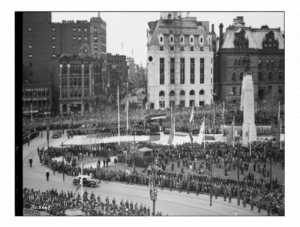
19 May 1939
In early May 1939, King George VI and his wife Queen Elizabeth sailed from England on the Empress of Australia bound for Canada on a month-tour of North America. It was the first visit by a reigning sovereign to Canada, for that matter to any overseas Dominion. It was also the first time that a British monarch had visited the United States of America. With the clouds of war darkening Europe, the tour had tremendous political significance as Britain sought allies in the expected conflict with Nazi Germany. Lesser known is the constitutional significance of the trip, with the King visiting Canada, not as the King of Great Britain, but as the King of Canada.
Lord Tweedsmuir, Canada’s Governor General, raised the possibility of a Canadian Royal Tour in early 1937, with Prime Minister Mackenzie King extending the official invitation while he was in London for the King George’s coronation in May of that year. Tweedsmuir, also known as John Buchan, the famous Scottish novelist, was a passionate supporter of Canada. He sought to give substance to the Statute of Westminster. The Statute, passed in Britain in December 1931, effectively gave Canada its autonomy, recognizing that the Canadian government was in no way subordinate to the Imperial government in either domestic or international affairs, although they shared a common allegiance to the Crown. At a time when many Canadians saw their first loyalty as being to the Empire, Tweedsmuir hoped that a Royal Tour of Canada would strengthen a still nascent Canadian nationalism. He believed that it was essential that King George be seen in Canada doing his kingly duties as the King of Canada rather than a symbol of Empire. Earning the ire of Canadian imperialists, Tweedsmuir publicly stated that “A Canadian’s first loyalty is not to the British Commonwealth of Nations but to Canada and Canada’s King.” When U.S. President Roosevelt heard that a trip to Canada was being planned for the royal couple, he extended an invitation to the King and Queen to come to the United States as well, writing that a visit would be “an excellent thing for Anglo-American relations.”
Although the British Government was supportive of a North American Royal Tour, the trip was delayed for almost two years owing to the political situation in Europe. When the decision was finally made to proceed in the spring of 1939, the original plan to use a battleship for the transatlantic voyage was scrapped in favour of a civilian ocean liner in case the warship was needed to defend Britain. Even so, the trip was almost stillborn given deteriorating European political conditions. The cruisers HMS Glasgow and HMS Southampton provided a military escort for the King and Queen. The two vessels also secretly carried fifty tons of British gold destined for the Bank of Canada’s vault on Wellington Street, out of reach of Germany, and ready to be used to buy war material and other supplies, from Canada and the United States.
After taking leave of their daughters, the Princesses Elizabeth and Margaret Rose, at Waterloo Station in London, the royal couple made their way to Portsmouth where they met the 20,000 ton Empress of Australia. Delayed two days by heavy seas and fog, the gleaming white ship received a rapturous welcome on its arrival in Québec City on 17 May. In the days before the Quiet Revolution, the Crown, seen as a guarantor of minority rights, was held in high esteem in French Canada. More than 250,000 people crammed onto the Plains of Abraham and along the heights overlooking the St Lawrence to greet the ocean liner, and for a glimpse of their King and Queen. The crowds roared Vive le Roi and Vive la Reine as the King and Queen alit on Canadian soil for the first time at Wolfe’s Cove. A National Film Board documentary covering the event described King George as the “symbol of the new Canada, a free nation inside a great Commonwealth.”
The royal couple was greeted by federal and provincial dignitaries, including Prime Minister Mackenzie King and Quebec Premier Maurice Duplessis, as well as an honour guard of the francophone Royal 22nd Regiment—colloquially known in English as the Van Doos—that escorted them through the crowded, flag-bedecked streets of old Québec to the provincial legislature building. There, the King and Queen were officially welcomed, with the King replying in both English and French in the slow, deliberate style he used to overcome his stammer.
The King and Queen spent two days in la belle province, also stopping in Trois Rivières, and Montreal before making their way to the nation’s capital. By one estimate, two million people were on the streets of Montreal to greet the monarchs. Their luxurious blue and white train, its twelve cars each equipped with a telephone and radio, stopped beside a reception platform located on Ottawa’s Island Park Drive at about 11am on 19 May. Despite the cold, inclement weather—drizzle and what suspiciously looked like snow—tens of thousands had assembled to greet the King and Queen. Many had gone early, either to the train station, or to find a viewing spot along the processional route. At morning rush hour, downtown Ottawa was deserted “as though its entire population had been mysteriously wiped out overnight” according to the Ottawa Citizen. In actual fact, the city’s population had doubled with many coming from outlying areas to see the King and Queen. Thousands of Americans had also come north to witness history in the making.
Descending from the train onto a red-carpeted platform under a canopy draped with bunting, King George and Queen Elizabeth were met by Lord and Lady Tweedsmuir, Prime Minister Mackenzie King, members of cabinet who were not presented at Québec City, and Ottawa’s mayor Stanley Lewis. A 21-gun salute was fired by the 1st Field Battery of the Royal Canadian Artillery to honour the sovereigns’ arrival. Church bells began pealing. With the clouds parting, the royal party, accompanied by an escort of the 4th Princess Louise’s Dragoon Guards, rode in an open landau from the Island Park Station through the Experimental Farm, along Highway 16, down the Driveway to Connaught Place, and finally along Mackenzie Avenue and Lady Grey Drive to Rideau Hall, the home of the Governor General. Along the route, the royal couple was greeted by a continuous rolling applause by the hundreds of thousands that line the eight-mile route.
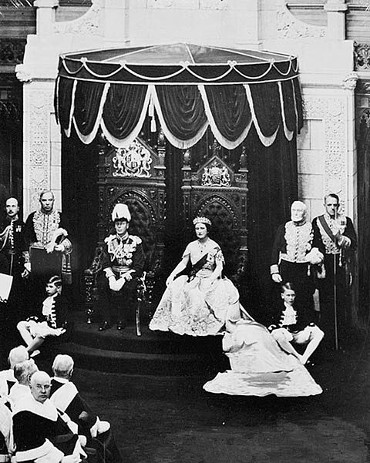 King George VI and Queen Elizabeth in Canada's Senate. Prime Minister Mackenzie King is to the King's right.With the King now resident in Canada, the Governor General, as the King’s representative in Canada, was essentially out of a job—exactly what Lord Tweedsmuir wanted to achieve with the Royal Visit. According to Gustave Lanctôt, the official historian of the tour, “when Their Majesties walked into their Canadian residence [Rideau Hall], the Statute of Westminster had assumed full reality: the King of Canada had come home.” One of his first acts as King of Canada was accepting the credentials of Daniel Roper as the U.S. Ambassador to Canada, something that the Governor General would normally have done. Later that afternoon in the Senate, after another procession through the streets of Ottawa to Parliament Hill, the King gave Royal Assent to nine bills; again, this typically would have been the job of the Governor General. The King subsequently ratified two treaties with the United States—a trade agreement, and a convention on boundary waters at Rainy Lake, Ontario. For the first time ever, King George appended the Great Seal of Canada. Prior to the Royal Visit, The Seals Act 1939 had been passed specifically to allow the King to append Canada’s Seal rather than the Seal of the United Kingdom. Once again, this underscored Canada’s sovereignty as a distinct nation within the British Commonwealth.
That evening, a State Dinner was held at the Château Laurier hotel for more than 700 guests consisting of clear soup, a mousse of chicken, lamb with asparagus, carrots, peas, and potatoes, followed by a fruit pudding with maple syrup. While a formal affair, the meal was held “in an atmosphere of democratic ease.” Before dinner, the King and Queen stepped out on the balcony of the hotel to receive a thunderous applause from the 40,000 people in the Square below.
The following day, 20 May, was declared the King’s official birthday; his actual birthday was 14 December. With great pageantry, a Trooping of the Colours was held on Parliament Hill to mark the event. This was followed by the laying of the cornerstone of Canada’s Supreme Court building on Wellington Street by Queen Elizabeth as her husband looked on. Speaking in English and French, the Queen remarked that “Perhaps it is not inappropriate that this task [laying the cornerstone] should be performed by a woman; for a woman’s position in civilized society has depended upon the growth of law.”
After the laying the Supreme Court’s cornerstone, the royal couple had a quick tour of Hull, with an impromptu stop in front of the Normal School so that the Queen could accept a bouquet of flowers. They then returned to Ottawa via the Alexandra Bridge for a private lunch with the Prime Minister at Laurier House. That afternoon, the King and Queen took a break from their official duties to tour the Quebec countryside near Aylmer. On their way back home to Rideau Hall, they stopped at Dow’s Lake where they talked to a small boy who was fishing. When informed that he was talking to the King and Queen, the little boy fled.
On Sunday, 21 May, the King formally unveiled the National War Memorial in front of more than 100,000 spectators and 10,000 veterans of the Great War. Commenting on the allegorical figures of Peace and Freedom at the top of the memorial, the King said that “It is well that we have in one of the world’s capitals a visible reminder of so great a truth that without freedom there can be no enduring peace, and without peace, no enduring freedom.”
After the unveiling, God Save the King and O Canada were played. There was considerable press commentary that the King remained in salute for O Canada, which was until then just a popular patriotic song. It is from this point that the song became Canada’s unofficial national anthem, something which was finally officially recognized in 1980. The King and Queen then strolled into the crowd of veterans to greet and talk to them personally. This was an unprecedented event. Never before had the King and Queen walked unescorted and unprotected through such crowds; an act that delighted the ex-servicemen and terrified the security men.
Mid-afternoon, the King and Queen returned to their train, leaving Ottawa for Toronto, their next stop on their month-long Royal Tour of Canada and the United States. Interestingly, on their short U.S. visit, no British minister accompanied the King and Queen. Instead, Canadian Prime Minister Mackenzie King was the sole minister present to advise the King. This underscored the point that King George was visiting the United States as King of Canada. After four days in the United States, with stops in Washington and New York, including a visit to Canada’s pavilion at the World Fair, the King and Queen resumed their Canadian tour in eastern Canada.
After crisscrossing the continent by train, King George and Queen Elizabeth bade farewell to Canada on 15 June, leaving Halifax on the Empress of Britain, bound for St John’s, capital of Newfoundland, then a separate Dominion. The royal couple left North America two days later, returning to England on 21 June.
The trip was an overwhelming success. The King was seen and widely acclaimed as King of Canada—the objective of the Governor General. It was a political triumph for Prime Minister Mackenzie King who accompanied the royal couple throughout their trip. It was also a huge success for the King and Queen. Later, the Queen remarked that “Canada had made us, the King and I.” The handsome, young couple charmed their Canadian subjects. With the world on the brink of war, they pushed the grim international headlines to the back pages, and reminded Canadians of their democratic institutions, and the freedoms they enjoyed. The King and Queen also enchanted President Roosevelt and the U.S. public. The goodwill they earned was to be of huge importance following the outbreak of war less than three months later. Lastly, the visit was a triumph for the new Canadian Broadcasting Corporation (CBC). With more than 100 journalists covering the Royal Tour, the event established the broadcaster as the authoritative voice of Canada.
Sources:
Bousfield, Arthur and Toffoli, Garry, 1989. Royal Spring: The Royal Tour of 1939 and the Queen Mother in Canada, Dundurn Press Ltd: Toronto.
British Pathé, 1939. Royal Banners Over Ottawa,
Canadian Crown, 2015. The Royal Tour of King George VI,
Galbraith, J. William, 1989. “Fiftieth Anniversary of the 1939 Royal Visit,” Canadian Parliamentary Review,
————————-, 2013. John Buchan: Model Governor General, Dundurn Press Ltd: Toronto.
Harris, Carolyn, 2015. “1939 Royal Tour,” Historica Canada,
Lanctôt, Gustave, 1964. The Royal Tour of King George VI and Queen Elizabeth in Canada and the United States of America, 1939. E.P. Taylor Foundation: Toronto.
National Film Board, 1939. “The Royal Visit,”
National Post, 2004. “It made Us, the King and I,”
The Ottawa Citizen, 1939. “Over 10,000 Veterans Ready To Line Route For Royalty,”1 May.
———————–, 1939. “Magnificent Royal Welcome Given By Quebec,” 17 May.
———————-, 1939. “Complete Official Program For Royal Visit To Ottawa Contains Ceremonial Detail,” 18 May.
———————, 1939. “Palace on Wheels Official Residence Of King And Queen,” 18 May.
———————, 1939. “Our King And Queen, God Bless Them!” 19 May.
———————, 1939. “Their Canadian Capital Extends Affectionate, Warm-Hearted, Greeting,”19 May.
ThemeTrains.com, 2015. “The Story of the Canadian: Royal Train of 1939,”
Vipond, Mary, 2010. “The Royal Tour of 1939 as a Media Event,” Canadian Journal of Communications, Vol. 35, 149-172.
Images:
Royal Visit, 1939. Credit: Canada. Dept. of National Defence / Library and Archives Canada / PA-063457.
King George VI and Queen Elizabeth giving Royal Assent to Bills in Canada’s Senate, 19 May 1939, Imperial War Museum, C-033278.
Story written by James Powell, the author of the blog Today in Ottawa's History.
Retired from the Bank of Canada, James is the author or co-author of three books dealing with some aspect of Canadian history. These comprise: A History of the Canadian Dollar, 2005, Bank of Canada, The Bank of Canada of James Elliott Coyne: Challenges, Confrontation and Change,” 2009, Queen’s University Press, and with Jill Moxley, Faking It! A History of Counterfeiting in Canada, 2013, General Store Publishing House, Renfrew, Ontario. James is a Director of The Historical Society of Ottawa.
The History of Ottawa
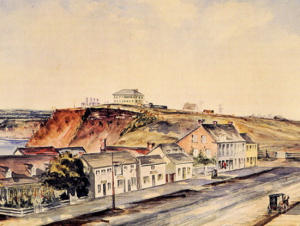
We are fortunate to live in one of the world's most beautiful cities and history is all around us. Most of us really don't know of more than a few of the contributions that have been made by Ottawa citizens and institutions.
Ottawans have contributed much to Canadian folklore, inventions, science and economic, social and cultural growth of Canada, not to mention the political goings on that have been part and parcel of the City's history since 1867 and before.
... to tell the stories of some of the people who have lived here over the last 175 years.
One purpose of this series of columns is to provide information on some of these happenings and also to tell the stories of some of the people who have lived here over the last 175 years. First, the native peoples and then the French explorers and Courieres-de-bois. Then came some people up from the new United States who had stayed loyal to the British Crown during the American Revolution After the War of 1812, the British government decided military preparedness had to be improved and Colonel John By was sent here to build the Rideau Canal. With him and his construction plans came English officials, Scottish stone masons and Irish labourers to join the Natives and French who were already here.. From this earliest time, we have the stories of Colonel By, Duncan McNabb (who, it is said, still haunts the Bytown Museum and the famous lumberjack Joseph Montferrand, better known to Stompin' Tom Connors as Big Joe Mufferaw. Early settlers built their homes, churches and schools. In 1831, a publication that sought to attract emigration to Canada said the lands “about the Canal” should soon become very valuable and ecouraged settlers there “lest some lynx eyed American be attracted”. He commented that the country around there is very beautiful and suitable for farming.
“The scenery about Bytown is, next to that at the Falls of Niagara, the most picturesque of the inhabited regions of Canada”.
Wm. Catermole who wrote the pamphlet achieved his purpose. The “Smith's Gazetteer” published in 1846 gives a goodly amount of detail about the place then called Bytown. Smith's report also speaks to the beauty of the area. He says “The scenery about Bytown is, next to that at the Falls of Niagara, the most picturesque of the inhabited regions of Canada”. He notes the town has some 7000 inhabitants divided between Upper and Lower towns, and is principally supported by the lumber trade. Inhabitants of Lower Town are said to be about one third French and that the remainder are “principally Irish” There are five churches in Lower Town and three in Upper Town. There are three weekly newspapers—the “Ottawa Advocate”, the Bytown Gazette” and the “Packet”. .. Mail was available each day, carried on horseback from Kingston.
On the entertainment front there were a “Commercial Reading room” and a “Mercantile Library Association”, four taverns in Upper Town and thirty five taverns plus twenty beer shops in Lower town. Two breweries manufactured products for the above! Health care was provided by a physician and surgeon and four druggists, while legal needs were served by seven lawyers Economically, allowing five dollars to the pound sterling, over $1,700,000 in timber was shipped—white pine, red pine, oak and elm and saw logs. Logs were worth about $2.50 each and timber pieces were anywhere from 15 to 25 cents a foot.
Land values had risen rapidly eg “The land on which the Upper town is erected, together with a portion of that comprising the Lower Town, was purchased some years ago for the sum of $400, and is now computed to be worth some $250,000 to $300,000” Much more is contained in the “Gazetteer” on the various trades in Bytown, educational facilities and stores. If readers are interested more can be published later. Catermole's prediction was achieved!. Bytown had grown considerably in fourteen years and much more was to come!
A few questions:
(1) By what margin did drinking establishments outnumber churches?
(2) What year is represented by the facts above?
(3) From what source do you think those seven lawyers made their incomes?
Answers:
(1) At least seven to one.
(2) 1846
(3) Probably real estate and timber contract
Cliff Scott, an Ottawa resident since 1954 and a former history lecturer at the University of Ottawa (UOttawa), he also served in the Royal Canadian Air Force and the Public Service of Canada.
Since 1992, he has been active in the volunteer sector and has held executive positions with The Historical Society of Ottawa, the Friends of the Farm and the Council of Heritage Organizations in Ottawa. He also inaugurated the Historica Heritage Fair in Ottawa and still serves on its organizing committee.
The Catch
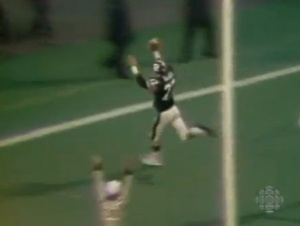
28 November 1976
The afternoon of 28 November, 1976 was chilly and overcast in Toronto, with the temperature hovering about the freezing point. A stiff northwesterly breeze made it seem even colder. But the weather did not deter the more than 53,000 exuberant Canadian football fans that crowded into Exhibition Stadium that afternoon for the 64th Grey Cup Championship between the Saskatchewan Roughriders and the Ottawa Rough Riders. It was a record crowd and a record gate of $1,009,000. Both teams had finished the regular season in first position in their respective divisions. To reach the Grey Cup, Ottawa had bested the Hamilton Tiger-Cats in the eastern divisional final held the previous weekend in a close 17-15 contest, while Saskatchewan had topped the Edmonton Eskimos 23-13 in the west. The western Riders were five-point favourites owing to the strong arm of their veteran, all-star quarterback, Ron Lancaster, and the best defence in the Canadian Football League. Saskatchewan had also beaten Ottawa 29-16 in their only meeting of the regular season. Despite the youthful Ottawa team’s lacklustre play during the second half of the season, it was no pushover. Its coach, George Brancato, had been named the CFL’s coach of the year in 1975, and had put together back-to-back first place finishes for the eastern Riders.
Televised coast-to-coast by both CBC and CTV, this Grey Cup game promised to live up to its pre-game hoopla. But fans could not have known that they were about to be treated to one of the greatest, if not the greatest, championship game in CFL history. It featured the heroics of unlikely players, broke Grey Cup records, and, with the outcome in doubt into the last minute, ended in one of the most thrilling plays seen in Canadian football. Sports fans will always remember it as “The Catch.”
Ottawa was the first to draw blood. With slightly more than five minutes left to play in the opening quarter, Gerry Organ scored a field goal from Saskatchewan’s 30-yard line. With the western Riders retaking control of the ball, Ottawa’s defence held tough, forcing Saskatchewan to punt, setting the stage for Bill Hatanaka, the 22-year rookie kick returner out of York University. Catching the ball booted by Saskatchewan kicker Bob Macoritti, Hatanaka scampered 79 yards for a touchdown, the first punt return touchdown in Grey Cup history. It was also the longest Grey Cup punt return to that time, and only subsequently surpassed twice. It was 10-0 Ottawa at the end of the first quarter.
Late in the second quarter, Ottawa’s fortunes soured when Macoritti finally put the western Riders on the board with a 32-yard field goal. With the Ottawa offence under the direction of sophomore quarterback Tom Clements (“Captain Cool”) unable to sustain a scoring drive, this was quickly followed by a Saskatchewan major when Ron Lancaster found wide receiver Steve Mazurak who ran 15 yards for the touchdown. With Macoritti’s convert, the game was tied at 10. Seconds later, Ted Provost intercepted an errant pass from Tom Clements, intended for Ottawa’s star receiver, Tony Gabriel. This set the stage for another Lancaster touchdown throw, this time to tight end, Bob Richardson. Again Macoritti converted. The score was 17-10 in Saskatchewan’s favour at half time. Despite the score, everything had not gone in Saskatchewan’s way. Running back, Molly McGee, suffered a rib injury late in the quarter after a bruising tackle, crimping Lancaster’s running game.
In the third quarter, the two teams traded field goals. With a stiff wind favouring Saskatchewan, the Ottawa defensive team did great work in holding the western champions to only three points. Late in the quarter, Ottawa fans were brought to their feet by Jerry Organ, who faked a punt and ran 52 yards to bring his team deep into Saskatchewan territory. Organ’s gamble, caught Coach Brancato by surprise. After the game, Organ revealed that the play originated in a half-time dressing-room discussion with linebacker Mark Kosmos about Saskatchewan not rushing punts. Organ said that he “ran like a scared rabbit,” and had planned to kick the ball had he got into difficulty. Unfortunately, his heroics were snuffed out when Saskatchewan linebacker Cleveland Vann intercepted another one of Tom Clements’s passes. Seven points continued to separate the two teams as they entered the final quarter.
With only 7.33 minutes left of the final frame, Gerry Organ kicked a 32-yard field goal to bring Ottawa to within four points of their rivals. On the next series of plays, the Ottawa defensive squad stopped Saskatchewan midfield. With third down and less than a yard to go, the Saskatchewan’s coach, John Payne, decided to punt the ball instead of trying for the first down. It was an uncharacteristic conservative play. It was also a fateful decision with huge consequences.
Macoritti’s punt gave the Ottawa Rough Riders the ball on their 26-yard line with five minutes to go. Tom Clements then went to work, methodically working the sticks down field to bring Ottawa just outside the Saskatchewan 10-yard line. After a short pass to Art Green, Clements attempted to run the ball in himself but was tackled short of the first down, and tantalizingly close to the goal line. It was third down and less than a yard to go. With 1:32 remaining on the clock, and Ottawa needing at least four points, Coach Brancato decided to gamble. But the Saskatchewan’s defensive wall stopped the eastern Riders inches short of the first down. With the western Riders taking possession of the ball, it looked like Saskatchewan had the Grey Cup in the bag.
But they hadn’t counted on the Ottawa defence. Promising Coach Brancato one last chance, the defensive team gave up only six yards, forcing Saskatchewan to punt into the wind from their own 7-yard line. Ottawa’s Hatanaka, returned the ball to the western Riders’ 35-yard line. In two plays, Clements moved the ball down to the 24-yard line, with a pass to Tony Gabriel picking up the first down. With only 31 seconds remaining on the clock, everybody knew that Clements would try to find Gabriel again, his go-to-man the entire season…everybody, that is, except the Saskatchewan Roughriders who failed to double cover the scoring threat. Waving off a play from Coach Brancato, quarterback Tom Clements sought out Tony Gabriel who, first faking a post pattern, had turned instead to the outside. Clements found him in the clear, five yards behind Saskatchewan’s Ted Provost in the end zone. The Ottawa quarterback launched the ball. Gabriel reached above his head and pulled it in. Touchdown! Fans poured onto the field and mobbed Gabriel in the end zone. With Gerry Organ’s convert, the Ottawa Roughriders went ahead 23-20.
Although Saskatchewan had one more opportunity to score, with only 20 seconds left in the game, there was simply not enough time. Ottawa became the 1976 Grey Cup Champions. The perfectly executed 24-yard touchdown pass from Clements to Gabriel went down in CFL lore as simply “The Catch.” Clements was named the game’s most valuable offensive player, while Gabriel was named the most valuable Canadian. Saskatchewan’s Cleveland Vann was the game’s most valuable defensive player. Members of the winning team each received $6,000 bonus, with the losing team members each receiving $3,000. Tom Clements, as the top offensive player of the game, was also given a new car, a timely prize as is old one was the “team’s joke.”
Back home in Ottawa, the place went wild as fans poured onto the streets. Bank Street turned into a parking lot as fans celebrated their Rough Riders’ victory, honking horns and consuming vast quantities of beer as police turned a blind eye to minor infractions. At noon the next day, the team returned home, greeted at the airport by hundreds of fans and a brass band. A civic celebratory dinner was held for the team that night. The event totally eclipsed a black tie dinner hosted by Prime Minister Trudeau on Parliament Hill for Team Canada, winner of the 1976 Canada Cup Hockey Tournament the previous September.
The 1976 Grey Cup was the Ottawa Rough Riders’ ninth and last CFL Championship. Although the team again made it to the finals in 1981, they went down to defeat 26-23 to the Edmonton Eskimos. The Ottawa Rough Riders team collapsed in 1996 owing to falling attendance, poor management, and growing debts. Founded in 1876, the oldest professional sports team in North America was no more. In 2002, a new team, the Ottawa Renegades, briefly played out of Landsdowne Park, but it too folded after only four years. In 2014, another Ottawa team, the Redblacks, wearing the familiar colours of their storied predecessors, took the field.
UPDATE (27 November 2016): Ottawa Redblacks win the Grey Cup! In an exciting contest in Toronto, the underdog Ottawa Redblacks held off a fourth-quarter surge by the Calgary Stampeders to take the Cup 39-33.
Sources:
CBC, 1976. 64th Grey Cup Game.
CFL, 2014. 64th Grey Cup, November 28, 1976.
The Globe and Mail, 2012. “Punt return in ’76 Grey Cup was one for the record books,” 23 November.
The Ottawa Citizen, 1976. “Grey Cup Returns to Ottawa,” 29 November.
———————–, “Football Fervor spoils hockey heroes’ dinner,” 29 November.
———————–, 1976. “Battle was saved in the third quarter,” 29 November.
———————–, 1976. “Organ weighs future,” 29 November.
———————–, 1976. “Clements, Gabriel dynamite,” 29 November.
———————–, 1976. “Inventive gambling pays,” 29 November.
Ottawa Citizen.com, 2006. “Our last Grey Cup ever?,” 26 November.
Story written by James Powell, the author of the blog Today in Ottawa's History.
Retired from the Bank of Canada, James is the author or co-author of three books dealing with some aspect of Canadian history. These comprise: A History of the Canadian Dollar, 2005, Bank of Canada, The Bank of Canada of James Elliott Coyne: Challenges, Confrontation and Change,” 2009, Queen’s University Press, and with Jill Moxley, Faking It! A History of Counterfeiting in Canada, 2013, General Store Publishing House, Renfrew, Ontario. James is a Director of The Historical Society of Ottawa.
Contact Us
Questions, queries, suggestions, comments? We'd love to hear from you!
The Historical Society of Ottawa
Box 523, Station "B",
Ottawa, ON
K1P 5P6
This email address is being protected from spambots. You need JavaScript enabled to view it.
Follow Us
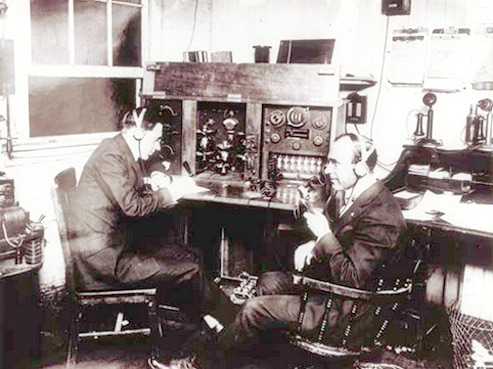 Marconi Radio Station, CFCF, formerly XWA, Montreal, circa 1922
Read the story
Local Museums
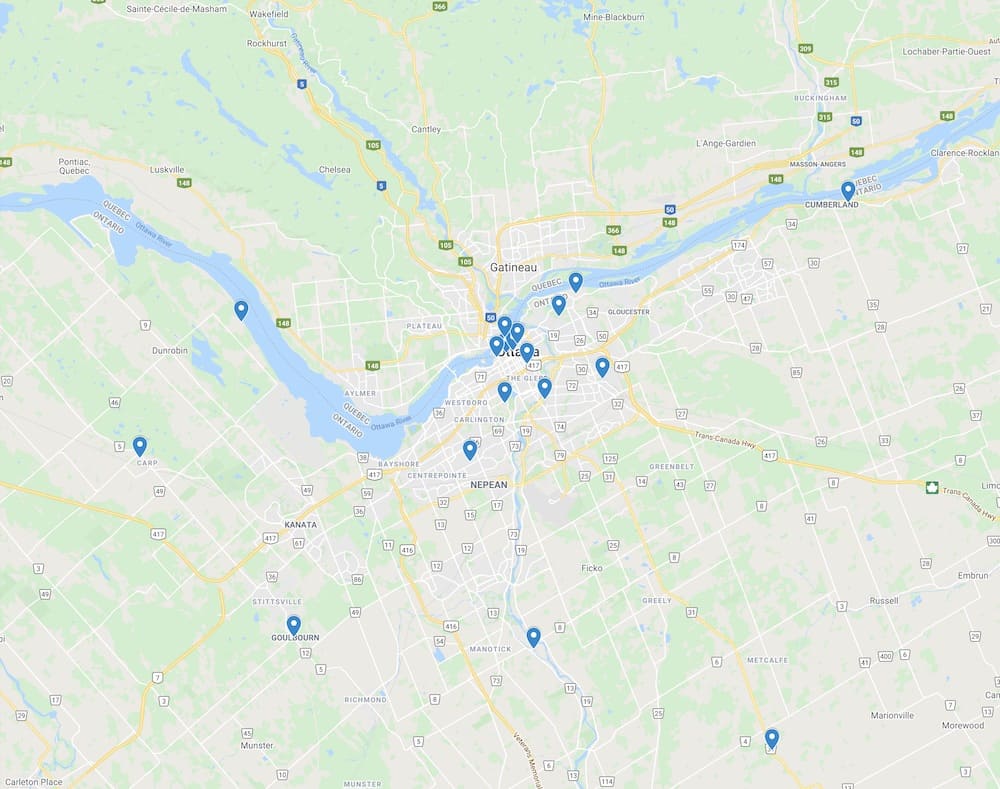
Click the map of Ottawa to explore local museums
Bytown Museum
"Located in the heart of downtown Ottawa, the Bytown Museum explores the stories of an evolving city and its residents from its early days as Bytown to present day Ottawa."
Ottawa Museum Network
Twelve Ottawa-area community museums, in-person and online.
Perth & Area Museums
A list of the museums in Perth and surrounding area.
Renfrew County Museums Network
"The Renfrew County Museums Network (RCMN) was formed in 2002 so that all of the county museums in operation at that time could both share technical information and collectively promote their facilities. ... At our museums throughout Renfrew County we celebrate the stories that have shaped the history of Canada."
Videos
On April 28, 2021, Dorothy Phillips, author and longtime HSO member, told us about researching and writing the story of the Duke of Devonshire during his time as Governor General of Canada.
If you missed the HSO presentation by Phil Jenkins (or you just want to watch again) check out his recap and reflections on the history of LeBreton Flats in this video from April 14, 2021.
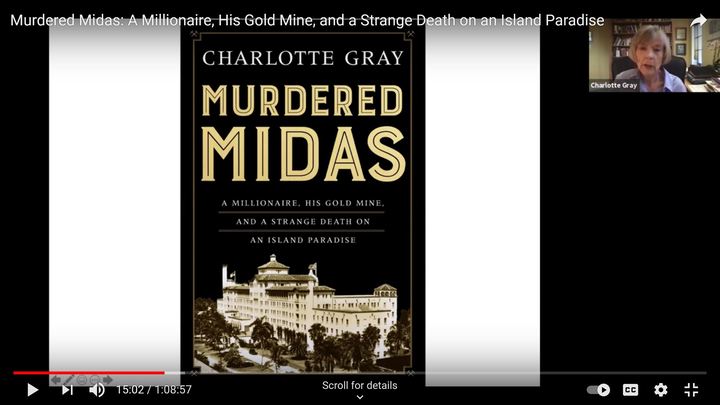
Ottawa resident and award-winning author Charlotte Gray shared with us the story of the life and death of Sir Harry Oakes on March 31, 2021.
On March 10, 2021, Andrew King, Ottawa artist, cartoonist, columnist, and author of the Ottawa Rewind books and blog, shared some of his discoveries of long-hidden secrets from Ottawa's fascinating past.
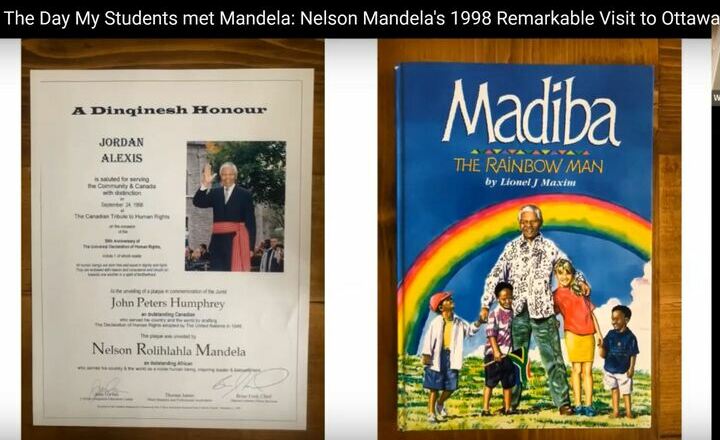
The Day My Students Met Mandela: Nelson Mandela's Remarkable 1998 Visit to Ottawa
Wendy Alexis shared stories and memories with us on February 10, 2021, about the day that Nelson Mandela visited the Canadian Tribute to Human Rights monument in Ottawa.
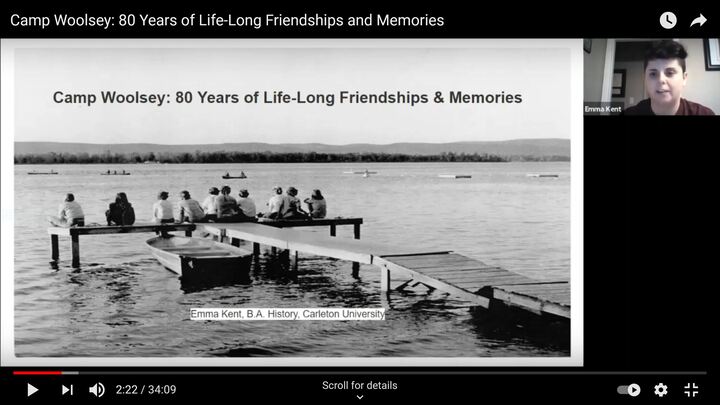
Camp Woolsey: 80 Years of Life-Long Friendships & Memories
Share some memories of the Girl Guide Camp Woolsey in this HSO presentation by Emma Kent on January 13, 2021.
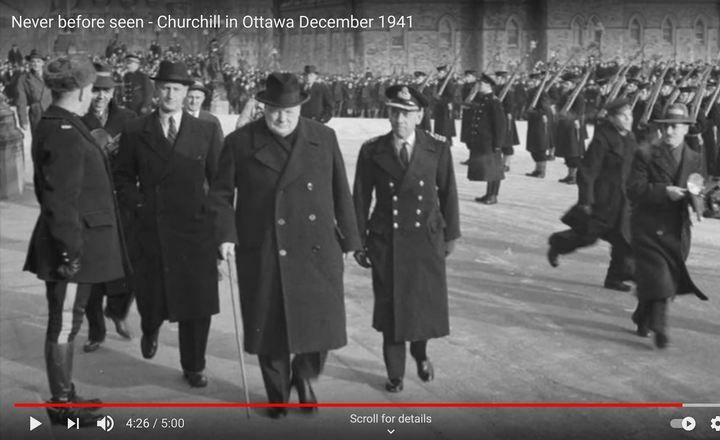
Rare film footage of Churchill's 1941 visit to Ottawa provided courtesy of Michael Evans.
Read about Churchill's visit in this recounting of the event by James Powell: Some Chicken, Some Neck - 29 December 1941.
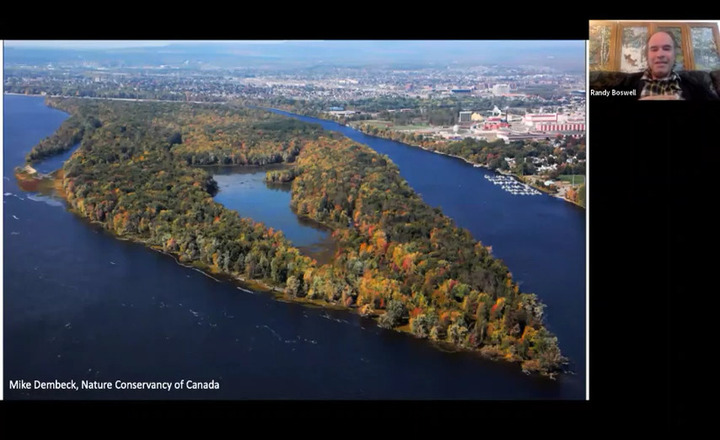
Kettle Island: A Bridge to Ottawa's Past
Randy Boswell, Journalism Professor, Carleton University, explored the surprising history of Kettle Island in a virtual presentation to the Historical Society of Ottawa on December 2, 2020.
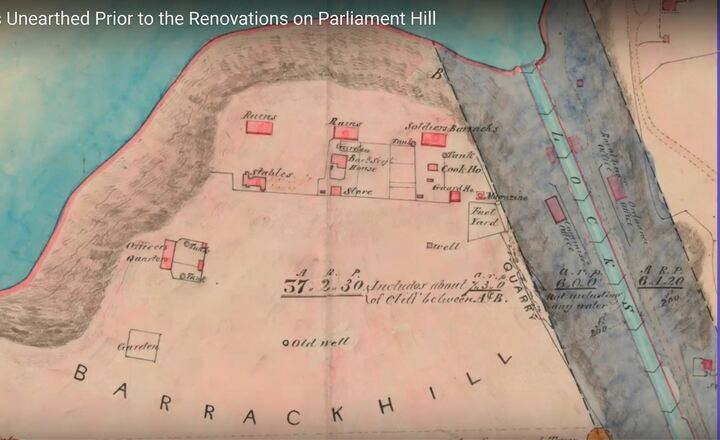
Uncovering Canada's Past: Digging up Parliament Hill
On November 18, 2020, Stephen Garrett, Project Manager of the archeological excavation of Parliament Hill in 2019, shared stories and discoveries from his work in a virtual presentation to the Historical Society of Ottawa.
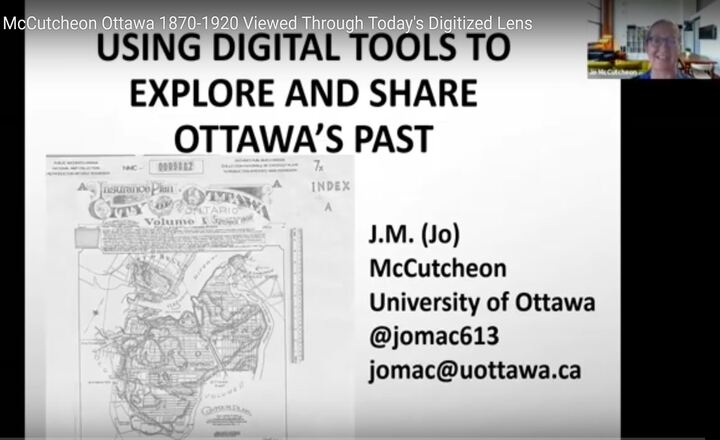
Using Digital Tools to Explore and Share Ottawa's Past
At the HSO virtual presentation on October 14, 2020, Jo-Anne McCutcheon of the University of Ottawa shared with us how technology and digitization techniques of today can help us explore the past.
Michael Kent from Library and Archives Canada explores the history and documents found in the repositories of Jewish synagogues and cemeteries in Ottawa and around the world.
On September 14, 2020, Michael Kent, Curator of the Jacob M. Lowy Collection at Library and Archives Canada, spoke to members of the Historical Society of Ottawa and guests via our first ever “Zoom” presentation. Michael’s fascinating presentation explored the hidden treasures of the Geniza in Ottawa and around the world. The “Geniza” is the sacred storage area in a synagogue or cemetery used for the disposal of worn-out religious books and papers.
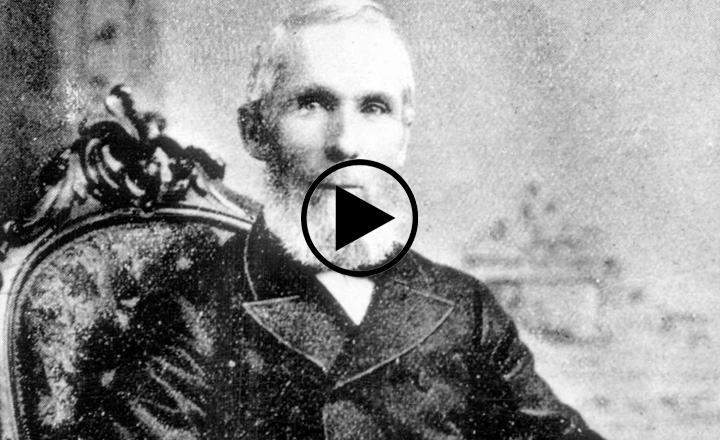
Hon. Alexander Mackenize
The Hon. Alexander Mackenzie was Canada’s second Prime Minister, serving from 1873-78. Mackenzie was Leader of the Opposition until 1880 and then continued to sit as a Liberal MP until April 17, 1892 when he died from a stroke after suffering a fall at the age of 70.
This video was prepared for the Historical Society to celebrate Canada 150 and to raise awareness and appreciation of Mackenzie's life and times and contributions to Canada.
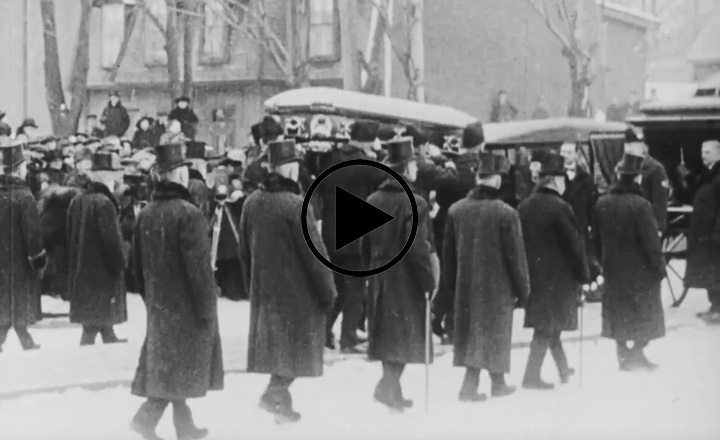
Funeral of Sir Wilfrid Laurier
The view in front of the Notre Dame Cathedral Basilica in Ottawa on Sussex Drive on 22 February 1919, Library and Archives Canada IDC: 94473
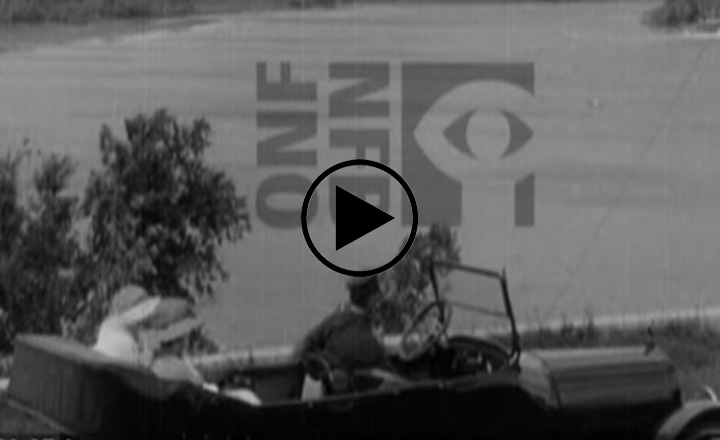
1920 - Film sequence from a visit to Ottawa
The film shows a woman receiving a letter from woman friend in Halifax followed by this friend arriving at the train station in Ottawa and being taken on a tour of the city in a convertible car.
1938 - Ottawa: Canada's Capital,
Library and Archives Canada
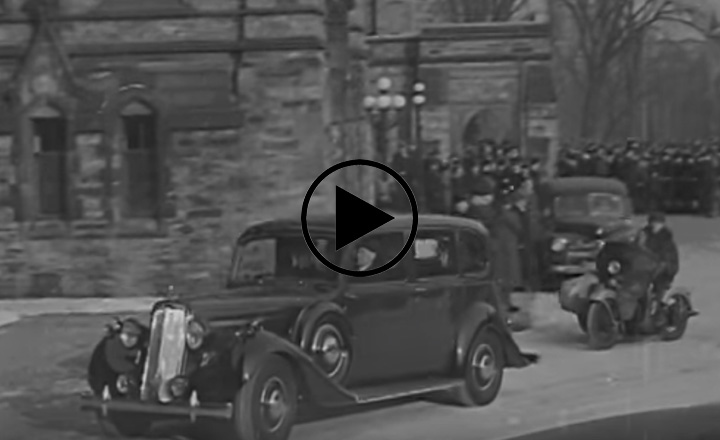
1939 - Royal Banners Over Ottawa
Visit to Ottawa by George VI and Queen Elizabeth
1940 - Odds and ends
from old footage of Ottawa
1941 - Ottawa on the River
A film about Ottawa in 1941
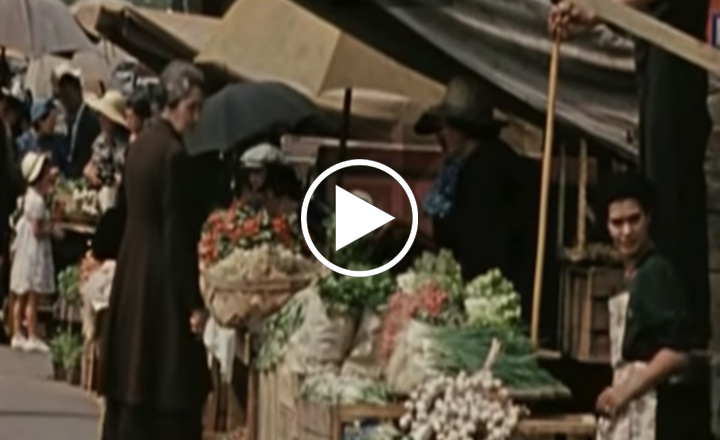
1946 - Byward Market
When Ottawa's Byward Market was a real market.
1968 - Touring Ottawa
Amateur film of from Maitland Avenue along the Queensway to downtown, around Parliament, to Champlain point, along the Ottawa River, Dows Lake and many other places in town.
Local History Websites
This is an incomplete list of online sites that focus on Ottawa history. The Historical Society of Ottawa does not necessarily subscribe to the views expressed in these blogs, nor can it attest to their accuracy. The responsibility for the content of the websites remains with their authors.
Britannia, A History
"This site is about the community of Britannia in Ottawa, Canada. It is mostly about the history, but ... [i]t is incomplete and always will be. ... Really it is more like an encyclopedia of Britannia; a collection of articles and information, not a single, continuous story."
Capital Chronicles | History of the National Capital
"The History You Were Never Told" as recounted by Rick Henderson.
Capital History
Carleton’s Centre for Public History explores histories about people, places, and events in Ottawa’s National Capital Region. An ongoing history and heritage project that links Ottawa history with the city’s built environment.
Civic Hospital Neighbourhood
Documenting the community’s transition from forest and farmland to today’s urban environment.
Colin Churcher’s Railway Pages
"Welcome to my home page. I live in Ottawa, Ontario, Canada. I have been interested in railways for many years and have been fortunate to pursue a career in railways. In these pages I will be setting out various aspects of my interest."
Forgotten Ottawa
Kevin Ballantyne recounts stories and places that have become forgotten parts of Ottawa's history.
Freaky P
"Freaky P" provides an eclectic mix of short videos on the history of various Ottawa buildings and streets combined with other material.
French Life in the Capital
This exhibition brings to light significant events in the capital’s history where Francophones have helped shape the face of Ottawa.
A History of Ottawa East
"Published May, 2004 by the Old Ottawa East Community Association. Written in part and compiled by Rick Wallace. Technical Direction by David Walker"
House History Ottawa - A project by M.S. Lowell and D. Lafranchise
"M.S. Lowell, (1961-) started doing house histories in 1989. He has conducted 23 various Ottawa House History projects in the past 15 years. Marc is originally from Toronto and is self-taught. Marc has also done work in genealogy. He is listed on the Library and Archives Canada Freelance Researchers list. D. Lafranchise (1952-) is a retired Civil Servant from Ottawa who has a major interest in Ottawa History."
Island Park Drive History
The history and vision behind Island Park Drive in Ottawa.
The Kitchissippi Museum
Dave Allston's blog about west Ottawa's little-known history, with stories, photos and information covering the fascinating history of the historic Kitchissippi neighbourhoods.
Lebreton Flats Remembered
"Reflections on the history of a vanished community. Our mission, rekindle memories of a lost legacy."
Lost Ottawa
"Lost Ottawa is a Facebook research community devoted to images of Ottawa and the Outaouais up to the year 2000. Anyone can join. Just "Like" the page."
Ottawa's Bygone Buildings
Through the years, Ottawa has seen many buildings come and go. Some were lost to fire, some demolished for the expansion of parkland, roads and other improvements while others were removed to make way for newer buildings.
This project includes an online map showing the outline footprint of buildings which existed in 1912 but no longer exist today. Each footprint contains information and photos of these buildings.
Ottawa Family Tree
"When Jean Cadieux, a locksmith, made his way from Luché, in the Loire Valley of France to Montréal, during 1653, the first of my ancestors set foot upon the North American continent. It was a wild ride .. literally! .. from then, as the fur trader Antoine Cadieux made his way across the rapids of the Ottawa River before settling down with a family in Quyon, QC. This blog pays tribute to these ancestors’ courage and daring under the rubric that every family’s story is worth telling and ought to be passed along! The purpose of this blog is to share across the internet information on the O’Connor, Doyle, Dolan, Killeen, Kelly, O’Callaghan, Cadieux, Frood, Wilson and McEwan families found in researching the family tree."
Ottawahh
A personal blog with many descriptions and historical photographs of Ottawa's past.
Ottawa History Hub
A celebration of the history of Ottawa, Ontario. More than just a municipal history project, the Ottawa History Hub is a narrative-driven podcast history of the Ottawa area, putting its history in context
Ottawa Past and Present
"A few decades ago, Ottawa was drastically different: Sparks Street was thriving, people were actually living downtown and at LeBreton Flats and a train could bring you to the heart of the city. The narrow and institutionalized vision of bureaucrats, the rapid expansion of car use, and a generalized neglect of architectural heritage changed the urban fabric of the Capital. The Gréber Plan and the NCC transformed Ottawa for the worse. One building at a time. We promote intensification and discourage sprawl. We are not against tall buildings, but we have a lot to say about bad design. This website is not strictly about heritage preservation, but rather what goes down the drain when those older buildings are demolished and streets are denatured."
Ottawa Police Service - Lives Tragically Lost in the Line of Duty
Follow this link as we join in honouring those police officers who made the ultimate sacrifice while working to keep Ottawa’s streets safe.
Ottawa Rewind
"Hello, welcome to Ottawa Rewind, a blog dedicated to stories that I think are pretty cool about Ottawa and the surrounding area. Pull up a chair, grab a drink and enjoy the ride as we rewind some time…"
Ottawa Start: History
"Photographs of Ottawa that capture the way of life up to about 1970. Much of the city has changed over time with growth and loss of heritage and street life"
Sandy Hill Stories
by François Bregha — Sandy Hill has a rich history that can still be seen in many of the mansions that grace the neighbourhood or in street names that recall former activities.
Stanley Brede
Photographer and cinematographer who was stationed at Rockcliffe with the Royal Canadian Air Force during WWII and had a long career with Crawley Films, Ottawa.
The Margins of History
A personal ramble through the history of Ottawa.
Today in Ottawa’s History
"The purpose of this blog is to provide readers with a brief account of an interesting or important event that happened in Ottawa’s history on a given day of the year. Ultimately, my objective is to have an article for every day of the year. While I will try to cover the highlights of each event, the brevity of the articles precludes a lot of detail and analysis. If readers wish to explore a topic in more detail, the sources listed at the end of each story will provide a useful starting point for research."
Urbsite
A blog by Robert Smythe on a variety of Ottawa historical topics.
Vanished Ottawa
A blog on abandoned buildings, fading buildings and buildings long gone from Ottawa.
Vintage Ottawa
"Nostalgic look at Ottawa's past be it buildings, people, events, houses or more."
Win, Tie, or Wrangle
A blog dedicated to the history of the old Ottawa Senators, 1883-1935. It is based on the book of the same name by the late Paul Kitchen (Penumbra Press 2008). Paul Kitchen, 1937-205, was a librarian, executive director of the Canadian Library Association, Ottawa-based hickey historian, and a past president of the Society for International Hockey Research. His Dey Brothers' Rinks Were Home to the Senators was published in the Society's Pamphlet Series in 1993.
Workers' History Museum
Dedicated to the development and preservation of workers’ history and heritage in the National Capital Region and Ottawa Valley with a goal to present, promote, interpret, and preserve workers’ history, heritage, and culture.
Focus on Heritage

Canadian National Digital Heritage Index (The)
"The Canadian National Digital Heritage Index (CNDHI) is an index of digitized Canadian heritage collections located at Canadian universities and provincial and territorial libraries. Supported by funding from Library and Archives Canada and the Canadian Research Knowledge Network, CNDHI is designed to increase awareness of, and access to digital heritage collections in Canada, to support the academic research enterprise and to facilitate information sharing within the Canadian documentary heritage community."

Canadiana Collections
"With the support of major memory institutions, CRKN identifies, catalogues, and digitizes documentary heritage—books, newspapers, periodicals, images and nationally-significant archival materials—in specialized searchable databases."

CBC Historical Archives
"The CBC Archives is a unique collaboration of creative teams in Toronto working together with archivists and educational writers across Canada."

Capital Heritage Connexion
The Capital Heritage Connexion/Patrimoine de la Capitale is an umbrella organization serving heritage stakeholders in Canada’s Capital area. The CHC plays a leading role in developing and sustaining Ottawa’s heritage sector and ensuring local residents have access to heritage.

City of Ottawa Archives
"Discover Ottawa's hidden treasures. Explore more than three million photographs, research your home or family and bring the past into the present. The caretakers of Ottawa’s documentary history, the City of Ottawa Archives, are mandated to preserve original documents on behalf of past and future generations. Ottawa’s history lives here. Uncover and discover for yourself."
Explore the many virtual exhibits compiled from the vast archives collection.

Cumberland Township Historical Society
The Cumberland Township Historical Society is a non-profit, volunteer and community-based organization whose goal is to preserve Cumberland Township history.
Gloucester Historical Society
"An organization for preserving and promoting the history of the former Gloucester Township."

Glengarry History
"Glengarry History has been formed ... with the intent of acting as a liaison and partnership group for other organizations active in the area of preserving the history of Glengarry."
Goulbourn Township Historical Society
"Welcome to the Goulbourn Township Historical Society – a community group dedicated to the history of the former Goulbourn Township, now amalgamated into the City of Ottawa in Ontario, Canada.If you have ties with Goulbourn, or are interested in history generally, you might Richmond-Fair-2010 for webwant to join us."
Heritage Ottawa
"We are a group of dedicated volunteers who are passionate in our commitment to promote awareness, appreciation and preservation of outstanding examples of historic buildings and places in Ottawa and the National Capital Region."

Huntley Township Historical Society
"The Huntley Township Historical Society was formed in 1985 ... [t]o collect historical and genealogical material and establish a repository of information and artifacts on the former Huntley Township for research purposes and as a contribution to Canadian history, and to publish and display related materials."

Library and Archives Canada
Library and Archives Canada’s "mandate is as follows: to preserve the documentary heritage of Canada for the benefit of present and future generations; to be a source of enduring knowledge accessible to all, contributing to the cultural, social and economic advancement of Canada as a free and democratic society; to facilitate in Canada co-operation among communities involved in the acquisition, preservation and diffusion of knowledge; to serve as the continuing memory of the Government of Canada and its institutions."
Ottawa Public Library Ottawa Room
A centralized information resource about Ottawa and surrounding areas, both past and present, that helps preserve Ottawa’s written heritage for researchers and for residents with a passion for local history. The collection includes over 15,000 items that can be consulted free of charge. Main Library, 3rd floor.

Ottawa South History Project
"We are a group of local amateur historians whose interest is to research, document, and present facts and information about the history of Old Ottawa South in a fun and informative way."
The Rideau Canal
"is a non-commercial site run (and paid for) on a hobby basis by Ken Watson."

The Rideau Township Historical Society
"Preserving and promoting local history for the former Rideau Township."
Books
On occasion, the Historical Society of Ottawa publishes substantive research in the form of a book.
Prices of books vary — as shown below — and the cost of postage is extra.
To order, please contact the Historical Society of Ottawa by mail or This email address is being protected from spambots. You need JavaScript enabled to view it..
| Title | Author | Date Published | Member Price | Non-member Price | |
|---|---|---|---|---|---|
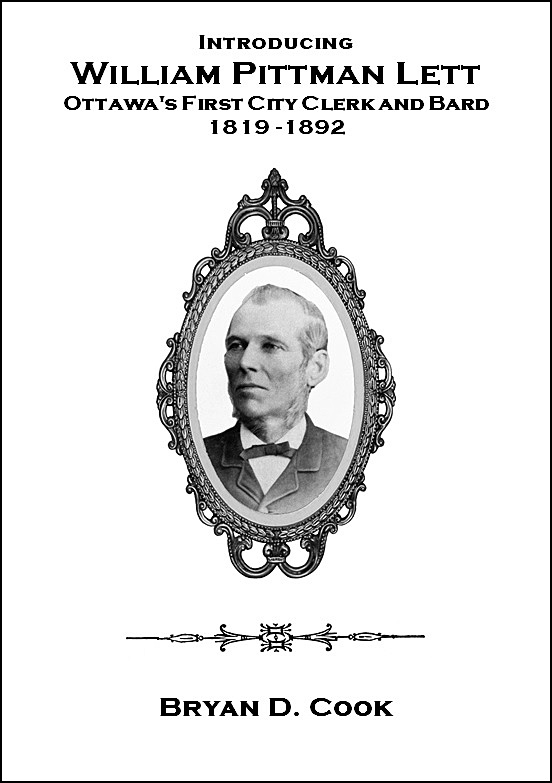 |
Introducing William Pittman Lett, Ottawa's First City Clerk and Bard, 1819-1892 A digital version of this book is now available online — see Introducing William Pittman Lett by Bryan D. Cook. |
Bryan D. Cook | 2015 | $15.00 | $20.00 |
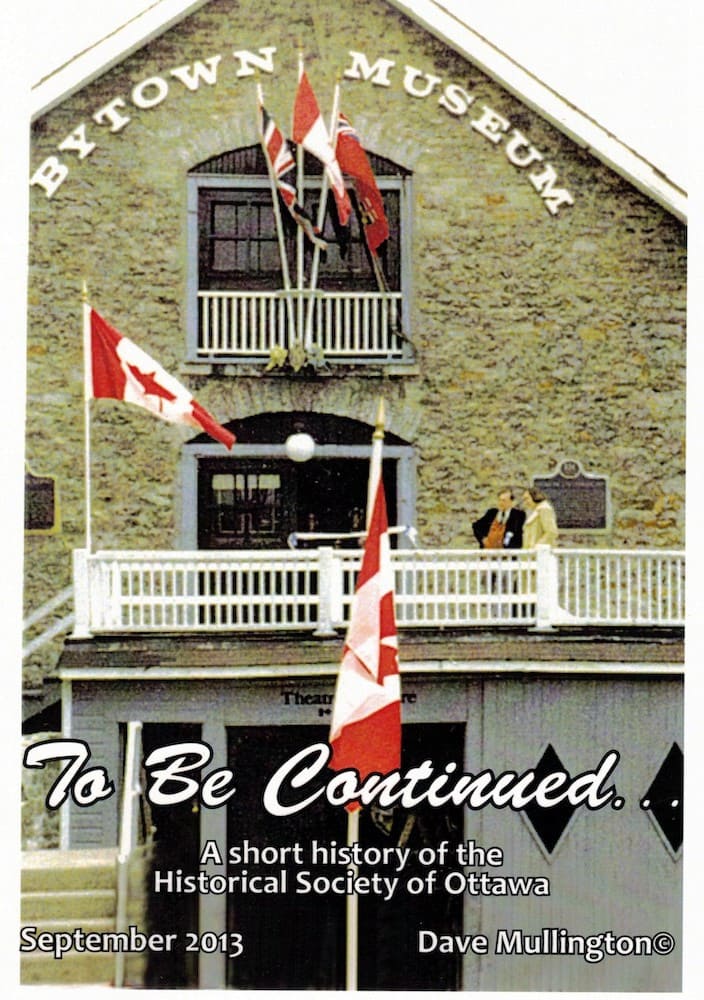 |
To Be Continued . . . A Short History of The Historical Society of Ottawa | Dave Mullington | 2013 | $10.00 | $15.00 |
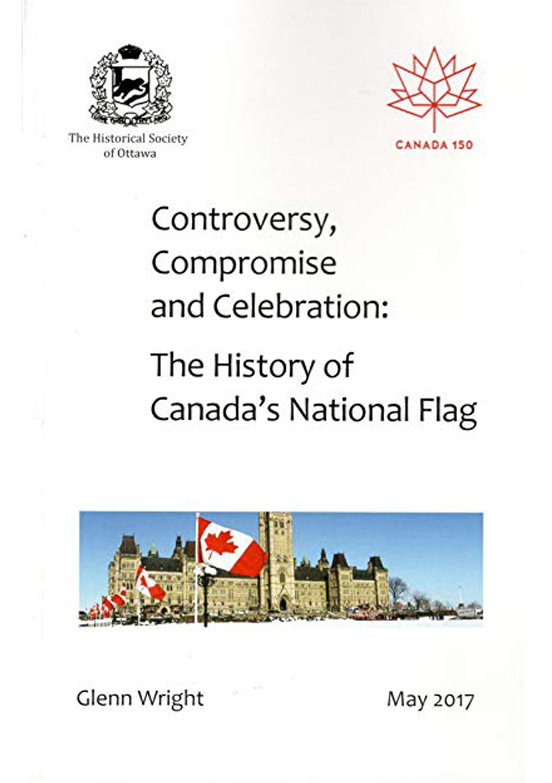 |
Controversy, Compromise and Celebration: The History of Canada’s National Flag (bilingual) A digital version of this book is now available online — see Controversy, Compromise and Celebration: The History of Canada's National Flag / Controverses, compromis et célébrations : L'histoire du drapeau national du Canada |
Glenn Wright | 2017 | $10.00 | $15.00 |
Looking for more local history books? Check out these titles available from the Cumberland Township Historical Society.
The Return of "D" Company
3 November 1900
It is said that Canada became a nation at the Battle of Vimy Ridge in April 1917 during World War I when the Canadian Expeditionary Force took the German-held high ground amidst fierce fighting—an achievement that had eluded British and French forces in three years of fighting. Although there is no disputing the heroism and the accomplishment of the Canadian soldiers, some historians maintain that the significance given to Vimy Ridge in the development of Canadian nationalism is a modern invention. It also overlooks the impact of an earlier war on Canadian national confidence. That war was the South African War, also known as the Boer War.
The Boer War was a nasty colonial conflict that pitted Britain against two Boer (Afrikaans for farmer) republics called the South African Republic, also known as the Transvaal, and the Orange Free State. There were actually two wars. The first, in which the British got a drubbing, lasted from 1880 to 1881, while the second more famous one lasted from 1899 to 1902. The wars resulted from British imperial designs over southern Africa butting up against the desire by Boer settlers for their own independent, white republics. Thrown into the mix was the discovery of gold in Boer territories, an influx of foreign, mostly British prospectors and miners (called uitlanders) who were denied political rights by Boer governments who feared being swamped by the incomers, rival British and Boer economic interests, British fears of German interference in southern Africa, and the ambitions of Cecil Rhodes, the premier of the Cape Colony from 1890 to 1896.
The South African war began in October 1899 after talks between the British government and the Boer governments failed. Boer soldiers invaded the British Natal and Cape Colonies and subsequently laid siege to ill-prepared British troops at Ladysmith, Mafeking, and Kimberly. The attacks galvanized pro-British sympathies throughout the Empire, whipped up by nationalistic newspapers. Australia and New Zealand sent troops to assist the Mother Country in its hour of need.
In Canada, public opinion in English Canada was likewise strongly in favour of Britain and the uitlanders. The Ottawa Evening Journal said “Britain, a democratic monarchy, is at war with a despotic republic, and seeks to give equality to the people of the Transvaal.” Pressured by English Canada, the Liberal government of Sir Wilfrid Laurier agreed to send 1,000 volunteers to support the British cause over the opposition of many French Canadians including fellow Liberal party member Henri Bourassa, who resigned his federal seat in protest. Bourassa later founded the newspaper Le Devoir. This was the first time Canada had committed troops to an overseas war. In 1884, Canadian volunteers, many from the Ottawa area, had agreed to serve as non-combatants in the relief of “Chinese” Gordon at Khartoum, Sudan.
In Ottawa, imperial sentiment was strong, even reportedly among its francophone population. One such resident opined that “French Canadians had no reason to be other than loyal to England…England had dealt fairly with us and we should be unhesitatingly be loyal.” Another said “Every British subject, whether of French or any other extraction, should be willing to bear the responsibilities of Empire.” Of the first 1,000 volunteers to serve in South Africa in the 2nd Battalion, Royal Canadian Regiment of Infantry under the command of Colonel Otter, sixty-seven came from the Ottawa area.
The Ottawa contingent, “D Company,” left the Capital for Quebec City by train in late October 1899 under the command of Captain Rogers, formerly Major Rogers of the 43rd Regiment based in Ottawa. Rogers had served with distinction in the North-West Rebellion. A crowd of 30,000 saw the volunteers off “to defend the honour of Britain.”
Many Ottawa residents took a special train to Quebec City to see their boys off on the Sardinian for South Africa on 30 October 1899. The Journal was moved by the occasion to write: “Descendants of the men who fought with Montcalm and Wolfe marched side by side to play their part in the great South African drama.” Before boarding the ship, the Canadian contingent was fêted at the Quebec City Drill Hall. The Ottawa volunteers cheered “Hobble, gobble, Razzle, dazzle, Sis boom bah, Ottawa, Ottawa, Rah. Rah. Rah.” as if they were going to a football game.
Over the next year, the soldiers of the Canadian contingent proved in battle that they were second to none. The Canadians distinguished themselves at the Battle of Paardeberg where after nine days of bloody fighting in late February 1900, British forces defeated a Boer army. It was their first major victory of the war. The Boer general, Piet Cronjé, surrendered when his soldiers woke to find themselves facing Canadian rifles from nearly point blank range. In the dead of night, the Canadian troops had silently dug trenches on the high ground overlooking the Boer line. In the fighting, the British forces sustained more than 1,400 casualties, of which 348 men died. Thirty-one Canadian soldiers lost their lives in the battle, including two Ottawa men. Many more were wounded. Boer losses amounted 350 killed or wounded and 4,019 captured. Canadian forces subsequently distinguished themselves in the capture of the Transvaal capital, Pretoria.
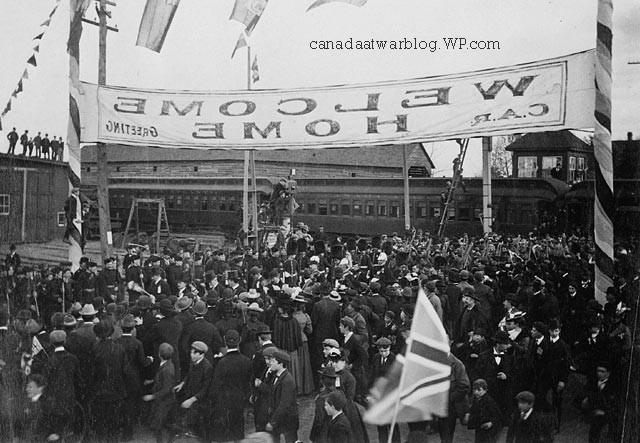 Crowds welcoming home Ottawa's "D" Company at the Canada Atlantic Railway Company's Elgin Street Train Station
Library and Archives Canada, C-007978After completing their one year tour of duty, the first Canadian contingent to fight in the South Africa War returned home aboard the transport ship Idaho. The men were paid off in Halifax with the government also providing them new winter clothes. A special train then carried the veterans westward, dropping off soldiers along the way. Many had brought mementoes home. One man carried a little monkey on his shoulder while another had a parrot in a wooden box. Captain Rogers of Ottawa’s “D” Company brought home a Spitz dog from Cape Town. With the Idaho having stopped in St Helena on the way to Canada, another officer brought home sprigs of the willow trees that grew at Napoleon Bonaparte’s grave.
Thirty-one Ottawa veterans arrived home at 2.45pm on Saturday, 3 November 1900. The famed “Confederation poet,” W. Wilfred Campbell, who lived in Ottawa, penned a poem to welcome them. Titled Return of the Troops, the first verse went:
Canadian heroes hailing home, War-worn and tempest smitten, Who circled leagues of rolling foam, To hold the earth for Britain.
The return of “D” Company was signalled by the ringing of the City Hall bell, a refrain that was taken up by church bells across the city. More than 40,000 flag-waving citizens were in the streets to watch their heroes arrive at the Elgin Street station and march to Parliament Hill to the tunes of Rule Britannia and Soldiers of the Queen. They were joined by other South African veterans who had been invalided home earlier. In the parade were elements of all regiments based in Ottawa, including the 43rd Regiment, the Dragoon Guards, the Field Battery, the Governor General’s Foot Guards and the Army Medical Corps. The parade was led by members of the police force, on foot, horse, and bicycle to clear the streets of well-wishers, followed by members of the reception committee. Also present were veterans of the 1866 and 1870 Fenian raids.
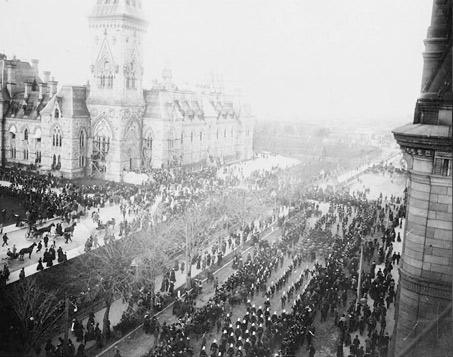 Return of "D" Company, Parade along Wellington Street, 3 November 1900
Library and Archives Canada, C-002067Along the parade route, homes and stores were bedecked with flags, bunting and streamers. Store fronts and window displays were also decorated in patriotic themes. In the window of George Blyth & Son was a figure of Queen Victoria in a triumphal arch with two khaki-clad soldiers standing in salute. In the background was a canvas tent. The words “Soldiers of the Queen” were written in roses in the foreground. Ross & Company displayed a crowned figure with a sceptre in her hand being saluted by two sailors. R.J. Devlin’s and R. Masson’s stores were lit with electrical lights with Queen Victoria’s cypher, “V.R.” displayed over their doors in large letters. The Ottawa Electric Company building on the corner of Sparks and Elgin Streets was draped in bunting, flags and strands of electric lights. Above the main entrance there was a large maple leaf and beaver in coloured lights. Not to be left out, the usually staid citizens of Ottawa were also patriotically dressed. Women wore little flags in the hats while young men had flags for vests.
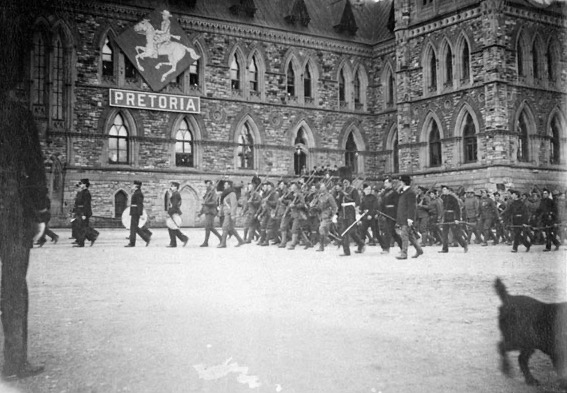 "D" Company parading in front of the central block on Parliament Hill, 3 November 1900
Library and Archives Canada, Mikkan No. 3407088Parliament Hill was decorated to greet the return of “D” Company. The central block was ornamented by two large pictures picked out in electric lights on either side of the main entrance. On the left was a soldier charging with a rifle in hand with the word “Paardeberg” underneath. On the right was a trooper on horseback with the word “Pretoria,” underneath. Other emblems mounted on the towers included “VRI,” which stood for Victoria Regina Imperatrix, over the main entrance, as well as a crown, maple leaf and beaver. All were illuminated with electric lights. Strings of lights also stretched from the Victoria Tower in the centre of the main block to the east and west corners of the building.
The returning soldiers marched in the khaki uniforms that they had worn in South Africa. As they passed by the cheering multitudes, men from the crowd jumped into the ranks to shake the hand of a friend or family member. At times the police had difficulty in controlling the seething crowd. The Journal reported that on a couple of occasions, “the police, without warning, caught the eager relative of the long-absent warrior by the throat and hurled him back into the crowd.”
On Parliament Hill, the veterans were welcomed home by Lord Minto, the Governor General, who told the troops that he was proud “to be able to receive the Ottawa contingent into the Capital of the Dominion, the Ottawa representatives of the regiment that won glory for Canada at Paardeberg.” He then read out a message of thanks from Queen Victoria. This was followed by speeches from the Hon. W. R. Scott, secretary of state, and Ottawa’s Mayor Payment.
Ottawa sparkled that night. In addition to the lights on Parliament Hill that scintillated like diamonds, Sparks Street was ablaze with strings of Chinese lanterns strung across the road from Bank Street to Sappers’ Bridge. Electric lights illuminated Wellington Street. The words “Our Boys,” and “Welcome Home” were written in lights on the Victoria Chambers and the Bank of Montreal buildings.
The following Monday evening, another reception was held in honour of returning heroes at Lansdowne Park in the Aberdeen Pavilion. Close to ten thousand people cheered the Ottawa veterans. The biggest cheer was reserved for Private R. R. Thompson who had received the “Queen’s scarf” for bravery. The scarf was one of eight personally crocheted by Queen Victoria to be awarded to private soldiers for outstanding bravery in the South African conflict. Thompson had received his award for aiding wounded comrades at Paardeberg.
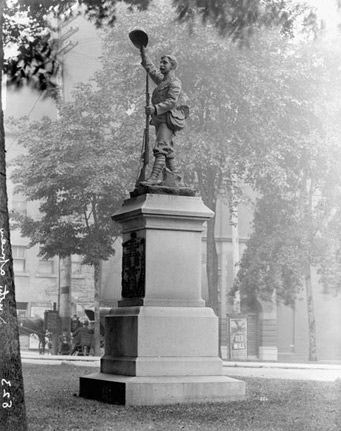 Boer War statue honouring Ottawa soldiers who died in the South African War once stood on Elgin Street in front of the City Hall which burnt down in 1931. It currently stands in Confederation Park
Topley Studios, Library and Archives Canada, PA-008912Canadians everywhere basked in the reflected glory of their returning heroes from the South Africa War with celebrations across the country. Canada had done its part in preserving the honour of Queen and Empire. Moreover, Canadian soldiers were seen as equals of the finest in the British Army. The Journal wrote: “One year ago they left a country that was little known to the world, save as a prosperous colony; only one year, and they returned to find a nation; a nation glorying in its newly acquired honor, and a nation that does them homage as the purchasers of that honor.” In an editorial titled Patriotism and Loyalty, the newspaper added that “Canadians have always been both patriotic and loyal to the Mother Country.” But now “the fruits of confederation have suddenly ripened, and we have begun to feel our nation-hood.”
Canadian soldiers subsequently gained distinction in later battles in South Africa, including at Leliefontein and Boschbult. Four Canadians received the Victoria Cross for valour during the war. In total, more than 7,000 Canadian soldiers and twelve nurses volunteered to serve in South Africa, of whom 267 died and whose names are recorded in the Book of Remembrance of the Canadian service personnel who have given their lives since Confederation while serving their country. In Ottawa, 30,000 children donated their allowances to build a statue to honour the sixteen Ottawa volunteers who died in the conflict.
After the Imperial forces defeated Boer armies on the field in 1900, the Boers resorted to guerrilla warfare for the next two years before surrendering. The British responded with a scorched earth policy and placed Boer women and children in concentration camps. Owing to neglect and disease due to overcrowding, tens of thousands of civilians died. Non-combatant deaths exceeded 43,000 including Afrikaaner women and children and black Africans. More than 22,000 British and allied soldiers died in the three-year conflict, while suffering a similar number of wounded. Boer military deaths numbered more than 6,000.
Sources:
BBC. 2010. “Second Boer War records database goes online,” 24 June.
Canadian War Museum, 2017. Canada & The South African War, 1899-1902.
Evening Citizen (The), 1900. “The Canadians Are At Halifax,” 1 November.
————————–, 1900. “The Boys Will Be Here On Time,” 3 November.
————————–, 1900. “It Was A Right Royal Welcome They Received,” 5 November.
————————–, 1900. “Form Paardeberg to Pretoria,” 5 November.
Evening Journal (The), 1899. “A Canadian Contingent,” 13 October.
————————————-, 1899. “Have Gone to Defend the Honor of Britain,” 25 October.
————————————-, 1900. “With the Ottawa Boys Down at the Citadel,” 30 October.
————————————-, 1900. “Return of “D” Company, 3 November.
————————————-, 1900. “Return of the Troops,” 3 November.
————————————-, 1900. “Patriotism and Loyalty,” 5 November.
————————————-, 1900, “Forty Thousand Glad Acclaims to Ottawa’s Brave Soldiers. 5 November.
————————————-, 1900. “Gold lockets Given to Ottawa’s Gallant Soldiers,” 6 November.
McKay, Ian & Swift, Jamie, 2016. The Vimy Trap: Or, How We Learned to Stop Worrying and Love the Great War, Toronto: Between the Lines.
Miller, Carmen & Foot, Richard, 2016. “Canada and the South African War,” Historica Canada.
New Zealand History, 2017. South African War.
Pretorius, Fransjohan, 2014. “The Boer Wars,” BBC.
South African History Online, 2017. Second Anglo-Boer War, 1899-1902.
Story written by James Powell, the author of the blog Today in Ottawa's History.
Retired from the Bank of Canada, James is the author or co-author of three books dealing with some aspect of Canadian history. These comprise: A History of the Canadian Dollar, 2005, Bank of Canada, The Bank of Canada of James Elliott Coyne: Challenges, Confrontation and Change,” 2009, Queen’s University Press, and with Jill Moxley, Faking It! A History of Counterfeiting in Canada, 2013, General Store Publishing House, Renfrew, Ontario. James is a Director of The Historical Society of Ottawa.
Quick Links
About
Supporting Partners