

Working to preserve Ottawa's past
for future generations.
Ottawa... Then & Now
Artist Catherine Willis-O’Connor began contemplating how the arrival of the Ottawa’s LRT would soon impact neighbourhood culture, and so she set out to capture the memories of the businesses, houses, parks and streetscapes that have come to define our city’s ambiance.
Join Catherine as she animates Ottawa’s past by guiding us through her joyous paintings, each of which promises to unleash a treasure trove of memories.
Media
On Tuesday, August 18, 2026, the Museum Club undertook its final outing of the season, a trip to Perth to visit the Perth Museum and to learn the history of the Tay Canal. We were welcomed on our arrival by Kathryn Jamieson, Manager of Tourism & Culture for the Town of Perth, who had been instrumental in making all the arrangements for our visit. Though 24 of our members had registered, only 17 were able to attend on the day, but boy!, were they ever treated to a wonderful time.
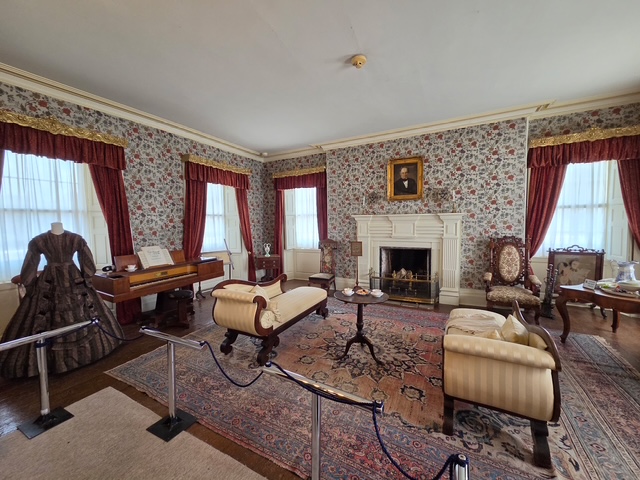 Perth Museum 2nd floor parlor photo by Justin Lacasse.
We started our day with a guided tour of the 1 st and 2 nd floor of the Perth Museum, 11 Gore Street East, the former Matheson House. Our guide, Debbie Sproule, had an encyclopedic knowledge of the history of the Matheson family, the house and seemingly every artifact contained there-in. Her presentations as she led us through the rooms were both highly informative and often amusing as she revealed the history of the house, and the community as a whole. Following the tour, we were invited to explore the other artifacts on display on the 3 rd floor and to visit the Information Centre and gift shop on the ground floor. We all took advantage.
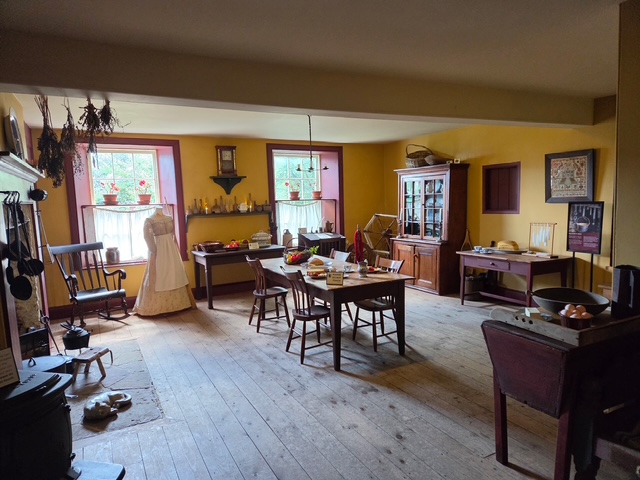 Perth Heritage Museum kitchen photo by Justin Lacasse.
After our tour, we took the short walk to Fiddleheads, 53 Herriott Street, accompanied by Debbie and Susan Code McDougall, who was our guide for the afternoon walking tour. Once our orders had been placed, and many of us were happily sipping on a locally produced beverage, Susan gave us a talk on the history of the two Tay Canals. The first Tay Canal was completed in 1834 and connected Perth to the mouth of the Tay River. Built by the Tay Navigation Company to take advantage of the economic opportunities offered by linking to the now completed Rideau Canal, the Tay Canal consisted of 5 locks and was narrower and shallower than the Rideau Canal. Though suitable for barge traffic hauled along a tow path, it was not suitable for steamship use and was never a commercial success. It soon fell into disrepair and was abandoned. In the 1880s, there was renewed interest in a Tay Canal, initiated by the local M.P., John G. Haggart. The canal would be known locally as “Haggart’s Ditch”. It was built to the same specifications as the Rideau Canal, using a revised route from Perth to a set of 2 locks at Beveridge Bay on the Lower Rideau Lake. The canal is run today by Parks Canada and is part of their Rideau Canal system.
Susan then took us on a walk through Code Park and Stewart Park, explaining their industrial heritage, mainly in distilling, and noted that Stewart Park had been gifted to the Town of Perth with several conditions, one being that no economic activity could take place within the park. As such, the annual Stewart Park Music Festival is free, and the vendors, including the food trucks, line up along the street outside of the park. Crossing Gore Street East, Susan pointed out a number of the historic buildings in the downtown, including the beautiful Town Hall and the former Carnegie Library. As we walked beside the canal, we passed the “Crystal Palace” an event venue, that in its previous life was the ill-fated OC Transpo Bus shelter that stretched along both sides of Rideau Street, east from the Rideau Centre for a couple of blocks. Reaching the old tow path at the swing bridge at Beckwith Street, we ended the formal part of our visit, several of us stopping in at Bridge Masters Brewing Company, 29 Beckwith Street East, for a final taste of Perth before heading home.
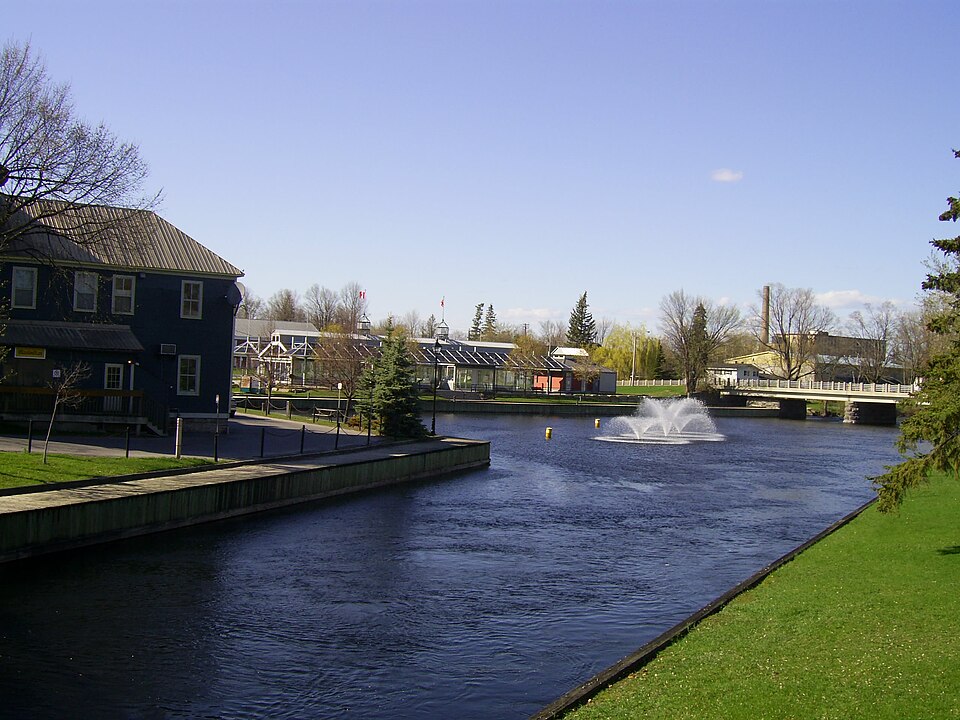 Tay Canal Basin, Perth Ontario. Photo by Kenn Chaplin from Toronto, Canada, CC BY-SA 2.0 , via Wikimedia Commons
Sixty of us gathered in the auditorium of the Main Branch of the Ottawa Public Library on the afternoon of June 20, 2026 to hear a presentation from Glenn Crawford on the history of “Gays of Ottawa”, (GO), the first major social and political 2SLGBTQI+ organization in Ottawa. The presentation was timed to coincide with Pride Month.
Glenn was born in Edmonton but has lived in Ottawa since he was three. He is an entrepreneur/designer with an extensive background in design, service, journalism, art, communications and marketing. In 2021, he relocated his home and business. Jack Of All Trades, to Gatineau. Glenn has been an activist within the 2SLGBTQ+ community in the National Capital area for the past 20 years. In 2007, Glenn won the Capital Extra’s Hero award as Community Activist of the Year and in 2010 he was the Grand Marshall of the Capital Pride Parade. Since 2015, Glenn has been the researcher and creator of the Village Legacy project that documents Queer history in the Ottawa area: The Village Legacy Project | Le Projet de legs du village.
Glenn began by discussing, what he called the “touchy subject” of the various acronyms and abbreviations that are used to describe his community, including: LGB, LGBT, 2SLGBTQ+ and Queer. He explained that there is no term agreed to within the community, but that he would use “Queer” as an umbrella term to represent the whole community, noting that it is not always embraced by all members.
Glenn then described some of the risks of being Queer before the “Liberation Movement”. The risks were many upon discovery: loss of employment, loss of family and friends, loss of housing and the risk of physical assault, even from the police. Isolation was a serious problem, leading to depression, self-destructive behaviours, such as alcohol and drug usage, and suicide. With no organizations and no formal communications, word of mouth was the only means of communications available. There were few Gay bars, many being allegedly Mafia owned. A “Cruising Culture” developed in the male community exposing members and non-members to additional risks. Major’s Hill Park became a well-known venue. The risks faced were tragically illustrated when, on August 21, 1989, 33-year-old Alain Brosseau was assaulted and thrown to his death from the Alexandra Bridge. Brosseau, a waiter at the Château Laurier, and not Gay himself, was attacked by a gang of teens in a targeted homophobic hate crime. The same teens were involved in another targeted attack the same night. The tragic incident sparked public outrage and eventually forced the Ottawa police to start to take anti-Gay violence more seriously.
At the height of the Cold War in the 1950s &1960s, Glenn explained, the RCMP became focused on national security and saw the 2SLGBTQ community as a potential risk. What followed was “The Purge” in which individuals suspected as being queer were hunted down, exposed, threatened, and fired. A special device was “invented” to detect these individuals, known as "The 'Fruit Machine", though its use was more as a tactic of intimidation than any scientific merit. The irony was, of course, that it was the risk of persecution at the hands of the RCMP and other government agencies that created the very threat they feared.
Change was coming, if slowly, and perhaps remarkably it was starting at the top. On February 21, 1967, then Minister of Justice, Pierre Trudeau commented in a press scrum “there’s no place for the state in the bedrooms of the nation” while discussing Bill C-150, which came into effect on August 26, 1969. This was a broad modernization and liberalization of the criminal code and most famously legalized private, consensual sexual acts between adults 21 and older, the age restriction being lowered to 18 in 1972. Another incident that raised public awareness of the persecution being inflicted upon the community was the June 28, 1969 raid on the Stonewall Inn in New York City. The subsequent spontaneous demonstrations are widely regarded as the start of the liberation movement in North America.
With this background, Glenn went on to explain that, sparked by the “We Demand Rally” of August 28, 1971 on Parliament Hill, which had been organized by Gay groups from Toronto to present a list of 10 demands,Gays of Ottawa (GO) was formed on September 14, 1971. The first meeting was held in an apartment on Sommerset Street West, subsequent meetings also being held in private homes, until a space was obtained in the basement of St, George’s Church a few months later. By 1975, GO had moved, and along with public awareness, advocacy and social programming, it had created a newsletter, a helpline and had started a library.
Glenn explained that not all members of the Gay community were comfortable with the efforts of GO. Some believed that the new openness being promoted by GO risked “rocking the boat” and threatened their own carefully balanced double-lives. Despite this, by 1975, and after another move, GO became increasingly involved in the support of the legal defence of individuals being charged with criminal offences or dismissed from their jobs, based solely on their sexual orientation.
Glenn described GO in its early days as primarily a male organization, queer women having different needs and goals and not always being comfortable with the culture of GO. They were also not always welcomed by other feminist organizations, though they shared many of the same objectives. In June 1976, Lesbians of Ottawa Now, (LOON), was formed in preparation for the National Lesbian Conference, which was held in Ottawa that October, with over 300 delegates from across the country. By 1981, however, GO had established gender parity on their Board of Directors.
After two more moves, one the result of a fire of uncertain origins that destroyed all of GO’s materials and records, it settled again and in 1984 split its social services components, such as the helpline and library, away from its political and social activities to form Pink Triangle Services, the first 2SLGBTQ+ registered charity in Canada.
Glenn told us that, in August 1982, near the start of the AIDS epidemic, GO hosted a meeting of over 70 concerned members. Later, in 1985, two of their members were key in forming the AIDS Committee of Ottawa. In total, there were over 350 AIDS related deaths in Ottawa between 1984 and 1995 with almost 9,000 AIDS related deaths in Ontario during the epidemic.
GO moved for the last time in 1985, when their landlord refused to renew their lease. It remained at the new location, above a laundromat, until it ceased operations in 1995, changing its name twice, first to the Association of Lesbians and Gays of Ottawa, and then to the Association of Lesbians, Bisexuals and Gays of Ottawa. Though gone, GO’s legacy lives on in the organizations it spawned, the leaders it inspired and the attitudes it changed.
Lillian Scott Desbarats – Bytown Mayor Richard W. Scott, “Peace Maker” on July 12, 1852
HSO“My father, R. W. Scott (an Irish Catholic) was Mayor of Bytown in 1852, being but 27 at the time. The (Protestant) Orangemen asked him if they could walk in procession through the streets of Bytown on the 12th of July.
He gave them permission to do so. The other (Catholic) Irishmen said, ‘If you let those (Protestant) Orangemen walk, there will be trouble, we will stone them’.
My father said: ‘If you do, you will stone me, I am going to head the procession’ and so he did. (I have heard it said that he rode a white horse, but I am sorry to say that is not true.)
He lived in Lower Town; from there he drove a horse and buggy on to the Sappers Bridge, and when the Orange Parade came along he joined it, leading them all through Lower Town.
Not a stone was thrown, but he was defeated for Mayor when the elections came around. The Irish Catholics wouldn't vote for him because he joined an Orange procession, and the Orangemen wouldn't vote for him because he was Catholic."
The above is a short excerpt from “The Irish Settlers of Bytown and Early Ottawa", a chapter from Lillian Scott Desbarats' fascinating memoir, “Recollections", published in 1957, in which she recalls the time her father, Richard Scott, tried to play “peace maker” in pre-Confederation Bytown.
View the accompanying document for her full text regarding her father’s exploits on July 12, 1952: The Irish Settlers of Bytown.
Richard W. Scott survived this defeat and went on to an extraordinary career in the Ontario Legislature and Canadian Parliament, serving as Secretary of State in the Cabinets of both Alexander Mackenzie (1874-1878) and Wilfrid Laurier (1895-1908) and serving in the Senate until 1913.
Sir Richard Scott was one of the leading proponents behind Ottawa’s eventual choice as Canada's capital. He was also responsible for the 1863 Scott Act guaranteeing the right to separate schools in Ontario and the 1878 Scott (Temperance) Act allowing counties and municipalities to prohibit the sale of liquor.
In Bytown Pamphlets #80, #81, #82 and #84 we have published further excerpts from Lillian Scott Desbarats’ 1957 memoir “Recollections”: www.historicalsocietyottawa.ca/publications/bytown-pamphlets
Billings Estate National Historic Site Tour: Seeing History Preserved
Zoe-Elizabeth CookOn July 3rd 2026, the Museum Club visited the Billings Estate National Historic Site. Our guide Aiden led us through a detailed tour of the estate that went over the contributions of the five generations that lived in this house, on the property and to the surrounding community.
The home had been built by Braddish Billings, after his wife Lamira Dow didn’t like the home that he had on the shores of the Rideau River. We began the tour in what used to be the family kitchen, with the original stove still installed. The family later installed a second kitchen (where the lobby of the estate now is), to be used during the summer, as the stove would get too hot to use. Eventually the stove was boarded over, to be found later and the summer kitchen was the only one in use. The room also contained the complete family tree of the Billings family with details about their life. Braddish and Lamira had 9 children, 7 of whom reached adulthood.
Here we got our first insight into the contributions of the Billings family to their community, as we learned that Lamira had been a schoolteacher who was heavily involved in education so her children were quite well educated and the Billings family built the first schoolhouse in Ottawa. Braddish also made contributions with his ice business and by selling goods to lumber workers for the Rideau Canal.
In the second room we went into there were numerous artifacts on display and we learnt a bit more about two of Braddish and Lamira’s children, Sabra and Sally Billings. Braddish had gone against the societal norms with the ownership of his property as he left the home to his two eldest daughters rather than his oldest son. The daughters continued the Billings family style of contributions to their community with both of them helping with the dairy business and helping with the fruit and vegetable gardens on the property whose goods were sold in the Byward Market. The sisters ended up splitting the house, with each of them getting a half. This led to the addition of another room which was Sally’s dining room (now used to display information about the dairy business that the Billing’s had), which still has its original windows to this day.
The last room that we went to on the first floor was one that served multiple purposes over the years. It was initially built for Lamira and Braddish as they grew too old to go up the stairs, then it was used as Sabra’s music room, and later it was used by Sally and Sabra’s nephew Charles Murray Billings as an office.
Our tour continued upstairs as we entered what was referred to as “the green room”. The room has had multiple uses over the years and its wallpaper demonstrates the care that the Billings Estate has taken to preserve its historical accuracy. The wallpaper colour was determined by taking paint chips from around the house to figure out what the most used colour was, resulting in the green colour visible in the room. There were also maple leafs on the wallpaper to represent the contributions that the Billings family had on Canada. Currently this room is serving as a temporary exhibition called “Beyond the Brim: Tales Told Through the Hats We Wore” which has numerous hats on display with the stories of the individuals who wore them and their impact on Canada. Using this room as an exhibition room was another way of giving back to the community the same way that the Billings Family did.
The final room that we went into had been Beatrice Lindsay Billings’ (wife of Charles Alexander Billings). The room has two key pieces to it that showed the historical touches still present in the house. One of them is the original flowered wallpaper that was kept in one area behind a door in the room (pictured below). The other connects the generations together, it’s the ceramic doorknob leading to the room. One side is from Beatrice’s time, and the other side contains the Cypher of William, showing that it was from the first generation of this house.
 The preserved wallpaper at the Billings Estate. Photo by Emma Kent.
A big thank you to our tour guide Aiden, and to the Billings Estate for having us. Our tour was so popular that it sold out, but there is another opportunity to see this amazing property with the Museum Club on August 7, 2026!
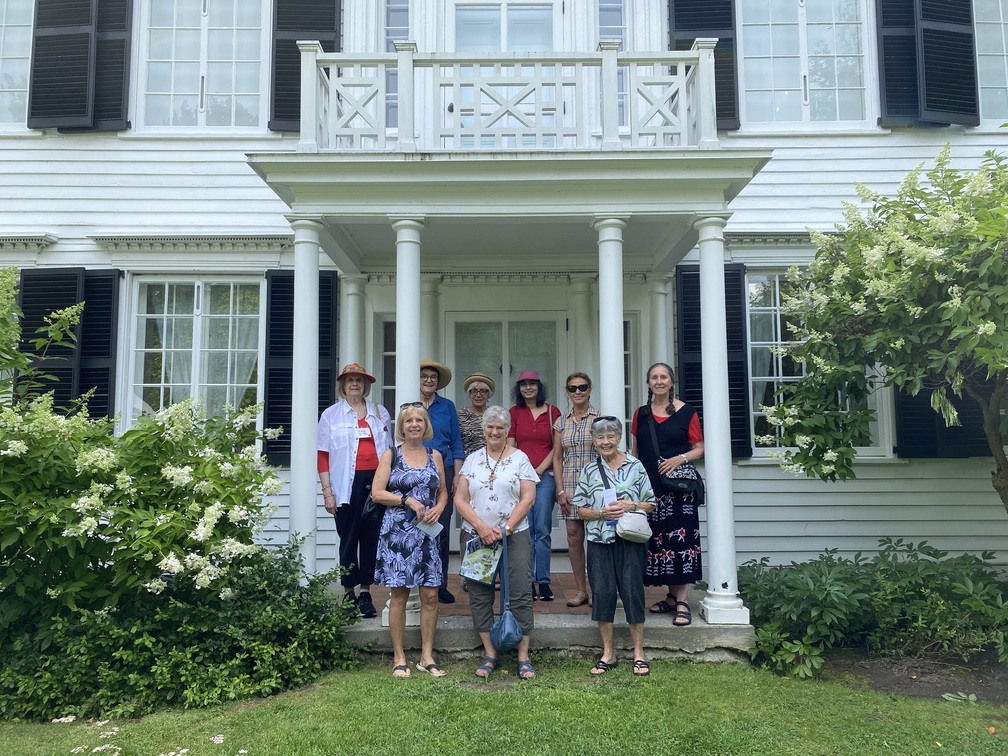 The Museum Club at the Billings Estate National Historic Site on August 7, 2026. Photo by Zoe-Elizabeth Cook.
On August 7th, the Museum Club returned to Billings Estate for another tour, this time given by Nyah. A big thank you to her and to the Billings Estate National Historic Site for having us back for a second time.
Hamnet Pinhey Hill – LeBreton’s Influence on the Route of the Rideau Canal: Historical Fact… or Myth?
HSOA favourite tale of Ottawa lore, re-told repeatedly, is the intriguing story that a plan to place the Rideau Canal entrance at LeBreton Flats was changed because of Lord Dalhousie’s anger at Captain John LeBreton, who the Governor General believed had used privileged information of the plan to purchase Lot 40 (the planned location) for personal gain.
Historians, however, as far back as Hamnet Pinhey Hill in 1919, have persevered to dispel the apparently groundless legend that this dispute actually had any impact on plans for the Rideau Canal.
Reproducing primary sources, including the full written accounts of both Dalhousie and LeBreton, Hill attests that the story of canal plans playing a part in the matter is without basis – the only plan figuring into Dalhousie’s anger having been one for placement of a storehouse to serve the terminus of the Richmond Road.
As per Hill: “There was however, an unpleasant misunderstanding between Lord Dalhousie and LeBreton over his purchase of Lot 40 at the sale, and the freedom with which Dalhousie vented his indignation probably accounts for the distorted story”.
Hill maintains that the land purchase disputed between Dalhousie and LeBreton had been in regard to planned use of the lot for a storehouse, not for the Rideau Canal.
Here is the link to the essay penned in 1919 by Hamnet Pinhey Hill, a local lawyer, MLA for Ottawa West and great-grandson of early March Township landowner Hamnet Pinhey.
We invite you to read Chapter V (pages 28-39), which will prove to be of particular interest to this long-running debate, as to whether the legend of the Dalhousie/LeBreton/Rideau Canal "scandal" is historical fact... or myth.
Jean-Luc Pilon & Randy Boswell – Below the Falls: An Ancient Cultural Landscape in the Midst of Canada’s National Capital Region
HSORecent discoveries, combined with archaeological evidence accumulated in the past, has made it apparent that the north shore of the Ottawa River, between the Chaudière Falls and the mouth of the Gatineau River, constituted a cultural landscape dating back more than 4,000 years -- millennia before the establishment of Bytown and the start of the Rideau Canal.
Evidence has been found at Hull Landing (today the site of the Canadian Museum of History) of an ancient burial ground used as long ago as 4,500 to 4,900 years. That same location served as the beginning of a major portage.
This portage, of course, was required to navigate around the nearby Chaudière Falls, itself, for thousands of years, a place of great spiritual significance and power.
Downstream, the delta of the Gatineau River was a summer gathering place providing a wealth of food and resources such as for making stone implements..
Both the Gatineau River and the nearby Rideau River had been bringing travellers together to meet, trade and exchange information for as many as 4,600 years.
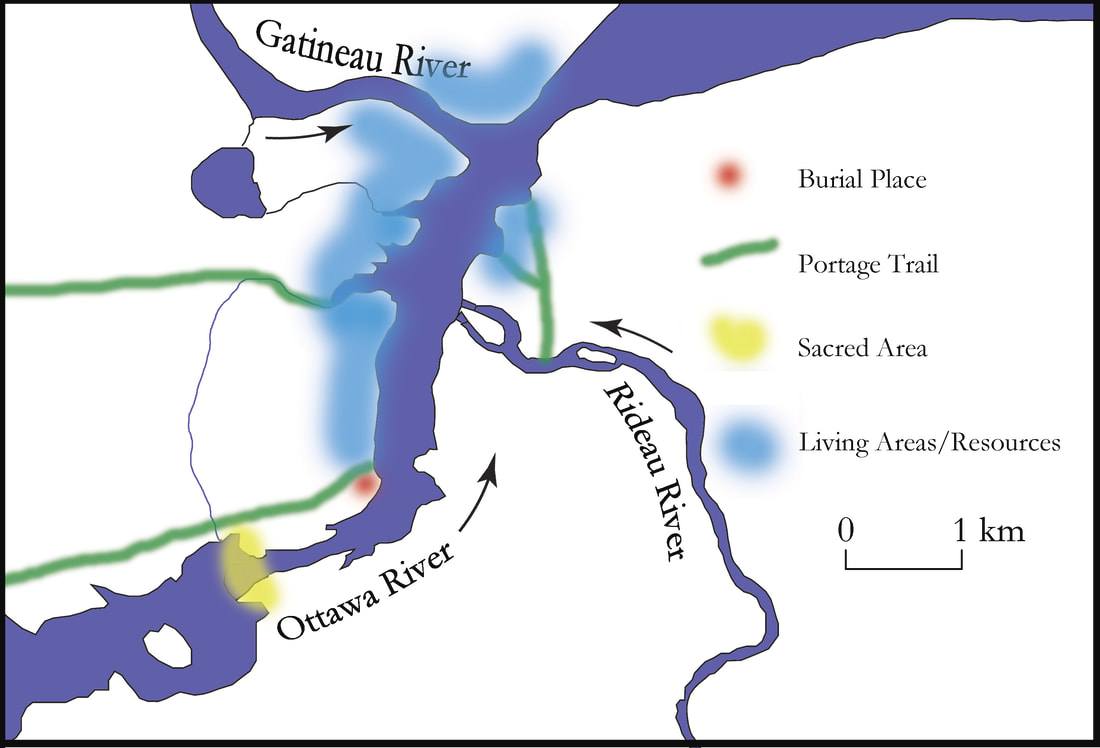
In the attached two articles, originally published in the Canadian Journal of Archaeology in 2015, professor and journalist Randy Boswell and renowned archaeologist Jean-Luc Pilon delve into the great significance of this important archaeological zone, located, by ironic happenstance, at the core of Canada’s national capital, and counting among its “tenants”, the Canadian Museum of History.
In the second of the two articles, we learn more specifically about how the findings from this site impacted in the origins of Canadian archaeology, the formations of Canada’s first museums and the important role played by Bytown-era physician Dr. Edward Van Cortlandt in the early investigation and exhibition of Canada’s prehistoric past:
"Below the Falls; An Ancient Cultural Landscape in the Centre of (Canada’s National Capital Region) Gatineau": pilon-boswell-cja.pdf
"The Archaeological Legacy of Dr. Edward Van Cortlandt": boswell-pilon-cja.pdf
Elsewhere in the HSO Bytown200 Bicentennial Story Collection, Algonquin elder Albert Dumont and Algonquin author Dr. Lynn Gehl have both written about the historic and spiritual significance of the Chaudière Falls and surrounding area:
Albert Dumont The Kettle of Boiling Waters Chaudiere Falls Algonquin Territory
Patty Mooney – The Woman at the Lock: The Unrecorded Year at Narrows Lock
HSOHas a gap in the official record at Narrows Lock, between 1896 and 1897, concealed that truth that the lock was actually maintained by the Rideau Canal’s first female lockmaster during that period?
Three generations of the Mooney family (all named Michael Mooney) served as lockmaster at Narrows Lock, spanning 87 of the lock’s first 122 years of operation.
During the unexplained period in question, no name is listed, yet the lock kept running, the boats kept moving -- someone kept the gates.
Kate Carty Mooney had lived at the lock station her entire married life. She understood the water levels, the boats, the seasons, and the weight of responsibility the lock carried.
In her submission to the HSO Bytown200 Bicentennial Storytelling Challenge, filmmaker, writer, musical artist Patty Mooney mines family memory and public records to make the case that, from the time her great-grandfather died, until his son was appointed the next year, it was more than likely Patty’s great-grandmother Kate Carty Mooney who had stepped in as lockmaster at Narrows Lock.
The Woman at the Lock
Kate Carty Mooney and the Unrecorded Year at Narrows Lock
There is a gap in the official record at Narrows Lock on the Rideau Canal. Between the death of Lockmaster Michael Mooney Jr. and the formal reappointment of his son Edmund, known to everyone as Ebb, in 1897, the Parks Canada lockmasters document lists no name. The lock kept running. The boats kept moving. Someone kept the gates.
That someone, according to family history passed down through four generations, was Kate Carty Mooney: wife of Michael Mooney Jr., mother of Ebb, and, in the memory of all who knew the family, the first woman to hold the gates at Narrows Lock.
This is her story, as best as it can be told from family memory, public records, and the silences that speak as loudly as the documents themselves.
The Carty Family: Roots in Canada West
Before Kate Carty became Kate Carty Mooney, her family had already established deep roots in Canada West. A death notice in The Ontario Reporter, published in Whitby, Canada West on September 13, 1851, records the death of John Carty, placing the Carty family in Ontario five years before the first Michael Mooney took up his post at Narrows Lock. The Carty family was part of the great wave of Irish emigrants who made Canada their home in the mid-nineteenth century, arriving with faith, industry, and a determination to build something lasting in a new country.
That determination proved generational. A Westport, Ontario birth register from 1906, the same year Father Tom Mooney was born in that same town, records the birth of Kathleen Carty on April 30th, daughter of D. Carty and Anastasia Welch, father's occupation listed as Railroad Trainman, residence Westport. The Carty family remained in the Westport community, living alongside the Mooneys, for decades after Kate's marriage. The two families were woven together not just by marriage but by place, by community, and by the shared life of a small Ontario town on the shores of Upper Rideau Lake.
When Kate Carty married Michael Mooney Jr. and came to Narrows Lock, she was not a stranger to the region. She was a daughter of it.
Three Michaels and a Canal
The Mooney family's connection to Narrows Lock is one of the most remarkable in the history of the Rideau Canal. Three generations, all named Michael Mooney, held the position of lockmaster there, spanning 87 of the first 112 years of the lock's operation. As family cousin Jim Bulger has observed, after all that service, the lock could well have been renamed Mooney's Lock.
The first Michael Mooney and his wife Jane Cain were both born in Ireland but emigrated to Canada, where Michael became lockmaster at Narrows Lock from 1856 to 1871. His son, Michael Mooney Jr., took over in 1871 and served until his death in 1894. Together, father and son gave the lock more than three decades of continuous Mooney stewardship. The family became so woven into the identity of the place that Mooney's Bay, now a beloved public park on the Rideau River in Ottawa, carries their name to this day.
Michael Mooney Jr. married Kate Carty, and together they raised nine children at the lock station, among them John Henry Mooney (my grandfather) and Michael Edmund Mooney, known to everyone as Ebb. Ebb grew up watching his father and grandfather work the gates, learning the rhythms of the water and the seasons from the people who knew them best.
Ebb would go on to marry Anna Cecelia Mooney, known warmly to family and friends as Birdie. By all family accounts, Ebb and Birdie were exemplary people in every respect. Their son, Father Thomas Edmund Mooney, was born in Westport, Ontario on January 21, 1906, within sight of the lock his great-grandfather had first tended fifty years before. He earned a Bachelor of Arts from the University of Toronto and diplomas from the Pius X School of Music in New York and became Director of Music at St. Mary's Roman Catholic Cathedral in Kingston, beloved by his congregation and widely admired across the diocese.
When war came, Father Tom volunteered as a chaplain in the Canadian Army. Before he was killed ministering to the wounded at Ouse Camp, Belgium, on September 14, 1944, he wrote a letter to his mother. The Toronto Daily Star of September 26, 1945, quoted his words when the story was shared at the 12th annual meeting of the Canadian Catholic Historical Association: "If I am killed, I am not afraid. The only important thing is to be ready to face God, and I am ready. Somehow it wouldn't seem so useless if one 'got it' here." He was 38 years old. He was believed to be the first Canadian Catholic Chaplain reported killed in action in the Second World War.
He is buried at Adegem Canadian War Cemetery in Belgium, Plot X, Row A, Grave 8. His headstone carries the inscription: 'Greater love than this no man hath' and 'Caritas Christi urgetnos,' the love of Christ compels us. He is commemorated on Page 397 of the Second World War Book of Remembrance. His life was honoured further by the naming of Mooney Creek in the Yukon Territory. His story was told in a small booklet, 'A White Knight of God,' written by Rev. D.A. Casey. A creek in the Canadian wilderness, a headstone in Belgium, a page in the Book of Remembrance: the family's reach across this country, and across its history, runs deep.
The memorial service held for Father Tom at St. Mary's remains among the very largest in the history of the City of Kingston. People and clergy from all faiths and all walks of life came to pay their respects. Family cousin Jim Bulger recalls that Carmel Patterson Bulger, who attended the service, said she had never seen her mother cry until she came home from Father Tom's memorial. She was not alone in expressing her sorrow that way.
The Mooneys of Narrows Lock were, in every generation, people who gave themselves fully to something larger than themselves. From Kate at the lock gates to Father Tom at the front, the family's story is one of service, sacrifice, and an unbroken commitment to the communities they called home.
Kate at the Lock
When Michael Mooney Jr. died in 1894, the question of the lock's continuity arose immediately. Kate's brother, William Carty, stepped in to hold the position. Then in the summer of 1895, Kate's son Ebb took over temporarily. Ebb was discharged in late 1896, and the Parks Canada compilation of Rideau Canal lockmasters, assembled from primary sources by Ellen Manchee and updated through 2007, records no lockmaster at Narrows Lock for the period between that discharge and Ebb's permanent reappointment in 1897.
In the language of official records, this is simply a blank. No name, no date, no note.
In the language of family memory, this is Kate.
Family members recall that Kate Carty Mooney served as lockmaster during the time between her husband's death and when her son took over permanently. She knew the work intimately. She had lived at the lock station her entire married life, raising nine children there while watching three generations of her family work the gates. She understood the water levels, the boats, the seasons, and the weight of responsibility the lock carried. When the station needed her, she was ready.
This account is carried in family memory and has not found its way into the official record of the Rideau Canal. The appointment ledgers of the Department of Public Works recorded formal titles, and formal titles in that era went to men. Kate kept her own record in the way that mattered most: the lock ran, the boats passed through, and four generations of family remember who made that happen.
Why This Story Belongs in the Record
The HSO Bytown200 storytelling challenge specifically invites stories about people whose contributions have not been fully captured in the historical record. Kate Carty Mooney is precisely that person.
If family history is accurate, and the timeline fits, the gap is real, and no contradictory record has been found, then Kate was doing the work of lockmaster on one of the Rideau Canal's busiest stations at a pioneering moment: a woman holding the gates at a time when such a role had belonged exclusively to men. She kept the lock running because it needed to be kept running, and she was the one who knew how.
Women's contributions to the Rideau Canal's history have long lived in exactly this kind of space: visible in family memory, present in the daily work of the stations, and largely absent from the formal record. The Bytown bicentennial is an opportunity to say, plainly and for the record: there was a woman here, and her name was Kate Carty Mooney.
What the Record Does Confirm
The following facts are documented in public sources and are consistent with the family's account:
The first Michael Mooney and his wife Jane Cain emigrated from Ireland to Canada, where Michael served as lockmaster at Narrows Lock from 1856 to 1871.
Michael Mooney Jr., son of Michael and Jane, married Kate Carty and together they had nine children. He served as lockmaster from 1871 until his death in 1894.
Following Michael Jr.'s death, Kate's brother William Carty held the position. Ebb then took over temporarily in the summer of 1895, was discharged in late 1896, and was reappointed permanently in 1897, serving until 1946, a tenure of fifty years.
Three generations of Michael Mooneys served as lockmaster at Narrows Lock, covering 87 years of the lock's history. Mooney's Bay in Ottawa is named for the family.
The Parks Canada lockmasters document records no official lockmaster at Narrows Lock between Ebb's 1896 discharge and his 1897 reappointment.
Father Thomas Edmund Mooney, son of Ebb and Anna Cecelia, and great-grandson of Kate, was born in Westport, Ontario on January 21, 1906. He earned a B.A. from the University of Toronto and diplomas from the Pius X School of Music in New York. He served as Director of Music at St. Mary's Roman Catholic Cathedral in Kingston before volunteering as a Canadian Army chaplain. He was killed in action at Ouse Camp, Belgium, on September 14, 1944, age 38, and is buried at Adegem Canadian War Cemetery, Plot X, Row A, Grave 8. His death certificate, graves registration documents, cemetery headstone schedule, the Book of Remembrance (Page 397), the Toronto Daily Star, The Observer of the Rockford Diocese, and The Guardian of March 1945 all confirm these details. He was the first Canadian Catholic Chaplain reported killed in action in the Second World War. Mooney Creek in the Yukon Territory was named in his honour.
The Carty family's presence in Canada West is documented as early as 1851, when a death notice for John Carty appeared in The Ontario Reporter of Whitby, Canada West, on September 13, 1851. This places the Carty family in Ontario five years before the first Michael Mooney took up the Narrows Lock post, establishing Kate's family as long-settled Canadians before her marriage.
A Westport, Ontario birth register from 1906 records the birth of Kathleen Carty, daughter of D. Carty and Anastasia Welch, with a Westport residence, confirming that members of the Carty family remained in the Westport and Narrows Lock community into the twentieth century, living alongside the Mooneys across generations.
Archives Ontario holds a photograph of the Carty family at Narrows Lock circa 1916, further confirming the family's enduring presence at the station across generations.
Family tradition also holds that a Carty Point near the Narrows Lock area carries the family name, though this has not yet been confirmed through the Canadian Geographical Names Database and warrants further local research.
Family members recall that Kate served as lockmaster during the period between her husband's death and when her son took over permanently. The lock's long continuity under Mooney and Carty stewardship, and Kate's lifelong presence at the station, make this account entirely consistent with what the written record shows.
The Story Lives in the Family
When photographs of Kate Carty Mooney were recently shared within an online family history community, the response confirmed something important: this story is carried independently across more than one branch of the family.
Linda Diane Crump Kenney wrote: "We got the same story from Maureen Murray Kenney, born May 1940 and married to Wilfred Kenney. Maureen's mother, Anne Mooney Murray, must be your Dad's cousin. She would have been born around 1910 and graduated as a nurse from Hotel Dieu Hospital in Kingston in the late 1930s."
Anne Mooney Murray was a daughter of the Mooney family, from a different line than the submitter's own. The fact that she passed the same account of Kate to her daughter Maureen, who passed it to Linda, means this memory was alive in at least two separate branches of the family simultaneously, preserved independently and consistently over generations.
A commenter in the same thread, noting the 200th anniversary of the Rideau Canal, observed that the story of the first female lockmaster would be a wonderful contribution to the historical record. That observation is the direct inspiration for this submission.
Oral history that survives across multiple independent family lines, telling the same story in the same terms, carries a particular kind of authority. Kate Carty Mooney kept the lock. Her family remembers. And now, two centuries after the canal first opened its gates, it is time to write it down.
Primary Documents Accompanying This Submission
The following original documents are submitted with this account as supporting evidence for the history of Father Thomas Edmund Mooney and the Mooney family of Narrows Lock:
Military death certificate: Rank H/Captain Thomas Edmund Mooney, Canadian Chaplain Services, killed in action Belgium, 14th September 1944. Next of kin listed as Mr. Michael Edmund Mooney (father), R.R. #1, Westport, Ontario.
Graves Registration Report Form: Adegem Canadian War Cemetery, Belgium, Schedule No. 65, certified October 1955. Confirms burial at Plot X, Row A, Grave 8.
Graves Concentration Report Form: Adegem CDN Military Cemetery, E. Flanders. Confirms reburial from Moerbrugge on 21 June 1945.
Cemetery headstone Schedule A: Records the full inscription on Father Tom's headstone: 'Chaplain to the Forces / The Rev. T.E. Mooney, BA. / Canadian Chaplain Service / 14th September 1944 Age 38 / Greater love than this / No man hath / Caritas Christi urgetnos / R.I.P.'
Adegem Canadian War Cemetery register page: Confirms full biographical details including parentage, education, and role as Director of Music, Kingston Cathedral.
Second World War Book of Remembrance, Page 397: Lists H/Capt Mooney, Thomas Edmund, CCS.
Toronto Daily Star, Wednesday September 26, 1945: Headline 'If I'm Killed, I'm Not Afraid: Heroic Padre's Last Words.' Reports Father Tom's letter to his mother written before his death.
The Observer (Official Organ of the Rockford Diocese), October 29, 1944: Photograph of Father Tom with caption confirming he was the first Canadian Catholic chaplain reported killed in action.
The Ontario Reporter, Whitby, Canada West, September 13, 1851, Vol. 2, No. 22: Contains a notice recording the death of John Carty, establishing the Carty family's presence in Canada West five years before the first Michael Mooney became lockmaster at Narrows Lock.
Westport, Ontario birth register, 1906: Records the birth of Kathleen Carty, daughter of D. Carty and Anastasia Welch, resident of Westport, confirming the Carty family's continued presence in the Westport community in the same year Father Tom Mooney was born there.
A Personal Note from the Submitter
My name is Patty Mooney. I am a filmmaker and musician based in San Diego, California, and Kate Carty Mooney is my great-grandmother.
I grew up knowing her name. I knew she had kept the lock. I knew it was something the family was proud of, in the quiet way families hold onto the things that were always understood but never written down. Researching this submission, in the context of the Rideau Canal's 200th anniversary, brought me to the gap in the official record that makes her story a genuine historical question worth asking.
I am submitting this story in the hope that it will encourage further research. If there are parish records, Department of Public Works correspondence, boat passage logs, or any other documentation from Narrows Lock in the 1894 to 1897 period that might shed light on who was operating the station day to day, I would be deeply grateful to know of them. The family's memory is strong, it is consistent across branches, and it deserves a place in the written record.
Kate Carty Mooney kept the lock. The boats passed through. The water did what water does. And for her unrecorded time at the gates of one of the oldest continuously operated canal systems in North America, she deserves to be remembered by name.
On Tuesday June 9. 2026, the HSO Museum Club had the privilege of visiting Beechwood Cemetery for a tour, led by Nicolas McCarthy, about the history of Bytown and the role that Beechwood played in it.
As the tour began, we learnt that Beechwood is a non-denominational cemetery which could be seen in the layout of the plots and in the symbols present throughout the cemetery. Our first stop as we walked was the gazebo on the property that provides a gorgeous view of Parliament Hill, which is fitting given the industry and jobs that Parliament Hill brought to Ottawa. The spot also showed us how integrated the cemetery is within Ottawa and Bytown history as Tommy Douglas, the man responsible for the preservation of that view, is buried at Beechwood.
Beechwood was founded in 1873 when lumber barons saw an opportunity in the farmland to make some money off of its lumber. The development was helped by the discussions at the time about building a cemetery that could stand the test of time, as Beechwood would go on to do. Nicolas then explained that Beechwood has always been a place of natural beauty. As early as the spring of 1874, it was supplying flowers to the governor general and was having to count its guests daily because the newspapers were encouraging people to come out and see the space. In Boston, it was mentioned how there weren’t as many green spaces, so as a result cemeteries played a dual role of a place to bury the dead and a green space, of which Beechwood was a prime example.
As we walked over to where some of the key members of Bytown are buried, we saw the original entrance to the cemetery marked by cobblestones. This entrance showed that people would carry their deceased loved ones up through the forest path and have to walk by all of the affluent families of Bytown that were buried there.
 Monument photo by Emma Kent.
As we walked through the cemetery, we learnt the specifics of some of those families buried at Beechwood, particularly ones that were crucial to Bytown’s development. For instance, there was the Slater family who were part of the construction of the canal, and the Booth family who became big in the lumber business. Their two plots would have been easily seen when the dead were being brought in from the old entrance. The Booth family in particular was hoping to be noticed with its towering Italian marble monument that is the tallest one at Beechwood.
As we continued on our tour we discovered that it was not just the Booth family that had an elaborate monument. For instance, there’s the Bytown Mason burial plot, which is the oldest one in the city of Ottawa. It is shaped like a keystone, which has been used by stone masons for centuries, and includes the symbols of a compass, a slide ruler and other stone mason tools.
While many contributors to Bytown are buried at Beechwood, there are some who stuck out on the tour. For instance, there were quite a few who showed the entrepreneurial spirit of Bytown. There was Thomas Mackay, who convinced Colonel By that the stone at Major’s Hill Park was good enough to use for the Rideau Canal allowing them to save money. Another was Thomas Ahearn who was an inventor, developer, and businessman. He built a car company, tramways, and developed the electricity grid. He was also responsible for electric stoves as a response to his wife’s suggestion that women would love that invention due to the struggles of lighting a stove to cook.
There are others who weren’t as entrepreneurial but created lasting impacts, such as Ella Hobday Webster Bronson, who, among other things, founded and operated the Ottawa Maternity Hospital. There was George Hay who created the first Ottawa coat of arms which ushered in the ending of Bytown and the beginning of Ottawa.
The final piece of Bytown that can be seen at Beechwood is John Bower Lewis’ plot. He was the last mayor of Bytown, and when he died it was declared a national holiday and he was brought through all of Ottawa, which had been draped in black in his honour. The procession ended at Beechwood, thus ending Bytown and cementing Beechwood as ‘the’ Ottawa cemetery.
On Sunday, June 14, 2026, Nicolas McCarthy graciously repeated his tour, which allowed a second group of our members and other guests to learn the early history of Ottawa as it is preserved at Beechwood.
 June 14th cemetery tour photo by Emma Kent.
The history of Bytown that shines through at Beechwood is especially important to look at in the 200th anniversary Bytown this year. It is incredibly interesting to see how far this city has come to become the Ottawa we know today. A special thank you to Nicolas McCarthy for the tours, and to learn more about Beechwood go to the Beechwood Cemetery website for more information about the cemetery and tours. You can also check out the book written by Nicolas and Erika Wagner entitled “The Journey of Beechwood Cemetery: Canada's Legacy Written in Stone” that provides even more knowledge about Beechwood.
Quick Links
About
Supporting Partners