

Working to preserve Ottawa's past
for future generations.
At the Historical Society of Ottawa November 2019 afternoon meeting, Joanna Dean, a Carleton University history professor, described to listeners the Trouble With Trees. While being a lover of trees, Joanna acknowledged that trees sometimes do cause the city and its residents problems.
William Saunders, the first director of the Experimental Farm was instrumental in promoting elm trees. Many were planted on King Edward Avenue and Clemow Avenue. However, in 1903, 1922, and 1932 reports, city engineers described problems that trees were causing to infrastructure. They heaved sidewalks, grew into the sewers, and tangled with a “multiplicity of poles carrying wires for telephone, telegraph, electric light, electric railway, and fire alarm services.” Various city utility companies took turns butchering the trees. It is estimated that 4,000 trees were removed between 1921 and 1945.
A shift came in the 1960s when Dutch elm disease came to Ottawa. It devastated these tall, stately trees. The dead elms had to be removed. The streets looked barren and empty. A city-wide planting campaign was put in place, 2600 trees were planted in 1961, compared to 24 trees planted in 1944.
The white birch is another popular city tree. During construction of the Parliament Buildings in the 1860s, the bluffs along the river were a handy dumping place for refuse and rubble. To make the bluffs accessible to the public a walkway, named Lover’s Walk, was built in the late 1800s that wound along the sides of the hill. The walk became a major tourist attraction. White birches were planted in the early 1900s. Birches are a pretty tree but are susceptible to disease and didn’t do well. People pulled bark off, the canopy was thin, the roots were exposed, and caterpillars were identified. The trees were struggling. In the end the walk was closed. The birches died out.
Lombardy poplars were planted in the Glebe, bordering Central Park. They are fast growers, up to six feet in a year, and a great shade tree. So fast and so shady that they caused consternation with the neighbours. Some of whom complained to the Federal District Commission, now the NCC, for years. A few were cut down to limit the complaints. Trees cause trouble. Political trouble.
Crab apple trees were planted as the 1967 Centennial tree, a declared war on ugliness, a Made in Canada solution. They were and are a very pretty tree. But they are so susceptible to disease that even Trevor Cole who managed the arboretum in the Central Experimental Farm singles them out as trees that should not be planted.
Bur oaks are native to Canada and to the Ottawa area. Champlain described them when he came up the Ottawa River. The Deschênes Rapids are named after them. They can live up to 300 years. When one that is a mere 150 years old was approved by the city to be removed in Champlain Park to make room for a house expansion it impacted the neighbourhood. It was taken down. Joanna obtained a cookie from the trunk and counted the rings. It was 158 years old.
From the human perspective, trees cause problems. We need to remember that from the trees perspective they are simply pursuing their own agenda.
Construction of the Rideau Canal began early in the year 1827. Taking only four years to construct, it opened for navigation in the spring of 1832.
About 150 years later, Hunter McGill arrived in Ottawa to attend Carleton University, located near Hartwell’s Locks. Since the 1980s he has been a member of the Friends of the Rideau. Hunter talked about the history of the Canal, how it has operated since its opening, and some of his views on the Rideau Canal today.
The British Colonial Administration of Canada was very concerned, during and in the immediate after-math of the war of 1812, about the vulnerability of the blockading, by the United States forces, of the communications route via the St. Lawrence River from Montreal to Kingston.
In 1820, Lord Dalhousie was appointed Governor of British North America. The Duke of Wellington thought a canal was a good idea. With this high-level backing, Dalhousie, as a preliminary step, began to acquire land in key locations.
Dalhousie chose Entrance Valley, the present site between the Château Laurier and Parliament Hill, for the canal headlocks.
A retired Royal Engineer officer, Lt.-Col. John By, was reactivated and hired by the British Army Ordinance department to be Superintendent of the Rideau Canal. He was an excellent choice.
He recommended that the lock size plan be increased to accommodate steam-powered vessels that were just coming into use.
The definitive approval for the building of the Rideau Canal was given in September of 1826. Work, began early in 1827.
The work was hard and the tools modest, such as picks, shovels, draft animals, simple rigs to lift and postion the stones for the lock chamber walls. Diseases such as typhoid, malaria, typhus and poor nutrition were prevalent.
The opening of the entire canal for navigation took place in the spring of 1832. Of the completed 202 kilometres length of the Rideau Canal, 19 kilometres are constructed canal. The remainder is through natural waterways. Final cost was 822,000 pounds, about $150 million Canadian in today’s dollars.
By the time the canal was completed the military needs were not pressing. It was more needed as a commercial enterprise. The canal made movement of settlers into the region much easier.
With the completion of canals on the Ottawa River in 1834, transportation links were opened to Montreal. During the 19th century the Rideau waterway was used to transport minerals from iron, phosphate, and mica mines in the Rideau Lakes area to smelters and other users.
In the 20th century, as commercial navigation ebbed due to improved roads and railway lines, a recreational fishing and tourism industry developed.
It took engineering genius to construct the Canal, in four years, in the sparsely populated region of Canada using simple tools and facing dis-ease and other great challenges.
Hunter says we are not doing a good job of telling Canadians and visitors about the Rideau Canal. The designation of the Rideau Canal, in 2007, as a UNESCO World Heritage Site was only the second canal in the world to be so recognized. This helped to raise the profile of the canal, but it has not been matched by any of the three levels of government involved, he argued.
Hunter stated that the biggest threat to the historic character of the Rideau Canal is putting heritage landscapes at risk, thus making commemorative integrity an ongoing issue. Both private sector and public sector investments and infrastructure often do not adequately take into account the need to respect key settings.
Hunter McGill spoke at the HSO meeting October 30, 2019.
Although COVID-19 continues to prevent us from getting together in person, your Society is getting back in action—virtually!
After a successful, virtual, Annual General Meeting held in July, Ben Weiss has organized three fantastic, virtual presentations to kick off our 2020-2021 speakers’ programme. Leading off will be Michael Kent, the curator of the Jacob M. Lowy Collection at Library and Archives Canada. Michael will be speaking to us about Ottawa’s Jewish history on September 16th. Up second on October 14th will be Jo-Anne McCutcheon from the University of Ottawa. Jo-Anne will be examining vintage Ottawa from 1870 to 1920 viewed through today’s digitized lens. Finally, but by no means least, Stephen Jarrett, Project Manager, Archeological Excavation of Parliament Hill 2019, will reveal to us Parliament Hill’s past on November 18th.
The three presentations will be held at 7:00 pm on the dates indicated using the Zoom conferencing system. While we will miss out on the comradery of our in-person get-togethers, one benefit from going virtual is that our members and friends from outside of the Ottawa area will be able to enjoy and participate in the meetings. So, come and enjoy insightful, interesting presentations on Ottawa’s rich heritage and history from the comfort and safety of your own living rooms! All are welcome.
For more details on how to register and watch the presentations, please consult “Upcoming Events.”
We do indeed live in interesting times. Normally HSO holds its Annual General Meeting in May, but with all of us putting our lives on hold, the decision was made in April to postpone the AGM until we could safely get together again. Once it became clear that a community gathering was not going to happen soon, the decision was made to invite as many members as possible to join us electronically for an Annual General Meeting on July 22, 2020. We’re aware that this is not a perfect solution, since some of our members may not have an internet connection, but at this “interesting time” we felt that an on-line AGM, via Zoom, was the best way to connect to members and get some much-needed housecleaning done.
If you’ve not heard of Zoom (I hadn’t until just a few months ago), it’s like a conference call but on your computer or tablet. Zoom allows those who have linked in to the meeting to post comments, ask questions and – most importantly for us – vote on motions.
Considering this was our first attempt at an on-line AGM, and a first-time experience for many of the 29 members who joined in, the event went smoothly. A glitch with the voting process early on was quickly resolved by having members vote through the “Chat” option. Special thank to one of our directors, Erik Foisy, for chairing the event under challenging circumstances.
Here’s an update of the AGM for those who were unable to “attend”.
James Powell ask for a motion, seconded by Randy Boswell, to approve the agenda. Lynn Payton moved to have the minutes of the 2019 AGM approved, seconded by Dylan Van Heck. (The agenda for the 2020 AGM and the minutes of the 2019 AGM had earlier been sent to members). Both motions were carried.
Then the members were asked to approve the President’s report, as well as the reports from the Membership committee, Regular Events committee, Special Events committee, Publications committee, and Communications committee. These reports were sent out to members prior to the AGM. A motion to approve these reports was made by Karen Lynn Ouellette, and seconded by Dylan Van Heck. The motion was carried.
James Powell was invited to present members with a brief explanation of our 2020 Budget, and a Special Financial Statement. Before voting to approve these, Karen Lynn made a motion (seconded by Dylan Van Heck) that monies in excess of $50,000 in the R&D fund and $10,000 in the Colonel By Fund be used to fund projects consistent with the HSO mandate. After discussion, the motion was present and carried. As a result of approval of this motion, Karen Lynn made another motion (seconded by Dorothy Phillips), that HSO develop a clear process to encourage and receive ideas from our members about how to utilize these liberated funds, reviewing the ideas based on clear criteria supporting the society’s mandate, and a clear process for decision-making. The participating members discussed this motion through Zoom’s “Chat” option. The motion was carried.
Next, a motion to approve the HSO’s 2020 Budget was made by Dylan Van Heck, and seconded by Lynn Payton. The motion was carried.
Last on the agenda was the nomination and election of directors. The slate of directors presented, alphabetically, is as follows: Dave Allston (Director at Large), Randy Boswell (Newsletter and Publications), Richard Collins (Director at Large), Erik Foisy (Treasurer), Kathy Krywicki (Secretary), George Neville (Past President), Karen Lynn Ouellette (President), Evlyn Payton (Special Events), and James Powell (Communications). Dylan Van Heck (who, as you can tell by now is an experienced Chat user and, as a result, quick to reply to motions) made the motion to accept the slate of directors as presented. I had the honour of seconding the last motion of the AGM. The motion was carried.
It took about 90 minutes to get through the meeting, but it was necessary, and those who participated generally agreed that our first “virtual AGM” was a unique experience and well worth their time.
Hope to see you all for our next AGM . . . in person.
Owing to the ongoing COVID-19 emergency, our President, Karen Lynn Ouellette, unanimously supported by the Society’s Board of Directors, announces that the Society’s Annual General Meeting, scheduled to be held on Wednesday, May 27, 2020 at the Main Branch of the Ottawa Public Library, has been postponed. The meeting will be rescheduled once there is a clearer idea of when the emergency will be lifted and members can once again meet in safety.
Reception & Lunch, Plus Music by Paul Weber
The Historical Socidety of Ottawa was blessed with exceptionally good weather for this event as the Society Members and other attendees arrived, registered and chose their seats in “Borden Hall” (in its previous incarnation, the church’s “nave” or main area). The dining area, its pews long since repurposed elsewhere and replaced by tables and chairs, was copiously illuminated by the sunlight shining through the hall’s many tall stained glass windows. A sumptuous buffet of sandwiches and soup, accompanied by a beverage service, provided no small attraction in itself, and the excellent lunch contributed towards an upbeat and relaxed atmosphere as those present settled in.
At 12:30, Ottawa composer, guitarist and admitted local history buff Paul Weber took to the stage, introducing and playing the first Ottawa song he wrote, “The Great Fire (1870)”, about the conflagration that levelled much of the Ottawa Valley East of Arnprior and North of Smiths Falls up to Bell’s Corners, narrowly sparing Ottawa proper. He followed this with “The Heron Road Bridge” about Ottawa’s worst construction accident, the August 1966 collapse that cost nine construction workers their lives.
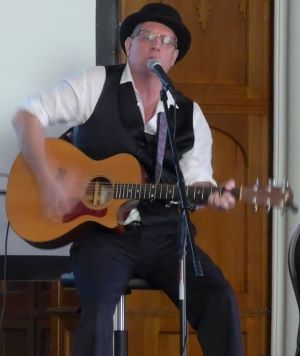 Paul Weber - Musician, Songs of OttawaAfter Paul’s first set, HSO Events Coordinator Ben Weiss thanked him and then gave a brief overview of All Saints Church, from its genesis as a gift from Henry Newell Bate (later Sir) to the community through its many years of service to an array of prime ministers, other notables, and parishioners in general. Ben then addressed the HSO Speakers Series, mentioning both Rawlson King’s recent talk and the upcoming topics featuring Ottawa’s Francophone community and founders.
The first of two door prize draws followed, after which Paul Weber continued his serenade. His second set began with a song about Ottawa’s “First Train (1854), followed by his “Ode to Gerry Barber” about an infamous beefy bouncer at “The Chaud” (the Anglo name for Chaudière Club in Aylmer, QC) and a song on the construction of the “Rideau Canal”. He next sang “Je suis né dans un mille carré”, referencing “l’Ordre Jacques Cartier”, a Francophone Secret Society of the 1960s advocating for French-language services and closed with “We got…”, a humorous song about Ottawa’s many (if debatable) attractions.
Ben Weiss then thanked Paul for his music, presenting him with an honorary HSO membership, and then introduced HSO Member and Sandy Hill Resident François Bregha as the next speaker.
“All Saints Church, Sandy Hill, Prime Ministers’ Row & Their Vital Role in Ottawa’s History”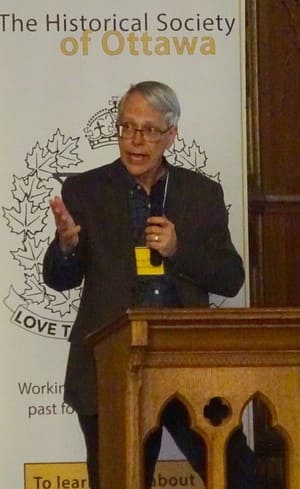 François Bregha - Speaker, Stories of Sandy Hill
François Bregha (who spoke last October 9 on Prime Ministers’ Sandy Hill homes), began his presentation with the history of All Saints Church, dedicated in 1900 by the Earl of Minto (then Governor General) in a grand ceremony attended by dignitaries including the Duke of Connaught, parishioners and the public. He spoke also to the several additions and donations made to the church and community over the years by the Bate family, notably, Sir Henry and his brothers (see HSO pamphlets 91 through 93), whose Trennick House home once occupied an entire Sandy Hill block.
All Saints Church, over its earlier life, hosted a wide variety of services and events, beyond its regular services, among which were a large Sunday School and later daycare services for the community and, in 1924, on “an ideal Canadian winter day”, Canada’s only Royal Wedding at which Prince Erik of Denmark married J. R. Booth’s granddaughter Lois. The wedding drew a huge crowd, estimated at over 10,000 souls, among them four Prime ministers, past, sitting and yet to be. A more somber event at All Saints Church followed in June 1937, with the state funeral of Sir Robert Borden, Sandy Hill resident and parishioner of long standing and Canadian Prime Minister for a decade that spanned the First World War. After a small private service at Sir Robert’s residence on Wurtemburg Street, the funeral cortège proceeded to All Saints church, the streets lined with mourners including over a thousand veterans. After the service, the cortège reassembled and continued on to Beechwood Cemetery for the interment.
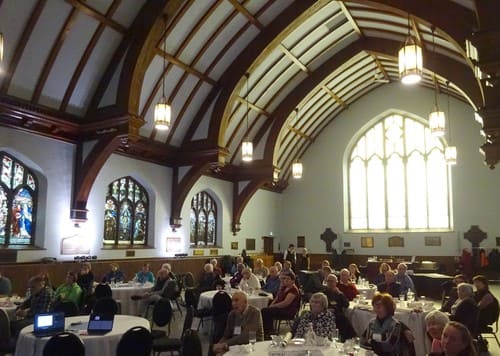
François then addressed six notable Ottawans whose contributions were memorialized in plaques on the church walls. First, on the north wall, was a tribute to Canon G. P. Woollcombe, a founder of Ashbury College and survivor of the torpedoed ocean liner “Athenia”. On the West wall, a second plaque commemorates Frederick Toller, Comptroller of Dominion Currency. Among the plaques on the south wall are one in memory of Sir George H. Perley, businessman, cabinet minister and philanthropist, and Archdeacon C. G. Hepburn, whose contributions included notable wartime chaplaincy.
The South wall also bears a plaque commemorating James W. Woods, who developed an especially waterproof make of canvas that won his outfitting company major supply contracts with the British Army for WWI, continuing to innovate and grow his company and product line to the point where he could sponsor major expeditions such as Amundsen’s and where author Ernest Hemingway would mention one of his sleeping bags by name in For Whom the Bell Tolls. Finally, the same wall commemorated David Finnie, long-time manager of the Bank of Ottawa, before its 1920 merger with the Bank of Nova Scotia.
After a brief question period, Ben Weiss thanked François, completed the draw for door prizes and introduced the next speaker, Leanne Moussa, the Founder and President of All Saints Development Inc. which owns and manages the All Saints Event Space.
“Mixing Business and Heritage Presentation”
Leanne Moussa began her presentation by outlining her personal involvement with the All Saints Church over time and the Bettye Hyde daycare center that operated there for forty years.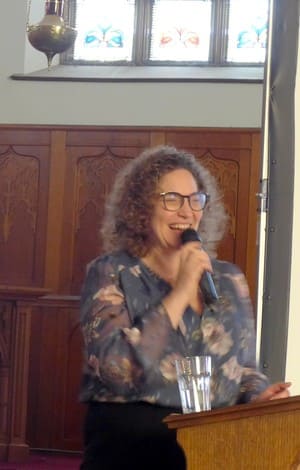 Leanne Moussa - President and Founder, All Saints Event Space However, she recognized that church’s impact extended beyond the immediate community and that it had become a “national legacy”. Its importance notwithstanding, the dramatic decline in parishioners over recent decades and the growing need for substantial maintenance had made it a perplexing financial issue for the Diocese so, after years of study, it was listed for sale in 2014.
Leanne was instrumental in forming a “Save the Saints” working group to generate ideas for the “adaptive reuse” of the facility. This initiative was complemented by a plan to recognize a “Prime Ministers’ Row” in Sandy Hill and a corporation formed with a view to purchasing the church and operating facilities there with priorities asset by “Save the Saints”. In time, sufficient funds were identified to cover the down payment and on December18, 2018, the purchase took place, with the Anglican Diocese of Ottawa as the mortgage holder.
With both new services and much-needed maintenance to prioritize, the process of ongoing management required a specialized development approach, namely : “How can we build a business model that makes financial sense and that still gives our community what they want?” Priorities had to include maintaining the facility as some form of public space, preserving the history of the building, and making it a place for all the community rather than just an enclave of gentrification.
Leanne outlined several of the initiatives in this area, such as a successful new restaurant facility, building repairs and renovations (notably heating and air conditioning), and the disposition of artifacts such as the church pews, two of which are now – quite appropriately – among the holdings of the Canadian Museum of History.
After several questions, Ben Weiss thanked Leanne for all her efforts and presented her with an honorary membership in the Society. The formal luncheon then adjourned and members proceeded home or to explore further the All Saints Event Space.
Ian Browness and Cynthia Coristine researched and wrote a series of Bytown Pamphlets titled The Bate Brothers of Ottawa.
Booklet 1: The Brothers' Circuitous Path to Bytown (#91)
Booklet 2: Charles "C.T." Bate: Merchant, Mayor and More (#92)
Booklet 3: Sir Henry Newell Bate and Family: A Civic Legacy (#93)
Please see our Pamphlets Available for Sale to purchase Booklet 1 and 2. Booklet 3 is not currently available.
Our website is a vital tool in the Society’s communications tool kit. It not only informs members of upcoming events and Society news, it is our prime means of disseminating information about the Society and interesting Ottawa historical stories to the general public. Its reach is global; we have visitors from around the world. Look for a forthcoming HSO article on our readership.
Despite its success, few are probably aware of the person who built the website and maintained it since its inception. That person is John Reeder. In January 2007, he answered a small advertisement that appeared in the HSO quarterly newsletter that read “Help wanted. – HSO webmaster.” After being interviewed by then director Dave Mullington, John had the job. Just a couple of weeks later, on February 8, 2007, the Society’s website went live. It was a modest affair at the beginning, just a few webpages – a Home page as well as pages titled About Us, News, Executive Contacts, Coming Events, and Web Sites of Interest. But it launched the Society into the internet age.
Since that humble beginning, under John’s guidance, the HSO website grew in complexity and richness. It is now a fantastic repository of information not only about the Society and its many activities, but also about Ottawa’s history and heritage. For students of history, seventy-five issues of the Society’s Bytown pamphlet series are now available on the website free of charge, courtesy of John, as are a growing number of short historical stories on Ottawa. The website also provides a useful one-stop portal to numerous websites and blogs that touch on Ottawa history. As well, there are videos of old Ottawa that teleport us back into time.
But who is this volunteer benefactor of the Society, working steadily and virtually anonymously behind the scenes? John had a first career as a high school teacher. After he retired in 1998 after thirty-two years in front of a backboard, he started a second career. While he shuddered at the prospect of leaving teaching, retirement turned out to be the “best job” he ever had. John became a keen volunteer for a number of organizations, including Meals on Wheels and the Ottawa Heart Institute. Somehow, he also found the time to teach himself how to build and maintain websites. In addition to building the Historical Society's website, he worked on websites for the Ottawa Public Education Retirees Association, the Somerset Community Police Centre, the Ottawa Smockers’ Guild, and the Bethany Hope Centre.
John is also an inveterate walker, and has been since the first oil crisis of 1973. Looking for a way of reducing his energy consumption beyond the usual things like turning off lights and turning down the thermostat, he took up walking to and from work each day, rain or shine. This was not a trivial initiative, living as he did some four and half miles from his school. Think of doing that in a winter snow storm, or an autumn gale. As John wryly put, “Gene Kelly was a fraud,” referring to the Hollywood star dancing in the Hollywood classic Singing in the Rain. When he and his wife decided to give up suburban life to move downtown, his walk to school became seven miles each way! This necessitated him getting out the door by 4 am to be at work on time, with a midway stop at Tim Horton’s for a restorative bagel and coffee. Luckily for the Historical Society, he developed a keen appreciation for Ottawa, its neighbourhoods and its history on his walks to and from work.
Last year, John let us know that the Society should begin to think of replacing him. He noted that it was never a good idea for an organization to become dependent on one individual. And, while he was healthy, at age 76 he was no longer a “spring chicken.” Should he become unavailable for some reason, the Society could be severely disrupted. Prophetic words as it turned out.
Work began in the summer of 2019 on the daunting task of replacing John. As he used software that was not transferable to the Society, replacing him required the Society to move its website to a new platform. After investigating a number of alternatives, and realizing the extent of the job, the Society sought outside assistance. In late 2019, Vince and Cindy Murphy, who operate a small web design firm called ProbaseWeb from their home in Kemptville, Ontario, began the task of “migrating” our website to its new home. This will be the subject of a forthcoming HSO article.
In January 2020, John Reeder, the confirmed walker, slipped on the ice while passing through the courtyard at the city hall. It was a nasty break which required a number of pins and a plate. To add insult to injury, the break didn’t heal properly, requiring John to have to have a second operation in February. As a consequence, he and his wife were sadly unable to attend the Historical Society luncheon at the former All Saints’ Church in Sandy Hill. We had hoped to honour John and his incredible contribution to the Society over the years at the event.
Despite being one-handed and making frequent visits to the hospital and doctor, John continued to update our website, making his last changes in late February, just over thirteen years from when the site went live in 2007. Fortunately for the Society, work on the new website was almost complete. With the website management team, trained and in place, we were collectively able to assume John’s former responsibilities for maintaining and updating the new website in an almost seamless fashion.
Thank you, John, for all you did for us over the years. You will be missed. But your website legacy lives on. Good luck on your future endeavours.
Not rain or snow or windy cold kept nine intrepid members of the Historical Society of Ottawa — and two people who had seen it advertised on our Facebook page — from enjoying a special walking tour of Beechwood Cemetery on November 10th 2018, Nick McCarthy, the cemetery’s director of marketing, communications and community, led us to the main historical sites and told stories of those buried in this well-tended National Cemetery of Canada.
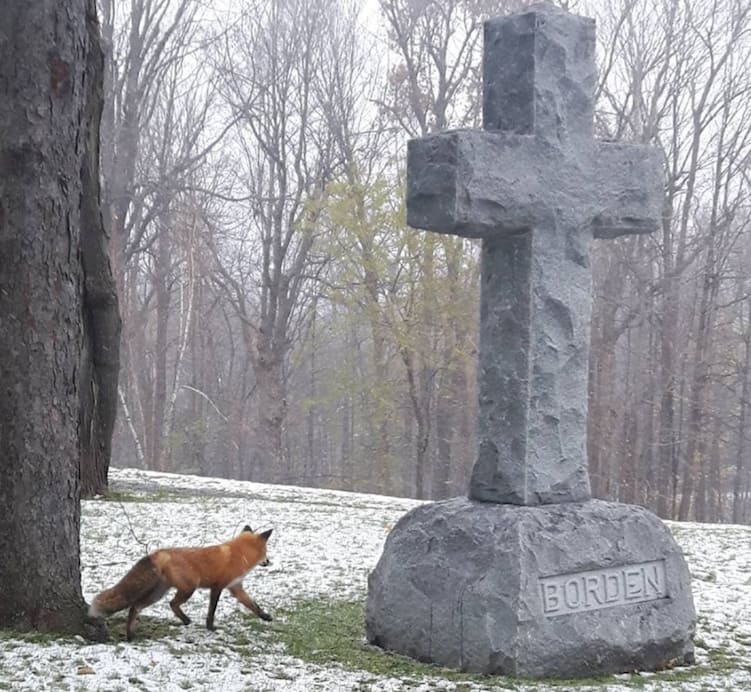
We began at the tomb of Robert Borden (1834-1937), notable because Sir Robert did not want his title, nor his designation as prime minister, used on his monument. However, the cemetery has placed a plaque nearby to remind visitors of his importance to Canada.
Just at that point, the cemetery mascot — a lithe and beautiful red fox — appeared beside Borden’s grave, unafraid of us and apparently intent on catching his dinner.
We saw the sites of many well-known Ottawa families — Bronson, Slater, Perley, Booth and others. Some family plots have a large monument at the highest point, then several rows of graves marking the descending generations.
Among the Canadians commemorated in the cemetery is Sir Sanford Fleming (1827-1915), inventor of our modern-day time zones and designer of our first postage stamp.
A large monument, which honours Hardial Bains (1939-1997), a onetime leader of the Communist Party of Canada, stands alone on a centrally located plot of land, apparently because no one wants to be buried beside him.
As we turned a corner, there was the tomb of Ramon John Hnatyshyn, (1934-2002) Governor General of Canada from 1990 to 1995.
 The cemetery also has monuments honouring people who died elsewhere. The hospital ship Llandovery Castle has been in the news recently because it was sunk 100 years ago on June 27, 1918 on its way from Halifax to Liverpool with a full complement of medical staff. On the ship was Canadian Nursing Sister Minnie Katherine Gallaher (1880 1918), born in Pittsburgh, Ont. Her family laid a stone in her honour in the cemetery.
Our guide told of the how Hungarians, who fled to Canada after the 1956 revolution, erected a monument to their heroes, only to have it ripped off its moorings and taken by Russians. The Hungarians replaced it with a more solid concrete cross firmly attached to a stone.
Like Canada, Beechwood is multicultural. People of many ethnic and faith groups are buried side by side. Several cemeteries within Beechwood’s grounds honour those who have served in the Canadian or Commonwealth Forces, the RCMP and the Ottawa Police.
Notable were the graves of General Henry David Graham Crerar, (1888-1965) who became Chief of the General Staff of the Canadian Army during World War II, and his successor, General Charles Foulkes (1903-1969), who became the first post-war Chief of the General Staff. The Canadian National Military Cemetery, opened in 2001, includes the grave of Nichola K. S. Goddard (1980-2006), the first woman soldier to die in Afghanistan.
We ended the tour with the monument to a teenager who loved elephants; her family erected a little elephant, symbol of family loyalty, on her grave-site.
Thanks to Nick McCarthy, we now have a deeper appreciation of the stories to be found at Beechwood.
A brisk wind greeted us as we stepped onto the roof of the Chats Falls Hydro Power Generating Station situated on the Ottawa River at Fitzroy Harbour, across from Quyon, Que. Twelve HSO members and friends braved the November damp and chill to explore this fascinating and crucial component of our community. Our host was Gary Kowaluk and two of his associates. From the rooftop we could see this long rectangular building stretch across the Ottawa River, straddling the two provinces. The view of the Lac des Chats reservoir was spectacular. Large sections around the dam are fenced off to protect onlookers from falling into the turbulent waters. Gary pointed out how giant sliding gates control the amount of water flowing through the station.
Our tour had begun shortly after 9 a.m., when we passed through a high chain-link gate, driving down a long narrow road through dense woodland and over three bridges. The drive was reminiscent of entering a Cold War facility in post-war Europe. Over the bridges one could look down and see the remnants of what would have been the sides of the Chats Falls, where large boulders rested with only a trickle of water splashing between them. The 35-foot falls were destroyed to accommodate the power station, built 1929-31.
Now in operation for nearly 90 years, the facility provides renewable energy that is 99% free of air pollutants and greenhouse gas emissions. At maximum output, the plant could power nearly 200,000 homes. Output varies upon demand as well as precipitation that affects water levels, which are constantly monitored for environmental balance to minimize any possible damage.
We then viewed a film made during the construction of the dam and station. Grainy black and white images showed many men at work. The hydro village in Fitzroy Harbour was created to accommodate many of the workers who stayed for the duration of the project, bringing considerable activity and revenue to the village.
After the viewing, we started through the plant, which included our rooftop excursion. We saw firsthand the two-storey-high turbines at the heart of the energy-generating process that powers our modern life. We even journeyed beneath to glimpse in the dim light where the power of nature connects to the ingenuity of human machines.
Many thanks to Gary Kowaluk, his staff and the good people who joined us, and especially our past president George Neville, who first suggested it as a part of our fall excursion, as his own father had worked on the construction of the dam.
On Friday, June 14, 2019, eighteen society members took part in the society’s spring excursion to Tucker House, a well-preserved historic estate in rural Clarence-Rockland, just beyond the eastern boundary of the City of Ottawa. The trip was a great success, including a delightful tea and lunch, and an informative presentation from local historian Gilles Chartrand.
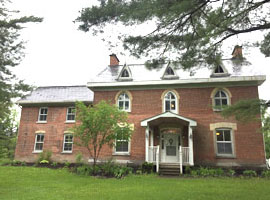 Tucker House
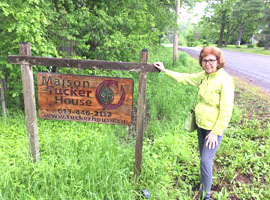 HSO member, Mary Edwards, at Tucker House
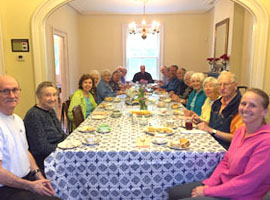 The HSO gang having lunch at Tucker House after a fascinating presentation by local historian Gilles Chartrand (far left)
Quick Links
About
Supporting Partners