

Working to preserve Ottawa's past
for future generations.
Under threatening skies, the Museum Club visited Dickinson Square in Manotick on Sunday, August 18, 2024, for a guided tour of Watson’s Mill and Dickinson House. Eighteen of the twenty registered participants took the chance and were rewarded with a wonderful experience.
After we gathered and were welcomed by our host Avery Geboers, we split into two groups, one starting in Watson’s Mill and the other in Dickinson House.
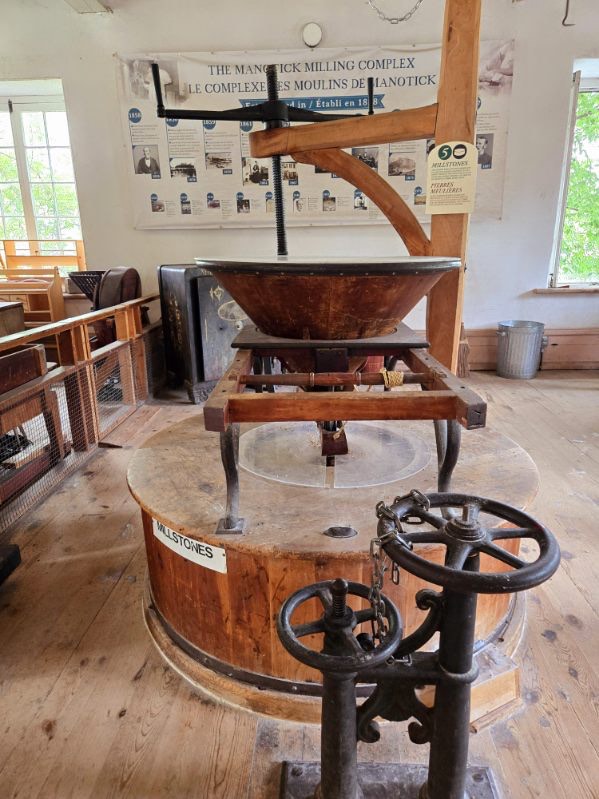 Inside Watson's MillWatson’s Mill was built by Moss Kent Dickinson and Joseph Merrill Currier, one of four mills to be constructed in the general location, including a sawmill (1859), a flour & grist mill (1860, Watson’s Mill), a wool carding mill (1861), and a bung, plug and spile mill (1875, 1888). The 4-storey mill was a marvel of automation for its day, powered by water turbines, rather than a waterwheel, which allowed the mill to operate year round. An ingenious combination of belts and chutes enabled the mill to be run by one person. As far as we know, we were not joined on our tour by the ghost of Ann Crosby Currier, (wife of Joseph for only 6 weeks), who died in a tragic accident in the mill in 1861 and is said to have never left.
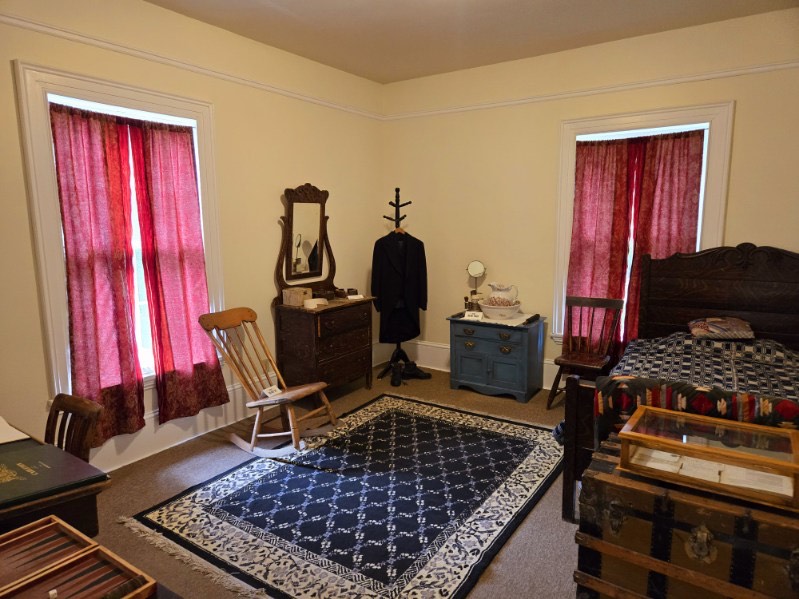 Inside Dickinson HouseDickinson House, across the street from the mill was built in 1867 and served as the village post office, general store and home to the Dickinson family and all subsequent mill owners. The house is furnished in pieces from the late 1800s, though only one chair and a notary seal are from the Dickinson family.
The costumed interpreters in both the mill and the house were poised, polite, professional and extremely knowledgeable. They added greatly to our understanding of the site and our overall enjoyment of our visit.
When both tours were completed, we gathered again in the mill. On most summer Sunday afternoons there is a milling demonstration, but due to unfortunate circumstances, this could not be done on the day of our visit (a good reason for another trip). Our hosts did, however, arrange for us to start the water turbine so we could see some of the mill equipment in motion. The President of the Historical Society of Ottawa, Emma Kent, was put to work, turning the heavy wheel to start the mill. You can watch her in this video:
If you were unable to join us for the day, we strongly urge a visit to this very interesting complex. There is much more to learn about Watson’s Mill and Dickinson Square from their fact-filled website: Watson's Mill & Dickinson House
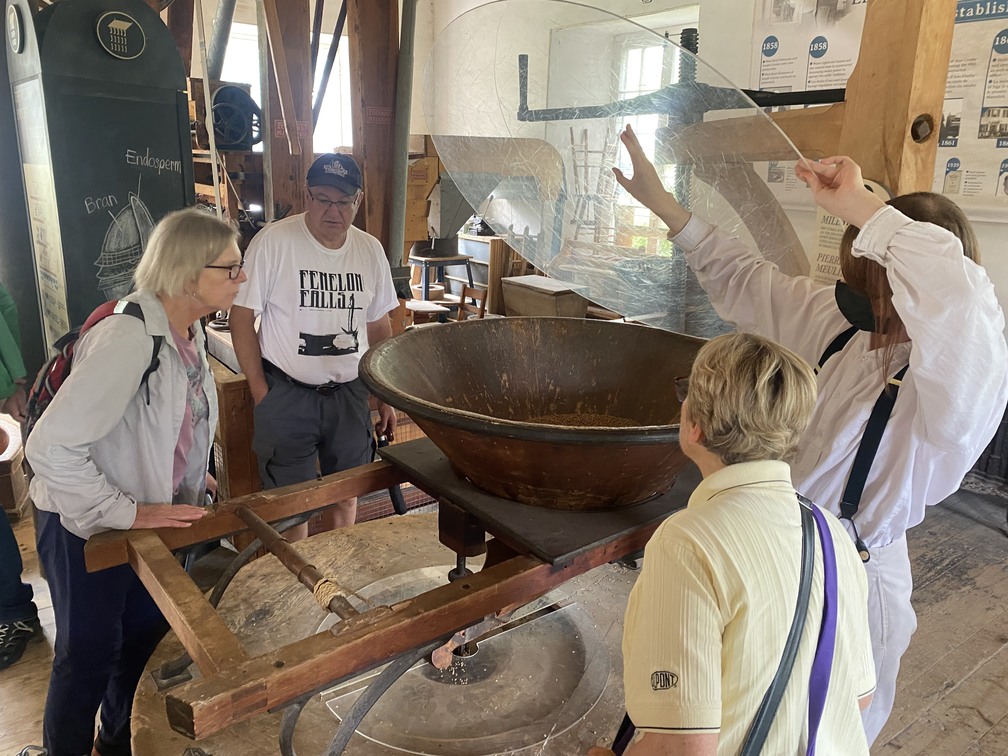 Grain Milling Process at Watson's Mill
Having finished at the mill site, fifteen of us took the short walk to The Vault Bistro where we enjoyed a variety of fine dishes.
The weather smiled upon us and we all left Manotick with smiles ourselves.
Video and photos courtesy of Justin Lacasse.
The third Museum Club outing took place on Thursday, July 18, 2024, when a dozen registered participants, and two “foundlings” received a guided tour of the Merrickville Blockhouse Museum from our host, Jane Graham, who is the President of the Merrickville & District Historical Society (MDHS). Jane explained that the Blockhouse was built in 1832 to defend the Rideau Canal but never served in its original role. Instead, it became the home of the first lockmaster, Sgt. Johnston, his wife and children. Over the years the Blockhouse has had many other uses including as a storage facility and a church. Eventually it fell into disrepair and was scheduled to be demolished in the early 1960s. It was saved by the community of Merrickville who raised funds and created the Merrickville & District Historical Society to restore and operate the Blockhouse. The work has since become more than the volunteers of the MDHS can realistically handle, so the Town of Merrickville has now assumed responsibility for the Blockhouse Museum.
After about an hour in the Blockhouse Museum, Jane led ten of us on a guided walking tour along the main street of Merrickville pointing out many of the historic buildings and telling us the stories behind each. Jane told us some of the details of the history of Merrickville itself, from its origin as a thriving industrial and commercial hub, through its decline into the mid twentieth century and its renaissance in the past few decades as a vibrant community and a haven for artists and artisans of all kinds. She also told us some colourful stories of a number of its more prominent early residents and of the plans of the MDHS to honour one of these, Harry McLean, with a statue. The weather was perfect for the walking tour and there was much to see and yet more that could be explored independently based on a walking tour guide that is available through their web site.
Following our walking tour, which lasted just over an hour, we said good bye to Jane and retreated to the Mainstreet Restaurant, across the street from the Blockhouse, where the ten of us were warmly greeted. The large menu offered many tasty choices and their own lager was enjoyed by a number of our party. After lunch, the group dispersed, some browsing, and buying, in Merrickville’s fascinating array of shops.
Museum Club provides an opportunity for its participants to make new connections or in some cases discover existing connections they did not know they already had. The latter occurred on our Merrickville trip when a casual lunchtime discussion revealed that one of the participants knew the grandparents of another, even though the two participants had never met and the grandparents live in south-western Ontario. As they both agreed, it is a small world.
One of the goals of the Museum Club is to strengthen the relationships between the Historical Society of Ottawa and other organisations involved in the exploration of our local history or in preservation and conservancy. To this end, a partnership is now being established between the HSO and the MDHS whereby the MDHS will send the HSO electronic copies of their newsletters and invitations to their speaker series presentations and the HSO will reciprocate, providing more opportunities for the members of both organizations.
On Saturday June 3, 2023, members of the Historical Society of Ottawa accompanied the Gatineau Valley Historical Society on a bus trip to the Kitigan Zibi Pow Wow. Departing from Chelsea, Quebec, the bus trip stopped at the Centre Wakefield La Pêche for more pick-ups and proceeded to make its way through the vast Quebec wilderness along the Gatineau River.
Upon our arrival at the Pow Wow, we were delighted to see a very large turn out. Vehicles parked along the roads and in yards and parking lots. It was a great way for us to get in the mindset for the day ahead. As we stepped off the bus at the entrance to the Pow Wow, we were met with the sounds of people chatting and laughing, jingle dresses jingle-jangling, the smell of the rows of food vendors and, importantly a welcoming feeling.
The Kitigan Zibi Pow Wow started in 1986 as a social gathering, becoming an official Pow Wow only three years later in 1989 and after 37 years it was no surprise that this celebration has been practised, rehearsed and perfected over time.
Food vendors were the first thing we saw before continuing on into the larger dancing area, and more vendors. I can not continue without saying something about the food at Kitigan Zibi. Incredible options ranging from beans and bannock, to “Indian tacos”, to wild game, and some of the freshest, sweetest lemonade one could ask for on such a beautiful day. It is safe to say that a generous amount of time was dedicated to sampling the food from these vendors with only positive reviews.
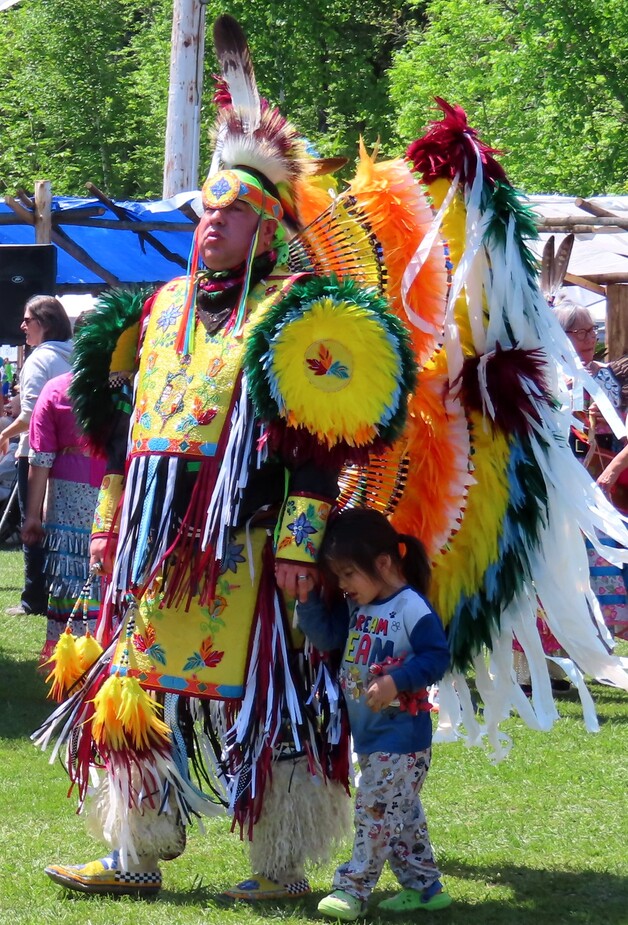 Photo by Ben Weiss.After making our way through the food area we were welcomed to an area with two circular sections. The outer section was dedicated to vendors selling t-shirts and hats, jewellery and crafts. The inner section was dedicated to spectators watching the various dances. The grass had been worn down clockwise as dancers expressed themselves to the sounds of the music coming from the branch-covered structure in the centre. One could feel the emotion in the sounds that flowed through the air and the energy that vibrated through the ground with every step and jump from the dancers. This continued for an indeterminable amount of time, as I was completely entranced, and followed by moving speeches from members of the Kitigan Zibi Reserve talking about the tragedy of the ever-growing number of missing and murdered Indigenous women, girls and two-spirit people. ‘Powerful’ and ‘moving’ are two words that best describe the tone of these speeches. The hurt that the speakers felt was felt by everyone listening, and the intended message was heard loud and clear. Minister of Crown-Indigenous Relations, Mark Miller was in attendance and the presence of him and his staff helped drive home the message that was being broadcast. If you or someone you know has been affected by the issue of murdered and missing Indigenous women, girls and two-spirit people, a hotline exists for those who need immediate emotional support and can be reached at 1-844-413-6649.
Later, HSO met with members of the Gatineau Valley Historical Society and their president Gilbert Whiteduck who was able to answer our many questions about the history of Pow Wows and their significance within Indigenous culture. We are thankful for the opportunity to start building a relationship with our sister society and look forward to working together in the future.
We finished our time at Kitigan Zibi watching the Grass Dances and the Jingle-Dress Dances, which were both incredible. The Grass Dances were performed by dancers in fantastic regalia with passion and reverence, and the Jingle-Dress Dancers performed harmoniously with the beat of the songs.
After a long day of fantastic food and dance it was time to head home. The bus – half silent with sleeping patrons, half noisy with excited recounts of the day – was a vessel of positive energy after our experience at the Kitigan Zibi Pow Wow. It was truly a rewarding experience and an incredibly significant piece of the history of Ottawa and the Gatineau Valley.
We would also like to thank long-time HSO member Evelyn Burke for joining us on this trip and hope she had a great experience.
Reception & Lunch, Plus Music by Paul Weber
The Historical Socidety of Ottawa was blessed with exceptionally good weather for this event as the Society Members and other attendees arrived, registered and chose their seats in “Borden Hall” (in its previous incarnation, the church’s “nave” or main area). The dining area, its pews long since repurposed elsewhere and replaced by tables and chairs, was copiously illuminated by the sunlight shining through the hall’s many tall stained glass windows. A sumptuous buffet of sandwiches and soup, accompanied by a beverage service, provided no small attraction in itself, and the excellent lunch contributed towards an upbeat and relaxed atmosphere as those present settled in.
At 12:30, Ottawa composer, guitarist and admitted local history buff Paul Weber took to the stage, introducing and playing the first Ottawa song he wrote, “The Great Fire (1870)”, about the conflagration that levelled much of the Ottawa Valley East of Arnprior and North of Smiths Falls up to Bell’s Corners, narrowly sparing Ottawa proper. He followed this with “The Heron Road Bridge” about Ottawa’s worst construction accident, the August 1966 collapse that cost nine construction workers their lives.
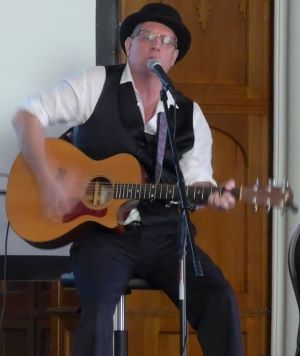 Paul Weber - Musician, Songs of OttawaAfter Paul’s first set, HSO Events Coordinator Ben Weiss thanked him and then gave a brief overview of All Saints Church, from its genesis as a gift from Henry Newell Bate (later Sir) to the community through its many years of service to an array of prime ministers, other notables, and parishioners in general. Ben then addressed the HSO Speakers Series, mentioning both Rawlson King’s recent talk and the upcoming topics featuring Ottawa’s Francophone community and founders.
The first of two door prize draws followed, after which Paul Weber continued his serenade. His second set began with a song about Ottawa’s “First Train (1854), followed by his “Ode to Gerry Barber” about an infamous beefy bouncer at “The Chaud” (the Anglo name for Chaudière Club in Aylmer, QC) and a song on the construction of the “Rideau Canal”. He next sang “Je suis né dans un mille carré”, referencing “l’Ordre Jacques Cartier”, a Francophone Secret Society of the 1960s advocating for French-language services and closed with “We got…”, a humorous song about Ottawa’s many (if debatable) attractions.
Ben Weiss then thanked Paul for his music, presenting him with an honorary HSO membership, and then introduced HSO Member and Sandy Hill Resident François Bregha as the next speaker.
“All Saints Church, Sandy Hill, Prime Ministers’ Row & Their Vital Role in Ottawa’s History”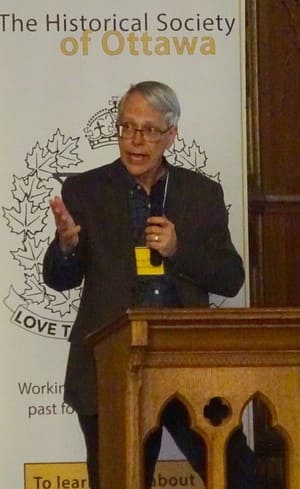 François Bregha - Speaker, Stories of Sandy Hill
François Bregha (who spoke last October 9 on Prime Ministers’ Sandy Hill homes), began his presentation with the history of All Saints Church, dedicated in 1900 by the Earl of Minto (then Governor General) in a grand ceremony attended by dignitaries including the Duke of Connaught, parishioners and the public. He spoke also to the several additions and donations made to the church and community over the years by the Bate family, notably, Sir Henry and his brothers (see HSO pamphlets 91 through 93), whose Trennick House home once occupied an entire Sandy Hill block.
All Saints Church, over its earlier life, hosted a wide variety of services and events, beyond its regular services, among which were a large Sunday School and later daycare services for the community and, in 1924, on “an ideal Canadian winter day”, Canada’s only Royal Wedding at which Prince Erik of Denmark married J. R. Booth’s granddaughter Lois. The wedding drew a huge crowd, estimated at over 10,000 souls, among them four Prime ministers, past, sitting and yet to be. A more somber event at All Saints Church followed in June 1937, with the state funeral of Sir Robert Borden, Sandy Hill resident and parishioner of long standing and Canadian Prime Minister for a decade that spanned the First World War. After a small private service at Sir Robert’s residence on Wurtemburg Street, the funeral cortège proceeded to All Saints church, the streets lined with mourners including over a thousand veterans. After the service, the cortège reassembled and continued on to Beechwood Cemetery for the interment.
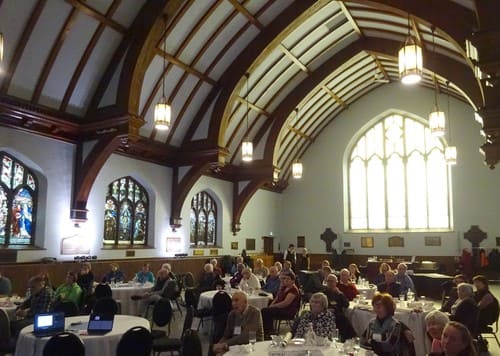
François then addressed six notable Ottawans whose contributions were memorialized in plaques on the church walls. First, on the north wall, was a tribute to Canon G. P. Woollcombe, a founder of Ashbury College and survivor of the torpedoed ocean liner “Athenia”. On the West wall, a second plaque commemorates Frederick Toller, Comptroller of Dominion Currency. Among the plaques on the south wall are one in memory of Sir George H. Perley, businessman, cabinet minister and philanthropist, and Archdeacon C. G. Hepburn, whose contributions included notable wartime chaplaincy.
The South wall also bears a plaque commemorating James W. Woods, who developed an especially waterproof make of canvas that won his outfitting company major supply contracts with the British Army for WWI, continuing to innovate and grow his company and product line to the point where he could sponsor major expeditions such as Amundsen’s and where author Ernest Hemingway would mention one of his sleeping bags by name in For Whom the Bell Tolls. Finally, the same wall commemorated David Finnie, long-time manager of the Bank of Ottawa, before its 1920 merger with the Bank of Nova Scotia.
After a brief question period, Ben Weiss thanked François, completed the draw for door prizes and introduced the next speaker, Leanne Moussa, the Founder and President of All Saints Development Inc. which owns and manages the All Saints Event Space.
“Mixing Business and Heritage Presentation”
Leanne Moussa began her presentation by outlining her personal involvement with the All Saints Church over time and the Bettye Hyde daycare center that operated there for forty years.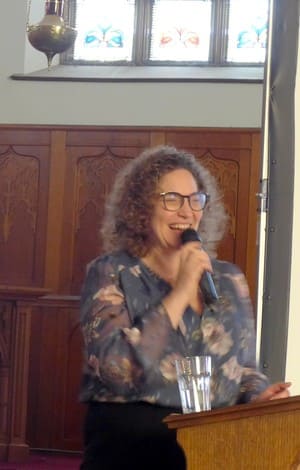 Leanne Moussa - President and Founder, All Saints Event Space However, she recognized that church’s impact extended beyond the immediate community and that it had become a “national legacy”. Its importance notwithstanding, the dramatic decline in parishioners over recent decades and the growing need for substantial maintenance had made it a perplexing financial issue for the Diocese so, after years of study, it was listed for sale in 2014.
Leanne was instrumental in forming a “Save the Saints” working group to generate ideas for the “adaptive reuse” of the facility. This initiative was complemented by a plan to recognize a “Prime Ministers’ Row” in Sandy Hill and a corporation formed with a view to purchasing the church and operating facilities there with priorities asset by “Save the Saints”. In time, sufficient funds were identified to cover the down payment and on December18, 2018, the purchase took place, with the Anglican Diocese of Ottawa as the mortgage holder.
With both new services and much-needed maintenance to prioritize, the process of ongoing management required a specialized development approach, namely : “How can we build a business model that makes financial sense and that still gives our community what they want?” Priorities had to include maintaining the facility as some form of public space, preserving the history of the building, and making it a place for all the community rather than just an enclave of gentrification.
Leanne outlined several of the initiatives in this area, such as a successful new restaurant facility, building repairs and renovations (notably heating and air conditioning), and the disposition of artifacts such as the church pews, two of which are now – quite appropriately – among the holdings of the Canadian Museum of History.
After several questions, Ben Weiss thanked Leanne for all her efforts and presented her with an honorary membership in the Society. The formal luncheon then adjourned and members proceeded home or to explore further the All Saints Event Space.
Ian Browness and Cynthia Coristine researched and wrote a series of Bytown Pamphlets titled The Bate Brothers of Ottawa.
Booklet 1: The Brothers' Circuitous Path to Bytown (#91)
Booklet 2: Charles "C.T." Bate: Merchant, Mayor and More (#92)
Booklet 3: Sir Henry Newell Bate and Family: A Civic Legacy (#93)
Please see our Pamphlets Available for Sale to purchase Booklet 1 and 2. Booklet 3 is not currently available.
Not rain or snow or windy cold kept nine intrepid members of the Historical Society of Ottawa — and two people who had seen it advertised on our Facebook page — from enjoying a special walking tour of Beechwood Cemetery on November 10th 2018, Nick McCarthy, the cemetery’s director of marketing, communications and community, led us to the main historical sites and told stories of those buried in this well-tended National Cemetery of Canada.
We began at the tomb of Robert Borden (1834-1937), notable because Sir Robert did not want his title, nor his designation as prime minister, used on his monument. However, the cemetery has placed a plaque nearby to remind visitors of his importance to Canada.
Just at that point, the cemetery mascot — a lithe and beautiful red fox — appeared beside Borden’s grave, unafraid of us and apparently intent on catching his dinner.
We saw the sites of many well-known Ottawa families — Bronson, Slater, Perley, Booth and others. Some family plots have a large monument at the highest point, then several rows of graves marking the descending generations.
Among the Canadians commemorated in the cemetery is Sir Sanford Fleming (1827-1915), inventor of our modern-day time zones and designer of our first postage stamp.
A large monument, which honours Hardial Bains (1939-1997), a onetime leader of the Communist Party of Canada, stands alone on a centrally located plot of land, apparently because no one wants to be buried beside him.
As we turned a corner, there was the tomb of Ramon John Hnatyshyn, (1934-2002) Governor General of Canada from 1990 to 1995.
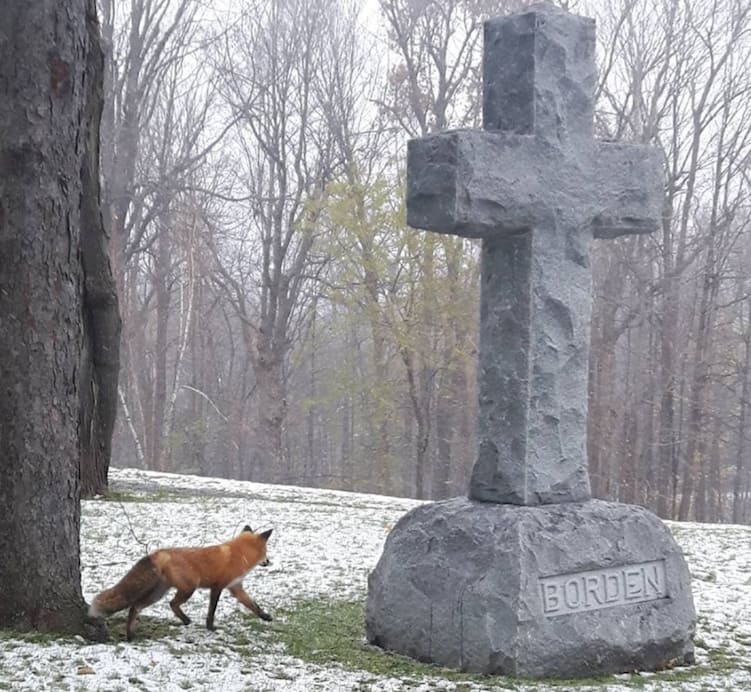 The cemetery also has monuments honouring people who died elsewhere. The hospital ship Llandovery Castle has been in the news recently because it was sunk 100 years ago on June 27, 1918 on its way from Halifax to Liverpool with a full complement of medical staff. On the ship was Canadian Nursing Sister Minnie Katherine Gallaher (1880 1918), born in Pittsburgh, Ont. Her family laid a stone in her honour in the cemetery.
Our guide told of the how Hungarians, who fled to Canada after the 1956 revolution, erected a monument to their heroes, only to have it ripped off its moorings and taken by Russians. The Hungarians replaced it with a more solid concrete cross firmly attached to a stone.
Like Canada, Beechwood is multicultural. People of many ethnic and faith groups are buried side by side. Several cemeteries within Beechwood’s grounds honour those who have served in the Canadian or Commonwealth Forces, the RCMP and the Ottawa Police.
Notable were the graves of General Henry David Graham Crerar, (1888-1965) who became Chief of the General Staff of the Canadian Army during World War II, and his successor, General Charles Foulkes (1903-1969), who became the first post-war Chief of the General Staff. The Canadian National Military Cemetery, opened in 2001, includes the grave of Nichola K. S. Goddard (1980-2006), the first woman soldier to die in Afghanistan.
We ended the tour with the monument to a teenager who loved elephants; her family erected a little elephant, symbol of family loyalty, on her grave-site.
Thanks to Nick McCarthy, we now have a deeper appreciation of the stories to be found at Beechwood.
A brisk wind greeted us as we stepped onto the roof of the Chats Falls Hydro Power Generating Station situated on the Ottawa River at Fitzroy Harbour, across from Quyon, Que. Twelve HSO members and friends braved the November damp and chill to explore this fascinating and crucial component of our community. Our host was Gary Kowaluk and two of his associates. From the rooftop we could see this long rectangular building stretch across the Ottawa River, straddling the two provinces. The view of the Lac des Chats reservoir was spectacular. Large sections around the dam are fenced off to protect onlookers from falling into the turbulent waters. Gary pointed out how giant sliding gates control the amount of water flowing through the station.
Our tour had begun shortly after 9 a.m., when we passed through a high chain-link gate, driving down a long narrow road through dense woodland and over three bridges. The drive was reminiscent of entering a Cold War facility in post-war Europe. Over the bridges one could look down and see the remnants of what would have been the sides of the Chats Falls, where large boulders rested with only a trickle of water splashing between them. The 35-foot falls were destroyed to accommodate the power station, built 1929-31.
Now in operation for nearly 90 years, the facility provides renewable energy that is 99% free of air pollutants and greenhouse gas emissions. At maximum output, the plant could power nearly 200,000 homes. Output varies upon demand as well as precipitation that affects water levels, which are constantly monitored for environmental balance to minimize any possible damage.
We then viewed a film made during the construction of the dam and station. Grainy black and white images showed many men at work. The hydro village in Fitzroy Harbour was created to accommodate many of the workers who stayed for the duration of the project, bringing considerable activity and revenue to the village.
After the viewing, we started through the plant, which included our rooftop excursion. We saw firsthand the two-storey-high turbines at the heart of the energy-generating process that powers our modern life. We even journeyed beneath to glimpse in the dim light where the power of nature connects to the ingenuity of human machines.
Many thanks to Gary Kowaluk, his staff and the good people who joined us, and especially our past president George Neville, who first suggested it as a part of our fall excursion, as his own father had worked on the construction of the dam.
On Friday, June 14, 2019, eighteen society members took part in the society’s spring excursion to Tucker House, a well-preserved historic estate in rural Clarence-Rockland, just beyond the eastern boundary of the City of Ottawa. The trip was a great success, including a delightful tea and lunch, and an informative presentation from local historian Gilles Chartrand.
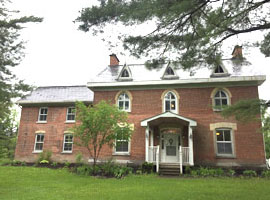 Tucker House
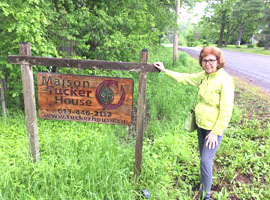 HSO member, Mary Edwards, at Tucker House
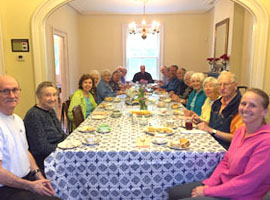 The HSO gang having lunch at Tucker House after a fascinating presentation by local historian Gilles Chartrand (far left)
On Sunday, Sept. 15th, 2019, forty-two HSO members and their guests boarded a coach and headed out to Vankleek Hill, where they visited the local museum — housed in a recently restored 19th-century general store. Participants were then split into three groups for a leisurely walking tour of Ontario’s “Gingerbread Capital” guided by Denis Séguin, the architect responsible for the restoration, the town’s ex-mayor and a well-informed resident whose family has lived in Vankleek Hill for five generations.
In 1797, Simeon Van Kleeck, an United Empire Loyalist, received a land grant for his services in what is now known as Vankleek Hill.
A mural depicting 19th-century life in the town is painted on buildings on Home Street. Further along this street is the entrance to the Higginson Tower.
Many of the buildings display the craftmanship which is the source of the Gingerbread reputation earned for the town. Several beautiful gardens and trees enhance the beauty of the area.
We had lunch at Herb’s Travel Plaza on the 417, ordered from a preset menu which offered eight choices.
Then we proceeded to the Macdonell-Williamson House located at the Ontario-Quebec border. Also known as Poplar Villa, it is located on the banks of the Ottawa River in the town of PointeFortune.
The afternoon was spent at the historic house, an exceptional example of Georgian architecture in the Palladian style.
We were again split into two groups so half could enjoy their tea and scones in the formal dining room of the 200-year-old house, while the other half were guided through the building, which was expropriated to make way for construction of the Carillon Hydro Electric Dam in 1961-62.
Due to geological anomalies, the location of the dam was moved 200 metres farther upstream and the house was allowed to deteriorate until it was taken over by the Ontario Heritage Trust in 1978 to save it from demolition.
The house was built between 1817 and 1819 by fur trader John Macdonell for his Métis wife, Magdeleine Poitras, and their six children. The family expanded to 12 children but unfortunately few of the children survived to adulthood. Some unique features are a cooking hearth, 12 fireplaces, bed closets and a second floor ballroom. It served as a centre for Macdonell’s milling, general merchandising, warehousing and freight-forwarding business.
According to a plaque erected by the Historic Sites and Monuments Board of Canada, the house’s “impressive stone exterior and exquisitely detailed interior proclaimed Macdonell’s position as a major business and political figure along the Ottawa River.”
The Williamson family purchased the home and property in 1882. Over the years, they made several changes, including the construction of a verandah on three sides of the house.
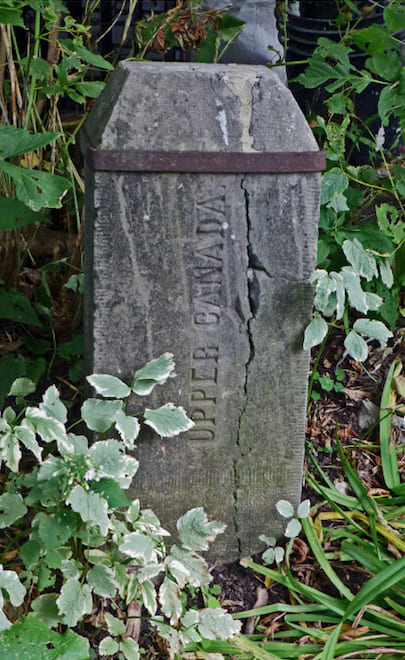 Boundary marker placed by surveyor Da- vid Thompson, circa 1823, marking the line between Upper and Lower Canada near Macdonnell-Williamson House.Owner William Williamson ran a general store in the house and later founded the Laurentian Lumber Company.
Under the Heritage Trust, the house was opened to the public in 1995. Work is ongoing to have the site restored as a Cultural Centre for local and early Canadian History.
Just east of the house is a plaque commemorating David Thompson, the surveyor who, circa 1823, marked the boundaries between Upper Canada (now Ontario) and Lower Canada (now Quebec).
Thompson (1770-1857) is described as “The Greatest Map Maker of North America” on a plaque near the site, which was erected in 2007 by the Friends of the Macdonnell-Williamson House.
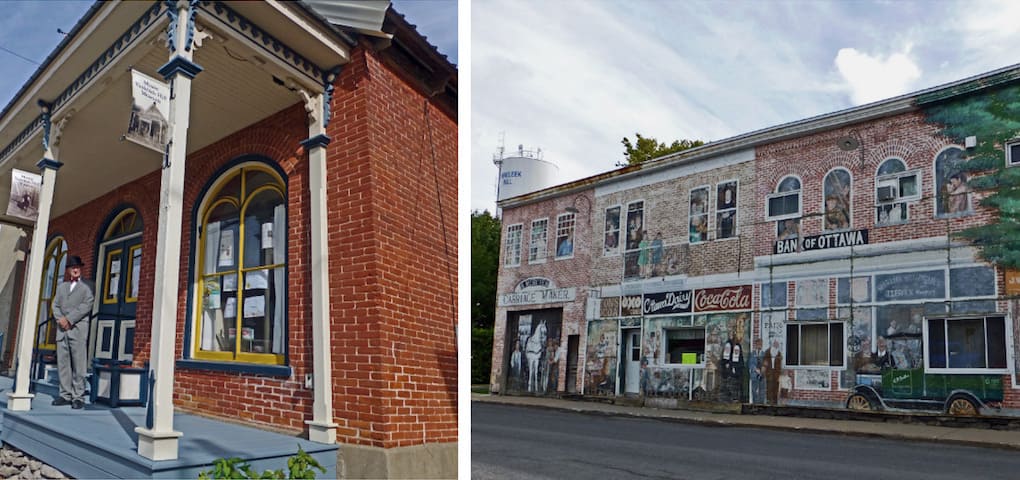 The Vankleek Hill museum, left, and historic mural on Home Street depicting scenes from 19th-century life are among the attractions in the “Gingerbread Capital” of Ontario.
Photo by Evelyn Burke
Quick Links
About
Supporting Partners