

Working to preserve Ottawa's past
for future generations.
Victor and Evie
On April 28, 2021, Dorothy Phillips, author and longtime HSO member, told us about researching and writing the story of the Duke of Devonshire during his time as Governor General of Canada.
Media
Our March 31st guest speaker shares an interest history’s darker side. Author of nine award-winning books on Canadian history, Charlotte Gray published Murdered Midas: A Millionaire, His Gold Mine, and a Strange Death on an Island Paradise in 2019 to tell the story of the rise to wealth, and the unsolved murder of Sir Harry Oakes.
Harry’s life was not a rags-to-riches story (his father was a lawyer, and Sir Harry studied to be a doctor) but his life became one of adventure (with a bit luck here and there) that lead to his becoming one of the world’s wealthiest men. Harry made some famous and influential friends along the way, but it’s possible that one of these might have been responsible for his brutal death.
Charlotte traveled to such diverse places as the silver mines of Kirkland Lake and the elegant mansions of the Bahamas, in search of details on the life and death of the mining magnate who was considered a generous philanthropist and gentleman to some, and a crude and arrogant monster to others. Which of these is the true version of Sir Harry? You’ll have to watch the video of Charlotte’s presentation to find out how she feels about this Murdered Midas.
The Historical Society of Ottawa went underground for our March 10th presentation, following author Andrew King on a journey to some of the hidden secrets of Ottawa’s past.
In 2019, Andrew wrote Ottawa Rewind: A Book of Curios and Mysteries. This was a collection of stories Andrew had written individually for local publications, about lesser-known people, places and events in Ottawa’s past. He followed this book up recently with Ottawa Rewind 2: More Curios and Mysteries, which takes a more “in-depth” look at the city beneath our feet.
One of Andrew’s earliest investigations lead to historic Pooley’s Bridge in search of a cave. Years earlier some girls had found the cave by accident, entered and followed the dark path about 150 feet before turning back in a panic after hearing what seemed to be the sound of mournful organ music.
Other secret passages are not so hard to find. One of the more curious of these is in plain sight, near the steps that lead from the Rideau Canal locks up to Parliament Hill.
Andrew not only searched for the location of the city’s many hidden tunnels, passageways and “subterranean secrets”, he mapped them out in 3D to help us better visualize where these mysterious place are; in case you’re interested in following Andrew’s path of research. Or, if you’d rather play it safe, watch the video of Andrew’s presentation and let him tell you his stories.
Additional Info
- Year 1960
- Date February 12
The Society’s Board of Directors is delighted to announce that it has approved a pledge of $5,000 towards a project to construct a replica gazebo at Strathcona Park. This project was proposed by HSO member, François Bregha.
At last year’s Annual General Meeting, members agreed to allocate funds to finance community projects over the coming years. Members were asked to suggest potential projects, and a process was established to choose among projects. The selection process was based on a number of criteria, including relevance to HSO’s mission and objectives, cost, and the availability of people to take the lead on the project.
The construction of a replica pavilion at Strathcona Park has long been the dream of Action Sandy Hill, a local community group. Strathcona Park, which is located on the western bank of the Rideau River, was originally the home of the Dominion Rifle Range. During the early 20th century, the range was turned into a park by the Ottawa Improvement Commission, the forerunner of the National Capital Commission. The park is now maintained by the City of Ottawa.
The park was named in honour of Scottish-Canadian businessman, financier and politician Donald Smith who became 1st Baron Strathcona and Mount Royal in 1900. During the nineteenth century, Smith was president of the Bank of Montreal, and co-founded the Canadian Pacific Railway with his cousin George Stephen, later known as Lord Mount Stephen. Smith also for a time represented Montreal in the House of Commons. Later, he became Canada’s High Commissioner to London. Lord Strathcona was also a great philanthropist, endowing hospitals, including the Royal Victoria Hospital in Montreal. He was also Chancellor of McGill University and the University of Aberdeen.
A feature of Strathcona Park is a large fountain sculpture by Mathurin Moreau which was donated by Lord Strathcona in 1909. The four standing figures supporting a bowl represent Europe, Asia, Africa and America. Another original feature of the park was a Victorian-style gazebo, the site of many band performances and other events. Unfortunately, the aging gazebo was dismantled in 1961 and never replaced. The initiative of Action Sandy Hill to re-build the gazebo will restore a historic structure and provide a new focal point for the Park.
Planning for the structure is well advanced. Action Sandy Hill (ASH) will allocate up to $26,000 to this endeavour using money received from a developer earmarked for community benefits. The City of Ottawa has agreed to match the ASH funds. Heritage architect Barry Padolsky is contributing the gazebo design and specifications pro bono. Action Sandy Hill held a community consultation on the gazebo in September 2020 and is looking for estimates for its construction. It is also seeking funds from the broader Ottawa community to complete the financing.
The Historical Society of Ottawa is delighted to support this initiative to rebuild the gazebo and reintroduce a lost historical artifact in a well-used and much-loved park.
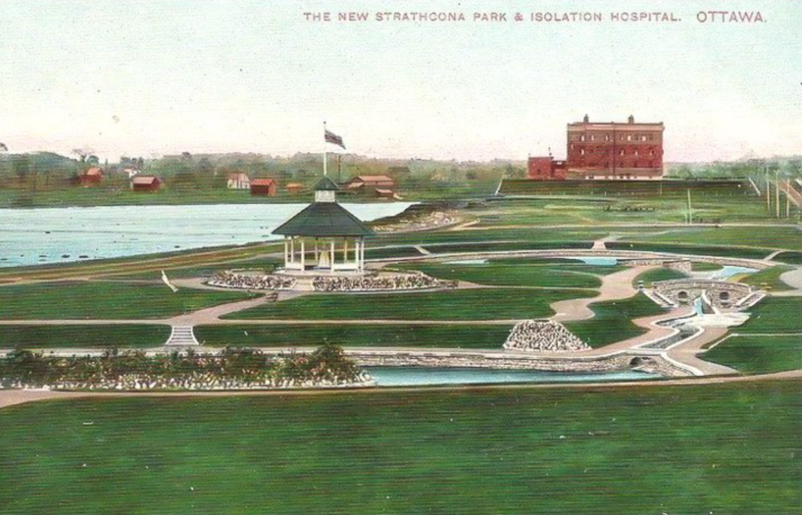
The tall building in the background is the isolation hospital, now the site of an apartment building.
HSO’s Declaration on Diversity of Perspective 2021 (updated)
HSO's Acknowledgement
The Historical Society of Ottawa's mission, since its founding in 1898, has been to preserve and increase public knowledge of our local history.
We acknowledge that, in pursuing this mission, we have often done so within a narrow cultural perspective that has not always been inclusive of the equally important perspectives of those among us of different race, national or ethnic origin, mother tongue, colour, religion, gender, or sexual orientation.
We are dedicated to highlighting the diverse experiences of Indigenous peoples, racialized groups, under-represented communities (including but not limited to children/youth, low income/in poverty, women, elderly, etc.), 2SLGBTQI+ groups, and others, who continue to enrich our communities.
HSO's Commitment
- HSO shall do its utmost to ensure that our presentations, publications, and activities consider diverse cultural perspectives and address past and present injustices.
- In further support of this commitment The Historical Society of Ottawa officially recognizes and embraces the United Nations International Decade for People of African Descent (2015-2024)
In doing so, The Historical Society of Ottawa acknowledges the roles that the slave trade, colonialism, systemic racism, and civil and human rights violations have played in our history and which continue to resonate in present times.
Additional Info
- Year 1915
- Date February 14
Additional Info
- Year 1955
- Date August 26
Additional Info
- Year 1983
- Date January 29
If you missed our virtual Speaker Series presentation "Kettle Island: A Bridge to Ottawa's Past" with Randy Boswell, or you'd just like to watch it again, you can view this presentation online.
Here's a link to the recorded video of Randy's talk. Enjoy!
Quick Links
About
Supporting Partners