

Working to preserve Ottawa's past
for future generations.
The Historical Society of Ottawa’s October 9, 2020 meeting was our first evening gathering at the main branch of the Ottawa library. We had many first-time attendees. Maybe the new time and location are the attraction. Or it may have been our guest speaker, who is well known in Ottawa for his passion for history.
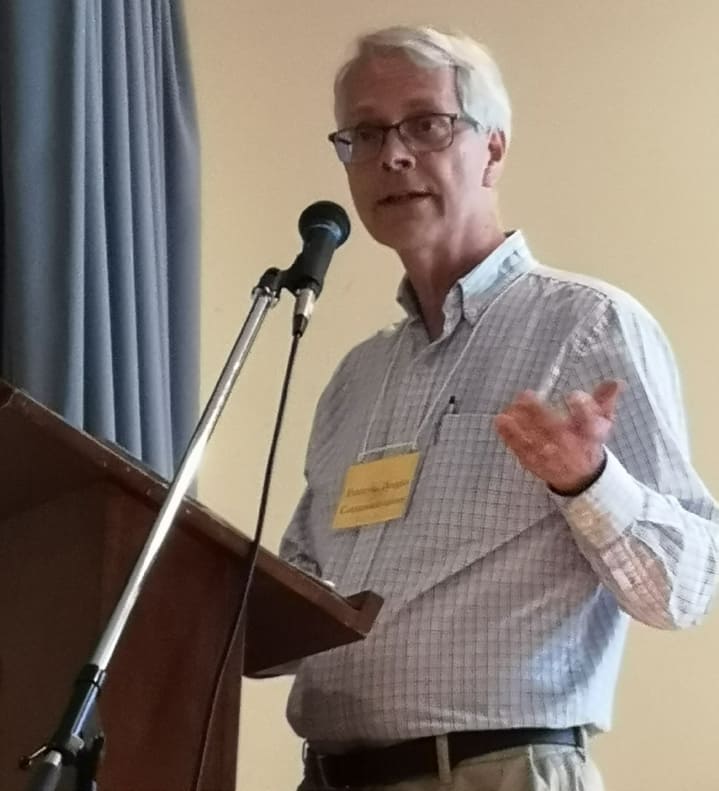 Neighbourhood historian François Bregha, described many prime ministerial homes during his Oct. 9 evening presentation.Sandy Hill is more than just a passing interest for François Bregha. He has lived in Sandy Hill for 34 years. In this time, François has undertaken research on ten prime ministers who have lived in his community, in over a dozen different homes. Many of these homes are still standing, and have become regular stops on François’ community walking tours.
Some of Sandy Hill’s prime ministerial homes are well known, like Stadacona, the Strathcona Apartments and Glensmere. The last of these three was the home of Canada’s eight prime minister, Sir Robert Borden. Built in 1894 for Indian Affairs superintendent Hayter Reed, Borden moved into the home in 1907, giving it the name Glensmere.
After prime minister Borden’s third son, Henry Clifford Borden, moved out in 1941, the home served for 27 years as the Chinese legation, back when the Canadian government considered Taiwan to be “China”. When the much bigger China came to be recognized as the proper “China” in 1972, they established an embassy at the former Our Lady of Charity of the Good Shepherd convent and Glensmere, suddenly empty, was demolished.
Sad, but everyone in attendance for François’ talk at least got a good laugh at the photo he showed of the towering monstrosity that replaced Borden’s elegant abode. Fortunately, Stadacona (Sir John A. Macdonald’s third Sandy Hill home) and the Strathcona Apartments continue to provide architectural dignity on Laurier Avenue East.
Probably the best-known home is Laurier House, built in 1878. Canada’s seventh and tenth prime ministers lived here, although it’s probably less well known that the museum that now honours Sir Wilfrid Laurier and William Lyon Mackenzie King was originally named Kininvie by the home’s first owner, jeweler John Leslie. Leslie named his Sandy Hill home after Kininvie Manor in Banffshire.
This Scottish castle has been in the possession of the Leslie clan since 1521. King renamed the home Laurier House in honour of his mentor, in 1923.
François did some considerable research to dig up information on the many less well-known homes in Sandy Hill. The 13th prime minister, John Diefenbaker not only lived in the Strathcona Apartments, he later rented a small apartment in a house on Wilbrod Street. Our 15th prime minister, Pierre Trudeau, rented an apartment on Besserer Street in the early 1950s, in a home built in 1896 for broker A.M. Sutherland. The home had just been converted to apartments when Trudeau moved in.
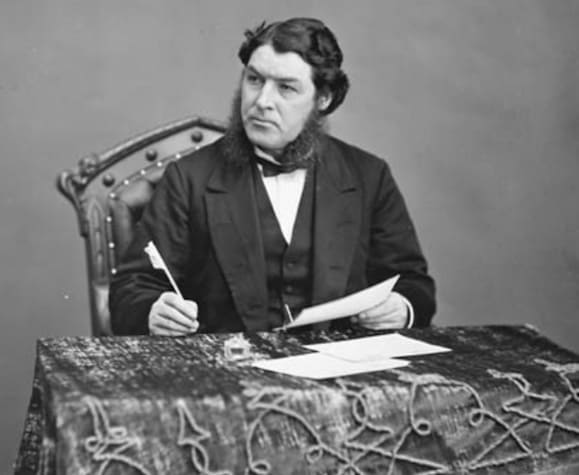 Future prime minister Charles Tupper lived at 274 Daly Ave. in 1872
Source: Library and Archives CanadaTrudeau’s predecessor, Lester Pearson, seems to have had a particular penchant for Sandy Hill. He lived in three homes in the neighbourhood. Sadly the last of these – the apartment he was living in when he won the Nobel Peace Prize – is slated for demolition. The Ugandan High Commission, which has occupied the building since 1985 has allowed the historic landmark to fall into disrepair.
During the Q&A session with François, special attention was drawn to Canada’s sixth prime minister Sir Charles Tupper who, while on his morning walk to the office at Parliament Hill took a daily diversion to meet up with a lady-friend on Chapel Street. François had hoped to exercise some discretion concerning the affair but was cajoled by the audience to offer some details.
Tupper is unique in having lived in two homes that had also been the home of other prime ministers.
Tupper’s 1872 home at 274 Daly Avenue was converted into apartments in 1982.
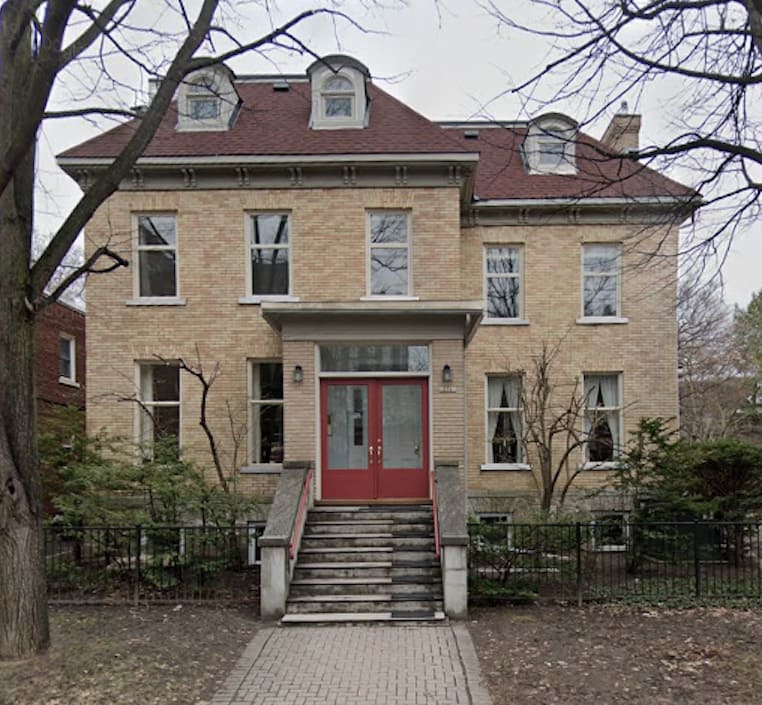 More than a century later, the home was converted into apartments and another future prime minister, Paul Martin, lived there from 1994 to 2003.Paul Martin (our 21st prime minister) lived in one of these units from 1994 until 2003, when he was able to move into 24 Sussex Drive.
As for Sir Charles, he later moved to a home named Cliffside, just west of the Parliament Buildings.
This same residence had earlier been the home of Canada’s second prime minister, Alexander Mackenzie. Cliffside was demolished in 1929.
If you’re interested to learn more about Sandy Hill’s many magnificent historic homes, visit the Sandy Hill History website. Here François has more stories, not just of prime ministers, but of business people, war heroes, architects and artists who called Sandy Hill home.
Ottawa LRT Art Celebrates HSO’s 1898 Origin
Historical Society of OttawaAn elaborate public art installation at the new Lyon Street light rail transit station in downtown Ottawa is sharing the origin story of the HSO with thousands of daily commuters.
The undulating stainless steel sculpture commemorates and celebrates the 1898 founding of the Women’s Canadian Historical Society of Ottawa — later opened to men and renamed the Historical Society of Ottawa — and incorporates the entire 5,000-word text of a society-published pamphlet about the city’s early history.
Individualized silhouettes representing the 32 women who were present at the first meeting of the society in June 1898 adorn the top of the two-metre tall sculpture, which is fully reproduced in French.
The artwork covers a 14 x 4 metre area along a main public concourse, even snaking around one of the station’s support pillars.
The title of the artwork, With Words As Their Actions, is incorporated in a message that appears in large letters across the top of the sculpture: “These Women Built Bytown And Ottawa With Words As Their Actions.”
Along the bottom edge of the steel curtain of text, another message in large letters details the historic gathering that brought the society into existence more than 120 years ago: “Lady Edgar invited thirty-one ladies to her drawing room on 3 June 1898 to consider the formation of a Women’s Historical Society.”
The same messages appear in the French-language half of the art-work, titled Par la Force des Mots.
 In March 1950, the Ottawa Citizen covered the appointment of the directors of the Women’s Canadian Historical Society of Ottawa, which would soon admit male members and rename itself the Historical Society of Ottawa. She added: “With Words as Their Actions pays tribute to the women who kept Bytown alive long after its transformation into Ottawa . . . Here were these women who were saying, ‘We are going to start losing history if we don’t start saving it.’ ”
The installation was created by the Toronto-based firm PLANT Architect Inc., which was awarded the commission after a public art competition held in 2015. The company previously created the Canadian Firefighters Memorial on LeBreton Flats.
As part of the contract for construction of the LRT system, one per cent of the overall construction cost was set aside for displays of artwork at each of the 13 light rail stations.
PLANT Architect’s tribute to the founders of the WCHSO and their work as preservers and promoters of the city’s history cost $200,000.
The silhouetted figures are arrayed in pairs of women facing each other, “representing the society’s founders gathered in conversation” and “passing their knowledge from one another, and to the viewer,” the creators explained.
“This historical society was Ottawa’s first, and from the late 19th century until after World War II, all of its members were female,” PLANT partner Lisa Rapoport, the project’s design lead, told the Daily Commercial News in an interview earlier this year. “While their husbands were building with wood, stone, rail ties and financial capital, the society’s members were building an edifice of words and stories.”
 Society member Anne Forbes Dewar, top left, authored a 1954 paper titled “ The Last Days of Bytown ,” republished by the HSO in 1989. The entire 5,000-word text of the pamphlet — in English and French — has been incorporated in a steel sculpture installed at the Lyon LRT station that celebrates the role of the WCHSO in preserving and promoting Ottawa’s history.
The design, states a PLANT over-view of the project, “celebrates women as keepers of history — and in particular, the 32 women who, in 1898, founded the Ottawa chapter of the Women’s Canadian Historical Society (now the Historical Society of Ottawa).”
The bulk of the sculpture is comprised of alternating English and French lines of text from a presentation titled “The Last Days of By-town,” written in 1954 by society member Anne Forbes Dewar and published in 1989 as No. 32 of the HSO’s Bytown Pamphlet series.
There are now more than 100 published papers in the Bytown Pamphlet series, most of which are available for download at the HSO website — including Dewar’s essay — and all of which are available through the Ottawa Public Library. In a brief introduction to the Dewar pamphlet, the author was described as “an early and active member” of the WCHSO, which she also served as a board member: “She loved history and was extremely knowledgeable and well-read, especially about local history.”
Dewar, who died in 1964, had prepared her 1954 research paper by poring over old Ottawa newspapers, consulting local history books and tapping a variety of other sources to paint a portrait of Bytown as it exist- ed 100 years earlier, in 1854 — the year before the city was officially renamed Ottawa on Jan. 1, 1855.
“This is an amazing document,” Rapoport said in the DCN interview, referring to Dewar’s painstaking reconstruction of 1854 Bytown, on the eve the change to the City of Ottawa. “We thought it would be great for everybody to read it.”
Among the most noteworthy passages in Dewar’s pamphlet — especially now that her words have been laser-cut in steel into a permanent artwork at a downtown train station — were her observations about the December 1854 inauguration of the Bytown and Prescott Railway.
It was a landmark event in Ottawa history and marks the birth of rail transportation in the city.
In recounting the arrival in By-town of the first-ever trainload of passengers from Prescott on Christmas Day 1854, Dewar commented that a celebratory banquet following the event “provided the appropriate jollification.”
She then offered further thoughts on the railway’s launch that should offer some solace to present-day city officials who have faced sharp criticism over the LRT’s bumpy rollout throughout the fall and early winter of 2019.
“The railway had been a great accomplishment,” Dewar wrote of the launch of train service in 1854. “As might have been expected in the early days of operation, unlooked for difficulties arose . . . (but) before long the Bytown and Prescott was generally acknowledged to be the safest and smoothest railway line on the American continent.”
 The silhouettes of Lady Matilda Ridout Elgar, host of the inaugural meeting of the WCHSO, and found- ing member Gertrude Kenny appear to engage in conversation atop the massive art installation at the Lyon Street LRT station.
Photo: Randy BoswellSeveral HSO members, including past president George Neville and former board members Don Baxter and Bryan Cook, were consulted during the design of the Lyon Station artwork.
The impressive LRT tribute to the matriarchs of the present Historical Society of Ottawa joins a host of other landmarks around the capital attesting to the HSO’s enduring impact since its founding near the end of the 19th century.
These include the Bytown Museum beside the Rideau Canal head-locks and the statue of Lt.-Col. John By in Major’s Hill Park, both of which were society initiatives.
“No longer will only society members be familiar with our beginnings as the WCHSO,” said Karen Lynn Ouellette, president of the Historical Society of Ottawa. “This stunning artistic installation invites all LRT travellers to learn about our society’s contributions to saving and sharing our local heritage.”
She added: “I am so proud to be part of this legacy of women helping to preserve our city’s history.”
 The curving, curtain-like sculpture (below), a tribute to the female founders of the historical society, invites passersby to sample bits of early Ottawa history inscribed in steel.
Photo Randy Boswell
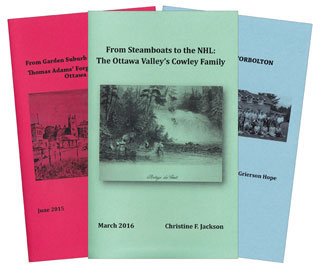
If you interested in having a more in-depth knowledge of Ottawa rich and diverse history, the HSO’ s Bytown Pamphlet series is for you!
Since the early 1980s, the Society has regularly published monographs on various aspects of Ottawa’s history. These monographs are available free to members and through the Ottawa Public Library, Library and Archives Canada, and the City of Ottawa Archives. We are currently in the process of scanning and digitizing all of our pamphlets to make them more accessible to the general public.
The first introductory pamphlet produced by the Historical Society of Ottawa contains excerpts from an address on the history of the Historical Society given by E.M. Taylor before the Ontario Genealogical Society (Ottawa Branch) on March 22, 1976.
Pamphlet Series
Most of the Society's pamphlets are available in digital format to download free of charge.

Heritage Day
Heritage Day is part of Heritage Week, a nation-wide celebration that encourages all Canadians to explore their local heritage, to get involved with stewardship and advocacy groups, and to visit museums, archives, and places of significance. Heritage Day is a time to reflect on the achievements of past generations and to accept responsibility for protecting our heritage.

Ottawa Regional Heritage Fair
Aimed at students in Grades 4-10, the Fairs inspire young people to explore the many aspects of Canadian history, heritage and culture in a dynamic learning environment and to celebrate the results of their efforts at a public exhibition.
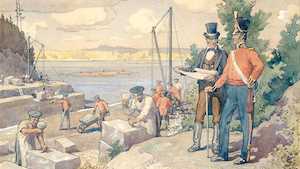
Colonel By Day
Colonel By Day takes place on the holiday Monday in August each year, close to the Colonel’s birth date of August 7, 1779. This popular summer event named in Colonel By’s honour celebrates Ottawa’s history and heritage with open air events, walking tours and a host of family friendly, heritage-themed activities.
BIFHSGO Annual Conference
"Genealogy always reminds me of a treasure hunt: we use our investigative skills to find the genealogical nuggets left behind about our ancestors. BIFHSGO’s annual conference provides a wonderful opportunity to advance one’s knowledge, expand one’s skills and meet a community of like-minded people."
– BIFHSGO Past President Duncan Monkhouse
Additional Info
- Year 1847
- Date January 28
Additional Info
- Year 1897
- Date April 20
Additional Info
- Year 1920
- Date May 20
Additional Info
- Year 1958
- Date April 25
Additional Info
- Year 1854
- Date December 25
Additional Info
- Year 1983
- Date October 26
Quick Links
About
Supporting Partners