

Working to preserve Ottawa's past
for future generations.

Super User
The Day My Students Met Mandela: Nelson Mandela's Remarkable 1998 Visit to Ottawa
Wendy Alexis shared stories and memories with us on February 10, 2021, about the day that Nelson Mandela visited the Canadian Tribute to Human Rights monument in Ottawa.
Ottawa's Subterranean Secrets
On March 10, 2021, Andrew King, Ottawa artist, cartoonist, columnist, and author of the Ottawa Rewind books and blog, shared some of his discoveries of long-hidden secrets from Ottawa's fascinating past.
Murdered Midas
Ottawa resident and award-winning author Charlotte Gray shared with us the story of the life and death of Sir Harry Oakes on March 31, 2021.
Arrested Development
If you missed the HSO presentation by Phil Jenkins (or you just want to watch again) check out his recap and reflections on the history of LeBreton Flats in this video from April 14, 2021.
Victor and Evie
On April 28, 2021, Dorothy Phillips, author and longtime HSO member, told us about researching and writing the story of the Duke of Devonshire during his time as Governor General of Canada.
Supporting Partners


The Historical Society of Ottawa gratefully acknowledges the financial support of the Province of Ontario through its Heritage Organization Development Grant Program, and the City of Ottawa through its Heritage Funding Programs.

The Historical Society of Ottawa is a member of the Capital Heritage Connexion which is an umbrella organization serving heritage organizations in the Ottawa area. Heritage Day, organized by Capital Connexion, is a signature event where heritage groups gather to network and share heritage information with the public.
Ottawa's Castle
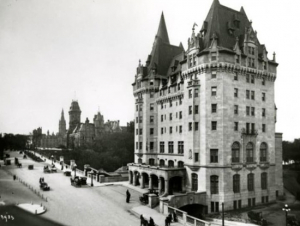
June 1, 1912
The Château Laurier Hotel with its fairyland turrets and copper roof is one of Ottawa’s iconic buildings. Majestically located beside the Rideau Canal locks on Wellington Street and backing onto Major Hill’s Park, it has breathtaking views of Parliament Hill, the Ottawa River, and the Gatineau Hills. Given its aristocratic bearing and central location, one can almost forgive tourists for confusing it with Canada’s Parliament buildings but a short walk away. Indeed, its architecture was deliberately chosen to complement the Gothic Revival style of Canada’s legislative buildings.
The hotel and the Union Train Station (now the temporary home of the Senate), located across the street and connected via a pedestrian subway, were constructed by the Grand Trunk Railway Company (GTR) during the early twentieth century. They were lynchpins in a new trans-continental rail and hotel network being developed by the GTR to compete head on with the Canadian Pacific Railway (CPR) in the travel and hospitality industry. The Château Laurier was the first in a series of grand railway hotels that the GTR was to build, including the Macdonald Hotel in Edmonton and the Fort Garry Hotel in Winnipeg. For the federal government, which had an almost symbiotic relationship with the GTR, the hotel and train station were part of a broader plan to beautify Ottawa. They provided a striking entrance to the city, helping to realize Sir Wilfrid Laurier’s dream of turning it into the “Washington of the North.”
The preliminary design for the hotel was drafted by U.S. architect Bradford Lee Gilbert who had been hired in 1907 by fellow American, Charles Melville Hays, then General Manager and later President of the Grand Trunk Railway. Gilbert was famous for designing the “Tower Building” in New York City, that city’s first skyscraper. The French château architecture he proposed for Ottawa’s new hotel was a style popularized by the CPR which had previously built several grand baronial hotels, including the Château Frontenac in Quebec City, and the Banff Springs Hotel in Banff, Alberta. After submitting drawings of the proposed hotel to Hays, the railway tycoon fired Gilbert, replacing him with George Ross and David McFarlane of Montreal. However, the new Ross-McFarlane design was remarkably similar to that originally submitted by Gilbert, leading to charges of architectural plagiarism. Gilbert sued in 1908, and received $20,000 (close to $500,000 in today’s money) in an out-of-court settlement with the Grand Trunk Railway. Although their ethics were debatable, the controversy did not dent Ross and McFarlane’s careers. Their success with the Château Laurier demonstrated that Canadians were competent to tackle large architectural projects, hitherto typically given to Americans. Their company subsequently gained national prominence, winning major contracts across the country.
With a budget of $1.5 million, construction on the new hotel began in 1909 and was competed in 1912. It was named after Sir Wilfrid Laurier, the sitting prime minister of Canada. If this sounds a bit odd, it was. But it was an astute political move. Laurier had used his influence to carve out a piece of Major’s Hill Park for the site of the new hotel; an action that had provoked considerable controversy in Ottawa. Also, the railway owed its survival to the federal government that had provided it with millions in subsidies and loan guarantees. Even as the Château was being readied for its opening day in the spring of 1912, the GTR’s finances were on shaky grounds, with President Hays in London trying to find fresh funds for the railway. Indeed, the Grand Trunk was destined to be nationalized roughly a decade later to form, along with other bankrupt lines, the Canadian National Railway (CNR).
The grand opening of the hotel, with guests coming from across Canada and the United States, was originally scheduled for May 24, 1912, Victoria Day. Five weeks before the opening, catastrophe struck. Charles Hays and his family, which had accompanied him to England, elected to return to North America for the hotel’s opening on the RMS Titanic. They were the special guests of J. Bruce Ismay, the chairman of the White Star Line that owned the “unsinkable” liner. As we all know, the ship struck an iceberg four hundred miles south of Newfoundland and sank. More than 1,500 people perished in the cold North Atlantic waters. Although Hays’s wife and daughter survived the ship’s sinking, as did Ismay, Hays, his son-in-law, and his secretary drowned. Hays’s body was subsequently recovered, and was buried in the Mount Royal Cemetery in Montreal. Also lost in the sinking of the Titanic were dining room furniture and other decorations purchased in London by Hays for his new hotel.
Paul Chevré, the Belgain-born sculptor of the bust of Sir Wilfrid Laurier, which can be seen today in the lobby of the Château Laurier, was also aboard the Titanic. He boarded the ship as a first class passenger at Cherbourg, France. Chevré was on his way to Canada for the installation of his statue of former Quebec Premier Honoré Mercier on the grounds of the National Assembly in Quebec City, and for the unveiling of his Laurier bust in Ottawa. Chevré survived the sinking, having been persuaded to board the first life boat to be lowered into the water. Contrary to rumours, the bust, which was also making its way across the Atlantic, neither went down with the Titanic, nor was smuggled onto one of the Titanic’s life boats. Instead, it was safely shipped aboard another ship, La Bretagne, arriving in Ottawa in time for the hotel’s official opening.
Delayed by a week, the magnificent Château Laurier and Union Station were officially opened to the public on 1 June 1912. With Hays’s death just six weeks before, the opening was a subdued affair. A silent toast was drunk to his memory. In attendance were senior executives of the Grand Truck Railway who played hosts at an informal banquet for the Parliamentary Press Gallery and a few journalists from Montreal, Boston and New York. That day, two hundred guests registered, with Sir Wilfrid Laurier the first to sign the hotel’s register.
The Château Laurier received rave reviews. The day after the opening, the reporter from Toronto’s Globe newspaper enthused “The latest word in palace hotels on this continent in point of chaste and impressive architecture, in point of beauty of interior decorations, and in point of completeness of arrangements for the comfort and convenience of guests, was spoken last night.” The hotel was indeed a masterpiece. Its walls were built of Indiana limestone, its lobby of Belgian marble, and its windows by Tiffany. Each of its principal public rooms on the main floor was thematically decorated: the lobby in simple Flemish style, the “palm room” in Renaissance style, and the waiting room in wainscoted oak, reminiscent of Tudor England. The dining rooms were fitted out in the manner of Louis XVI, with panels painted with classical subjects. In the basement, was the grill-room, bar, and barber shop, while on the mezzanine were the ladies’ parlours and the corridor writing room; a balcony overlooked the rotunda. As well as being beautiful, the hotel had all the modern comforts of the time, with electricity, and a state-of-the art kitchen and refrigeration plant. Also almost unheard of for the era, 155 of the hotel’s 350 bedrooms had private baths. The rest were equipped with washstands, complete with running hot and cold water. Room rates started as low as $2 per night, (equivalent to roughly $42 today).
The hotel immediately became the premier resting spot for visitors to the capital, eclipsing the old Russell hotel which subsequently fell on hard times. The Château also became the watering hole of choice for MPs and senators; so much so that it became known as the “third chamber of Parliament”—and not necessarily the least important being the location of many smoke-filled, back-room, political deals. In 1929, the hotel underwent a major expansion, adding its east wing and the installation of an art deco swimming pool. Another major refit occurred in 1983 that saw many of its small rooms enlarged to present-day standards.
In recent years, the hotel has changed hands several times. It’s currently owned by Capital Hotel Limited Partnership, a subsidiary of Larco Investments of Vancouver. Larco is a family-run private company co-owned by Amin and Mansour Lalji. The Laljis purchased it in late 2013 from Ivanhoé Cambridge, the real estate subsidiary of Quebec’s Caisse du dépôt et placement, for an undisclosed amount, but believed to have been in the range of $100-150 million.
Over its storied past, the Château has hosted kings, queens, princes and princesses, as well as a host of celebrities and politicians, including Shirley Temple, Marlene Dietrich, Winston Churchill, Charles de Gaulle, the Beatles, Roger Moore, and Nelson Mandela. R.B. Bennett called it home from 1930 to 1935 while he was prime minister of Canada. Yousuf Karsh, the famed portrait photographer, had his studio in the Château from 1973 until his retirement in 1992. The sixth floor of the Château was also the home of the Canadian National Railway Radio Station (CNRO) from 1924 until 1937 when the Canadian Broadcasting Corporation (CBC) took it over. CBC continued to broadcast from the same location until it moved to its new headquarters on Sparks Street in 2004. The Château Laurier Hotel was designated a national historic site in 1981.
Recent plans to add a new wing to the historic hotel have been hotly debated as being inconsistent with the original design and for destroying iconic views of the building. In the van of the fight has been Heritage Ottawa, the non-profit organization that oversees Ottawa’s historic structures. Agreement on a compromise plan was reached in 2021 but it remains controversial.
Sources:
CBC News, 2013. “Ottawa’s Iconic Fairmont Château Laurier hotel sold,” http://www.cbc.ca/news/canada/ottawa/ottawa-s-iconic-fairmont-ch%C3%A2teau-laurier-hotel-sold-1.2335695, 2 November.
Charles, R., 2012. “Fairmont Château Laurier,’s Unsinkable Titanic Link,” Vacay.ca, http://vacay.ca/2012/04/fairmont-chateau-lauriers-unsinkable-titanic-link/.
Encylopedia Titanica, 2014. “Paul Romaine Marie Léonce Chevré,” http://www.encyclopedia-titanica.org/titanic-survivor/paul-chevre.html.
Fairmont Chateau Laurier, 2014. Hotel History, http://www.fairmont.com/laurier-ottawa/hotel-history/.
Heritage Ottawa, 2021. https://heritageottawa.org/news/heritage-ottawa-statement-proposed-addition-chateau-laurier.
Lachapelle. J., 2001. “Le Fantasme Métropolitaine,” Érudit, http://www.erudit.org/livre/lachapellej/2001/livrel1_div7.htm.
National Post, “Not just any hotel: Ottawa’s Château Laurier celebrates 100 years of celebrity,” http://news.nationalpost.com/2012/06/01/not-just-any-hotel-ottawas-chateau-laurier-celebrates-100-years-of-celebrity/.
The Citizen, 1929. “Fills a Long Felt Want In The Capital,” 8 June.
The Globe, 1908. “Chateau Laurier Plans,” 10 October.
—————, 1912. “Mr. Chevre Repudiates False ‘Interviews,’” 13 April.
—————, 1912. “Chateau Laurier Opened in Ottawa,” 3 June.
Ottawa Journal, 1912. “Epoch in History of Ottawa Set For May 24,” 9 March.
Wikipedia, 2014. “Château Laurier,” http://en.wikipedia.org/wiki/Ch%C3%A2teau_Laurier.
Image: Château Laurier, circa 1912, City of Ottawa Archives
Story written by James Powell, the author of the blog Today in Ottawa's History.
Retired from the Bank of Canada, James is the author or co-author of three books dealing with some aspect of Canadian history. These comprise: A History of the Canadian Dollar, 2005, Bank of Canada, The Bank of Canada of James Elliott Coyne: Challenges, Confrontation and Change,” 2009, Queen’s University Press, and with Jill Moxley, Faking It! A History of Counterfeiting in Canada, 2013, General Store Publishing House, Renfrew, Ontario. James is a Director of The Historical Society of Ottawa.
The Ottawa City Hall Fire
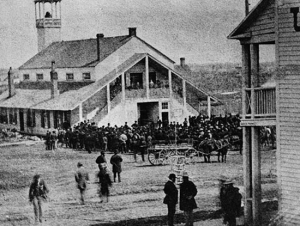
31 March 1931
Ottawa’s first city hall was a wooden structure built close to Elgin Street in 1848 by Nicholas Sparks. It had originally been a market. But when the market failed the following year, eclipsed by the more popular Byward Market in Lower Town, Sparks donated the building to Bytown (later known as Ottawa) as the town’s city hall. For close to thirty years it served in this capacity, for a time also doubling as the community’s fire hall. Pressed for space, the city’s municipal offices moved into a bespoke building constructed in 1876 on an adjacent lot located on Elgin Street between Queen and Albert Streets—roughly where the National Arts Centre is today. The four-storey, stone building was designed by the architects Henry H. Horsey of Ottawa and Matthew Sheard of Toronto in the French Empire style, a mode of architecture which was much admired during the late nineteenth century. The City Hall, built for $85,000, was apparently considered by many at the time as “the finest example of municipal architecture.”
But by the 1920s, the City had once again outgrown its now aging city hall. In 1927, the Liberal government of Mackenzie King came to an agreement with the City over the eventual expropriation of the building, along with the Police and Central (No. 8) Fire Station buildings located behind it, the Russell Hotel, the Russell Theatre, and the Post Office, in a grand plan to beautify Ottawa through the creation of Confederation Park, the construction of a War Memorial to honour Canadian service personnel who died during the Great War, and the widening of Elgin Street. Although the Russell Block was expropriated in 1927 by the federal government, and the City itself took over several buildings including Knox Presbyterian Church for the widening of Elgin Street, plans for the park stalled with the coming of the Great Depression in 1929 and the election of a parsimonious Conservative government under R. B. Bennett in 1930.
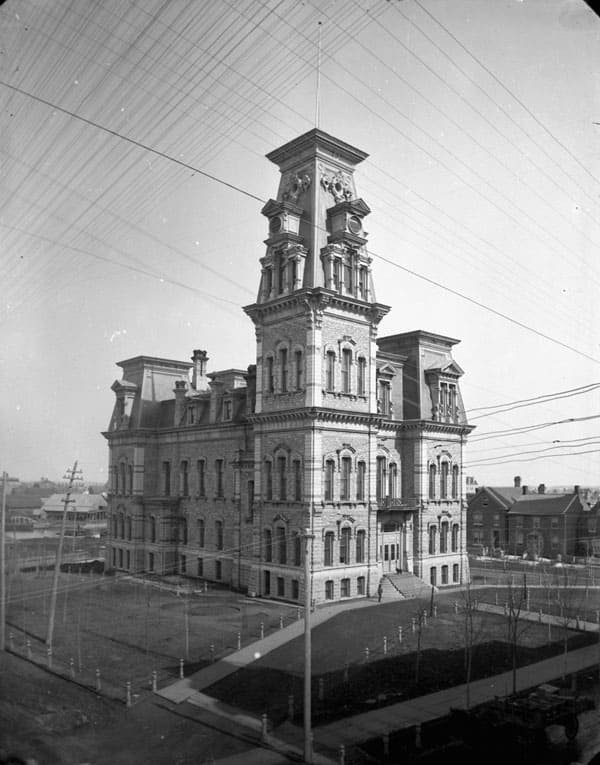 Ottawa City Hall, 1877-1931, Elgin Street
Library and Archives Canada, Mikkan 3325359.The municipal offices were still located in their Elgin Street premises when a fire gutted the building. During the evening of 31 March 1931, two men passing by the nearby Post Office spotted smoke and flames coming from the top corner of the north-east side of the City Hall. The passers-by rushed to the No. 8 Fire Station. The fireman on duty initially thought the men were pulling an April Fool’s prank on him. But after stepping outside, he quickly call out the fire fighters. The first alarm sounded at 9.25 pm with a second alarm sounding a few minutes later, calling in fire fighters from across the city.
Firemen initially entered the east tower of the Hall that led to the office of Vincent Courtemanche, the City’s paymaster. Courtemanche was working late that night preparing workers’ pay sheets. Hearing the hubbub outside his office, he initially thought a prisoner had escaped from the police lock-up. On finding that the City Hall was ablaze, he rushed upstairs to warn Finance Commissioner Gordon who was also working late. The two men fled the building after retrieving $8,000 in cash and $20,000 in cheques. Gordon also managed to save a cheque-writing machine newly purchased for $1,000. Reportedly, a one-ton safe was dragged be two policemen and two volunteers from the Treasury Department to the offices of Hugh Carson Ltd, the maker of leather goods at 72 Albert Street, for safe-keeping.
The fire started in the office of T. B. Rankin, the accountant of the City’s engineering department located on the northeastern corner of the top floor. Firemen were able to bring two hoses to Rankin’s office, but the blaze had already spread through the false ceiling and could not be contained. It quickly swept through the neighbouring offices of the Waterworks department and the draughting room of the Works department. The office of the building inspector was also consumed by the flames.
Downstairs, a meeting of the Central Council of Social Agencies was underway in the Board of Control boardroom. Controller J.W. York, who was attending the meeting, immediately called Mayor Allen and other councilmen. After saving the records of the Board of Control, Controllers Gelbert and York, along with a Journal newsman, went upstairs to salvage records from the Waterworks and Works departments. The three men had a narrow escape when a wall collapsed under the pressure of the water from the firemen’s hoses on the other side of the wall of the room they were in. They were forced to drop everything and flee to safety. Following his arrival on scene, Mayor Allen took charge of saving documents. Men frantically slid steel filing cabinets filled with important municipal records down the building’s marble staircase to get them outdoors.
The fire was intense. Seven firemen were injured when the top floor on which they were working collapsed without warning, dropping them more than fifty feet into the basement. Some were pinned for more than an hour under smoldering debris while their colleagues desperately dug to free them. Rev. Father J. L. Bergeron of Ottawa University smashed the glass of a basement window and crawled in to administer last rites to the pinned men. Fortunately, the sacrament was not needed. All the trapped firemen were rescued by their colleagues who “worked like Trojans” to get them out. None of their injuries proved to be life-threatening. But it was a narrow escape. Later in the Water Street hospital, one of the injured admitted that they had received “a real break,” though he phlegmatically added that it was “all part of the game.” Ironically, just two weeks before the fire, the City’s Board of Control had received a report indicating that the Works department vault was supported by only one girder that placed it at risk in the event of a fire. The Board of Control had discussed the building of a more secure vault at the rear of the City Hall at a cost of $70,000 dollars but no decision had been taken.
One hundred and twenty-five firemen from across the city were called out to fight the blaze. To help increase the water pressure, an old steam engine from No. 7 Fire Station was brought into action. A detachment of the RCMP was also called in to help Ottawa police keep more than 20,000 on-lookers from hindering the work of the fire brigade, and to keep them a safe distance from falling debris and flying embers. Just after midnight, tons of masonry from the stone tower at the south-west corner collapsed sending the vault in the Assessment department through the floor through the Health department, the Board of Control room, and the Central Canada Exhibition offices.
Fortunately, the fire didn’t reach the ground floor office of N. H. Lett, the City Clerk. His precious records of elections, plebiscites, and vital statistics survived the fire. Paintings and other valuables were also rescued, including portraits of former mayors and pictures of the King and Queen. Small busts of Sir John A. Macdonald and Sir Wilfrid Laurier were later found in the Mayor’s Office intact albeit somewhat water damaged. The stock of a little cigar stall that stood at the front entrance was also saved. Estimated losses associated with the fire were placed at more than $200,000. Total insurance coverage amounted to only $91,200 for the building and $10,000 for contents. The cause of the blaze was never ascertained.
Even before the flames were extinguished, work began on finding temporary accommodations for civic workers. The City obtained permission from the federal Department of Public Works to use two floors of the Regal building on O’Connor Street that had just been vacated by the Department of Labour for the Confederation Building on Wellington Street. But efforts to move furniture into the building and set up a switch board were quickly halted when the owner of the building objected. As the City began seeking other alternatives, Mayor Allen and other City Controllers worked out of Controller York’s law office. Some city services set up temporary offices at the Coliseum on Bank Street, others on Bank Street and in LeBreton Flats. Three days after the fire, the City found satisfactory accommodations in the Transportation Building on Rideau Street. (The Transportation Building, built in 1916, stands at the corner of Rideau Street and Sussex Drive and is now incorporated into the Rideau Centre.) Previously the home of the Auditor General, the City rented the top three floors at a cost of $22,500 per year, equivalent to $1.50 per square foot. Most civic departments eventually moved here.
Despite the confusion in the days immediately following the fire, most municipal services were unaffected. City staff were paid on time that week by City Paymaster Courtemanche using temporary facilities at the Police Station. Only Ottawa’s sweethearts were disappointed. City Clerk Lett halted the issuance of marriage licences for twenty-four hours owing to his stock of blank certificates being waterlogged.
The Mayor and Council quickly initiated talks with the Bennett government over the future of the gutted City Hall building. The Mayor proposed that the federal government purchase the land for $2 million consistent with the 1927 plan to establish Confederation Park on the site. But Bennett’s government demurred. The price tag was simply too great. Discussions then focused on whether to restore the damaged building, rebuilt on the same site, or seek an alternate site for a new City Hall. The Ottawa Journal was of the view that restoring the damaged building was a waste of money. It opined that the fire had shown the “folly and danger” of its “ugly, wooden towers which architects of a generation or two ago seemingly insisted upon.” It added “The truth is that a lot of mid-Victorian architecture was as slovenly as the dress of a lot of mid-Victorian women – and about as useless.” What had been viewed as the epitome of fine municipal architecture fifty years earlier was now thoroughly out of fashion and a fire hazard to boot.
It took some months for Council to make its decision to demolish the gutted building, contracting with D. E. Mackenzie to pull it down for $1,800 in October 1931. The City retained ownership over the cornerstone, and all plaques and memorials. The decision to demolish the old building was not unanimous. Mayor Allen and Controller Gelbert favoured erecting a temporary roof and using the basement as the civic employment office. A number of potential locations were discussed for a new home for the City Hall, including sites on Wellington Street next to St. Andrew’s Church between Kent and Lyon Streets, the west side of Elgin Street between Queen and Albert Streets, as well as rebuilding on the existing site. But with a price tag of $600,000, and in light of the considerable expenditures the City had recently incurred on sewer upgrades following the sewer explosions earlier that year, and the cost of building a water purification system, city fathers believed it prudent to wait until better economic conditions prevailed before re-building. It wouldn’t be until the 1950s that Ottawa moved into new accommodations constructed on Green Island. The new City Hall building was officially opened by Princess Margaret in early August 1958. The structure, now known as the John G. Diefenbaker building, is currently occupied by Global Affairs Canada.
With the creation of a single-tier city structure, and the merger of surrounding communities into the City of Ottawa in 2001, city government moved to the offices of the defunct Regional Municipality of Ottawa-Carleton at the corner of Laurier Avenue and Elgin Street, facing Confederation Park. Interestingly, this is roughly the site proposed for Ottawa’s City Hall by the Ottawa Citizen newspaper in 1931.
Sources:
Citizen (The), 1931.”5 Firemen In Narrow Escape, Property Loss $15,000,” 1 April.
—————-, 1931. “Ask Government If It Wants City Hall Razed,” 1 April.
—————-, 1931. “City Hall Built in 1875-76, Renovated During 1910-11,” 1 April.
—————-, 1931. ‘For A New City Hall,” 2 April.
Ottawa Evening Journal (The), 1931. “Mayor and Board See Premier About City Hall,” 1 April.
————————————, 1931. “How Ottawa City Hall Looks Today After Night Blaze of Six Hours,” 1 April.
————————————, 1931. “Three firemen Say They Had A Lucky Break,” 1 April.
————————————, 1931. “Cause of Blaze – A Mystery To Chief Lemieux,” 1 April.
————————————, 1931. “Thrilling Scenes And Brave Rescues Mark City Hall Fire,” 1 April.
————————————, 1931. “Fourth Floor Collapses Trapping Seven Men Under Debris In Cellar,” 1 April.
———————————–, 1931. “Board in Special Meeting Decides on New Offices,” 1 April.
———————————-, 1931. “Ask Government $2,000,000 For City Hall Site,” 2 April.
———————————-, 1931. “City Business Carried on Despite Difficulties Faced Securing Temporary Offices,” 2 April.
———————————-, 1931. “Why Waste $150,000 On An Inadequate Building,” 2 April.
———————————-, 1931. “Wretched Wooden Towers,” 2 April.
———————————-, 1931. “Will Consider Construction New City Hall on Present or Some Other Location,” 3 April.
———————————-, 1931. “New Quarters For City Staff Are Arranged,” 4 April.
———————————-, 1931. “Will Demolish The Fire Ruins Of City Hall,” 12 August.”
———————————-, 1931. “Another Site For New City Hall Offered,” 18 September.
———————————-, 1931. “Decide To Tear Down City Hall Ruins At Once,” 3 October.
———————————-, 1931. “Still Unable Start Tearing Down Building,” 6 October.
Story written by James Powell, the author of the blog Today in Ottawa's History.
Retired from the Bank of Canada, James is the author or co-author of three books dealing with some aspect of Canadian history. These comprise: A History of the Canadian Dollar, 2005, Bank of Canada, The Bank of Canada of James Elliott Coyne: Challenges, Confrontation and Change,” 2009, Queen’s University Press, and with Jill Moxley, Faking It! A History of Counterfeiting in Canada, 2013, General Store Publishing House, Renfrew, Ontario. James is a Director of The Historical Society of Ottawa.
The Russell House Hotel
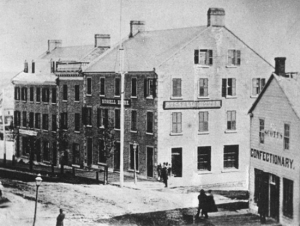
8 June 1863
During the late nineteenth and early twentieth century, the centre of Ottawa’s social life was the Russell House Hotel that stood on the southeast corner of Sparks and Elgin Streets. It was a grand and stately hostelry that dated back to about 1845. Originally, the hotel was a three-storey structure with an attic and tin roof known as Campbell’s House after its first owner. Located in Upper Town close to the Rideau Canal, it was the main stopping point for people vising Bytown, later known as Ottawa. Its food and other supplies came from Montreal by river in the summer and overland by sled in the winter.
When Queen Victoria selected Ottawa as the capital of the Province of Canada in 1857, the future of the small community was secured. Its population soared after the Parliamentary and Governmental buildings were completed in the early 1860s, and civil servants and Members of Parliament decamped from Quebec City to Ottawa. Thinking ahead to the business opportunities that this influx of people would bring, Mr James A. Gouin from Quebec City bought Campbell’s Hotel. He renamed it the Russell House after the Russell Hotel in Quebec City where he had worked.
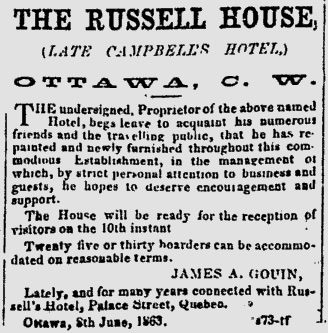 Advertisement, The Ottawa Citizen, 17 July 1863Advertisements dated 8 June 1863 appeared regularly in the Ottawa Citizen through the latter part of that year announcing that Gouin, the new proprietor of the Russell House, had completely repainted and refurnished “this commodious Establishment,” and that “on the 10th instant” would be ready to receive visitors. The hotel could accept twenty five to thirty boarders “at reasonable rates.” The advertisement added that Gouin had been “connected for many years with Russell’s Hotel, Palace Street [Côte du Palais], Quebec.” This hotel, located just a few blocks from the provincial parliament buildings (now the site of Parc Montmorency), had been owned by the Russell family, Americans who had apparently settled in Quebec when it had been the centre of the lumber industry. Gouin later built the Caledonia Springs Hotel, a famous spa in eastern Ontario, and was appointed Ottawa Postmaster by Sir John A. Macdonald.
Like its namesake at Quebec, the new Russell House Hotel was conveniently located at short stroll from Parliament Hill. It immediately attracted the great and powerful, becoming the home for many Members of Parliament, including Sir John A. Macdonald, in need of a place to live while the House of Commons and Senate were in session. On Confederation Day, 1 July 1867, the Russell House was full, hosting prominent Canadians from across the country who had come to Ottawa to bear witness to that first Dominion Day, now known as Canada Day. Other prominent early guests included George Brown, the fiery Liberal MP. He was apparently staying at the Russell when he penned a complaint to Macdonald regarding the cost of building the Parliament buildings saying: Never mind expenses. Go ahead. Ruin the Country. Stop at nothing. Why not fountains and parks and gardens? It is also believed D’Arcy McGee, the Canadian nationalist and Father of Confederation who was assassinated in 1868 penned some of his poems at the Russell House Hotel.
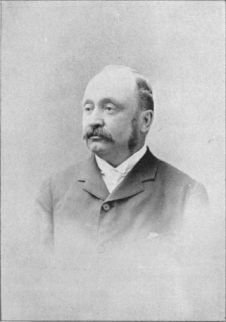 Mr James A. Gouin, First Proprietor and Manager of the Russell House Hotel
The Canadian Album, 1895.The hotel was enlarged during the 1870s, with the “New Wing” erected on the Elgin Street side across from the Central Chambers (which still stand today). The hotel’s dining room was located in this wing. In 1880, the original Campbell’s Hotel building was torn down and was replaced by a new, larger, five-storey building on Sparks Street, built in the French Second Empire style, with shops located at ground level. Shortly afterwards, a final extension was made on the east side of the building towards what was then known as Canal Street. (Canal Street disappeared with the building of Confederation Plaza and the extension of the Driveway in 1928.) In the end, the hotel boasted more than 250 rooms.
The hotel reached its peak of popularity during the 1880s and 1890s, and was famous across the country as the place to stay while visiting the nation’s capital. The hotel’s manager, François Xavier St Jacques, who succeeded Gouin, was a living legend. Known as “the Count,” St Jacques was a great eccentric who greeted guests wearing high heel shoes that gave him an odd gait. Visiting Victorian luminaries, such as Oscar Wilde, Lilly Langtry, Lillian Russell, and the boxer “Gentleman” Jim Corbett were Russell House guests. Sir Mackenzie Bowell lived there for seventeen years, including when he was prime minister from 1894 to 1896. Sir Wilfrid Laurier was another long-term tenant, staying at the Russell for ten years before moving to Laurier House in 1897. The hostelry with its long bar and leather chairs was also the site of many political intrigues and debates over the decades, second only to the Parliament buildings themselves.
The Russell House Hotel, synonymous with Ottawa and renowned across the country for elegance and fine dining, was eclipsed by the Château Laurier Hotel when that hotel opened for business a short distance away in 1912. By then, the grand old lady had become worn and shabby. In 1923, several thousand dollars was spent upgrading the main entrance and the rotunda, but it was too little too late. By that point, the hotel was rat and cockroach infested.
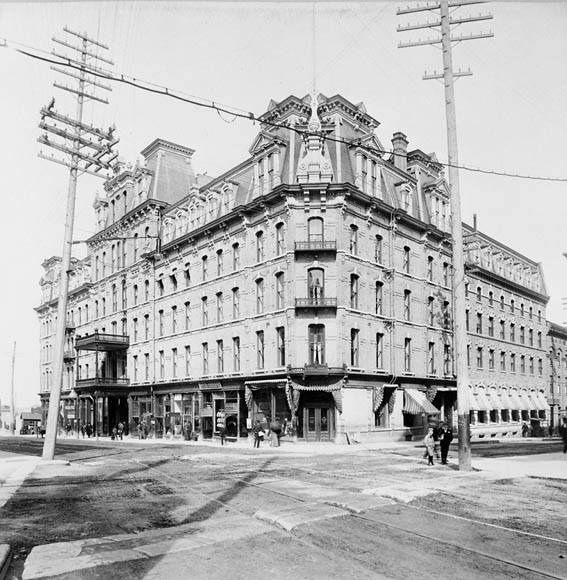 The Russell House Hotel, July 1893
Topley Studio Fonds/Library and Archives Canada, PA-008436.At noon on 1 October 1925, the hotel closed for good, a victim of rising costs and declining occupancy rates. Paradoxically, bookings during the hotel’s last summer had been strong, with the hotel attracting both tourist and convention business; the Russell was the headquarters of the Dominion Trades & Labour Congress that year. But that was not enough to keep the venerable hotel from closing. On its last night, more than 150 guests were booked into the hotel. They had to take “pot luck” for supper in the cafeteria as food supplies were limited. In the rotunda, a number of old timers sat on battered chairs reminiscing about happier times. One hotel veteran was moved by the occasion to pen a poem entitled “Old Russell Farewell.” Its first verse went:
Adieu, adieu old rendezvous
With saddened hearts we’re leaving you;
‘Twas here friends were wont to meet;
Here argued we affairs of state,
How oft’ we talked long and late,
To make the other fellow know.
Ah! Life is but a passing show.
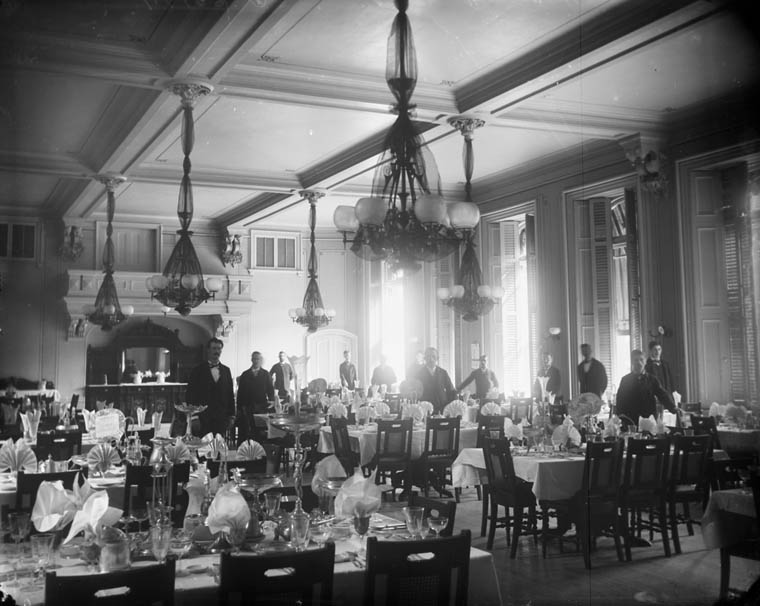 Russell House Hotel Dining Room, May 1884
Topley Studio/Library and Archives Canada, PA-027059.The next morning, with guests forced to seek their breakfast outside of the hotel, the place was virtually deserted. By shortly after noon, the only employee left out of a staff of 150 was a desk clerk tallying up the last day’s receipts. Gone also were the hotel’s “permanent” residents who had called the hotel home. One had been living at the Russell for thirty-three years.
Initially, its then owner, Russell L. Blackburn, planned to tear down the old hotel and replace it with a modern $1 million hostelry. However, Ottawa City Council balked at his demand to fix his property tax at $7,400 for twenty years. The empty building went into limbo, though the many ground-floor stores continued to operate until the Federal Capital District (FDC), the forerunner of the National Capital Commission, expropriated the Russell block of buildings and torn them down as part of its efforts to beautify the capital. In its place, the FDC built Confederation Plaza in commemoration of the diamond anniversary of Confederation in 1927.
The FDC bought the hotel property and the adjacent Russell Theatre property for $1,270,379.15 (equivalent to roughly $17.7 million in today’s money). The deal was still incomplete when just before midnight on 14 April 1928, the hotel went up in flames in a massive fire. Virtually all of Ottawa’s available fire equipment, which at the time was still being pulled by horses, were called in to tackle the blaze. Five firemen were injured by falling debris and flying glass. The cause of the fire was never ascertained. There was a suspicion of arson as first responders found fires in various places on different floors. However, the fire marshal speculated that had the fire been due to an electrical fault, the fire could have easily spread through the walls and floors before the alarm was called in. Alternatively, the evening’s high winds could have carried embers from floor to floor through the hotel’s many broken and open windows.
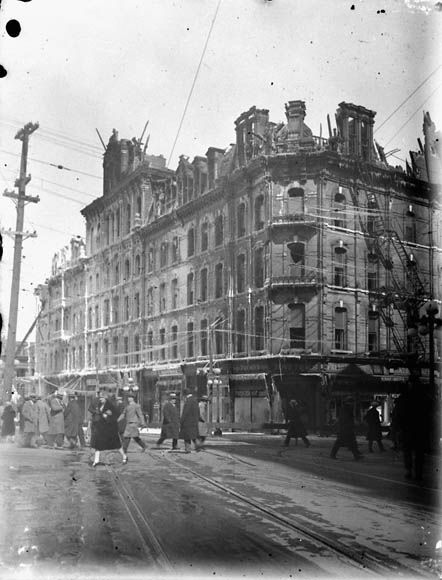 Russell House Hotel after the fire, 1928,
Samuel J. Jarvis/Library and Archives Canada, PA-025085.Thousands of Ottawa citizens watched the firemen fight the blaze. Many were in evening clothes having just left parties and dances. Guests at the Château Laurier Hotel located across Connaught Plaza from the Russell watched the fire from the windows of their rooms. Other spectators arrived by car, with the best parking spots on Parliament Hill near the East Block. There, people watched in the comfort of their heated automobiles. Knowing that the building was slated for demolition, people cheered as the fire progressed. It reached its height at about 2.30am when the flag pole over the central entrance succumbed to the flames. At 4am, more than a thousand hardy spectators were still on hand despite the cold. The firemen were able to contain the blaze, and stop the conflagration from spreading to other structures. At one point Ottawa’s City Hall further down on Elgin Street was threatened. Ironically, the City Hall was to be destroyed by fire three years later.
Losses from the Russell Hotel fire were relatively modest given the scale of the blaze. The Hotel was insured for only $30,000, the low amount reflecting the fact that it was almost derelict and had been emptied of its contents. Some of the small, street-levels shops were not so lucky. “The Treasure House” owned by Herbert Grierson, which sold jewellery, pottery, paintings, china and leather goods, suffered losses of $15,000-$20,000, of which only $8,000 was covered by insurance. The Premier Hat Company lost $10,000 in stock but carried only $2,500 in insurance. Looters also walked off with dozens of hats; one was seen carrying seventeen. Although the owner, Mr Samuel Gluck, was on hand, he was unable to rescue his stock in time owning to difficulty in obtaining a moving truck. Eighteen crates of Persian and Chinese carpets worth $90,000 were also stored in the former cafeteria of the Russell on Elgin Street awaiting auction. Fortunately, the carpets escaped with only minor water damage. They were disposed of in a “fire sale” held a few days later.
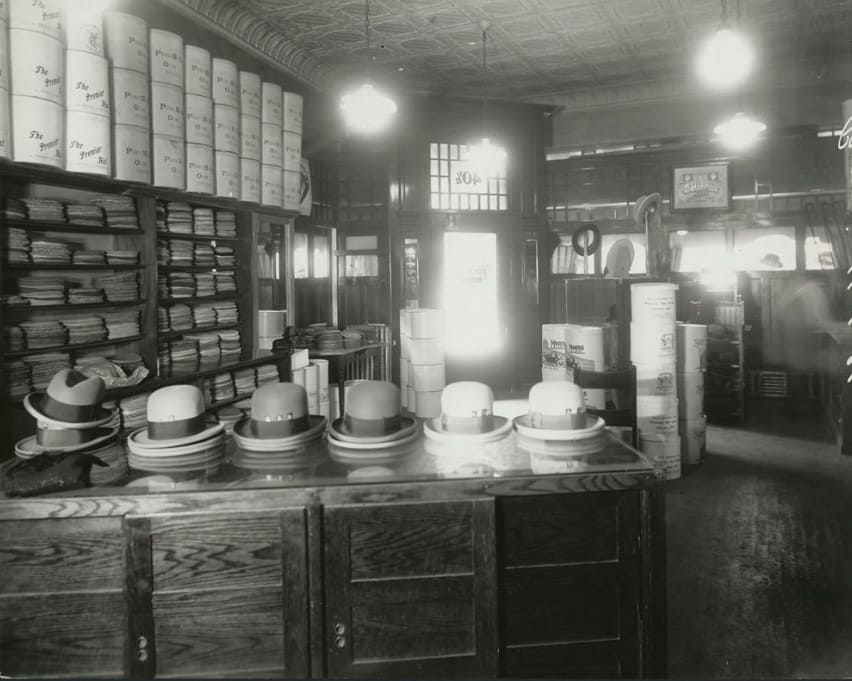 The Premier Hat Company before the fire, 1928
Library and Archives Canada, Mikan 4821789.With the hotel ruined, the authorities moved to clear the rubble. It took longer than expected with the city threatening legal action against the wrecking company if it didn’t hurry up. But at precisely 1.06 pm on Saturday 10 November 1928 the grand old Russell House Hotel, which had been the focal point of Ottawa social and political life for over sixty years, entered history. The last remnant to go was its 80-foot chimney. Recognizing the historic nature of the event, A. Brahinsky, a representative of City Iron & Bottle Company, announced the time of the pending demolition to allow citizens to come and watch the spectacle. Hundreds cheered as the chimney crash to the ground, brought down by heavy cables and a horse truck. There must have been a few tears, however. The Ottawa Journal commented that “there must be many among us who, as one by one the old landmarks go, feel little but loss of happy reminders of a brave and gracious past.”
Today, no trace of the old Russell House Hotel remains. The site of the hotel is now occupied by the War Memorial.
Sources:
Cockrane, William, Rev., 1895. The Canadian Album. Men of Canada; or Success by Example in Religion, Patriotism, Business, Law, Medicine, Education and Agriculture, Bradley Garretson & Co: Brantford,
Evening Journal (The), 1924. “Fixed Hotel Assessments,” 2 October.-
—————————, 1925. “Reached No Decision Over Hotel Request, 23 January.
—————————, 1925. “New Russell House Is Going Out Of Business After Being In Operation Over 50 Years,” 1 September.
—————————, 1925. “Russell Hotel Comes To An End Of Long Career,” 1 October.
—————————, 1928. “Five Firemen Hurt When Russell Block Is Prey To Flames,” 16 April.
—————————, 1928. “Russell Hotel For 60 Years Past An Intimate Part Of City Life,” 16 April.
—————————, 1928. “Demolish Russell,” 9 November.
—————————, 1928. “Hundreds Watch Demolition of Big Chimney At Russell,” 12 November.
—————————, 1928. “The Old Russell House: Some Memories,” 13 November.
—————————, 1934. “Understanding Shown In Letters Between King, Ministry and Ottawa Concerning Beautification of City, 6 January.
Ottawa Citizen (The), 1863. “Russell House,” 17 July.
————————-, 1925. “Russell Hotel Closes Doors: Passing of Historic Hotel Is Devoid Of Any Ceremony,” 1 October.
————————-, 1928. “Fire Will Help Park Scheme To Pass Commons,” 16 April.
Story written by James Powell, the author of the blog Today in Ottawa's History.
Retired from the Bank of Canada, James is the author or co-author of three books dealing with some aspect of Canadian history. These comprise: A History of the Canadian Dollar, 2005, Bank of Canada, The Bank of Canada of James Elliott Coyne: Challenges, Confrontation and Change,” 2009, Queen’s University Press, and with Jill Moxley, Faking It! A History of Counterfeiting in Canada, 2013, General Store Publishing House, Renfrew, Ontario. James is a Director of The Historical Society of Ottawa.
Building Parliament
20 December 1859
In early May 1859, roughly a year after the Canadian Parliament had ratified Queen Victoria’s selection of Ottawa as the permanent capital of the United Province of Canada, steps were taken to turn the regal decision into reality. John Rose, the provincial Commissioner of Public Works, announced an architectural competition for four government buildings to be constructed in Ottawa, still a rough-and-tumble lumber town that lacked the facilities and amenities of a capital city. Three were slated to be built on Barrack Hill, a spectacular 25-acre plot of land overlooking the Ottawa River. These comprised a new Provincial Legislature, and two Departmental buildings to house civil servants. A fourth, called Government House, was planned for nearby Major’s Hill, and was to be the official residence of the Governor General. Submissions were anonymous, with entries identified solely by a motto; the name(s) of the entrants were submitted in sealed envelopes that were opened only after the winning designs had been selected. The first and second-placed entries received prize money: £250 and £100 for the Parliament building, £250 and £100 for the two departmental buildings, and £100 and £50 for Government House.
The scale of the project was monumental, far larger than anything previously commissioned in British North America. Arguably, the buildings and their expected grandeur were out of keeping with both the size of Ottawa, and the population of the Province of Canada, which totalled only 2.5 million in 1860. But as was the case with the cathedrals of the Middle Ages, people were planning for the future.
The government specified that the Legislature building was to contain a Council Chamber and a Hall of Assembly for the upper and lower houses of Parliament, a lobby, a semi-detached library, a picture gallery, and 85 reading rooms, wardrobes, Speakers’ apartments, committee rooms, and clerk rooms, totalling 55,000 square feet. The two Departmental buildings, which together amounted to roughly the same square footage as the Legislature building, required 170 offices to house the entire Canadian public service, including space for the Governor General, the Executive Council, the Indian Department, Provincial Secretary, Crown Law Offices, the Adjutant General for the Militia, Agriculture, Public Works, Crown Lands, Finance, Customs, Audit, the Receiver General, and the Postmaster General. Specifications for the Governor General’s residence called for a 27,000 square foot mansion with 75 rooms, of which 40 would consist of staterooms, a ball room, dining room, private apartments, and a library, with the remainder taken up with domestic offices. In keeping with Victorian sensibilities, there was no direct reference to washrooms in any of the buildings. Presumably, they came under “&c., &c.” in the specifications. The most detailed requirements were stipulated for the Parliamentary Library for which the Parliamentary Librarian, Alpheus Todd, had insisted on state-of-the-art facilities, and rigorous fire precautions. These latter measures spared the Library the centre block’s fate when the main building was gutted by fire in 1916.
The government call for submissions did not specify any particular architectural style for the buildings beyond saying that it should be “plain” and “substantial,” with “hammer-dressed masonry, with neatly-pointed joints, and cut stone quoits, window dressings, cornices and entablatures,” and that the materials for construction should be found locally. The budget for the buildings was set at $300,000 for Parliament House, $240,000 for the two Departmental buildings which were to flank the Legislature building, and $100,000 for Government House.
Despite the size and complexity of the government’s requirements, architects were given little time to design and draw detailed architectural drawings; completed plans had to be submitted by the following 1 August. The competition had two judges, Samuel Keefer, Deputy Commissioner of Public Works, and Frederick Rubridge. Both were engineers. Rubridge was also a trained surveyor and architect.
Thirty-two designs and 298 drawings for the four buildings were submitted in a variety of styles, including Civil Gothic, Classical, Norman, Tudor, and Italian. They were judged on the basis of ten criteria: fitness of the plan and interior arrangement, economy of construction, beauty of design, adaptation to site, climate, and materials available locally, economy of heating and ventilation, conformity with required conditions, and safety against fire. Of the sixteen proposals submitted for the Parliament building and library, a Civic Gothic design by “Semper Paratus,” the nom de plume of Thomas Fuller and Chilion Jones of Toronto, emerged victorious. Of the seven designs submitted for the departmental buildings that were to flank the Legislature building, the Civic Gothic proposal of “Stat nomen in umbra,” (Ottawa architects Thomas Stent and Augustus Lever), took first place. Frederic Cumberland and W. George Storm’s Venetian-style design, submitted under the name “Odahwah,” won the contest for Government House.
It was perhaps no surprise that the two judges, Keefer and Rubridge, selected the Gothic style for the three most important buildings. This was the architectural style chosen for the British Houses of Parliament built during the 1830s. In contrast, the classical style, chosen for the U.S. Capitol building in Washington D.C., was associated with U.S. republicanism. The Gothic style, symbolic of ties with Britain, was enthusiastically embraced by Canadians who used it extensively over the next fifty years.
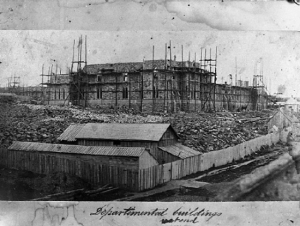
Site preparation on Barrack Hill for the Legislature building and the Departmental buildings began promptly, with the official ground-breaking ceremony taking place on Tuesday, 20 December 1859. It was a low-key affair, and little advertised. Nonetheless, thousands of Ottawa citizens walked to the construction site at noon to be part of the historic event. Mr Rose, the Commissioner of Public Works, the government department responsible for the buildings’ construction, turned the first sod for the Legislature building. In a short speech, he reflected on how laws would be enacted on this spot for the benefit of future generations. He also referred to the acrimonious debate surrounding the selection of Ottawa as the capital of Canada. While ostensibly expressing no opinion on the subject, he contended that the very continuance of the Canadian Union depended on Parliament being in Ottawa. Foreshadowing future constitutional debates, he expressed a “sincere hope that the cries of disunion, which is as yet but faintly heard, may never find an echo in the breasts of any considerable number of Canadian people.” He added that in light of the “moral and material progress made since the Union of Upper and Lower Canada, he could not reconcile himself to the idea that a desire for separation is prompted by…any sentiment of true patriotism.” At the conclusion of his speech, a cannon salute was fired.
Mr Keefer, the Deputy Commissioner and one of the two judges in the architectural competition for the Parliament buildings, was supposed to turn the first sod for the flanking departmental buildings. However, given the cold, and with people already drifting away after Rose’s speech, that part of the ceremony was dropped. Instead the official party, which include Ottawa’s mayor, Edward McGillivray, members of city council, the architects, and contractors, retired to Doran’s Hotel for refreshments.
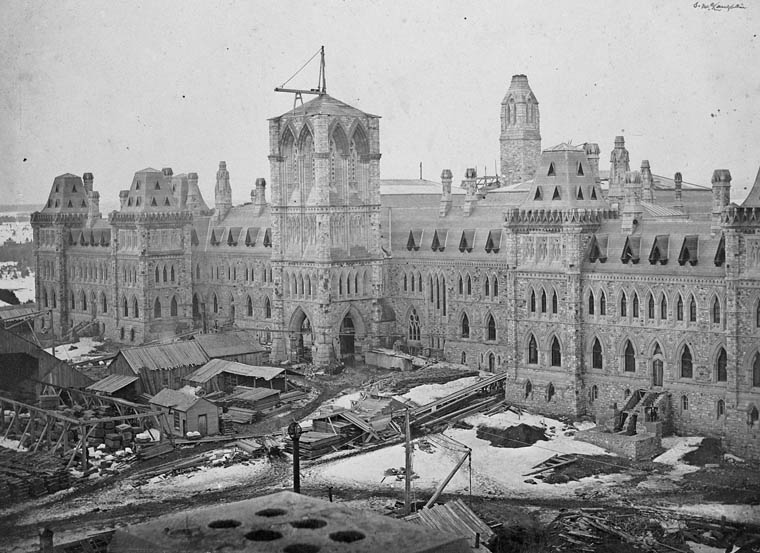 Centre Block under construction, 1865, by Samuel McLaughlinWithin weeks, Barrack Hill, later known as Parliament Hill, was a beehive of activity, employing thousands of labourers, representing a huge portion of Ottawa’s workforce—the city’s entire population numbered less than 15,000. Construction almost immediately ran into trouble leading to cost overruns and delays, though the foundations were sufficiently advanced for the Prince of Wales to lay the cornerstone of the Legislative building at the beginning of September 1860. But by October 1861, despite more than $1.4 million having been spent, the project was far from complete. Work was halted, and some 3,000 men lost their jobs, at least temporarily. To save money, the government also dropped the idea of building Government House.
In June 1862, the government appointed a commission to look into charges of financial mismanagement. Reporting back in January 1863, the commission concluded that the excessive costs were due to a number of factors including: a failure of Public Works to assess the depth of the bedrock on the site prior to signing contracts, the improper awarding of the construction contract to Thomas McGreevy, the principal building contractor, who received the job on the basis of patronage rather than price, and a failure to adequately factor in the cost of heating and ventilating the buildings. The architects were also taken to task for inadequately monitoring the progress of the construction. Samuel Keefer, the Deputy Commissioner, took the blame for the fiasco, and was fired.
Construction resumed in 1863 under the general supervision of Frederick Rubridge, the other judge in the architectural contest. By the fall of 1865, the East and West Blocks were sufficiently ready for civil servants to move from Quebec City into their new quarters. The Legislature building (Centre Block) was officially opened on 6 June 1866, roughly a year before Confederation. Construction on the Victoria Tower in the Centre block continued until 1873, while work on the Library lasted until 1877. The final cost of the three buildings was $2.9 million, four times the original budget.
Sources:
City of Ottawa, 2001-15. A Virtual Exhibit: Ottawa Becomes the Capital.
The Ottawa Citizen, 1859. “Breaking Ground for the Commencement of the Parliament Buildings in Ottawa,” 23 December.
Gowans, Alan, 2012, “Parliament Buildings,” The Canadian Encyclopedia .
Young, Carolyn A., 1995. The Glory of Ottawa: Canada’s First Parliament Buildings, McGill-Queen’s University Press, Montreal and Kingston.
Images: West Block under construction, 1861, Samuel McLaughlin, Library and Archives Canada, C-018354 .
Centre Block under construction, 1865, Samuel McLaughlin, Library and Archives Canada, C-003039.
Story written by James Powell, the author of the blog Today in Ottawa's History.
Retired from the Bank of Canada, James is the author or co-author of three books dealing with some aspect of Canadian history. These comprise: A History of the Canadian Dollar, 2005, Bank of Canada, The Bank of Canada of James Elliott Coyne: Challenges, Confrontation and Change,” 2009, Queen’s University Press, and with Jill Moxley, Faking It! A History of Counterfeiting in Canada, 2013, General Store Publishing House, Renfrew, Ontario. James is a Director of The Historical Society of Ottawa.
Quick Links
About
Supporting Partners