

Working to preserve Ottawa's past
for future generations.
Additional Info
- Year 1941
- Date July 16
Additional Info
- Year 2003
- Date August 14
Additional Info
- Year 1965
- Date February 15
Additional Info
- Year 1897
- Date June 22
Additional Info
- Year 1919
- Date January 20
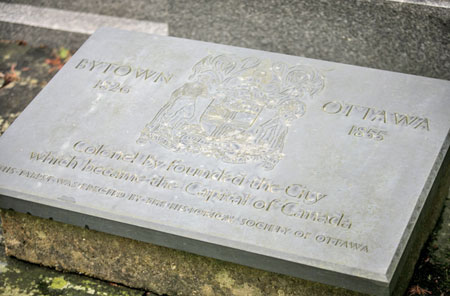 Plaque erected by the Historical Society of Ottawa in honour of Col. John By, founder of Bytown, later known as Ottawa. Photo by John Knight.The body of Lieutenant-Colonel John By, Royal Engineers, 1779-1836, is buried in St Alban’s Anglican Church in Frant, Sussex, England. Col. By supervised the building the Rideau Canal, and founded Bytown in 1826. In 1855, Bytown was renamed Ottawa. Two years later, Ottawa was selected by Queen Victoria to be the capital of the Province of Canada consisting of Canada West (Ontario) and Canada East (Quebec). With the Confederation of the Province of Canada, New Brunswick, and Nova Scotia on 1 July 1867, Ottawa became the capital of the Dominion of Canada.
For many years, the Historical Society of Ottawa provided funds for the maintenance of Colonel By’s resting place and memorial. For those wishing to visit St Alban’s, please consult the Church’s website.
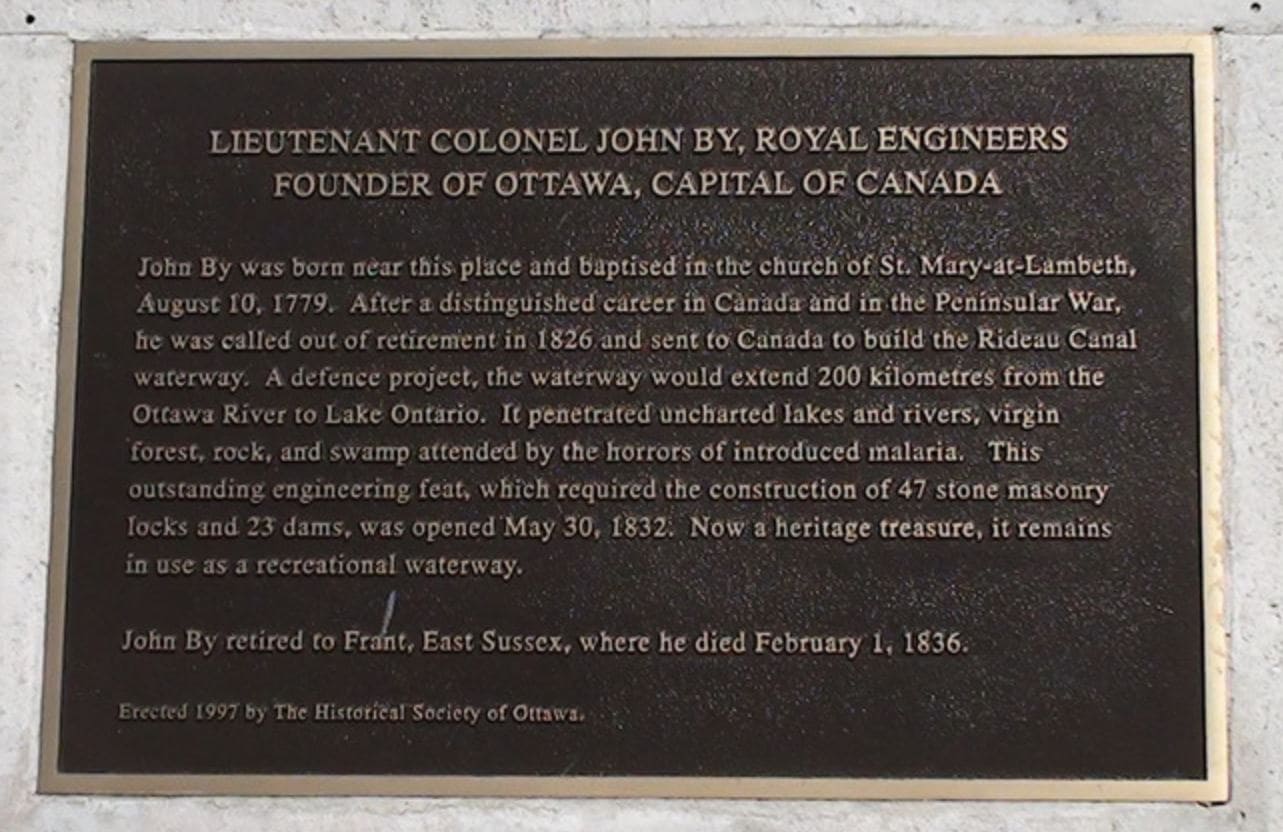 Image courtesy of LondonRemembers.com — see more about the John By memorial on the London Remembers website In 1997, the Historical Society of Ottawa erected a plaque in honour of Colonel By on the Albert Embankment in London near St Mary-at-Lambeth Church where he was baptized in 1779. Deconsecrated in 1972, St Mary-at-Lambeth is the home of The Garden Museum and is located next to Lambeth Palace, the London home of the Archbishop of Canterbury.
Meetings of the Historical Society of Ottawa
All are welcome, admission is free.
Our Speaker Series consists of in-person presentations and virtual (Zoom) presentations, in English and in French.
Our monthly English-language in-person Speaker Series presentations generally take place in the auditorium of the Main Branch of the Ottawa Public Library (120 Metcalfe St).
Our monthly French-language in-person Speaker Series presentations generally take place at the St. Laurent Branch of the Ottawa Public Library (515 rue Coté).
Both library locations are wheelchair accessible.
Our virtual Speaker Series presentations, via Zoom, generally begin at 7 p.m. Attendees may use the Zoom captions function to provide English language subtitles for French language presentations (and French language subtitles for English language presentations).
In addition, we conduct an Annual General Meeting (AGM), normally in May, an occasion for the board of directors to report on projects and activities during the preceding year and offer insight into plans for the future. All members are eligible to vote for candidates for the board of directors.
Interested in learning more about our Speaker Series or volunteering to help with our events? Please contact us by email: This email address is being protected from spambots. You need JavaScript enabled to view it.
See below for our full schedule of upcoming presentations.
Upcoming Meetings
 Guest Speaker: Gwen Tuinman
|
 Guest Speaker: Robert Colbourne
|
 Guest Speaker: Phil Gurski
|
View the full calendar
Past Meetings Reports
The Society shall publish reports in its Bytown Pamphlet Series on research which meets the Society’s objectives, and is either required of students under awards supported by the Society, or unsolicited from members or non-members, subject to passing an editorial review process approved by majority vote of the Board and to priorities dictated by the Society’s objectives and resources.
One copy of each report shall be distributed to each member in good standing as of its date of publication; others may buy copies at a price to be determined by a majority vote of the Board. Two copies of each published Bytown Pamphlet shall be sent to Library and Archives Canada, Ottawa, Ontario for legal deposit and registration under ISBN and ISSN. Two copies shall be deposited in the Historical Society of Ottawa holdings at the City of Ottawa Archives.
All manuscripts should be submitted to the Director for Publications or the Publications Committee. In accordance with the Copyright Act (R.S.C. 1970, c C-30, s.5), ownership of this intellectual material remains with the author for life plus 50 years, unless signed away to someone else. HSO published formats are copyright of the HSO and shall only be reproduced with the consent of the Director for Publications or the Publications Committee. A copyright release, as follows and also available from the Publications Committee, shall also require authors to assume responsibilities to verify the copyright status of quotations and illustrations which they have provided for use in their reports, and to ensure appropriate citation of sources.
For inquiries regarding publications, please email This email address is being protected from spambots. You need JavaScript enabled to view it.
Copyright Release
The Historical Society of Ottawa
Publications Committee
The Historical Society of Ottawa,
Postal Box 523, Station B, Ottawa, Ontario K1P 5P6
E-mail: This email address is being protected from spambots. You need JavaScript enabled to view it.
Contributor’s Certification
Manuscript Title ________________________________________________________
Publication Title ________________________________________________________
I certify that:
I have acquired permission to reproduce any previously copyrighted material which I have provided for use in my manuscript including, inter alia , sources, quotations and illustrations for which I have given accurate citation in the manuscript;
I agree to transfer to The Historical Society of Ottawa (HSO) publishing rights to the manuscript: that is, without relinquishing my proprietary rights as author, I transfer to HSO the rights to reproduce and distribute the article in HSO format, including figures and graphic reproductions, and the right to adapt the manuscript to conform to HSO publishing standards; and
(Please strike out one):
I agree that the article may be reprinted or copied for non-profit use by individuals and organizations without my written permission, providing proper credit is given to the source of the item
or
I require that the article should be accompanied by the copyright symbol (©) denoting that
the article may not be printed or copied without my written permission.
Signature: ____________________________________
Printed Name: ____________________________________
Date: _______________________
Personal Information Protection Policy and Guiding Principles
Written by Super UserThe Historical Society of Ottawa is hereafter referred to as HSO.
HSO is committed to respecting the privacy of its members and their families by adhering to the privacy principles set forth in Schedule 1 of the Personal Information Protection and Electronic Documents Act. Those principles are:
Principle 1. Accountability
The Board is accountable for compliance with this policy. The President is responsible for the management of the policy, including the guiding principles. The President can be contacted at This email address is being protected from spambots. You need JavaScript enabled to view it..
Principle 2. Identifying Purposes
HSO only collects personal information necessary to provide a volunteer program and to meet the individual development needs of each member. Name, address and other contact information concerning membership and event registration form a permanent record for members. All other information is kept only as long as required to fulfill the purposes identified, unless permission is obtained from the individual providing the information.
Principle 3. Consent
All members and non-members will have the ability to consent to the uses of their personal information. A person grants, through the act of registering for membership or other events, consent to the use of personal information by Board members and those HSO members designated by the Board, for the purposes of providing members with HSO publications, informing members of HSO activities, and for analysis. Signing membership or registration forms or registering online will be considered consent. HSO will assume consent is granted unless a member indicates otherwise.
Principle 4. Limiting Collection
HSO will explain the purpose for collecting each piece of personal information. If it is necessary to use the personal information collected for a purpose not identified when the information was collected, consent for the new use will be obtained from members.
Principle 5. Limiting Use, Disclosure and Retention
HSO will use the personal information obtained from members and non-members only for the purposes for which it was collected, and will not disclose the information for other purposes except as noted in Principle 3, Consent, or as required by applicable law. All personal information provided to HSO will be maintained in a secure manner to ensure that its use is limited to the purposes for which it was collected. Name, address and information concerning membership and or registration will be retained by HSO permanently. Other personal information will be retained by HSO for whatever periods are required by legislation governing our operation and/or the information provided, after which time the information will be destroyed in a secure manner (unless consent is given to keep information for a longer period). If there is no legislative requirement to retain other information it will be kept for 24 months from the time it was provided.
Principle 6. Accuracy
Members will have the ability to view and review data provided on their application for membership at any time. Individuals may on presentation of a document establishing their identity to the President, be able to find out whether personal information is on file with HSO, and if so consult it free of charge. A request may also be made in writing or by telephone to view information. A charge may apply for the transcription, reproduction, or transmission of the information.
Principle 7. Safeguards
HSO will assess and implement appropriate measures to properly protect personal data. These measures will be subject to independent audit to ensure their effectiveness.
Principle 8. Openness
This policy and the following processes and procedures for obtaining access to personal information will be available to any individual through the HSO web site, and in the compilation of HSO bylaws, policies and procedures. If any individual has a question regarding personal information, it may be directed to the President at This email address is being protected from spambots. You need JavaScript enabled to view it..
Principle 9. Individual Access
Individuals will have access to their personal information provided on the application for membership at any time. On request to the President, an individual will be informed of the existence, use and any disclosure of their personal information, and will be given access to view that information. An individual may challenge the accuracy and completeness of the information, and have it corrected or amended as appropriate.
Principle 10. Challenging Compliance
Individuals may challenge the compliance of HSO with this policy by contacting the President. Procedures will be established to deal with an individual’s concern in an appropriate and timely fashion.
Definitions:
- Member: an individual that has completed an application for membership, has been accepted for membership , has paid the annual membership fee for the current year and has been granted a membership for a current one-year period or holds a Life membership;
- Non-Member: an individual who attends or registers for an event or activity sponsored by HSO but is not a member;
- Individual: refers to a member or non-member.
A motion is a proposal that the entire membership take action or a stand on an issue. An Individual Member can:
- Propose a Motion;
- Second Motions;
- Debate motions;
- Vote on motions.
There are four Basic Types of Motions:
- Main Motions: The purpose of a main motion is to introduce items to the membership for their consideration. They cannot be made when any other motion is on the floor, and yield to privileged, subsidiary, and incidental motions;
- Subsidiary Motions: Their purpose is to change or affect how a main motion is handled, and is voted on before a main motion;
- Privileged Motions: Their purpose is to bring up items that are urgent about special or important matters unrelated to pending business;
- Incidental Motions: Their purpose is to provide a means of questioning procedure concerning other motions and must be considered before the other motion.
Presentation of a Motion
- Obtaining the floor:
- Wait until the last speaker has finished;
- Wait until the Chairman recognizes you;
- Rise and address the Chairman by saying, "Mr. Chairman, or Mr. President."
- Make Your Motion:
- Speak in a clear and concise manner;
- Always state a motion affirmatively. Say, "I move that we ..." rather than, "I move that we do not ...";
- Avoid personalities and stay on your subject.
- Wait for Someone to Second Your Motion:
- Another member will second your motion or the Chairman will call for a second:
- If there is no second to your motion it is lost.
- The Chairman States Your Motion:
- The Chairman will say, "it has been moved and seconded that we ..." Thus placing your motion before the membership for consideration and action;
- The membership then either debates your motion, or may move directly to a vote;
- Once your motion is presented to the membership by the chairman it becomes "assembly property", and cannot be changed by you without the consent of the members.
- Expanding on Your Motion:
- The time for you to speak in favor of your motion is at this point in time, rather than at the time you present it;
- The mover is always allowed to speak first;
- All comments and debate must be directed to the chairman;
- Keep to the time limit for speaking that has been established;
- The mover may speak again only after other speakers are finished, unless called upon by the Chairman.
- Putting the Question to the Membership:
- The Chairman asks, "Are you ready to vote on the question?";
- If there is no more discussion, a vote is taken;
- On a motion to move the previous question may be adapted.
Voting Policy
This Voting Policy applies to all HSO formally constituted meetings of the Membership and of the Board.
When the Chair calls for a vote, abstentions shall not be called for since an abstention is meaningless. "To 'abstain' means not to vote at all." (Robert's Rules, 11th ed., p 45). Unless there is good reason not to vote, all present should vote on all resolutions.
Notwithstanding that it is the duty of every eligible voter who has an opinion on a question to express it by a vote; the individual can abstain, since voting cannot be compelled. (Robert's Rules, 11th ed., p 407).
Remaining Silent.
The burden is on an abstaining individual to speak up in order to be recorded as an abstention. If the vote is called for and any individual fails or refuses to indicate "yes," "no" or "abstain," the Chair of the meeting shall deem the individual to have voted a " silent yes" and if the silent individual does not object, the vote shall be counted as a "yes" vote.
A block of recorded abstentions cannot defeat a resolution as a recorded abstention is not a vote unless, reductio ad absurdum, all eligible voters record their abstention.
Application to HSO Votes
- For an Ordinary (Majority) Resolution, if 51% of the eligible votes* cast are “yes” including “silent yes” votes, the motion is carried.
- For a Special Resolution, if 67% of the eligible votes* cast are “yes” including “silent yes” votes, the motion is carried.
- For an Extraordinary Resolution (including to approve the conduct of a Review Engagement), if 80% of the eligible votes cast* are “yes” including “silent yes” votes, the motion is carried.
- For a Unanimous Vote ( required of the Board to discipline a Member) , a recorded abstention shall defeat the motion
* This includes the Chairman’s privilege to cast a second vote in the event of a tied vote.
Required Abstentions for Directors
- Whenever a Director believes he/she has a conflict of interest, that Director shall abstain from voting on the issue and make sure the abstention is noted in the minutes. (Robert's Rules, 11th ed., p 407).
- A Director shall abstain when he/she believes that there is insufficient information to make a decision and make sure the abstention is noted in the minutes.
- A Director shall abstain when a motion directly affects his/her position, nomination or personal benefit and make sure the abstention is noted in the minutes.
- Unless the above clauses 1, 2, or 3 are invoked, a Director shall cast votes on all issues put before the Board. Failure to do so could be deemed a breach of fiduciary duties.
Quick Links
About
Supporting Partners