

Working to preserve Ottawa's past
for future generations.
Additional Info
- Year 1832
- Date June
Additional Info
- Year 2008
- Date July 25
Additional Info
- Year 1891
- Date September 14
Additional Info
- Year 1927
- Date November 14
Additional Info
- Year 1928
- Date December 27
Additional Info
- Year 1855
- Date September
Not rain or snow or windy cold kept nine intrepid members of the Historical Society of Ottawa — and two people who had seen it advertised on our Facebook page — from enjoying a special walking tour of Beechwood Cemetery on November 10th 2018, Nick McCarthy, the cemetery’s director of marketing, communications and community, led us to the main historical sites and told stories of those buried in this well-tended National Cemetery of Canada.
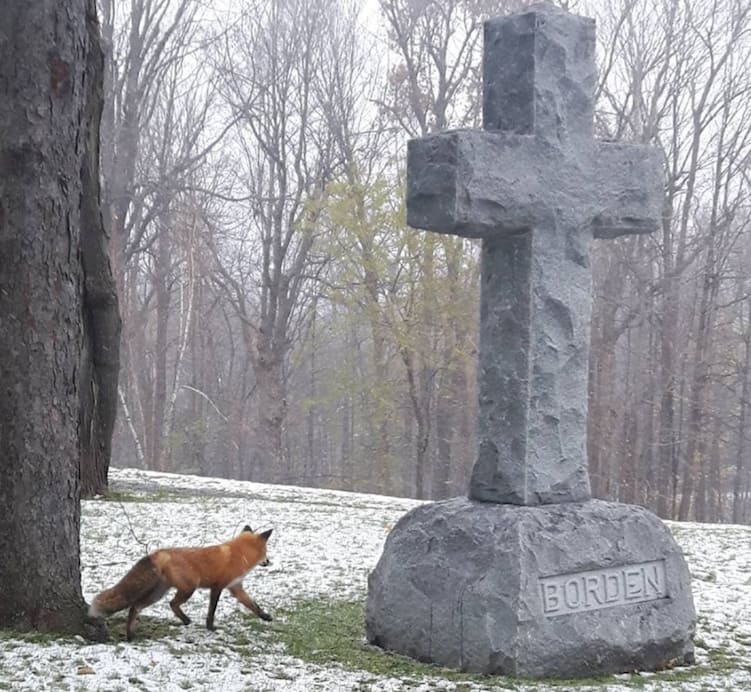
We began at the tomb of Robert Borden (1834-1937), notable because Sir Robert did not want his title, nor his designation as prime minister, used on his monument. However, the cemetery has placed a plaque nearby to remind visitors of his importance to Canada.
Just at that point, the cemetery mascot — a lithe and beautiful red fox — appeared beside Borden’s grave, unafraid of us and apparently intent on catching his dinner.
We saw the sites of many well-known Ottawa families — Bronson, Slater, Perley, Booth and others. Some family plots have a large monument at the highest point, then several rows of graves marking the descending generations.
Among the Canadians commemorated in the cemetery is Sir Sanford Fleming (1827-1915), inventor of our modern-day time zones and designer of our first postage stamp.
A large monument, which honours Hardial Bains (1939-1997), a onetime leader of the Communist Party of Canada, stands alone on a centrally located plot of land, apparently because no one wants to be buried beside him.
As we turned a corner, there was the tomb of Ramon John Hnatyshyn, (1934-2002) Governor General of Canada from 1990 to 1995.
 The cemetery also has monuments honouring people who died elsewhere. The hospital ship Llandovery Castle has been in the news recently because it was sunk 100 years ago on June 27, 1918 on its way from Halifax to Liverpool with a full complement of medical staff. On the ship was Canadian Nursing Sister Minnie Katherine Gallaher (1880 1918), born in Pittsburgh, Ont. Her family laid a stone in her honour in the cemetery.
Our guide told of the how Hungarians, who fled to Canada after the 1956 revolution, erected a monument to their heroes, only to have it ripped off its moorings and taken by Russians. The Hungarians replaced it with a more solid concrete cross firmly attached to a stone.
Like Canada, Beechwood is multicultural. People of many ethnic and faith groups are buried side by side. Several cemeteries within Beechwood’s grounds honour those who have served in the Canadian or Commonwealth Forces, the RCMP and the Ottawa Police.
Notable were the graves of General Henry David Graham Crerar, (1888-1965) who became Chief of the General Staff of the Canadian Army during World War II, and his successor, General Charles Foulkes (1903-1969), who became the first post-war Chief of the General Staff. The Canadian National Military Cemetery, opened in 2001, includes the grave of Nichola K. S. Goddard (1980-2006), the first woman soldier to die in Afghanistan.
We ended the tour with the monument to a teenager who loved elephants; her family erected a little elephant, symbol of family loyalty, on her grave-site.
Thanks to Nick McCarthy, we now have a deeper appreciation of the stories to be found at Beechwood.
A brisk wind greeted us as we stepped onto the roof of the Chats Falls Hydro Power Generating Station situated on the Ottawa River at Fitzroy Harbour, across from Quyon, Que. Twelve HSO members and friends braved the November damp and chill to explore this fascinating and crucial component of our community. Our host was Gary Kowaluk and two of his associates. From the rooftop we could see this long rectangular building stretch across the Ottawa River, straddling the two provinces. The view of the Lac des Chats reservoir was spectacular. Large sections around the dam are fenced off to protect onlookers from falling into the turbulent waters. Gary pointed out how giant sliding gates control the amount of water flowing through the station.
Our tour had begun shortly after 9 a.m., when we passed through a high chain-link gate, driving down a long narrow road through dense woodland and over three bridges. The drive was reminiscent of entering a Cold War facility in post-war Europe. Over the bridges one could look down and see the remnants of what would have been the sides of the Chats Falls, where large boulders rested with only a trickle of water splashing between them. The 35-foot falls were destroyed to accommodate the power station, built 1929-31.
Now in operation for nearly 90 years, the facility provides renewable energy that is 99% free of air pollutants and greenhouse gas emissions. At maximum output, the plant could power nearly 200,000 homes. Output varies upon demand as well as precipitation that affects water levels, which are constantly monitored for environmental balance to minimize any possible damage.
We then viewed a film made during the construction of the dam and station. Grainy black and white images showed many men at work. The hydro village in Fitzroy Harbour was created to accommodate many of the workers who stayed for the duration of the project, bringing considerable activity and revenue to the village.
After the viewing, we started through the plant, which included our rooftop excursion. We saw firsthand the two-storey-high turbines at the heart of the energy-generating process that powers our modern life. We even journeyed beneath to glimpse in the dim light where the power of nature connects to the ingenuity of human machines.
Many thanks to Gary Kowaluk, his staff and the good people who joined us, and especially our past president George Neville, who first suggested it as a part of our fall excursion, as his own father had worked on the construction of the dam.
On Friday, June 14, 2019, eighteen society members took part in the society’s spring excursion to Tucker House, a well-preserved historic estate in rural Clarence-Rockland, just beyond the eastern boundary of the City of Ottawa. The trip was a great success, including a delightful tea and lunch, and an informative presentation from local historian Gilles Chartrand.
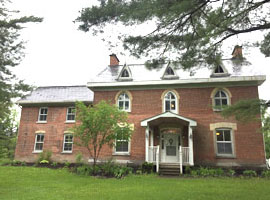 Tucker House
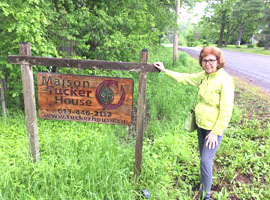 HSO member, Mary Edwards, at Tucker House
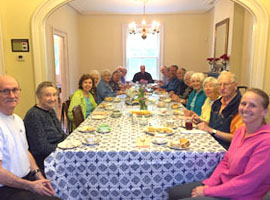 The HSO gang having lunch at Tucker House after a fascinating presentation by local historian Gilles Chartrand (far left)
Central to the life of The Historical Society of Ottawa is our volunteers. Being 100 per cent volunteer operated, the Society is totally dependent on its member volunteers for all facets of its operations. If you love history and would like to get involved, we have a job for you!
By volunteering with the Society, you will be helping to preserve and share Ottawa’s rich historical heritage. You will also be using your special skills, working with interesting people who share a passion for history.
Possibilities for helping are endless. We need people of diverse backgrounds and abilities for the Society to function effectively.
If you would like to get involved, or would like to find out more about volunteer opportunities with the Society, please contact us at This email address is being protected from spambots. You need JavaScript enabled to view it., or speak to one of the Society’s directors.
We look forward to meeting you!
Quick Links
About
Supporting Partners